I needed a professional consultation explanation of procedure for safe removal of Asbestos in my apartment complex. Without having an account yet, I was very impressed with the caring, knowledgeable and generous advice offered by Jessica, and will look forward to doing business in the future. Thank you so much! I feel much more informed about a sometimes scary endeavor. Peace. Nancy Silva Mineola, NY.
Mia Munoz
Used this company to clean up some water flood in my house. They were fast and easy to work with.very professional, Would recommend to anyone!
Nini Valle
Great company, had a flood and they responded quickly and efficiently. Billed my insurance company directly. I highly recommend this company!
joe colapietro, jr
I had pipe freeze in my basement right before a snow storm and they made to within an hour to help start the clean up process. They we by our side throughout the entire process and even helped with the insurance company. They did such a great job with the cleanup, repair, remidiation, I contracted them to perform the repairs and finishes in the basement. They came with enough manpower and material to get the job done. Leo and Jessica were nothing but a pleasure to deal with!!
Cristian Arredondo c
I had some water damage in my home and Green Island was able to take care of my issue quickly and effectively. I am very pleased with the work they did. They responded quickly and were very professional.
Michael M
Outstanding service! From the office to the field crew everyone was friendly, helpful and responsive. I highly recommend Green Island Group.
Brentwood has one of the oldest housing stocks in all of Suffolk County. Nearly 60% of homes here were built in the 1950s and 1960s, and most of those original bathrooms have never had a real renovation just patches, re-caulks, and the occasional new vanity. What’s behind the tile is a different story. Cracked grout lets moisture in. Decades of humidity do the rest. By the time most homeowners decide to remodel, there’s already water damage, mold, or worse sitting inside those walls.
When the demo starts and something unexpected turns up asbestos floor tile, lead paint, rotted framing a standard contractor has to stop. They call in a specialist, you wait, the project stalls, and the costs climb. We carry the asbestos abatement license and lead-based paint abatement certification to handle it in-house, without stopping your project. That’s not a small thing in a community where pre-1980 homes are the rule, not the exception.
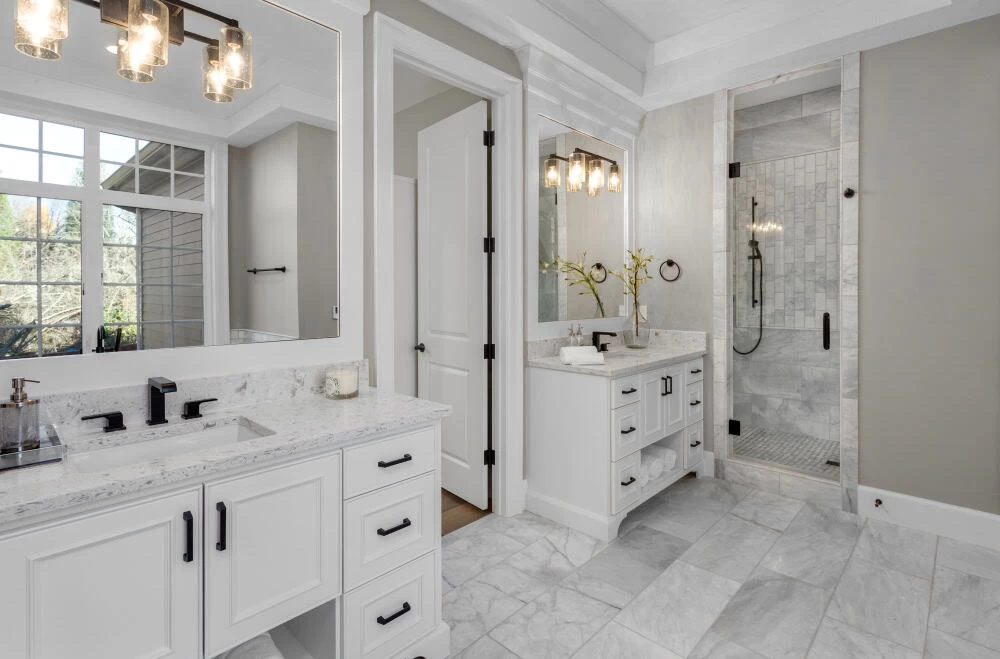
The end result isn’t just a bathroom that looks better. It’s one that’s properly waterproofed for Long Island’s humid summers, ventilated correctly so moisture doesn’t keep building up, and built on a substrate that won’t fail in five years. You get a finished space that actually functions and one that holds its value in a market where Brentwood home prices have climbed 148% over the last decade.
5,000 Projects. We Know Brentwood's Houses Inside and Out.
We’re based in Bohemia, NY a few minutes from Brentwood via the Sagtikos Parkway or I-495. Same town of Islip jurisdiction, same housing stock, same permit office. This isn’t a company stretching its service area across county lines to pick up extra jobs. We’re a local contractor who already knows what the Town of Islip Building Division requires, what a 1965 ranch in Brentwood Park looks like inside its walls, and what it takes to get a bathroom remodel done right in this specific part of Long Island.
With over 5,000 completed restoration and remodeling projects across New York State, our team has seen every scenario a bathroom gut renovation in Brentwood can produce. We’re available 24/7, we answer the phone, and we handle everything under one contract from demolition through the final inspection. No subcontractor juggling, no gaps, no surprises you weren’t warned about.
It starts with a walkthrough. Before anything is quoted or scheduled, someone from our team comes out to assess the bathroom what’s there, what needs to go, and what the walls and floor might be hiding. In Brentwood’s older homes, that assessment matters more than it does anywhere else. A house built in 1962 near Suffolk Avenue isn’t the same as new construction, and the estimate needs to reflect that honestly.
Once the scope is set, we pull permits through the Town of Islip Building Division. Any full bathroom renovation that involves moving plumbing, updating electrical, or making structural changes requires permits and any contractor who tells you otherwise is either cutting corners or uninformed. We handle the applications and schedule the inspections so you don’t have to chase anything down. Worth noting: the updated NYS Uniform Code took effect at the end of 2025, so any remodel starting now needs to meet the new standards. That’s already factored in.
Demo comes next. If asbestos tile, lead paint, or mold turns up and in a pre-1980 Brentwood home, there’s a real chance something does we handle it in-house under the appropriate licenses. No project stoppage, no third-party delays. From there, it’s waterproofing, cement board substrate, plumbing and electrical rough-in, tile, fixtures, and finish work. One crew, one timeline, one point of contact from start to final walkthrough.
A lot of bathroom remodel companies can handle a straightforward job in newer construction. We’re built specifically for the kind of work that Brentwood’s housing stock demands. That means full gut renovations where everything comes out tile, tub, vanity, flooring, and whatever’s underneath and gets replaced with materials and methods that are actually suited to a Long Island climate. Cement board instead of greenboard. Waterproof membranes behind the tile. Exhaust ventilation sized correctly for the room. These aren’t upgrades they’re the baseline for a bathroom that won’t need to be redone in a few years.
The scope of what’s included depends on what your bathroom needs. Tub-to-shower conversions are common in Brentwood’s older single-bathroom homes where the original cast iron tub has run its course. Walk-in shower installations, full vanity replacements, plumbing relocations, and accessible bathroom configurations are all part of the work we do regularly. If your remodel is connected to water damage or an insurance claim which happens often in homes with aging supply lines we have the restoration background to document the damage correctly and work directly with your carrier.
Everything is done under one contract, with licensing that covers both the remodeling side and any environmental hazards that turn up along the way. For a household of four or five people sharing one bathroom, the timeline matters as much as the quality. We keep both on track.
Do I need a permit for a bathroom remodel in Brentwood, NY?
It depends on what the remodel involves. If you’re doing purely cosmetic work swapping out a mirror, repainting, replacing a vanity without touching the plumbing no permit is required. But if your project involves moving or adding plumbing, updating electrical, installing new lighting or GFCI outlets, or making any structural changes, you’ll need permits through the Town of Islip Building Division.
In practice, a full bathroom gut renovation in Brentwood almost always requires permits, because it almost always touches plumbing and electrical. We handle the permit applications, coordinate with the Town of Islip, and schedule the required inspections so the project stays compliant from start to finish. The updated NYS Uniform Code that took effect in late 2025 also introduced new requirements that any remodel initiated now needs to meet something a contractor who isn’t current on local regulations may not flag for you.
How much does a bathroom remodel cost in Brentwood, NY?
Bathroom remodel costs in Brentwood vary depending on the size of the space, the scope of work, and what turns up during demo. A cosmetic refresh with new fixtures and tile might run $8,000–$15,000. A full gut renovation new plumbing, electrical, tile, tub or shower, vanity, and flooring typically falls in the $20,000–$45,000 range in this area. Labor and permitting costs on Long Island run 30–50% above national averages, so online cost calculators built around national data will usually underestimate what a project here actually costs.
If hazardous materials are discovered during demo asbestos floor tile or lead paint are both common in Brentwood’s pre-1980 homes remediation is handled in-house by us, which avoids the markup and delay that comes with bringing in a third-party specialist. The best way to get an accurate number is a proper on-site assessment, not a ballpark over the phone.
What happens if asbestos or mold is found during my bathroom renovation?
This is one of the most common concerns for Brentwood homeowners, and it’s a legitimate one. Homes built before the mid-1970s frequently have 9-inch vinyl asbestos floor tiles under layers of later flooring, and asbestos pipe wrap on original plumbing is also common. Lead-based paint on trim and walls is standard in any home built before 1978. When a contractor without the right licensing opens a wall and finds these materials, they’re legally required to stop work until a licensed specialist handles it which can mean days or weeks of delay and a half-demolished bathroom.
We hold an EPA-compliant asbestos abatement license and a lead-based paint abatement certification, so when these materials turn up, the project doesn’t stop. The remediation is handled in-house, the hazardous material is disposed of properly, and the renovation continues on schedule. Mold discovered behind tile or in the subfloor is treated the same way addressed, documented, and resolved before the new materials go in, so you’re not just covering up a problem that will resurface in two years.
How long does a full bathroom renovation take in Brentwood?
A straightforward full bathroom renovation typically takes two to three weeks once the project is underway. The actual timeline depends on the scope of work, whether permits are required, and what’s discovered during demo. In Brentwood’s older housing stock, it’s not unusual for demo to reveal conditions moisture damage, deteriorated framing, outdated plumbing that need to be addressed before the new work can go in. Accounting for that possibility upfront, rather than pretending every job goes perfectly, is part of what makes an honest estimate.
Permits through the Town of Islip Building Division add some lead time before work begins, and inspections need to be scheduled at specific stages. We manage all of that on your behalf. For a household with four or five people sharing a single bathroom which is common in Brentwood we work to minimize disruption and keep the project moving without unnecessary delays.
Is it worth remodeling a bathroom in an older Brentwood home?
For most Brentwood homeowners, yes and the numbers support it. Home values in Brentwood have appreciated roughly 148% over the last decade, with median property values reaching $416,000 and continuing to climb. A midrange bathroom remodel returns approximately 80 cents on the dollar at resale according to the 2025 Cost vs. Value Report, which makes it one of the higher-return renovations you can make in a rising market.
Beyond the financial return, there’s the practical reality that most original bathrooms in 1950s and 1960s Brentwood homes are functionally failing not just dated. Grout that’s been cracked for years lets moisture into the wall. Galvanized supply lines narrow over time and eventually fail. Exhaust fans that were undersized when new have been pushing humid air into the wall cavity for decades. A proper renovation doesn’t just update the look it fixes the underlying problems that are quietly getting worse. That’s a different calculation than a cosmetic refresh, and it’s the kind of work that actually protects the value of what’s likely your most significant financial asset.
Can Green Island Group handle a bathroom remodel tied to a water damage insurance claim?
Yes, and this comes up regularly in Brentwood. Older homes with galvanized or aging copper supply lines are vulnerable to the freeze-thaw cycles that Suffolk County winters reliably deliver a pipe fails, water gets into the bathroom floor and walls, and suddenly a repair becomes a full renovation. When that happens, navigating the insurance claim while also managing a remodel is a lot to handle on your own.
Our background is in restoration as well as remodeling, which means we understand how insurance documentation works, what carriers need to see, and how to make sure the full scope of covered damage is captured correctly. We’ve billed insurance companies directly for customers and guided homeowners through the process from the initial damage assessment through the completed renovation. If your bathroom remodel is connected to a water loss or an existing claim, that experience matters it’s the difference between a smooth process and months of back-and-forth between you, the contractor, and the adjuster.