East Meadow Kitchens Built for the Way Families Actually Live
Your home has gone up in value. Your kitchen hasn’t kept up. We handle full kitchen renovations in East Meadow — one contractor, every trade, no coordination headaches.
I needed a professional consultation explanation of procedure for safe removal of Asbestos in my apartment complex. Without having an account yet, I was very impressed with the caring, knowledgeable and generous advice offered by Jessica, and will look forward to doing business in the future. Thank you so much! I feel much more informed about a sometimes scary endeavor. Peace. Nancy Silva Mineola, NY.
Mia Munoz
Used this company to clean up some water flood in my house. They were fast and easy to work with.very professional, Would recommend to anyone!
Nini Valle
Great company, had a flood and they responded quickly and efficiently. Billed my insurance company directly. I highly recommend this company!
joe colapietro, jr
I had pipe freeze in my basement right before a snow storm and they made to within an hour to help start the clean up process. They we by our side throughout the entire process and even helped with the insurance company. They did such a great job with the cleanup, repair, remidiation, I contracted them to perform the repairs and finishes in the basement. They came with enough manpower and material to get the job done. Leo and Jessica were nothing but a pleasure to deal with!!
Cristian Arredondo c
I had some water damage in my home and Green Island was able to take care of my issue quickly and effectively. I am very pleased with the work they did. They responded quickly and were very professional.
Michael M
Outstanding service! From the office to the field crew everyone was friendly, helpful and responsive. I highly recommend Green Island Group.
Most East Meadow kitchens were designed for a different era — closed off from the rest of the house, sized for one cook, and built at a time when the idea of an open, functional family kitchen wasn’t really part of the plan. If yours still feels that way, you’re not imagining it. The layout is the problem, and cosmetic fixes won’t solve it.
A full kitchen renovation changes how your home feels from the moment you walk in. You get counter space that actually works, storage that makes sense, and a layout that connects to the rest of your living space instead of hiding from it. For families in East Meadow who use their homes hard — managing school schedules, commutes to the city, and everything in between — that kind of daily functionality matters more than any design trend.
There’s also the financial side, which is real and worth saying plainly. East Meadow home values have climbed from around $210,000 in 2000 to over $820,000 today. A kitchen that’s stuck in 1965 is a liability in that market. A well-executed renovation, done properly with permits and quality materials, is one of the highest-returning investments you can make in a Nassau County home — and buyers notice immediately when it hasn’t been done.
We’re a Long Island-based renovation contractor that manages kitchen remodels from the first design conversation through the final inspection. Every trade — cabinetry, countertops, plumbing, electrical, flooring — runs under one contract, with one point of contact for you throughout the entire project.
That matters a lot in East Meadow specifically. The homes here — the Cape Cods, ranches, and split-levels built throughout the 1950s and ’60s near Hempstead Turnpike and across the neighborhoods bordering Eisenhower Park — are not simple boxes. They have quirks. Load-bearing walls where you’d least expect them. Galvanized plumbing. Electrical panels that weren’t designed for modern kitchen appliances. A contractor who hasn’t worked in this era of Long Island housing will run into those things and call it a surprise. We don’t.
We’re registered with the Nassau County Department of Consumer Affairs, carry full general liability and workers’ compensation insurance, and pull every required permit through the Town of Hempstead’s Building Department. That’s not a bonus — it’s the baseline you should expect from anyone working in your home.
From the First Conversation to a Kitchen You'll Actually Use
It starts with a walkthrough of your existing kitchen — not a sales pitch, an actual assessment. We look at your layout, your plumbing and electrical configuration, what walls are structural, and what your space realistically allows. For East Meadow homes built between 1945 and 1970, this step matters more than most people expect. What’s behind the walls in a 70-year-old Cape Cod is often different from what shows on the surface, and we’d rather know that before demo day than after.
From there, we put together a detailed scope and a fixed-price proposal. You’ll know what’s included, what the timeline looks like, and how we handle anything unexpected that comes up once the walls are open — because in homes this age, something usually does. We document every change in writing before any additional work begins. No surprises handed to you mid-project.
Once the scope is agreed on, we file for the appropriate permits through the Town of Hempstead, coordinate all trades on a single schedule, and manage the project through to final inspection. A focused cabinet-and-countertop renovation in an East Meadow home typically runs three to five weeks. A full gut renovation with structural changes — opening a wall, relocating plumbing — is more realistically seven to twelve weeks. We’ll give you an honest timeline upfront based on your specific project, not an optimistic number designed to get you to sign.
Everything Your East Meadow Kitchen Renovation Actually Includes
A kitchen remodel with us covers the full scope — design consultation, demolition, cabinetry, countertops, tile, flooring, lighting, plumbing coordination, and electrical integration. You’re not hiring us for one piece and then scrambling to find someone else for the rest. The entire project runs through one team, on one timeline, with one person accountable for all of it.
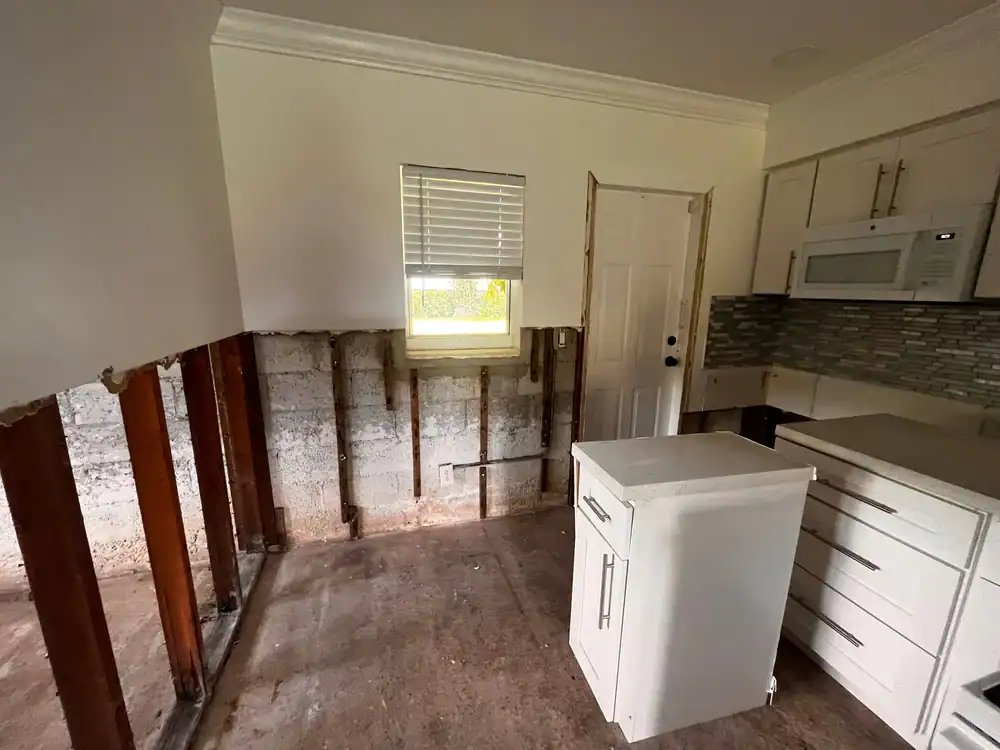
For East Meadow homeowners, a few things come up consistently that are worth knowing. First, moisture. Long Island’s humidity and the age of this housing stock mean that water damage behind original cabinets is common — not a worst-case scenario, just a reality of older construction. We know what to look for and how to address it properly as part of the renovation, not as an expensive add-on that catches you off guard. Second, lead paint. The federal EPA RRP Rule requires certified lead-safe practices on any renovation disturbing surfaces in pre-1978 homes — which is the vast majority of East Meadow’s housing stock. We’re EPA Lead-Safe certified. If you have kids in the house, that’s not a minor detail.
Every kitchen renovation we complete in East Meadow is fully permitted through the Town of Hempstead and built to pass inspection. That protects your home’s value, keeps your sale clean when the time comes, and gives you a finished project you can stand behind — not one you have to hope nobody looks too closely at.
Do I need a permit for a kitchen remodel in East Meadow, NY?
Yes — and it’s not something to skip. East Meadow is an unincorporated hamlet, which means building permits are issued through the Town of Hempstead’s Building Department rather than a village government. Any kitchen work that touches electrical circuits, plumbing, or structural elements requires a permit before work begins. That includes adding a new appliance circuit, relocating a sink, or removing a wall to open up your layout.
The reason this matters beyond just following the rules: unpermitted work is one of the most common issues that surfaces during Nassau County home sales. It can delay or kill a transaction, or force the seller to remediate the work at their own expense before closing. With East Meadow home values now exceeding $820,000, that’s a risk that simply isn’t worth taking. We handle the entire permit process with the Town of Hempstead — filing, scheduling inspections, and managing the process through to sign-off — so you’re covered from start to finish.
How much does a full kitchen renovation cost in East Meadow, NY?
For East Meadow specifically, you’re looking at a market where labor and material costs run 25 to 40 percent above national averages — that’s consistent across Nassau County and the broader New York metro area. A focused renovation covering cabinets, countertops, flooring, and fixtures in a typical post-war East Meadow kitchen generally falls in the $35,000 to $60,000 range. A full gut renovation with structural changes — opening a wall, relocating plumbing, upgrading electrical — typically runs $60,000 to $90,000 or more depending on scope and material selections.
What affects cost most in East Meadow homes is what’s found once demo begins. Homes built in the 1950s and ’60s frequently have moisture damage behind original cabinetry, outdated wiring that needs upgrading before new appliances can be installed, and galvanized supply lines that should be replaced while a plumber is already on-site. We build appropriate contingency into our proposals and document every change in writing before any additional work proceeds — so you’re not getting a low number to win the job and a much higher one after demo.
How long will my family be without a functioning kitchen during the remodel?
This is one of the most practical questions to ask, and the honest answer depends on the scope of your project. A cabinet-and-countertop renovation in a typical East Meadow ranch or Cape Cod — where the layout stays the same and no walls move — generally takes three to five weeks from demo to final install. A full gut renovation involving structural changes, plumbing relocation, or electrical panel work typically runs seven to twelve weeks, accounting for Town of Hempstead permit processing time, material lead times, and required inspections at key stages.
One thing that catches homeowners off guard is permit timing. The Town of Hempstead has its own processing schedule, and projects that require multiple inspections — rough electrical, rough plumbing, final — need to be sequenced around inspector availability. A contractor who’s familiar with this process can schedule around it efficiently. One who isn’t will cause unnecessary delays that extend your time without a kitchen. We give you a realistic timeline at the start of your project based on your specific scope, not a best-case estimate designed to make the decision easier.
What should I look for when hiring a kitchen contractor in Nassau County?
The most important credential to verify in Nassau County is registration with the Nassau County Department of Consumer Affairs. This is a county-level requirement — separate from state licensing — and it’s publicly verifiable. Any contractor performing home improvement work in Nassau County is required to carry this registration. Ask for the number and look it up before you sign anything.
Beyond that, confirm they carry general liability insurance and workers’ compensation coverage, and ask specifically whether they pull permits for every phase of work that requires one. In East Meadow’s older housing stock, that almost always includes electrical and plumbing at a minimum. You also want a contractor who has real experience with pre-1978 homes — not just general renovation experience, but familiarity with the specific conditions common in Long Island’s post-war construction: knob-and-tube wiring, galvanized plumbing, lead paint, and the structural quirks of Cape Cods and split-levels. A contractor who treats those discoveries as surprises is one who hasn’t done enough of this work in this area.
Is opening up my kitchen wall worth it in an East Meadow split-level or Cape Cod?
In most cases, yes — but it depends on what that wall is doing structurally. The walls separating kitchens from living spaces in East Meadow’s post-war homes were built as a matter of design convention, not always out of structural necessity. Many of them can be fully removed or partially opened without compromising the home’s integrity, which is what creates that open-concept connection between the kitchen, dining area, and living room that makes these homes feel dramatically larger and more livable.
The key step is having a proper structural assessment before any demo begins. If the wall carries load, the project requires an engineered beam and proper support — which adds cost and scope but is absolutely manageable with the right contractor. We handle the full process: assessment, engineering coordination where needed, Town of Hempstead permit filing, structural work, and finish — so the wall removal is part of a single, coordinated project rather than something you’re trying to piece together across multiple contractors. For East Meadow homeowners sitting on $800,000-plus in home value, a layout change that fundamentally transforms how the home feels is almost always worth the investment.
How do East Meadow's older homes affect what happens during a kitchen renovation?
Significantly — and any contractor working in this community should be upfront about it. The overwhelming majority of East Meadow’s housing stock was built between 1945 and 1970, which means these homes are carrying 60 to 70 years of wear, multiple rounds of previous renovation work of varying quality, and original construction materials that present specific challenges during a remodel.
The most common discoveries once demo begins: moisture damage or mold behind original cabinetry (Long Island’s coastal humidity accelerates this in older construction), knob-and-tube or early aluminum wiring that needs to be addressed before new circuits go in, galvanized supply lines that have degraded over decades, and lead paint on original surfaces — which triggers federal EPA RRP requirements for certified lead-safe work practices during any renovation. None of these are catastrophic when handled by a contractor who expects them. They become expensive and disruptive when a contractor doesn’t. We’ve worked extensively in East Meadow’s post-war housing stock. We price projects with realistic contingency built in, we’re EPA Lead-Safe certified, and we document every discovery and decision in writing so you’re never caught off guard mid-project.