Midtown's Pre-War Buildings Demand More Than a Sledgehammer
Every building in the Empire State corridor was built before asbestos regulations existed. We handle licensed demolition and abatement in one contract no handoffs, no gaps, no surprises.
I needed a professional consultation explanation of procedure for safe removal of Asbestos in my apartment complex. Without having an account yet, I was very impressed with the caring, knowledgeable and generous advice offered by Jessica, and will look forward to doing business in the future. Thank you so much! I feel much more informed about a sometimes scary endeavor. Peace. Nancy Silva Mineola, NY.
Mia Munoz
Used this company to clean up some water flood in my house. They were fast and easy to work with.very professional, Would recommend to anyone!
Nini Valle
Great company, had a flood and they responded quickly and efficiently. Billed my insurance company directly. I highly recommend this company!
joe colapietro, jr
I had pipe freeze in my basement right before a snow storm and they made to within an hour to help start the clean up process. They we by our side throughout the entire process and even helped with the insurance company. They did such a great job with the cleanup, repair, remidiation, I contracted them to perform the repairs and finishes in the basement. They came with enough manpower and material to get the job done. Leo and Jessica were nothing but a pleasure to deal with!!
Cristian Arredondo c
I had some water damage in my home and Green Island was able to take care of my issue quickly and effectively. I am very pleased with the work they did. They responded quickly and were very professional.
Michael M
Outstanding service! From the office to the field crew everyone was friendly, helpful and responsive. I highly recommend Green Island Group.
What Changes When Demo Is Done Right the First Time
When you’re managing a project near Empire State whether it’s a tenant fit-out on the 8th floor of a Garment District building or a full conversion under the 2025 Midtown South rezoning the cost of a wrong call isn’t just money. It’s a stop-work order from the NYC Department of Buildings, a DEP violation for improper asbestos handling, or a blown lease commencement date that your tenant isn’t going to forgive.
The buildings in this corridor were predominantly built in the 1920s. That means asbestos in the floor tiles, pipe insulation, ceiling materials, and fireproofing is not a maybe it’s almost a given. When your demolition contractor also handles abatement in-house, you eliminate the scheduling gap between the two scopes, the liability question of who owns what, and the project delay that comes from waiting on a separate crew to clear the site before physical demo can begin.
What you’re left with is a project that moves on your timeline, not around the limitations of your contractor. Permits pulled correctly the first time. Asbestos cleared before demo begins. After-hours work handled when the 34th Street foot traffic makes daytime work impractical. That’s what a clean outcome looks like in this market.
We’ve been operating across New York City’s five boroughs for over 12 years, with more than 340 documented demolition projects completed in the exact regulatory environment you’re dealing with NYC DOB permits, NYC DEP asbestos clearance, Local Law 196 site safety requirements, and the after-hours variance process that’s practically mandatory in a corridor as active as Midtown South.
This isn’t a Long Island contractor figuring out Manhattan as we go. The Garment District buildings between Seventh and Eighth Avenues near Empire State, the office towers along Fifth Avenue, the conversion projects now moving through the rezoning pipeline these are the kinds of jobs that are already in our work history. When a building in the Empire State area needs interior demolition, structural prep, or full abatement before a new tenant moves in, the permit process and the hazmat requirements are already familiar territory.
We’re MWBE certified and approved by New York State agencies, which matters directly for institutional clients like CUNY’s Graduate Center on Fifth Avenue and any government-adjacent projects in the Midtown South area.
From First Call to Final Clearance Here's the Sequence
It starts with a site assessment. Before anything gets touched, our team evaluates the scope, identifies what hazardous materials are likely present based on the building’s age and construction type, and determines what permits are required. In the Empire State area, that almost always includes a pre-demolition asbestos survey required by NYC DEP for any building constructed before 1980, which covers virtually every structure in this corridor. We conduct that survey through EPA-certified professionals, not subcontracted out.
Once the assessment is complete, we manage the full permit application with the NYC Department of Buildings. That includes the demolition permit itself, asbestos abatement notifications to the DEP, and when the job calls for it the after-hours variance permit that allows work before 7:00 AM or after 6:00 PM. Given how active 34th Street and the surrounding blocks are during business hours, after-hours scheduling is often the most practical path, and it’s one we’ve navigated many times.
Physical demolition begins after permits are issued and abatement is cleared. Sidewalk sheds, pedestrian barriers, and any DOT coordination for street-adjacent work are handled as part of our project scope. When the work is done, you get a site that’s clean, documented, and ready for whatever comes next whether that’s a new tenant build-out, a structural renovation, or a full conversion under the Midtown South rezoning plan.
Demolition Specialists Serving Midtown South Manhattan
One Contractor Covers Demo, Abatement, and Everything Between
The core of what we deliver in the Empire State area is full-scope demolition without the handoff problem. Interior demolition, selective demolition, structural demo, and site preparation are all handled in-house and so is the asbestos abatement, lead paint removal, mold remediation, and environmental work that almost always accompanies a project in a building that’s 90 to 100 years old. One contract, one schedule, one point of accountability.
For commercial tenants and building owners in the Midtown South corridor from the office towers along Fifth Avenue to the six- and eight-story Garment District buildings now entering the conversion pipeline that single-contractor model removes the most common source of project delays: the gap between when demo ends and when abatement clears, or the dispute over who’s responsible when two separate vendors overlap on scope.
We’re also equipped for the compliance layer that Manhattan requires at a level most markets don’t. NYC DOB Special Contractor registration, OSHA 30-hour certification, Local Law 196 site safety credentials, EPA and NYS asbestos licensing these aren’t credentials listed for show. They’re what allow a project in this area to move forward without a stop-work order shutting it down on day two. If you’re a developer working within the 2025 Midtown South rezoning area, or a property manager handling tenant turnover in an occupied building, that compliance foundation is what keeps your timeline intact.
Do I need a permit for interior demolition in a Manhattan commercial building near Empire State?
Yes and in Manhattan, the permit process is more layered than most people expect going in. For standard interior demolition in a commercial building, you’ll typically need an Alt2 permit from the NYC Department of Buildings, which requires engineering drawings and documentation showing the work won’t affect the building’s egress, structure, or occupancy classification. If the building was constructed before 1980 which applies to virtually every building in the Empire State and Garment District corridor you also need to complete a pre-demolition asbestos survey through a licensed asbestos investigator before the DOB will issue the demolition permit.
On top of that, if your project involves work before 7:00 AM or after 6:00 PM which is often the only realistic option on a block as active as 34th Street near Empire State you’ll need an after-hours variance permit from the DOB as well. We manage all of these filings as part of the project scope. You won’t be chasing paperwork or trying to decode the DOB portal on your own.
How much does commercial interior demolition typically cost near Empire State?
Commercial interior demolition in the Empire State area generally runs between $8 and $25 per square foot, depending on the scope, the condition of the space, and what materials need to be removed. A full-floor office fit-out demolition in a mid-rise building near Empire State stripping out partition walls, dropped ceilings, flooring, and mechanical systems can run anywhere from $50,000 to $200,000 or more depending on the floor plate size and what’s there.
If asbestos abatement is required, which it almost certainly will be in any pre-1980 building in this corridor, that adds to the overall cost but it also needs to happen regardless of who does it. Having abatement handled in-house by the same contractor means you’re not paying a separate mobilization cost or absorbing the scheduling delay that comes from coordinating two vendors. The total project cost is often comparable, and the timeline is significantly tighter. Get a site assessment first that’s where the real numbers come from, not general estimates.
What is an after-hours variance permit and do I need one near the Empire State Building?
An after-hours variance (AHV) is a permit issued by the NYC Department of Buildings that authorizes construction or demolition work outside of standard allowable hours which in New York City means before 7:00 AM, after 6:00 PM, or on weekends. In most of the city, after-hours work is the exception. In the Empire State area, it’s often the practical default.
The 34th Street corridor with Macy’s Herald Square one block west, the Empire State Building drawing tens of thousands of visitors daily, and the M34 Select Bus Service running the length of the street is one of the busiest pedestrian corridors in the country during business hours. Daytime demolition work in an occupied or street-adjacent building creates real disruption, and many building owners and property managers prefer to schedule the noisiest and most disruptive phases of demo work during off-peak hours. We’ve navigated the AHV process on multiple Manhattan projects and handle the application as part of the standard project workflow.
Does my building near the Empire State Building definitely have asbestos before I demolish?
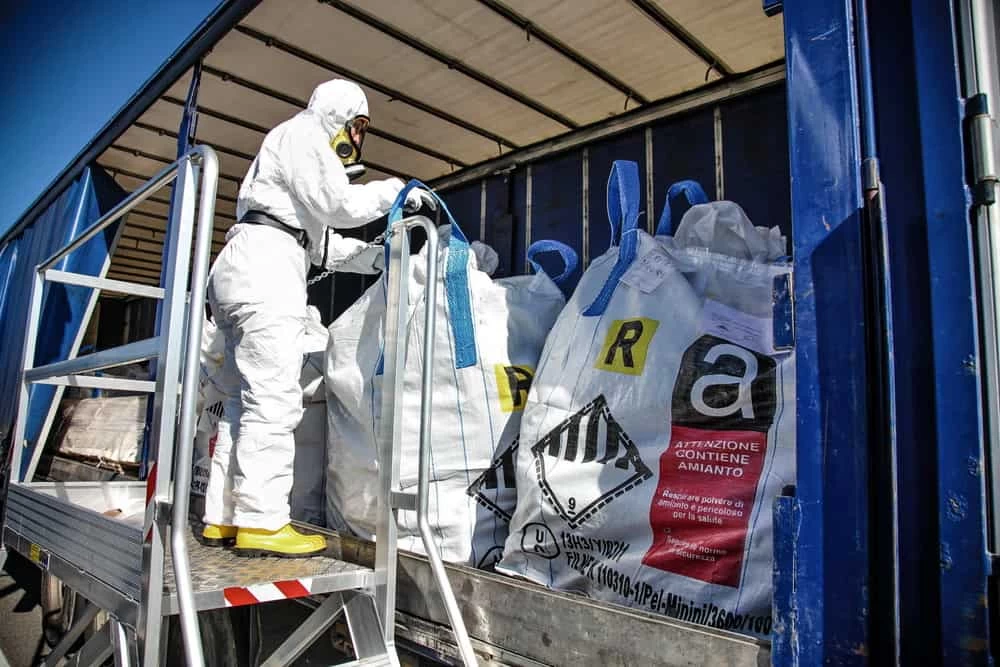
Not every building has asbestos, but if your building was constructed before 1980 and in the Empire State and Garment District area, that means almost every building you’re looking at the probability is high enough that you’re required by law to find out before demolition begins. NYC DEP regulations mandate a pre-demolition asbestos survey conducted by a licensed asbestos investigator for all pre-1980 structures. You can’t skip this step, and you can’t start demo until the survey is complete and any identified asbestos-containing materials are properly abated.
The 1920s-era buildings that dominate the Garment District were built at a time when asbestos was used widely in floor tiles, pipe insulation, spray-applied fireproofing, ceiling tiles, and joint compound. It’s not unusual to find multiple categories of asbestos-containing materials in a single floor. The survey identifies exactly what’s there, where it is, and what the abatement scope needs to be so there are no surprises mid-project. Our EPA-certified team handles the survey and abatement in-house, which keeps the process moving without a gap between inspection and remediation.
What is Local Law 196 and how does it affect a demolition project in New York City?
Local Law 196 is a New York City law that requires workers and supervisors on covered construction and demolition sites to hold specific site safety training credentials. For workers, that means a 40-hour Site Safety Training (SST) card. For supervisors on larger projects, additional credentials are required. The law was enacted in response to a rise in construction fatalities in New York City and is enforced by the NYC Department of Buildings through site inspections.
For any demolition project in the Empire State area that meets the covered site threshold which includes most commercial demolition projects in mid-rise and high-rise buildings all workers on site need to carry valid SST credentials, and the contractor needs to maintain documentation. A violation can result in a stop-work order, which in a commercial project with a tenant move-in deadline is a serious problem. Our workforce is fully credentialed under Local Law 196, and site safety compliance is built into the project plan from day one not addressed after the fact when an inspector shows up.
How does the 2025 Midtown South rezoning affect demolition timelines and requirements in the area?
The Midtown South Mixed-Use Plan, approved by the NYC City Council in August 2025, is one of the most significant zoning changes in this area in decades. It covers approximately 42 blocks immediately surrounding the Empire State Building and is expected to generate close to 9,500 new housing units through new construction and office-to-residential conversions. The buildings at the center of this rezoning the six- to ten-story pre-war structures along Seventh and Eighth Avenues that were originally built for the garment industry are exactly the type of projects that require the most thorough demolition and abatement planning.
What this means practically is that the demand for licensed demolition contractors in this specific area is increasing significantly, and the projects coming through the pipeline are not simple gut-outs. Many involve buildings within or adjacent to the Garment Center Historic District, which adds a Landmarks Preservation Commission review layer for certain structures. If you’re a developer, investor, or building owner with a property in the rezoning footprint, getting your demolition contractor lined up early with a team that already understands the NYC DOB, DEP, and LPC processes is the difference between a project that moves and one that stalls while you’re figuring out the regulatory path.