Your Co-op Was Built in the Asbestos Era Here's What That Means for You
Every building in Cooperative Village from Amalgamated Dwellings to East River Housing was built between 1930 and 1962. That’s not a risk factor. That’s a near-certainty. We at Green Island Group provide licensed asbestos abatement for co-op shareholders who need it done right, documented correctly, and board-ready from day one.
I needed a professional consultation explanation of procedure for safe removal of Asbestos in my apartment complex. Without having an account yet, I was very impressed with the caring, knowledgeable and generous advice offered by Jessica, and will look forward to doing business in the future. Thank you so much! I feel much more informed about a sometimes scary endeavor. Peace. Nancy Silva Mineola, NY.
Mia Munoz
Used this company to clean up some water flood in my house. They were fast and easy to work with.very professional, Would recommend to anyone!
Nini Valle
Great company, had a flood and they responded quickly and efficiently. Billed my insurance company directly. I highly recommend this company!
joe colapietro, jr
I had pipe freeze in my basement right before a snow storm and they made to within an hour to help start the clean up process. They we by our side throughout the entire process and even helped with the insurance company. They did such a great job with the cleanup, repair, remidiation, I contracted them to perform the repairs and finishes in the basement. They came with enough manpower and material to get the job done. Leo and Jessica were nothing but a pleasure to deal with!!
Cristian Arredondo c
I had some water damage in my home and Green Island was able to take care of my issue quickly and effectively. I am very pleased with the work they did. They responded quickly and were very professional.
Michael M
Outstanding service! From the office to the field crew everyone was friendly, helpful and responsive. I highly recommend Green Island Group.
You can finally move forward with the renovation you’ve been planning the kitchen update, the flooring replacement, the bathroom gut without the legal and health liability hanging over it. In Cooperative Village, that means more than just clearing the air. It means having the documentation your co-op board requires before they’ll approve a single alteration agreement. Without it, your project doesn’t start. With it, you’re covered at every level: the board, the city, and the building.
The buildings along FDR Drive and Grand Street sit close to the East River, and that proximity matters. Higher humidity, more temperature cycling, and decades of freeze-thaw stress on aging pipe insulation and ceiling coatings mean materials that were once safely sealed can become a problem over time. If your building has a steam heating system and most of them do the insulation around those pipes is one of the first places asbestos shows up.
Once abatement is complete and air clearance testing confirms the space is safe, you’re not just protected from a health standpoint. You’re protected from liability. You have the paperwork that satisfies NYC DEP, the DOB, and your co-op board simultaneously. That’s what a properly handled asbestos removal actually gives you the ability to move on without looking over your shoulder.
Licensed Asbestos Contractor, Cooperative Village NY
We've Worked in Cooperative Village Co-ops Not Just Around Them
We are a licensed environmental remediation company serving all five NYC boroughs, including Cooperative Village and the Lower East Side. We handle asbestos abatement, water damage restoration, mold remediation, and demolition all under one license. That matters in a building like yours, where a single burst steam pipe can create an asbestos exposure and a water damage situation at the same time.
We know how Manhattan co-op buildings work. We understand the alteration agreement process, the insurance certificate requirements your building management will ask for, and the NYC DEP filing requirements that have to be satisfied before a DOB permit can even be issued. We’ve done this in towers that look exactly like the ones on Grand Street and along the FDR Drive corridor buildings from the same era, built the same way, with the same materials.
Our team is available 24 hours a day, seven days a week. Verified customer reviews cite response times of 30 minutes to an hour. And we work directly with insurance carriers when abatement is connected to a covered event, so you’re not stuck managing that process on top of everything else.
No Surprises Here's Exactly How the Process Works in Your Cooperative Village Building
It starts with a free inspection. A certified asbestos investigator comes to your unit, assesses the materials in question floor tiles, pipe insulation, ceiling coatings, joint compound, whatever the scope of your renovation touches and gives you a clear picture of what you’re dealing with before any commitment is made.
From there, if abatement is needed, we handle the NYC DEP filing requirements. Depending on the scope of the project, that means submitting the correct ACP-5 or ACP-21 documentation and satisfying any notification timelines before work begins. In Cooperative Village, where your co-op board also requires licensed contractor credentials and specific insurance certificates as part of the alteration agreement, we provide all of that in the format your building management expects. You’re not chasing paperwork from multiple sources it comes from us.
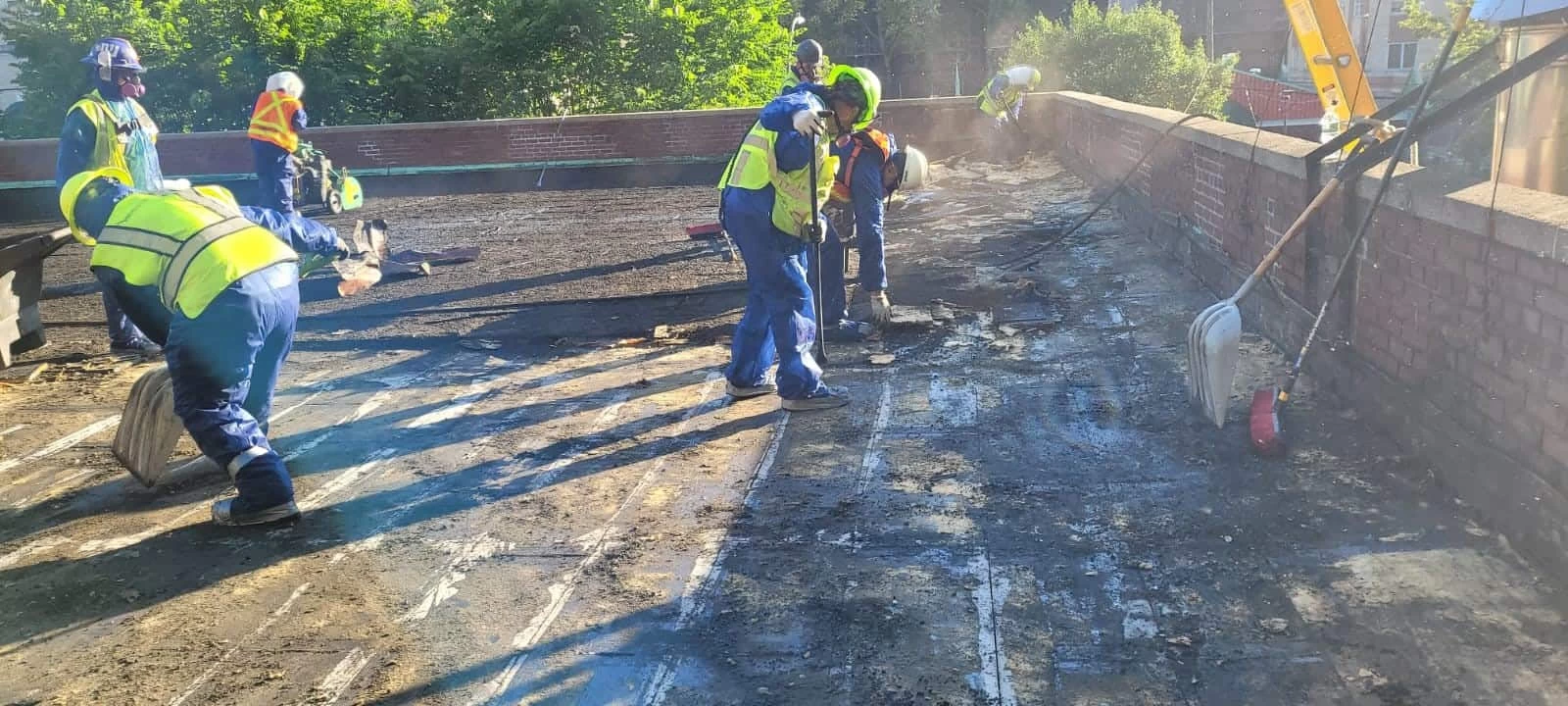
The abatement itself is performed under proper containment, with negative air pressure systems that prevent fiber migration to adjacent units or common areas. In a dense residential tower where your neighbors share walls, ceilings, and hallways, that’s not optional it’s the standard. When the work is done, post-abatement air clearance testing confirms the space meets safe reoccupancy levels. You get the clearance documentation, your board gets what they need, and you get to move forward.
Asbestos Remediation Services, Cooperative Village NY
Every Material, Every Layer Handled to NYC Standards
The asbestos-containing materials most commonly found in Cooperative Village’s mid-century buildings include vinyl asbestos floor tiles, steam pipe and boiler insulation, ceiling surface coatings, drywall joint compound, and roofing materials. These aren’t rare findings in buildings from this era they’re standard construction for the 1930s through early 1960s. Our certified technicians know where to look and how to test, so nothing gets missed before your renovation begins.
Asbestos tile removal and asbestos popcorn ceiling removal are among the most frequent requests we handle in co-op apartments throughout Manhattan. Both require proper containment, licensed removal, and post-clearance testing under NYC DEP regulations and both need to be fully documented before your co-op board will sign off on the alteration agreement. If you’re planning a kitchen or bathroom remodel in a Seward Park or Hillman Housing unit, there’s a real chance the floor tiles or pipe insulation will need to be addressed before anything else can happen.
When asbestos removal is connected to water damage a leaking pipe, a flood from an upstairs unit, or a failed steam line we handle both under one roof. That means one point of contact, one set of documentation, and no gap between the remediation work and the restoration work. We also bill insurance carriers directly when the event is covered, which removes a significant administrative burden for shareholders who are already managing a disruptive situation in their home.
Do I need an asbestos survey before renovating my Cooperative Village co-op apartment?
Yes and in New York City, this isn’t optional. Under NYC DEP regulations, any work that may disturb asbestos-containing materials requires a survey by a DEP-certified asbestos investigator before the project begins. In Cooperative Village specifically, this requirement hits twice: once from the city, and once from your co-op board. The alteration agreement process for buildings in Hillman Housing, East River Housing, Seward Park, and Amalgamated Dwellings typically requires lead and asbestos reports as a condition of board approval meaning your renovation can’t be approved until the survey is complete and documented.
Since every building in Cooperative Village was constructed before 1962, the likelihood of finding asbestos-containing materials in floor tiles, pipe insulation, or ceiling coatings is high. Getting the survey done early before you’ve committed to a contractor or a timeline gives you the clearest picture of what you’re actually dealing with and prevents costly delays once the project is underway.
What asbestos-containing materials are most common in 1950s Cooperative Village apartment buildings?
In mid-century residential towers like the ones that make up East River Housing and Seward Park Cooperative in Cooperative Village, the most frequently found asbestos-containing materials are vinyl asbestos floor tiles, steam pipe insulation, boiler insulation, ceiling surface coatings, and drywall joint compound. These were standard construction materials throughout the 1930s to early 1960s the exact window in which all of Cooperative Village was built.
Vinyl asbestos floor tiles are especially common in kitchens and bathrooms, and they’re often found under newer flooring that was installed on top of them over the years. Steam pipe insulation is another consistent finding in buildings with older heating systems, which describes virtually every building in the complex. If you’re planning to open walls, replace flooring, or do any work near the building’s mechanical systems, it’s worth having those materials tested before anything is disturbed.
Can I stay in my apartment during asbestos abatement in a NYC co-op building?
It depends on the scope and location of the work. For smaller, contained projects like asbestos tile removal in a single room it may be possible to remain in other parts of the apartment while work is in progress, provided proper containment is in place. For larger projects, or any work near HVAC systems or shared building infrastructure, temporary relocation is typically recommended and sometimes required.
In a co-op building like those in Cooperative Village, your building management may also have specific house rules about occupancy during remediation work. We’ll walk you through what’s required based on the specific scope of your project, the containment setup, and any building-level requirements your management office has in place. The goal is always to minimize disruption while keeping you, your family, and your neighbors safe throughout the process.
How does the NYC DEP asbestos permit process work before a renovation?
Before any renovation work begins in a New York City building that may contain asbestos, a DEP-certified investigator must survey the affected area. If asbestos-containing materials are found and the scope of disturbance exceeds 25 square feet or 25 linear feet, a permit from NYC DEP is required before work can start. The correct filing either an ACP-5 or ACP-21 form depending on the project must also be submitted before the NYC Department of Buildings will issue a renovation permit.
For Cooperative Village shareholders, this process runs parallel to the co-op board’s alteration agreement process. Both need to be satisfied, and both require documentation from a licensed abatement contractor. We handle the DEP filing requirements as part of the abatement scope, so you’re not managing that process separately. We know the notification timelines, the documentation requirements, and what the board will need to see and we make sure all of it moves forward together.
What happens if asbestos is found during an emergency water damage event in my building?
This is one of the most common scenarios we see in buildings like the ones along FDR Drive and Grand Street in Cooperative Village. When a steam pipe fails or a line bursts in a 1950s tower, the water damage and the asbestos exposure often happen at the same time. The pipe insulation that’s been safely encapsulated for decades gets disturbed, and suddenly you’re dealing with two separate remediation issues at once.
We handle both. Asbestos abatement and water damage restoration are part of the same service operation, which means one team responds, one scope of work is documented, and one set of clearance paperwork is produced at the end. We’re available 24 hours a day for exactly this kind of situation, and we work directly with insurance carriers when the event is covered so the billing and claims documentation doesn’t fall on you during an already stressful situation. Verified customers have specifically noted that direct insurance billing was one of the most valuable parts of working with us.
How do I find a licensed asbestos contractor who understands NYC co-op requirements?
The license you’re looking for is a New York State Department of Labor asbestos contractor license under 12 NYCRR Part 56. Any contractor performing asbestos abatement in New York State is legally required to hold it and in New York City, they also need to be familiar with NYC DEP regulations, ACP-5 filing, and the DOB permit process. That combination of state licensing and city-specific regulatory knowledge is what separates contractors who work in Manhattan from those who are figuring it out on your job.
For Cooperative Village specifically, you also want a contractor who understands the co-op board alteration agreement process one who can provide the insurance certificates, contractor credentials, and asbestos survey documentation in the format your building management requires. In a community where your neighbors will ask around and your board will review every document you submit, working with someone who has done this in co-op buildings before isn’t a preference. It’s the practical difference between a smooth approval and a delayed one. We serve Cooperative Village and the broader Lower East Side, and carry the licensing, insurance, and NYC regulatory experience the process requires.