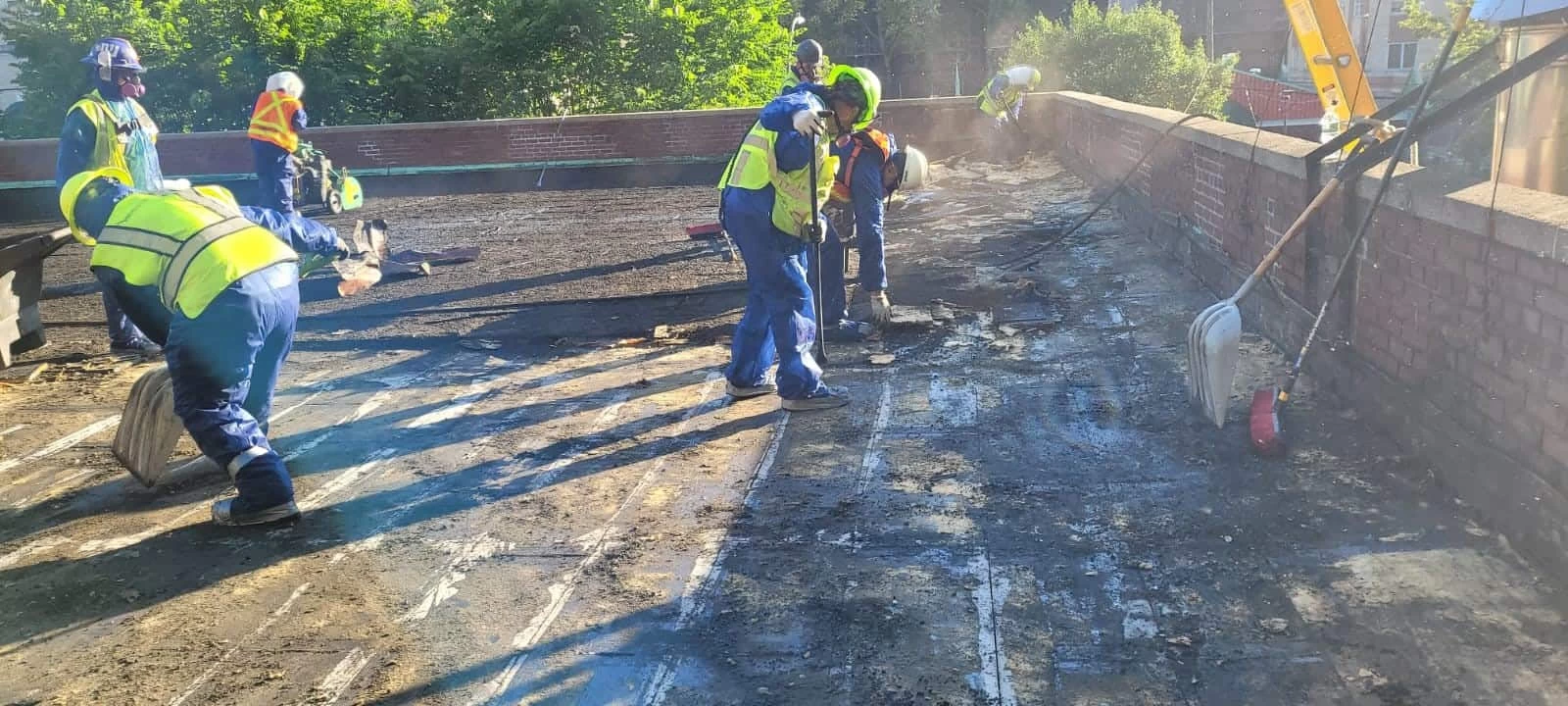
Pre-War Buildings in Franklin D Roosevelt Don't Hide Their Secrets Well
Behind the walls of Sutton Place co-ops and Turtle Bay high-rises in Franklin D Roosevelt, asbestos has been sitting quietly for decades. When renovation or an emergency brings it to the surface, you need licensed asbestos abatement that moves fast and gets the paperwork right because in this ZIP code, the regulatory stakes are real.
We handle the full scope of what pre-war buildings throw at us: steam pipe insulation, vinyl floor tile adhesive, plaster, joint compound. Asbestos shows up in places that aren’t always visible until a wall comes down or a pipe fails. Knowing what you’re dealing with before your contractor hits it is the difference between a smooth project and a full stop.
I needed a professional consultation explanation of procedure for safe removal of Asbestos in my apartment complex. Without having an account yet, I was very impressed with the caring, knowledgeable and generous advice offered by Jessica, and will look forward to doing business in the future. Thank you so much! I feel much more informed about a sometimes scary endeavor. Peace. Nancy Silva Mineola, NY.
Mia Munoz
Used this company to clean up some water flood in my house. They were fast and easy to work with.very professional, Would recommend to anyone!
Nini Valle
Great company, had a flood and they responded quickly and efficiently. Billed my insurance company directly. I highly recommend this company!
joe colapietro, jr
I had pipe freeze in my basement right before a snow storm and they made to within an hour to help start the clean up process. They we by our side throughout the entire process and even helped with the insurance company. They did such a great job with the cleanup, repair, remidiation, I contracted them to perform the repairs and finishes in the basement. They came with enough manpower and material to get the job done. Leo and Jessica were nothing but a pleasure to deal with!!
Cristian Arredondo c
I had some water damage in my home and Green Island was able to take care of my issue quickly and effectively. I am very pleased with the work they did. They responded quickly and were very professional.
Michael M
Outstanding service! From the office to the field crew everyone was friendly, helpful and responsive. I highly recommend Green Island Group.
Asbestos Removal Services, Franklin D Roosevelt NY
What Changes When Abatement Is Done Right in a Franklin D Roosevelt Co-Op
When asbestos is handled properly not just removed, but documented, cleared, and closed out your renovation can move forward without a DOB stop-work order hanging over it. Your managing agent gets the ACP-21 they need. Your board-approved alteration window stays intact. That’s the outcome that actually matters in a Midtown East co-op or condo in Franklin D Roosevelt.
The pre-war buildings throughout the 10022 area built largely between the 1920s and 1940s weren’t constructed with future renovations in mind. We’ve pulled asbestos from steam systems, floor tiles, plaster, and joint compound across Sutton Place, Turtle Bay, and Beekman Place. Every discovery requires the same disciplined approach: proper testing, containment, removal, clearance documentation.
And when a burst steam riser in a Sutton Place building exposes insulation at midnight in January, the outcome you need isn’t a callback on Monday. It’s a licensed team that answers now, contains the problem, and handles both the water damage and the asbestos under one roof so nothing falls through the gap between two separate contractors.
Licensed Asbestos Remediation near Franklin D Roosevelt
NYC DEP Compliance Isn't a Checkbox It's How We Work in Franklin D Roosevelt
Green Island Group is a full-service environmental remediation company serving all five NYC boroughs, including the Midtown East corridor and the residential neighborhoods of Franklin D Roosevelt. Every technician is certified. Every project is handled in compliance with NYC DEP, NYS Department of Labor, EPA, and OSHA standards not as a selling point, but because that’s what working legally in New York City requires.
What separates us in a market like Turtle Bay or Beekman Place isn’t just licensing it’s operational experience with how Manhattan buildings actually work. We understand alteration agreements, coordinate with managing agents, respect building access hours, and deliver the clearance documentation your co-op board needs to close out a permit. The administrative side of this process matters as much as the physical removal, and we handle both.
We also work directly with insurance carriers when coverage applies a detail that makes a real difference when you’re already managing an emergency in a high-value property in Franklin D Roosevelt.
Asbestos Abatement Process, Franklin D Roosevelt NY
From First Call to Final Clearance Here's How We Handle It
It starts with an inspection. A Certified Asbestos Investigator surveys the affected areas of your unit or building and generates the ACP-5 report required by the NYC Department of Buildings before any renovation permit can be issued. In virtually every pre-1987 building in the 10022 area and that covers nearly every residential building in Sutton Place, Turtle Bay, and Beekman Place this step is mandatory, not optional. If asbestos-containing materials are found in the scope of work, the process moves into abatement planning.
For qualifying projects, we submit an ACP-7 notification to NYC DEP’s Asbestos Technical Review Unit at least 10 business days before work begins. During abatement, our certified technicians work under containment protocols negative air pressure, sealed work zones, proper PPE while an independent air monitoring firm tracks fiber levels throughout. This isn’t theater. It’s what the regulation requires, and it’s what protects the occupants of adjacent units in a shared building.
Once removal is complete, post-abatement air clearance testing confirms the space is safe. That result, along with the ACP-21 completion form, is what your building needs before reoccupancy is authorized and your alteration permit can be closed. We deliver that documentation not a verbal okay, but the actual paperwork that gets the job done.
Every Material Type, Every Scenario Franklin D Roosevelt Buildings Present
Asbestos in the pre-war buildings of Franklin D Roosevelt doesn’t limit itself to one location or one material. Steam pipe insulation and boiler wrap are the most common finds in gut renovations throughout Sutton Place and Turtle Bay usually discovered behind walls and inside chases, not on open surfaces. Vinyl asbestos floor tiles and the adhesive mastic beneath them are a near-constant issue in kitchen and bathroom renovations. Plaster walls, joint compound, ceiling tiles, older roofing materials, and window caulking can all test positive in buildings from this era.
We handle the full range asbestos removal, asbestos tile removal, pipe insulation abatement, asbestos popcorn ceiling removal, and post-abatement air clearance testing across both residential and commercial scopes. Whether you’re a unit owner doing a kitchen gut in a 1930s co-op on Sutton Place South, a building manager overseeing a boiler replacement in a Turtle Bay high-rise, or a property owner facing an emergency pipe failure that’s exposed insulation, we adapt the service to what the situation actually requires.
We’re available 24 hours a day, 7 days a week for emergency response. For non-emergency projects, we coordinate directly with your managing agent and building superintendent to schedule access, meet alteration agreement requirements, and keep your renovation timeline on track.
Do I need an asbestos survey before renovating my Sutton Place co-op in Franklin D Roosevelt?
Yes and it’s not optional. New York City law requires that a Certified Asbestos Investigator inspect the affected areas of any building constructed before April 1, 1987, before renovation or demolition work can begin. In Franklin D Roosevelt, that covers virtually every residential building in Sutton Place, Turtle Bay, and Beekman Place. Without a completed ACP-5 report on file, the NYC Department of Buildings will not issue your renovation permit.
Beyond the legal requirement, most co-op boards and managing agents in Franklin D Roosevelt require the ACP-5 as part of the alteration agreement process before they’ll authorize contractor access at all. So even if you’re planning a relatively modest renovation replacing flooring, opening up a wall, updating a bathroom the survey needs to happen first. Getting it done upfront protects your timeline and avoids the much more disruptive scenario of a stop-work order mid-renovation.
What does asbestos abatement actually cost in a Manhattan apartment in 2025 or 2026?
For a single-room renovation scope a kitchen, a bathroom, or a section of flooring you’re typically looking at $2,000 to $8,000 for the abatement itself, plus $400 to $700 for testing. Costs have increased 8 to 12 percent in 2025 and 2026 due to updated NYS Department of Labor licensing requirements, higher disposal fees, and mandatory post-abatement air clearance testing that is now standard across NYC projects.
The scope of what’s found drives the final number. A floor tile removal with mastic is a different job than full pipe insulation abatement in a pre-war steam system. Building-wide capital projects boiler replacements, roof work, facade renovations in larger Turtle Bay or Sutton Place co-ops can run significantly higher depending on the linear footage of pipe insulation or the square footage of material involved. The clearest way to get an accurate number is a proper inspection first, so you’re not guessing at a scope that hasn’t been defined yet.
What happens if a steam pipe bursts in my Franklin D Roosevelt building and exposes asbestos insulation?
This is one of the most common emergency asbestos scenarios in the pre-war buildings throughout Franklin D Roosevelt. Steam heating systems in buildings from the 1920s and 1930s age, and when a pipe or riser fails especially in winter the insulation that wraps it is frequently asbestos-containing. When that happens, the affected area needs to be isolated immediately and the insulation treated as a regulated material until testing confirms otherwise.
NYC DEP does have an emergency variance process that allows abatement work to begin faster than the standard 10-business-day ACP-7 notification window when there’s a genuine emergency. The critical thing is to call a licensed contractor immediately not after you’ve already disturbed the material further trying to manage the water damage. We handle both the water damage restoration and the asbestos abatement together, which matters in this scenario because the two problems are happening at the same time and need to be addressed at the same time.
Do I have to leave my apartment during asbestos abatement in Franklin D Roosevelt, NY?
It depends on the scope and location of the work. For contained projects a single room or a defined work area proper containment protocols (sealed barriers, negative air pressure, HEPA filtration) are designed to prevent fiber migration into occupied portions of the unit. In those cases, temporary relocation may not be required, though it’s often recommended for the duration of active removal work.
For larger scopes full apartment gut renovations, multi-room abatement, or work involving HVAC or mechanical systems that affect the whole unit vacating during active abatement is the safer and more practical approach. In a Manhattan co-op or condo building, this also protects adjacent units, since shared HVAC pathways and building corridors can carry fibers if containment is inadequate. We’ll walk you through what the specific scope of your project requires before work begins not after.
How long does asbestos abatement take in a pre-war Manhattan building?
For a typical single-room or single-system scope floor tile removal, pipe insulation in one area, a bathroom gut active abatement work usually runs one to three days. The total project timeline is longer because of the regulatory steps on either end. The ACP-7 notification to NYC DEP must be submitted at least 10 business days before work begins on qualifying projects, and post-abatement air clearance testing and ACP-21 documentation add time on the back end before the space is officially cleared.
In a co-op or condo building in Franklin D Roosevelt, building-specific access restrictions elevator scheduling, work hours limited to weekdays between 8am and 5pm, noise restrictions can affect daily productivity and extend the overall timeline. This is why scheduling coordination with your managing agent needs to happen before work starts, not during it. We know how to plan around these constraints without blowing your alteration agreement window.
Can asbestos abatement in my Turtle Bay or Sutton Place building be covered by insurance?
In some cases, yes particularly when the asbestos disturbance is the result of a covered event like a pipe burst, water damage, or fire. If a steam pipe failure in your Turtle Bay or Sutton Place building exposes asbestos insulation as part of a larger water damage claim, the remediation may fall under your homeowner’s or building policy depending on how the claim is structured and what your policy covers.
The important thing is to document everything from the moment the damage occurs and to work with a contractor who has experience billing insurance carriers directly. We work with insurance companies on behalf of property owners and handle the billing and documentation coordination which matters when you’re already managing a building emergency and don’t have time to be the go-between. Not every asbestos project qualifies, and a planned renovation abatement typically won’t be covered, but in emergency scenarios it’s always worth a conversation with your carrier before assuming you’re paying out of pocket.