Most Islip Terrace Homes Were Built in an Era That Didn't Know Better
Most homes in Islip Terrace were built in the 1950s and ’60s which means asbestos abatement isn’t a rare situation here. It’s a near-certainty for anyone renovating, selling, or repairing one of these homes.
I needed a professional consultation explanation of procedure for safe removal of Asbestos in my apartment complex. Without having an account yet, I was very impressed with the caring, knowledgeable and generous advice offered by Jessica, and will look forward to doing business in the future. Thank you so much! I feel much more informed about a sometimes scary endeavor. Peace. Nancy Silva Mineola, NY.
Mia Munoz
Used this company to clean up some water flood in my house. They were fast and easy to work with.very professional, Would recommend to anyone!
Nini Valle
Great company, had a flood and they responded quickly and efficiently. Billed my insurance company directly. I highly recommend this company!
joe colapietro, jr
I had pipe freeze in my basement right before a snow storm and they made to within an hour to help start the clean up process. They we by our side throughout the entire process and even helped with the insurance company. They did such a great job with the cleanup, repair, remidiation, I contracted them to perform the repairs and finishes in the basement. They came with enough manpower and material to get the job done. Leo and Jessica were nothing but a pleasure to deal with!!
Cristian Arredondo c
I had some water damage in my home and Green Island was able to take care of my issue quickly and effectively. I am very pleased with the work they did. They responded quickly and were very professional.
Michael M
Outstanding service! From the office to the field crew everyone was friendly, helpful and responsive. I highly recommend Green Island Group.
When asbestos is properly removed not just painted over or ignored you get your renovation back on track, your home sale moving again, and the peace of mind that comes from knowing your family isn’t breathing something that was installed before anyone understood the danger.
For Islip Terrace homeowners, that matters in a specific way. The median construction year in this ZIP code is 1963, which puts the average home squarely in the window when asbestos was used most heavily in floor tiles, pipe insulation, joint compound, popcorn ceilings, and siding. These aren’t hypothetical risks. They’re materials that exist in the walls, floors, and ceilings of homes all along Carleton Avenue and throughout the surrounding blocks.
The South Shore climate adds another layer. Humidity, freeze-thaw cycles in winter, and the occasional nor’easter put stress on older building materials. When those materials crack, deteriorate, or get disturbed during a repair that’s when asbestos fibers become a real threat. Getting ahead of it, or handling it correctly when it surfaces, is what protects both your family and the value of a home worth $400,000 to $850,000 in today’s market.
Licensed, Local, and Familiar With Islip Terrace's Housing Stock
We’re a Long Island–based asbestos abatement and environmental remediation company serving Islip Terrace and the surrounding South Shore communities. The 631 area code isn’t a coincidence we’re a local operation, not a national franchise dispatching crews from three counties away.
The homes in Islip Terrace have a specific profile: 1950s ranch-style layouts, mid-1960s hi-ranch builds, split-levels that were constructed fast and filled with materials that were standard practice at the time. Our teams have worked extensively in this housing type throughout Suffolk County and know where asbestos tends to hide in these floor plans and what a proper scope of work actually looks like before a single sample gets pulled.
Every project we perform is done under NYS Department of Labor licensing, with full permit documentation filed through the Town of Islip Building Department. You’re not just getting a crew you’re getting a paper trail that holds up with real estate attorneys, insurance adjusters, and future buyers.
No Guesswork Here's Exactly What the Job Looks Like
It starts with an inspection and bulk sampling. A certified inspector walks the property, identifies suspect materials floor tiles, ceiling texture, pipe insulation, joint compound, siding and pulls samples for laboratory analysis. In a 1960s Islip Terrace home, that usually means checking the basement floor first, then the kitchen, then any original ceiling finishes. Results come back from the lab and tell you exactly what you’re dealing with and where.
From there, we write an abatement plan and submit it to the Town of Islip Building Department for permitting. This step is not optional any project involving more than 25 linear feet or 10 square feet of asbestos-containing material requires a permit and, in many cases, third-party air monitoring. We handle this entire process on your behalf. You don’t have to figure out the paperwork or make calls to Town Hall.
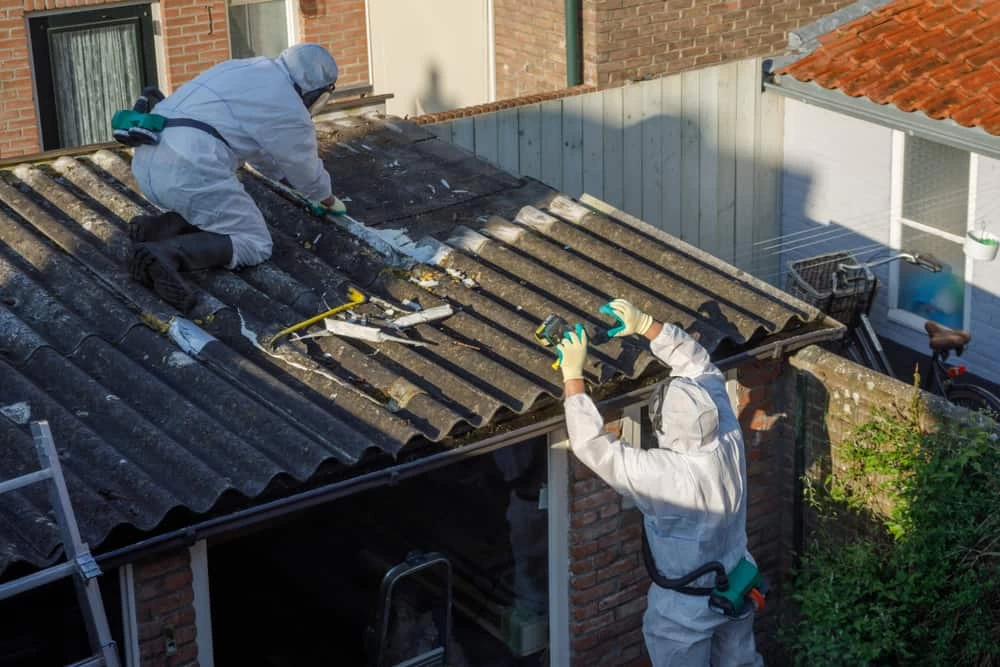
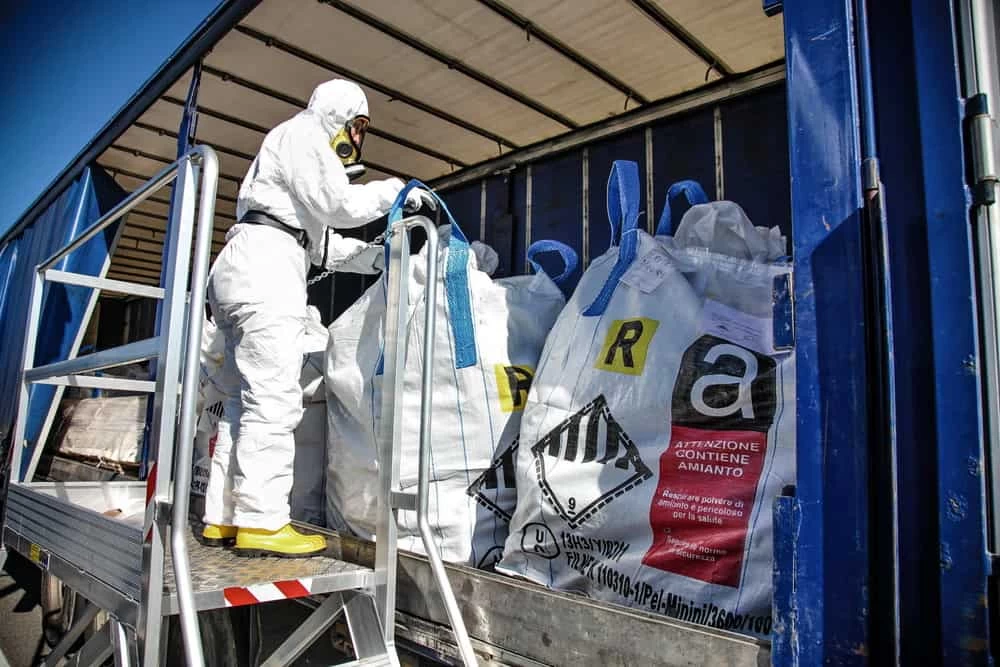
Once permitted, the physical removal happens under full containment negative air pressure, HEPA filtration, and proper protective protocols from start to finish. All waste is transported to a NYSDEC-licensed disposal facility in compliance with state environmental regulations. After removal, post-clearance air testing confirms the space is safe before containment comes down. You receive a complete documentation package at the close of the project: the survey, lab results, permits, waste manifests, and clearance report everything you need to satisfy a buyer, an insurer, or simply your own peace of mind.
The Materials Most Common in Islip Terrace Homes and What Removing Them Actually Involves
The two most frequently encountered asbestos-containing materials in Islip Terrace’s housing stock are 9×9 inch vinyl floor tiles and the black mastic adhesive underneath them. These tiles were installed in nearly every kitchen, bathroom, and finished basement built in the 1950s and ’60s, and the mastic is often more heavily contaminated than the tiles themselves. Asbestos tile removal requires certified bulk sampling first, then full containment setup, careful mechanical removal, and compliant disposal not a floor grinder and a dust mask.
Popcorn ceilings are the other common issue. The acoustic spray texture used on ceilings throughout the 1960s and ’70s frequently contained chrysotile asbestos, and it’s one of the first things homeowners want gone when they’re updating an older property. Asbestos popcorn ceiling removal follows the same containment and clearance protocol as floor work the difference is that disturbing it without proper setup releases fibers that stay airborne for hours. We perform both services under the same licensed, permitted framework, with no shortcuts on either end.
Beyond tiles and ceilings, pipe and boiler insulation in older oil-heated homes, drywall joint compound, and cement-asbestos siding shingles are all materials that turn up regularly in Islip Terrace inspections. The scope of each project is built around what’s actually found not a flat package that assumes every house is the same.
Does my 1960s Islip Terrace home actually have asbestos in it?
Statistically, yes and probably in more than one place. The median construction year for homes in Islip Terrace is 1963, which puts the average home squarely in the period when asbestos use in residential construction was at its peak. Floor tiles, the mastic adhesive beneath them, pipe insulation, ceiling texture, joint compound, and exterior siding shingles were all routinely manufactured with asbestos during this era.
That doesn’t mean every material in your home is a hazard right now. Asbestos that’s intact and undisturbed generally doesn’t pose an immediate risk. The problem starts when those materials are cut, sanded, broken, or torn out which is exactly what happens during a renovation. Before any significant work begins on a home of this age, a certified inspection and bulk sampling is the right first step, not an assumption in either direction.
How much does asbestos abatement typically cost in Suffolk County, NY?
For a single-room residential project in the Suffolk County market say, a basement floor tile removal or a bathroom ceiling you’re typically looking at $1,500 to $4,000 depending on the square footage, the condition of the material, and whether encapsulation is an option. Asbestos testing and inspection generally runs $650 to $2,200 depending on how many samples are needed. Encapsulation, which is an EPA-recognized alternative for intact materials that don’t need to be disturbed, usually costs $500 to $2,000 per room.
Larger projects a full floor removal across multiple rooms, pipe insulation throughout a basement, or a whole-home survey prior to a gut renovation will run higher. The honest answer is that cost depends entirely on what’s found and how much of it there is. What you should be cautious of is any contractor who quotes a flat price before they’ve done a proper inspection. Accurate scoping comes after sampling, not before.
Do I need a permit for asbestos removal in Islip Terrace, and who handles that?
Yes. Any asbestos abatement project in New York State involving more than 25 linear feet or 10 square feet of asbestos-containing material requires a permit and in Islip Terrace, that permit application goes through the Town of Islip Building Department. The application has to include documentation of the asbestos survey and the licensed contractor’s credentials. Skipping this step doesn’t make the requirement go away; it just creates liability for you as the property owner.
We handle the entire permit process on your behalf. That means filing the application, coordinating any required third-party air monitoring, and providing you with the completed permit documentation as part of your project file. For homeowners preparing to sell where a real estate attorney or buyer’s counsel may request proof of compliant abatement having that paperwork in order from the start is what keeps a transaction from stalling.
What's the difference between asbestos removal and asbestos encapsulation?
Removal means the material comes out entirely it’s physically extracted under containment, transported as regulated waste, and disposed of at a NYSDEC-licensed facility. Encapsulation means the material is treated with a sealant or covered in a way that prevents fiber release, leaving it in place. Both are recognized approaches under NYS DOL Industrial Code Rule 56, and both are legitimate depending on the situation.
The deciding factors are usually the condition of the material, what’s being done with the space, and whether a future renovation might disturb it anyway. If you’re finishing a basement in an Islip Terrace home and the floor tiles are intact, encapsulation might be appropriate. If those same tiles are cracked, water-damaged, or in the path of a full renovation, removal is the right call. A certified inspection is what determines which approach actually makes sense for your specific situation not a general preference either way.
Can I sell my house in Islip Terrace if it has asbestos?
You can, but it depends on what the inspection turns up and what the buyer’s attorney requires. In New York, sellers are required to disclose known material defects and a confirmed asbestos finding qualifies. That doesn’t automatically kill a deal, but it does change the negotiation. Buyers may request abatement as a condition of closing, ask for a price reduction to cover the cost, or require an escrow holdback until the work is completed.
In Islip Terrace’s active real estate market, where homes are selling in the $400,000 to $850,000 range, an unresolved asbestos issue is a negotiating liability you don’t want going into a transaction. Homeowners who get ahead of it who have the inspection done, the abatement completed, and the clearance documentation ready are in a much stronger position at the table. It’s one of those situations where spending $2,000 to $5,000 upfront protects significantly more than it costs.
Is it safe to stay in my home during asbestos abatement work in Islip Terrace?
It depends on the scope and location of the work. For a contained single-room project a basement floor removal, for example it’s sometimes possible for the rest of the home to remain occupied, provided the containment barriers are properly sealed and the HVAC system serving that area is isolated. For larger projects involving multiple rooms, or work in central areas like a main floor or shared living space, temporary relocation for the duration of the abatement is the safer and more practical choice.
In Islip Terrace, where most households are families with children in the East Islip school district, the timing of the work matters. Projects are often scheduled around the school week to minimize disruption and reduce the time kids are in or around the work area. We walk through this with every homeowner before the job starts what the containment setup looks like, which areas of the home are affected, and what the realistic timeline is from setup to post-clearance air testing. You’ll know what to expect before anything is touched.