If you’re renovating, selling, or just finally dealing with that old pipe insulation in the basement, we provide licensed asbestos abatement in Granite, NY with permits handled, air clearance documented, and zero guesswork on your end.
I needed a professional consultation explanation of procedure for safe removal of Asbestos in my apartment complex. Without having an account yet, I was very impressed with the caring, knowledgeable and generous advice offered by Jessica, and will look forward to doing business in the future. Thank you so much! I feel much more informed about a sometimes scary endeavor. Peace. Nancy Silva Mineola, NY.
Mia Munoz
Used this company to clean up some water flood in my house. They were fast and easy to work with.very professional, Would recommend to anyone!
Nini Valle
Great company, had a flood and they responded quickly and efficiently. Billed my insurance company directly. I highly recommend this company!
joe colapietro, jr
I had pipe freeze in my basement right before a snow storm and they made to within an hour to help start the clean up process. They we by our side throughout the entire process and even helped with the insurance company. They did such a great job with the cleanup, repair, remidiation, I contracted them to perform the repairs and finishes in the basement. They came with enough manpower and material to get the job done. Leo and Jessica were nothing but a pleasure to deal with!!
Cristian Arredondo c
I had some water damage in my home and Green Island was able to take care of my issue quickly and effectively. I am very pleased with the work they did. They responded quickly and were very professional.
Michael M
Outstanding service! From the office to the field crew everyone was friendly, helpful and responsive. I highly recommend Green Island Group.
Most Granite homeowners don’t go looking for asbestos. They find it mid-project pulling up old floor tiles, tearing out basement insulation, or scraping a popcorn ceiling and suddenly everything stops. The contractor won’t continue. The permit is on hold. And now you’re trying to figure out who to call, what the state actually requires, and whether the guy who offered to “just take care of it” is even licensed to touch the stuff.
That’s where having the right contractor from the start makes a real difference. Homes throughout Granite and the Town of Rochester corridor many of them built in the 1950s, 60s, and 70s were constructed during the peak years of asbestos use. Floor tiles, pipe wrap, joint compound, boiler insulation, roofing materials it was everywhere. The Catskills winters don’t help either. Freeze-thaw cycles crack old pipe insulation, and when that material fails, it doesn’t just create a heating problem. In a pre-1980 home in Granite, it can create an asbestos exposure situation that requires licensed abatement before any repair work can legally proceed.
When the job is done, you’ll have documented air clearance results not just a verbal “looks good.” That clearance certificate is what your contractor, your real estate attorney, or your home inspector will need to move forward. It’s not a formality. It’s the proof that the work was done right.
We hold the NYS DOL Asbestos Handling License the specific, state-issued credential required under New York Industrial Code Rule 56 to legally perform asbestos abatement in this state. This isn’t a general contractor’s license or an OSHA card. It’s the one credential the NYS Department of Labor actually requires, and it’s the first thing you should ask any contractor to verify before signing anything.
Beyond the license, we carry IICRC certification, USEPA Lead and RRP certifications, and handle asbestos alongside mold remediation, water damage, demolition, and HVAC cleaning. For homeowners in Granite and Kerhonkson where older homes often have layered issues that full-service capability means you’re not coordinating three different contractors to clear one job site.
Ulster County is a core service territory, not an afterthought. We know the regulatory requirements specific to this region, including the NYS DOL Asbestos Control Bureau’s Albany district jurisdiction that covers Ulster County. When a permit needs to be filed or a notification submitted, we handle it you don’t have to figure that out yourself.
What Actually Happens From First Call to Final Clearance
It starts with an inspection. Before any work begins, the affected materials are assessed either through visual identification or bulk sampling sent to a certified lab. If asbestos-containing materials are confirmed and the scope meets or exceeds the thresholds under NYS Industrial Code Rule 56 (10 square feet or 25 linear feet), licensed abatement is required by law. At that point, we file the required notifications with the NYS DOL and handle the permit process on your behalf. You don’t need to navigate the state’s regulatory process alone.
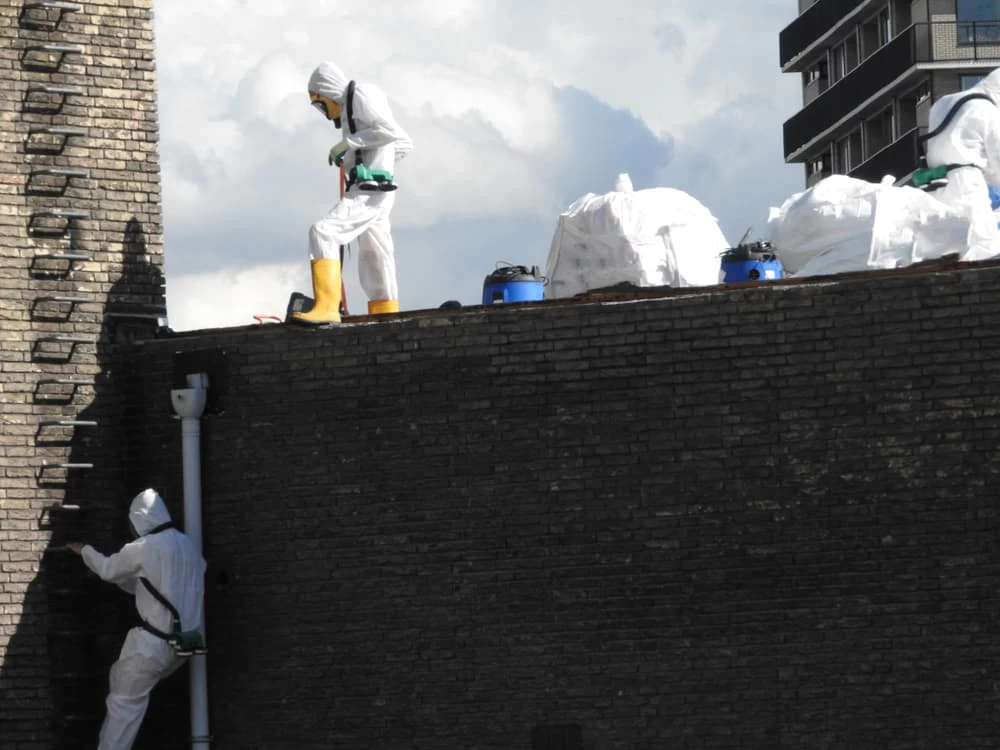
On the day of abatement, the work area is sealed and placed under negative air pressure to prevent fiber migration into the rest of your home. Our workers in full protective equipment remove the asbestos-containing materials using wet methods to minimize airborne fiber release, and all waste is bagged, labeled, and transported to a licensed disposal facility under NYSDEC requirements. Nothing gets left behind, and nothing gets handled informally.
Once removal is complete, post-abatement air monitoring is performed by a certified industrial hygienist. The results are documented and provided to you in writing. That clearance report is your proof for your contractor, your real estate attorney, your insurance company, or anyone else who needs to know the space is clean. In a rural area like Granite where contractor schedules can be tight and project delays cost real money, having that documentation in hand means your next step doesn’t have to wait.
Asbestos doesn’t show up in just one place. In the older homes that make up most of Granite’s housing stock, it can be in the 9×9 vinyl floor tiles and the black mastic adhesive underneath them, in the pipe and boiler insulation in the basement, in textured or popcorn ceilings, in the joint compound between drywall panels, and in asbestos cement siding or roofing shingles on the exterior. We handle all of it asbestos tile removal, pipe insulation abatement, ceiling texture removal, and full-structure abatement for larger renovation or pre-demolition projects in the Town of Rochester area.
Every project includes permit filing, containment setup, licensed removal, waste transport to a compliant disposal facility, and post-abatement air monitoring with written clearance results. If your discovery is connected to a water damage event a burst pipe during a hard Catskills winter, for example we bill insurance directly, so you’re not fronting costs and waiting for reimbursement.
If there’s mold alongside the asbestos, or if the project involves broader remediation or demolition, that work is handled under the same roof. For Granite homeowners who are already dealing with a disrupted renovation or a time-sensitive home sale, not having to source separate contractors for overlapping problems is a practical advantage that shows up immediately in your schedule and your stress level.
Does my Granite, NY home likely have asbestos if it was built before 1980?
Statistically, yes and in Granite and the Town of Rochester area, the odds are higher than average. New York State has the oldest owner-occupied housing stock in the country, with a median home age of 62 years, and in rural Ulster County hamlets like Granite, new construction has been minimal. Most of the homes here were built during the decades when asbestos was a standard ingredient in building materials floor tiles, pipe insulation, boiler wrap, joint compound, popcorn ceilings, roofing shingles, and exterior siding all commonly contained asbestos through the late 1970s.
The important thing to understand is that asbestos in good condition and left undisturbed doesn’t necessarily require immediate removal. The risk comes when those materials are disturbed during a renovation, a repair, or when age and freeze-thaw damage cause them to deteriorate. If you’re planning any work on a pre-1980 home in Granite, testing before you start is the move that keeps your project legal and your household safe.
What does asbestos abatement actually cost for a home in Ulster County?
For a typical residential project in the Ulster County area say, a single room of floor tile removal or a section of pipe insulation you’re generally looking at somewhere in the $1,500 to $5,000 range. Larger scopes, like whole-house abatement, full basement insulation removal, or pre-demolition clearance, can run $10,000 to $30,000 or more depending on the square footage and material types involved.
What drives the cost isn’t just the removal itself it’s the required compliance steps. NYS Industrial Code Rule 56 mandates licensed workers, proper containment, air monitoring, certified disposal, and documentation. Those aren’t optional line items. Any quote that seems unusually low is worth scrutinizing carefully, because cutting corners on any of those steps creates legal and health liability that falls on you as the property owner. We provide straightforward estimates so you know the real number before committing to anything.
Do I need a permit for asbestos removal in the Town of Rochester, NY?
Under New York State Industrial Code Rule 56, any asbestos abatement project involving 10 or more square feet or 25 or more linear feet of asbestos-containing material requires notification to the NYS Department of Labor before work begins. This isn’t a local permit from the Town of Rochester’s building department it’s a state-level notification and compliance requirement enforced by the NYS DOL Asbestos Control Bureau, which oversees Ulster County through its Albany district office.
In practice, this means paperwork needs to be filed before a single piece of asbestos-containing material is disturbed. We handle that entire process on behalf of clients the notification, the documentation, the project records that must be retained for 30 years under state law. You don’t have to figure out which state office to contact or what forms to file. That’s part of what you’re hiring a licensed contractor to manage.
Can I sell my home in Granite, NY if it has asbestos?
You’re not automatically required to remove asbestos before selling a home in New York State, but in practice, it almost always becomes an issue in Granite and the surrounding area. If a home inspector identifies suspected asbestos-containing materials during a buyer’s inspection which is common in older homes throughout the Kerhonkson and Granite area the buyer’s attorney will typically require either licensed abatement with clearance documentation or a significant price reduction to account for the future cost of removal.
The cleaner path for most sellers is to handle the abatement before listing or before closing, with a clearance certificate in hand. That documentation satisfies the buyer, their inspector, and their attorney without the negotiation. We work with sellers on timeline if you have a closing date, the goal is to get the abatement completed and documented in time to keep that date intact. In a market where older homes in the Rondout Valley corridor are actively changing hands, this is a situation that comes up regularly.
What types of asbestos-containing materials are most common in older Catskills-area homes?
The most frequently encountered materials in homes built in the Town of Rochester area before 1980 are vinyl floor tiles particularly the 9×9 inch format and the black mastic adhesive used to install them. These were almost universally made with asbestos through the 1970s. Pipe and boiler insulation is another common one, especially in homes with older heating systems, and this is the material that most often surfaces as an urgent issue during Catskills winters when pipes fail and emergency repairs are needed.
Beyond those, textured and popcorn ceilings, drywall joint compound, and asbestos cement siding or roofing shingles are all materials that appear regularly in older upstate New York homes. The challenge is that none of these materials are visually identifiable as asbestos-containing they look like ordinary building materials. The only way to know for certain is bulk sampling analyzed by a certified lab. If you’re about to start any renovation in a pre-1980 Granite home, that testing step is worth doing before the first wall comes down.
What happens if asbestos is disturbed accidentally during a renovation in Granite, NY?
If asbestos-containing material is disturbed before testing or abatement which happens more often than people expect, especially during gut renovations of older homes the right move is to stop work immediately, limit access to the area, and call a licensed abatement contractor. Continuing to work in a space where asbestos fibers may be airborne isn’t just a health risk. Under NYS Industrial Code Rule 56, it’s also a compliance violation that can create significant legal exposure for both the homeowner and any unlicensed contractor who continued the work.
In practical terms for a Granite homeowner, this means the renovation pauses until a licensed contractor can assess the situation, contain the affected area, perform abatement, and produce air clearance results confirming the space is safe to re-enter. We’re available around the clock for exactly this kind of situation because in a rural area like Granite, waiting until Monday morning for a callback isn’t always an option, especially when a contractor’s crew is scheduled and a project timeline is already in motion.