When the Croton Rises, Your Home Needs More Than a Fan
We respond 24/7 to water damage in Golden’s Bridge extracting, drying, and restoring your home completely, while handling your insurance claim directly.
I needed a professional consultation explanation of procedure for safe removal of Asbestos in my apartment complex. Without having an account yet, I was very impressed with the caring, knowledgeable and generous advice offered by Jessica, and will look forward to doing business in the future. Thank you so much! I feel much more informed about a sometimes scary endeavor. Peace. Nancy Silva Mineola, NY.
Mia Munoz
Used this company to clean up some water flood in my house. They were fast and easy to work with.very professional, Would recommend to anyone!
Nini Valle
Great company, had a flood and they responded quickly and efficiently. Billed my insurance company directly. I highly recommend this company!
joe colapietro, jr
I had pipe freeze in my basement right before a snow storm and they made to within an hour to help start the clean up process. They we by our side throughout the entire process and even helped with the insurance company. They did such a great job with the cleanup, repair, remidiation, I contracted them to perform the repairs and finishes in the basement. They came with enough manpower and material to get the job done. Leo and Jessica were nothing but a pleasure to deal with!!
Cristian Arredondo c
I had some water damage in my home and Green Island was able to take care of my issue quickly and effectively. I am very pleased with the work they did. They responded quickly and were very professional.
Michael M
Outstanding service! From the office to the field crew everyone was friendly, helpful and responsive. I highly recommend Green Island Group.
Water Damage Restoration Services, Westchester County
A Dry Home, A Clean Bill of Health, No Surprises
Water damage rarely looks like what it actually is. What you see on the surface a wet floor, a damp wall, a stained ceiling is almost never the full picture. Behind it, moisture is already working its way into framing, insulation, and subfloor material. Within 24 to 48 hours, mold begins. This is how the process works, and it’s why the first few hours matter more than anything else.
Golden’s Bridge sits in a river valley between I-684 and the Croton River, and the USGS has been monitoring a Croton tributary right here in the hamlet since 1976. That reflects how consistently this area deals with elevated groundwater, spring snowmelt, and storm runoff. Homes near the Colony and along the river’s edge face hydrostatic pressure that older foundations simply weren’t built to resist indefinitely. When that pressure wins, you need extraction and structural drying that actually reaches the moisture, not just the surface.
For owners of the pre-1940 homes throughout Golden’s Bridge especially in the Goldens Bridge Colony water damage restoration can get complicated fast. Older building materials disturbed during remediation may contain asbestos, which triggers a separate set of New York State licensing requirements. We handle both under one roof. You don’t have to find a second contractor, coordinate two schedules, or pay two mobilization fees. The job gets done start to finish, correctly, by one certified team.
Certified Water Restoration Company, Golden's Bridge NY
Twelve Years In, Every Credential Earned
We’ve been doing environmental restoration work in the New York metro area for over 12 years. That includes Westchester County, northern Westchester communities like Lewisboro, and the specific type of older residential and cooperative housing that defines places like Golden’s Bridge. We’re not a franchise with a local phone number. We’re a NYS and NYC M/WBE Certified Contractor with verifiable credentials, full liability insurance, and Workers’ Compensation coverage on every job.
We work directly with homeowner’s insurance carriers, bill them directly, and document damage in the format adjusters actually need. When the cost of restoration exceeds your coverage which happens more often than people expect on older Westchester homes we offer financing up to $200,000 at 0% APR. That’s not a teaser rate. It’s a real option that lets you authorize a complete restoration without waiting on a check or depleting savings while your home sits wet.
We also work with the NYS Office of General Services and other state agencies the kind of client roster that doesn’t happen without consistent, accountable work. That same standard applies to every residential job in Golden’s Bridge.
Emergency Water Removal Process, Golden's Bridge NY
What Actually Happens From First Call to Final Walkthrough
When you call, someone picks up any hour, any day. That first conversation is short and focused: where is the water, how long has it been there, is it still active. From there, we dispatch a certified technician to your home. The goal on arrival is to stop any ongoing source, assess the full scope of moisture intrusion, and begin extraction immediately. Industrial-grade equipment goes in fast because time is the variable you can’t get back.
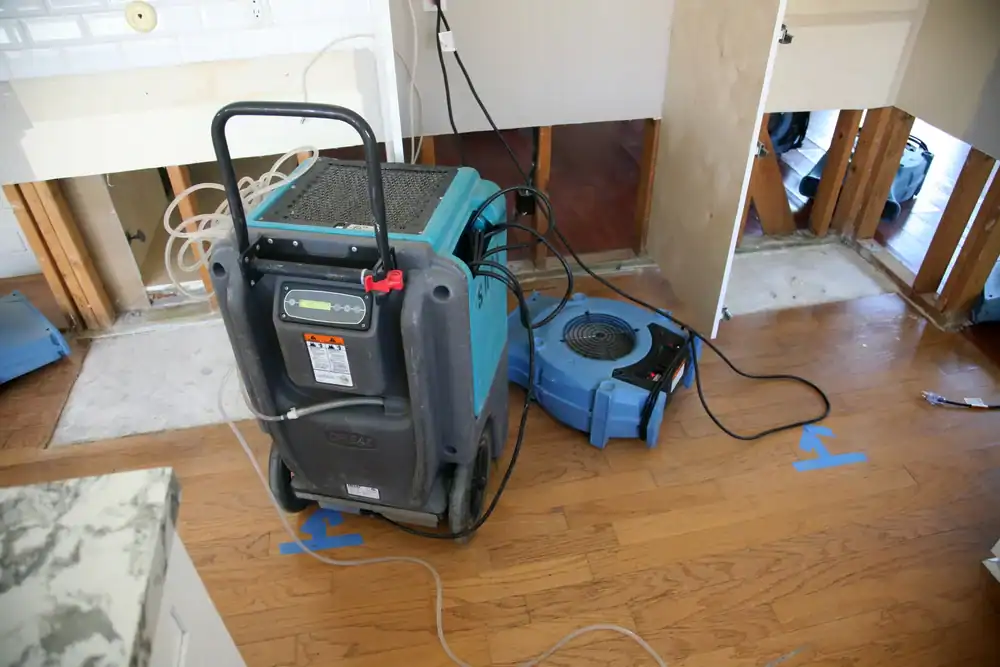
After extraction, the drying phase begins. This isn’t just running fans in a wet room. It involves moisture mapping with meters and thermal imaging cameras to locate water inside wall cavities, under flooring, and in ceiling assemblies the places you can’t see but where mold starts. In Golden’s Bridge, where many homes were built before 1940 or in the 1980s and have had decades of settling and material degradation, hidden moisture pockets are common. We build the drying plan around what the readings show, not a standard template.
Once the structure is confirmed dry, the remediation and reconstruction phase begins. Any mold that developed is addressed under New York State’s Mold Law, which requires licensed contractors for projects above 10 square feet. If the restoration disturbs pre-1980 materials that may contain asbestos a real possibility in Colony homes and other older structures in Golden’s Bridge we handle licensed abatement as part of the same job. Repairs follow: drywall, flooring, framing, finishing. The job isn’t closed until moisture readings confirm it’s done and you’ve signed off on the result.
Water Damage Restoration Services Near Lewisboro, NY
Full Restoration, Not Just Drying and a Good Luck
Some restoration companies extract the water, run equipment for a few days, and hand you a drying report. What comes after the mold testing, the repairs, the insurance documentation, the asbestos question becomes your problem to coordinate. That’s not how we operate. Our service covers the complete scope: emergency extraction, structural drying, mold assessment and remediation, asbestos abatement where applicable, and full reconstruction through to finished surfaces.
For Golden’s Bridge homeowners specifically, the asbestos piece is worth understanding before an emergency happens. The hamlet’s housing stock skews heavily toward pre-1940 construction and 1980s builds. Pre-1940 homes in and around the Colony frequently contain asbestos in pipe insulation, floor tiles, and ceiling materials. When water damage remediation disturbs those materials, New York State law requires licensed abatement and that work has to be performed by a contractor holding specific NYS Department of Labor credentials. We carry those credentials. You won’t be told mid-job that work has to stop while you find someone else.
The insurance coordination piece matters just as much. We bill your carrier directly, work with your adjuster, and provide the documentation format insurers require for claims. If there’s a gap between what your policy covers and what the job actually costs common on larger Westchester properties with extensive damage our 0% APR financing option bridges that gap without putting your restoration timeline on hold. A home with a median value approaching $800,000 deserves a complete fix, not a partial one based on what’s easiest to bill.
How quickly does mold start growing after water damage in my home?
Mold can begin colonizing wet building materials within 24 to 48 hours of water intrusion sometimes faster in warm, humid conditions. Once mold establishes itself inside wall cavities, subfloor assemblies, or behind insulation, you’re no longer dealing with a drying job. You’re dealing with a remediation project, which is more invasive, more expensive, and takes longer to complete.
In Golden’s Bridge, the combination of older housing stock and proximity to the Croton River watershed means groundwater and humidity levels are already elevated for much of the year. Homes near the Colony or along the river’s edge can experience moisture intrusion that goes unnoticed for days especially if it’s happening slowly through a foundation wall rather than a burst pipe. We use thermal imaging and moisture mapping on every job from the start. Finding the moisture you can’t see is what prevents a contained water event from becoming a long-term mold problem.
Does homeowner's insurance cover water damage restoration in Golden's Bridge, NY?
Most standard homeowner’s insurance policies cover sudden and accidental water damage a burst pipe in January, a failed appliance line, a roof breach during a storm. What they typically don’t cover is gradual damage: a slow foundation seep that went unaddressed for months, or a drainage issue that’s been building over multiple seasons. The distinction matters because it affects what gets approved and how quickly.
We work directly with homeowner’s insurance carriers and bill them directly. The documentation we provide moisture readings, thermal imaging reports, scope of damage assessments is formatted the way adjusters need it, which speeds up the claims process significantly. If your claim is disputed, delayed, or only partially approved, our 0% APR financing option up to $200,000 means you’re not waiting on a check while your home sits in a compromised state. For a home in the $700,000–$1.5 million range that Golden’s Bridge properties commonly fall into, a partial fix is a real financial risk. Complete restoration protects the full value of the property.
My Golden's Bridge home was built in the 1930s does that affect water damage restoration?
It does, and it’s worth knowing before an emergency happens. Homes built in the 1930s and earlier including many structures in the Goldens Bridge Colony were constructed during a period when asbestos was a standard building material. It appears in pipe insulation, floor tiles, ceiling tiles, and sometimes exterior materials. Under normal conditions, intact asbestos isn’t an immediate health concern. But water damage restoration involves cutting into walls, removing flooring, and disturbing building assemblies exactly the kind of activity that can release asbestos fibers if the material is present.
New York State law requires licensed abatement for any asbestos-containing material disturbed during a renovation or restoration project. We hold the NYS Department of Labor credentials required for this work. That means if asbestos is identified during your water damage restoration, the job doesn’t stop. We handle abatement by the same team, under the same contract, without you having to locate a separate licensed contractor and coordinate two separate scopes of work. For older homes in Golden’s Bridge, this is one of the most practical reasons to choose a contractor with both capabilities before you need them.
What's the difference between water extraction and full water damage restoration?
Water extraction is one step in a larger process it removes standing water from floors and surfaces using pumps and wet vacuums. It’s necessary, but it’s not restoration. Restoration is the complete scope: extraction, structural drying, moisture mapping, mold prevention or remediation, and reconstruction of anything that was damaged or removed. Stopping at extraction and leaving wet framing, insulation, and drywall in place is one of the most common reasons water damage jobs turn into much larger, more expensive problems weeks later.
The distinction matters especially in Golden’s Bridge, where the Croton River valley’s groundwater conditions mean moisture doesn’t just come in from above it can push up through foundations and into slab or crawl space assemblies. Industrial drying equipment and thermal imaging are what confirm that the structure is actually dry, not just dry on the surface. Our process doesn’t end when the standing water is gone. It ends when the moisture readings confirm that the building assembly walls, floors, framing is back within acceptable ranges and the risk of mold growth has been eliminated.
How long does water damage restoration typically take from start to finish?
The honest answer is that it depends on the scope of damage and how quickly work begins. A contained water event a single appliance line failure, a localized pipe burst that’s addressed within a few hours can often be dried and restored within three to seven days. A basement flooding event near the Croton River after a significant storm, or a slow foundation seep that went undetected for weeks, can extend the timeline considerably once mold is involved or structural materials need to be replaced.
The single biggest factor in timeline is response speed. Every hour of delay after water intrusion is an hour of additional moisture absorption into framing, insulation, and drywall. Our 24/7 emergency response is built around that reality getting equipment on-site fast compresses the overall timeline and reduces the scope of what needs to be replaced versus what can be dried in place. For Golden’s Bridge homeowners who work remotely or hybrid and are home during the day, faster discovery usually means faster resolution. The key is not waiting to call because the damage doesn’t look that bad yet.
Can water damage restoration be done while we're still living in the house?
In most cases, yes though it depends on the area affected and the extent of the damage. For contained events in a single room or basement, restoration work can typically proceed with the rest of the home fully occupied. Industrial drying equipment does run continuously and does produce noise and airflow, but most families manage it without relocating. If mold remediation is required, we contain the affected area with negative air pressure barriers to prevent spore migration to other parts of the home, and occupants are generally advised to stay out of that specific zone.
For Golden’s Bridge residents who work from home full or part-time which describes a significant portion of the community the disruption question is a real one. Our team works with homeowners to schedule the most disruptive phases around work schedules where possible, and the containment protocols we use during mold remediation are designed to protect the rest of the home as a livable, functional space. If the damage is extensive enough that temporary relocation is genuinely the right call, that’s something we discuss honestly in the initial assessment not after equipment is already running.