Your Belle Terre Kitchen, Built for the Home It's In
Salt air, older walls, and a village that holds its standards high your kitchen remodel needs a contractor who actually understands what that means. We’ve spent over a decade working in Belle Terre homes, and we know what coastal living does to kitchens over time.
I needed a professional consultation explanation of procedure for safe removal of Asbestos in my apartment complex. Without having an account yet, I was very impressed with the caring, knowledgeable and generous advice offered by Jessica, and will look forward to doing business in the future. Thank you so much! I feel much more informed about a sometimes scary endeavor. Peace. Nancy Silva Mineola, NY.
Mia Munoz
Used this company to clean up some water flood in my house. They were fast and easy to work with.very professional, Would recommend to anyone!
Nini Valle
Great company, had a flood and they responded quickly and efficiently. Billed my insurance company directly. I highly recommend this company!
joe colapietro, jr
I had pipe freeze in my basement right before a snow storm and they made to within an hour to help start the clean up process. They we by our side throughout the entire process and even helped with the insurance company. They did such a great job with the cleanup, repair, remidiation, I contracted them to perform the repairs and finishes in the basement. They came with enough manpower and material to get the job done. Leo and Jessica were nothing but a pleasure to deal with!!
Cristian Arredondo c
I had some water damage in my home and Green Island was able to take care of my issue quickly and effectively. I am very pleased with the work they did. They responded quickly and were very professional.
Michael M
Outstanding service! From the office to the field crew everyone was friendly, helpful and responsive. I highly recommend Green Island Group.
Belle Terre homes sit on a peninsula surrounded by water on three sides. That’s not a scenic detail it’s a material specification issue. Salt air off the Long Island Sound degrades cabinet hardware, corrodes appliance finishes, and breaks down grout joints faster than most homeowners expect. When we complete your kitchen remodel, the materials we choose actually hold up in that environment. That’s not something you get from a showroom sample. It comes from a contractor who’s worked in Belle Terre long enough to know the difference.
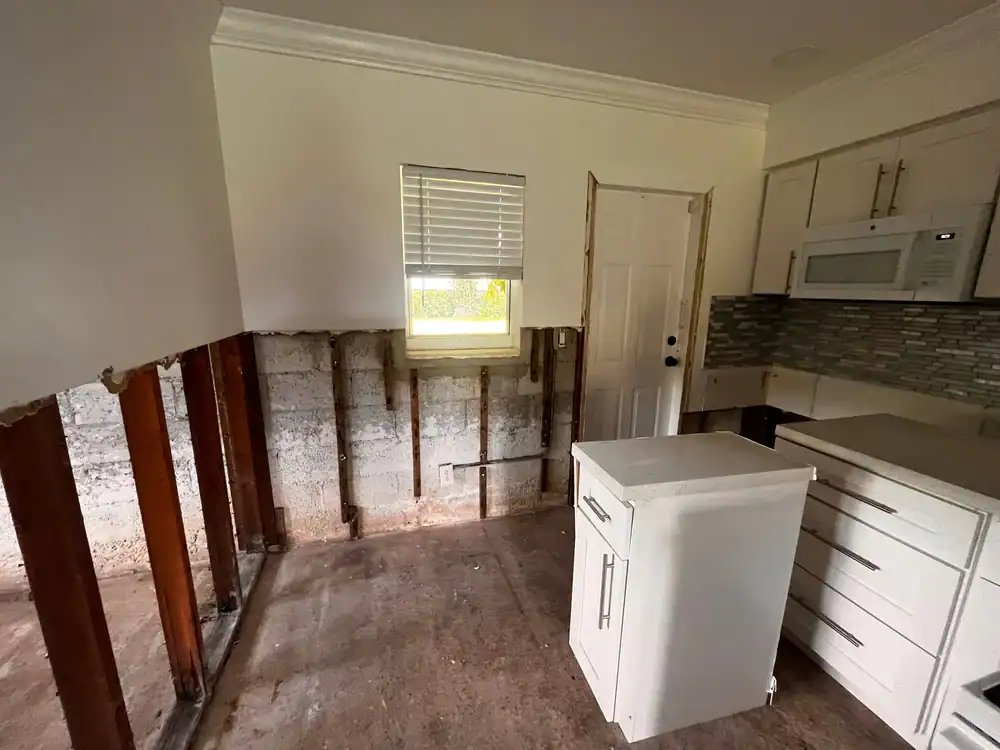
There’s also the question of what’s behind your walls. A meaningful portion of Belle Terre’s housing stock was built before 1980 the Tudor-era homes in the English section, the 1960s construction, the early 1980s builds. Homes in that range commonly contain asbestos in floor tiles and pipe insulation, and lead paint on older surfaces. Most kitchen remodelers hit that discovery and stop the project cold while they scramble to find a remediation subcontractor. That’s where timelines collapse and budgets blow up. We’re already licensed for abatement and environmental remediation, so the project keeps moving.
A finished kitchen in Belle Terre should reflect what the home is worth and what the community expects. That means a result you can actually see before demolition starts, materials specified for coastal Long Island conditions, and a contractor who handles every layer of the job not just the pretty parts at the end.
We’ve been operating out of Bohemia, NY since 2012 centrally located in Suffolk County with direct access to Belle Terre via Route 112 through Port Jefferson and up to Cliff Road. That’s not a stretch assignment for our team. It’s familiar territory. We’ve worked in Belle Terre homes long enough to understand the permit environment, the housing conditions, and what coastal Long Island actually does to construction materials over time.
We hold a Home Improvement Contractor license through Nassau County, five additional licenses covering environmental and remediation work, IICRC certification, and M/WBE certification from New York State. Those aren’t marketing claims they’re verifiable credentials you can look up. Over 5,000 completed projects across New York State since 2012 means we’ve encountered every complication a Long Island home can produce and delivered results through all of them.
Belle Terre’s Village Building Inspector enforces certificate of occupancy requirements with real rigor. We handle the permit process and coordinate directly with local inspectors, so you’re never navigating that on your own.
It starts with an in-home consultation not a sales pitch, but a real conversation about how your kitchen functions, what’s driving you crazy about it, and what you actually want from the finished space. We take full measurements and build a 3D design model. You see your kitchen before anything is ordered or demolished. If the island placement is wrong, you change it on screen. If the countertop material doesn’t read right against the cabinet color, you catch it before it’s installed. That step alone prevents the majority of mid-project disputes.
Once the design is approved, you receive a written, itemized quote. No vague estimates. No verbal agreements that become arguments later. Belle Terre homeowners expect that level of transparency, and that’s the standard we’ve built this process around.
Demolition comes next, and this is where our process diverges from what most remodelers offer. If your home was built before 1980 which covers a significant portion of Belle Terre’s housing stock we’re already licensed to identify and handle asbestos or lead paint discoveries in-house. The project doesn’t pause. It continues on schedule. After demo, construction and installation proceed with full permit coverage through the Village of Belle Terre, and the job isn’t done until the Building Inspector signs off on the certificate of occupancy. Spring is typically the busiest season for kitchen remodels on the North Shore, so if you’re planning ahead for summer or the holiday entertaining season, earlier is better.
A kitchen remodel in Belle Terre isn’t just a cabinet swap. It can involve structural changes, plumbing relocation, gas line work, electrical upgrades, and in older homes environmental remediation before any of the visible work begins. We cover all of it. You’re not coordinating between us and a separate abatement company. You’re not waiting on a subcontractor who doesn’t know your timeline. One team manages the job from the first measurement to the final inspection.
On the design and finish side, our work includes custom cabinetry, countertop installation, layout reconfiguration, and material selection guided by what actually performs in a coastal Long Island environment. The salt air and humidity cycles Belle Terre homeowners deal with year-round aren’t an afterthought here they shape every material recommendation we make. Cabinet hardware, countertop finishes, and grout specifications are all chosen with the understanding that your kitchen sits minutes from the Long Island Sound.
Kitchen cabinet renovation and full kitchen makeovers are both available depending on the scope of what you need. Some Belle Terre homeowners want a complete rip-and-replace new layout, new everything. Others want to keep the bones and upgrade the surfaces, hardware, and appliances. Either way, the process starts the same: a real conversation, a 3D design, a written quote, and a team that handles whatever the walls reveal.
Do I need a permit for a kitchen remodel in Belle Terre, NY?
In most cases, yes. Belle Terre is an incorporated village with its own Building Inspector and zoning code separate from the Town of Brookhaven’s general permit process. Any kitchen remodel that involves structural changes, plumbing relocation, gas line work, or electrical upgrades will require a building permit from the Village of Belle Terre before work begins. The village code also requires a certificate of occupancy to be issued by the Building Inspector before the space is occupied after renovation, certifying that the work conforms to all applicable ordinances.
The practical risk of skipping this step is significant. Late filing fees apply when work is started before a permit is issued, and unpermitted work can create real problems when you go to sell especially in Belle Terre, where homes transact above seven figures and buyers conduct thorough due diligence. We handle the permit application and inspector coordination on your behalf, so you’re not navigating the village’s regulatory process on your own.
How much does a kitchen remodel typically cost in Belle Terre?
In the New York metro area, a full kitchen rip-and-replace typically runs between $24,500 and $107,000 or more, depending on scope, materials, and what’s discovered during demolition. Luxury renovations in high-value markets can exceed $150,000 when custom cabinetry, high-end countertops, and full layout reconfiguration are involved. Labor accounts for roughly 50 to 60 percent of total project cost, which means the contractor you choose has more impact on your final number than almost any other variable.
For Belle Terre homeowners specifically, there’s an additional cost consideration that doesn’t apply everywhere: if your home was built before 1980, there’s a real possibility of encountering asbestos or lead paint during demolition. With us handling remediation in-house, that discovery gets addressed without stopping the project or adding a separate subcontractor invoice. It’s worth factoring that into your contractor evaluation, not just the base quote.
What kitchen materials hold up best in a coastal Long Island home?
This is one of the more consequential decisions Belle Terre homeowners face, and it’s one that gets underestimated when working with contractors who don’t have North Shore experience. Salt air off the Long Island Sound is a year-round presence in Belle Terre the village sits on a peninsula with water on three sides and it actively degrades certain materials faster than you’d expect in an inland home. Cabinet hardware finishes, particularly chrome and standard brushed nickel, can show corrosion within a few years in this environment. Stainless steel appliances with lower-grade finishes are similarly vulnerable.
For countertops, dense, low-porosity materials like quartz perform better than highly porous natural stones in high-humidity coastal conditions because they resist moisture absorption and are easier to maintain over time. For cabinetry, solid wood with a high-quality sealed finish outperforms MDF-core options that can swell with repeated humidity exposure. Grout joints in tile backsplashes should be sealed and specified for moisture resistance. These aren’t dramatic changes from a standard remodel they’re targeted material decisions that make a real difference in how your kitchen holds up five and ten years out.
What happens if asbestos is found during my kitchen demo in Belle Terre?
It’s a fair concern, especially in Belle Terre, where a meaningful portion of the housing stock predates 1980. Asbestos was commonly used in floor tiles, pipe insulation, ceiling materials, and joint compounds in homes built through the late 1970s. If your home is in that range and that includes many of Belle Terre’s Tudor-era homes and 1960s construction there’s a real possibility of encountering it during demolition.
With most kitchen remodelers, this discovery stops the project. They’re not licensed for abatement, so they have to pause work, bring in a third-party remediation company, wait for that company’s schedule, and then resume sometimes weeks later. We’re already licensed for asbestos abatement and environmental remediation. When the material is identified, it gets handled by our team already on-site, under proper containment and disposal protocols, without blowing up your timeline or adding a separate subcontractor invoice to the project. The work continues. That’s not a minor distinction when you’re midway through a kitchen renovation.
How long does a kitchen remodel take from start to finish?
A straightforward kitchen remodel cabinet replacement, new countertops, updated appliances, no structural changes typically runs three to six weeks from the start of construction. A full rip-and-replace with layout reconfiguration, plumbing relocation, and electrical upgrades can run eight to twelve weeks or longer depending on scope, material lead times, and permit processing.
In Belle Terre, the permit process through the village adds a step that isn’t present in unincorporated areas of Suffolk County. The Building Inspector’s review and approval timeline should be factored into your overall project schedule from the beginning not treated as an afterthought after demo has already started. If you’re targeting a specific date a holiday gathering, a home listing, a summer season work backward from that date and build in realistic buffer. Spring is the busiest season for kitchen remodels on Long Island, so if you’re planning a spring or summer project, getting your consultation and design finalized in late winter puts you in a much better position.
Is a kitchen remodel actually worth the investment for a Belle Terre home?
For most Belle Terre homeowners, yes and the numbers support it. Minor kitchen remodels currently deliver up to 113 percent return on investment according to 2025 industry data, meaning you can recoup more than you spend at resale. Fifty-four percent of realtors recommend upgrading the kitchen before listing. In Belle Terre, where homes regularly transact above $1 million, a kitchen that doesn’t match the quality of the rest of the home is a visible gap that buyers notice and price into their offers.
Beyond resale, there’s the daily use argument. Belle Terre homeowners tend to be established, long-term residents the median age in the village is 52, and the owner-occupancy rate is close to 90 percent. These aren’t people flipping homes. They’re living in them, entertaining in them, and spending real time in their kitchens. A well-designed kitchen renovation that functions better, looks better, and holds up against the coastal conditions of the North Shore is an investment in how you actually live not just in what the home is worth when you eventually sell.