When water gets into your home in New Hempstead, every hour you wait makes the damage worse. We respond 24/7, handle the insurance, and get your home back to normal — fast.
I needed a professional consultation explanation of procedure for safe removal of Asbestos in my apartment complex. Without having an account yet, I was very impressed with the caring, knowledgeable and generous advice offered by Jessica, and will look forward to doing business in the future. Thank you so much! I feel much more informed about a sometimes scary endeavor. Peace. Nancy Silva Mineola, NY.
Mia Munoz
Used this company to clean up some water flood in my house. They were fast and easy to work with.very professional, Would recommend to anyone!
Nini Valle
Great company, had a flood and they responded quickly and efficiently. Billed my insurance company directly. I highly recommend this company!
joe colapietro, jr
I had pipe freeze in my basement right before a snow storm and they made to within an hour to help start the clean up process. They we by our side throughout the entire process and even helped with the insurance company. They did such a great job with the cleanup, repair, remidiation, I contracted them to perform the repairs and finishes in the basement. They came with enough manpower and material to get the job done. Leo and Jessica were nothing but a pleasure to deal with!!
Cristian Arredondo c
I had some water damage in my home and Green Island was able to take care of my issue quickly and effectively. I am very pleased with the work they did. They responded quickly and were very professional.
Michael M
Outstanding service! From the office to the field crew everyone was friendly, helpful and responsive. I highly recommend Green Island Group.
Most homeowners in New Hempstead don’t realize how far water travels once it gets in. It moves through subfloors, soaks into wall cavities, and saturates insulation — all in places you can’t see from the surface. By the time you notice a smell or a stain, the damage has already been spreading for hours. That’s the part that costs you the most if it’s not handled correctly from the start.
When water damage is addressed the right way, you get your home back — not a patched version of it. Dry walls, clean air, intact flooring, and no lingering moisture hiding behind drywall waiting to grow mold. For a home worth close to $900,000 in a community like New Hempstead, that’s not just a comfort issue. It’s protecting a serious financial asset.
Rockland County’s winters create real pipe-freezing risk, and the area’s documented history of flash flooding — including the July 2023 event that hit southeastern New York hard and the 2025 storms that dropped four to five inches of rain on communities right in this zip code — means water damage here isn’t a rare scenario. It’s a when, not an if. Getting ahead of it with a team that does this completely, not partially, is what makes the difference between a contained repair and a months-long ordeal.
We’ve been doing environmental restoration work in the New York metro area for over 12 years. That means navigating New York State licensing requirements, working directly with insurance companies, and handling jobs that go beyond what most restoration contractors are even equipped to take on — including mold remediation and asbestos abatement under one roof.
New Hempstead sits in the Town of Ramapo, Rockland County — and the homes here reflect that. A mix of construction eras, finished basements, and properties that have been significantly invested in over the years. That matters when water damage hits, because the scope of what needs to happen isn’t always straightforward. We hold NYS and NYC M/WBE certification, carry full liability and workers’ compensation insurance, and work with the NYS Office of General Services — which means we’re not a company that showed up after a storm and will be gone by spring.
Emergency Water Damage Restoration Company near Me
From Standing Water to Dry Home — Here's What We Do
The first thing that happens when you call is assessment. One of our technicians arrives, identifies the source and scope of the water intrusion, and determines what’s been affected — including areas that aren’t visibly wet but have absorbed moisture. In New Hempstead homes with finished basements and drywall-finished walls, this step matters more than most people expect. Water doesn’t stay where you can see it.
Once the scope is clear, extraction begins. We use industrial-grade equipment to pull standing water out, and then the drying process starts — not just surface drying, but targeted dehumidification and airflow directed at wall cavities, subfloors, and any other affected structural areas. Moisture meters verify that every surface is actually dry, not just dry on the outside. If mold is present or asbestos-containing materials are disturbed during the process — a real possibility in homes built before 1980, which exist throughout this area — we handle that in the same engagement, not hand it off to a separate contractor.
From there, structural repairs bring everything back to pre-loss condition. Throughout the entire process, we communicate directly with your insurance company, document the damage, and manage the claim so you’re not stuck in the middle trying to translate between an adjuster and a contractor. New York State has specific mold remediation licensing requirements, and all work we perform meets those standards.
Water Damage Restoration Services near New Hempstead
Everything the Job Needs — Not Just the Easy Parts
Water damage restoration done right isn’t just extraction and a few fans. For homeowners in New Hempstead, where properties carry significant value and most are single-family homes with real investment behind them, the work has to go all the way. We cover water extraction, structural drying, mold remediation, asbestos abatement, and full structural repairs — all under one contractor, one contract, and one point of accountability.
The asbestos piece is worth addressing directly. New Hempstead’s housing stock includes homes built across several decades, and pre-1980 construction commonly used asbestos in insulation, floor tiles, and drywall joint compound. When water damage requires tearing out walls or flooring, those materials can become a hazard. Most restoration companies stop work the moment asbestos is identified and refer you out. We handle both — which means no delays, no contractor handoffs, and no gaps in the chain of responsibility.
Financing is available up to $200,000 at 0% APR, which no regional competitor in Rockland County currently offers. If insurance covers part of the job and you’re managing the rest, that option exists. The work is also backed by a 100% Satisfaction Guarantee — the job isn’t finished until it’s right. For a homeowner on New Hempstead Road or anywhere in the surrounding Ramapo area, that’s the kind of commitment that should be standard. With us, it is.
How quickly does mold start growing after water damage in my home?
Mold can begin growing within 24 to 48 hours of water exposure — and that timeline doesn’t slow down because you’re waiting on an insurance callback or trying to find a contractor. Once moisture is present in wall cavities, subfloors, or insulation, the conditions for mold growth are already in place.
For New Hempstead homeowners, this urgency is especially relevant given the area’s documented flash flooding history and the region’s cold, wet winters that create pipe-freeze risk throughout the season. A burst pipe at 11 p.m. in January isn’t something you schedule for next week. The faster extraction and drying begin, the smaller the remediation scope — and the lower the final cost. We respond 24/7 for exactly this reason.
Does homeowners insurance cover water damage repair in New Hempstead, NY?
It depends on the cause. Most standard homeowners insurance policies in New York cover sudden and accidental water damage — a burst pipe, an appliance failure, or water intrusion from a storm. What’s typically excluded is gradual damage, meaning a slow leak that’s been going on for months without being reported. Flood damage from rising groundwater is also generally excluded from standard policies and requires separate flood insurance.
For New Hempstead homeowners, this distinction matters. Rockland County has experienced significant storm-related flooding events, and not every cause of water entry is covered the same way. We bill insurance companies directly and document the damage in a way that supports your claim — so you’re not left guessing what’s covered or trying to negotiate with an adjuster on your own. Getting the documentation right from the start is one of the most important things a restoration company can do for you.
What's the difference between water damage mitigation and full restoration?
Mitigation is the emergency phase — stopping the damage from getting worse. That means extracting standing water, removing saturated materials, and drying everything down to prevent mold growth. It’s critical, but it’s not the end of the job. Restoration is what comes after: repairing or replacing drywall, flooring, subfloors, insulation, and any structural elements that were damaged.
Some contractors only do one or the other, which means you end up coordinating between multiple companies during an already stressful situation. For homeowners in New Hempstead — where homes are high-value, often have finished basements, and may contain older building materials that complicate the process — having one company handle both phases is a meaningful practical advantage. We cover the full scope, from the first extraction to the final structural repair, without handing you off mid-project.
How much does water damage repair typically cost for a home in Rockland County?
The national average for water damage restoration sits around $3,864, but that number moves significantly depending on scope. A contained pipe burst caught early might stay in that range. A basement flood that went undetected for 24 hours, or a situation where mold has already begun forming, can push costs to $10,000 or more — and cases involving structural damage or asbestos-containing materials can reach $16,000 and beyond.
In New Hempstead, where median home values are approaching $900,000 and the housing stock includes homes built across multiple construction eras, the scope of a water damage job isn’t always predictable until a full assessment is done. That’s why getting a thorough inspection early matters — it defines the actual cost before work begins, not after. We offer financing up to $200,000 at 0% APR, so if the job is larger than expected and insurance doesn’t cover everything, you have a real option that doesn’t require liquidating savings or delaying necessary work.
What happens if asbestos is found during water damage repairs in my home?
If asbestos-containing materials are identified during a water damage job — in insulation, floor tiles, ceiling tiles, or drywall joint compound — most restoration contractors will stop all work immediately and refer you to a separate abatement company. That means delays, additional coordination, and a gap in the restoration timeline during which moisture continues to affect your home.
This is a realistic concern in New Hempstead, where the housing stock includes homes built before 1980. Pre-1980 construction commonly used asbestos in materials that are often disturbed during water damage repairs — particularly when walls or flooring need to come out. We’re licensed to handle both water damage restoration and asbestos abatement, which means the work continues without interruption and without you managing two separate contractors. New York State has specific licensing requirements for mold remediation and abatement work, and we meet all of them.
How do I know if my basement has hidden water damage I haven't found yet?
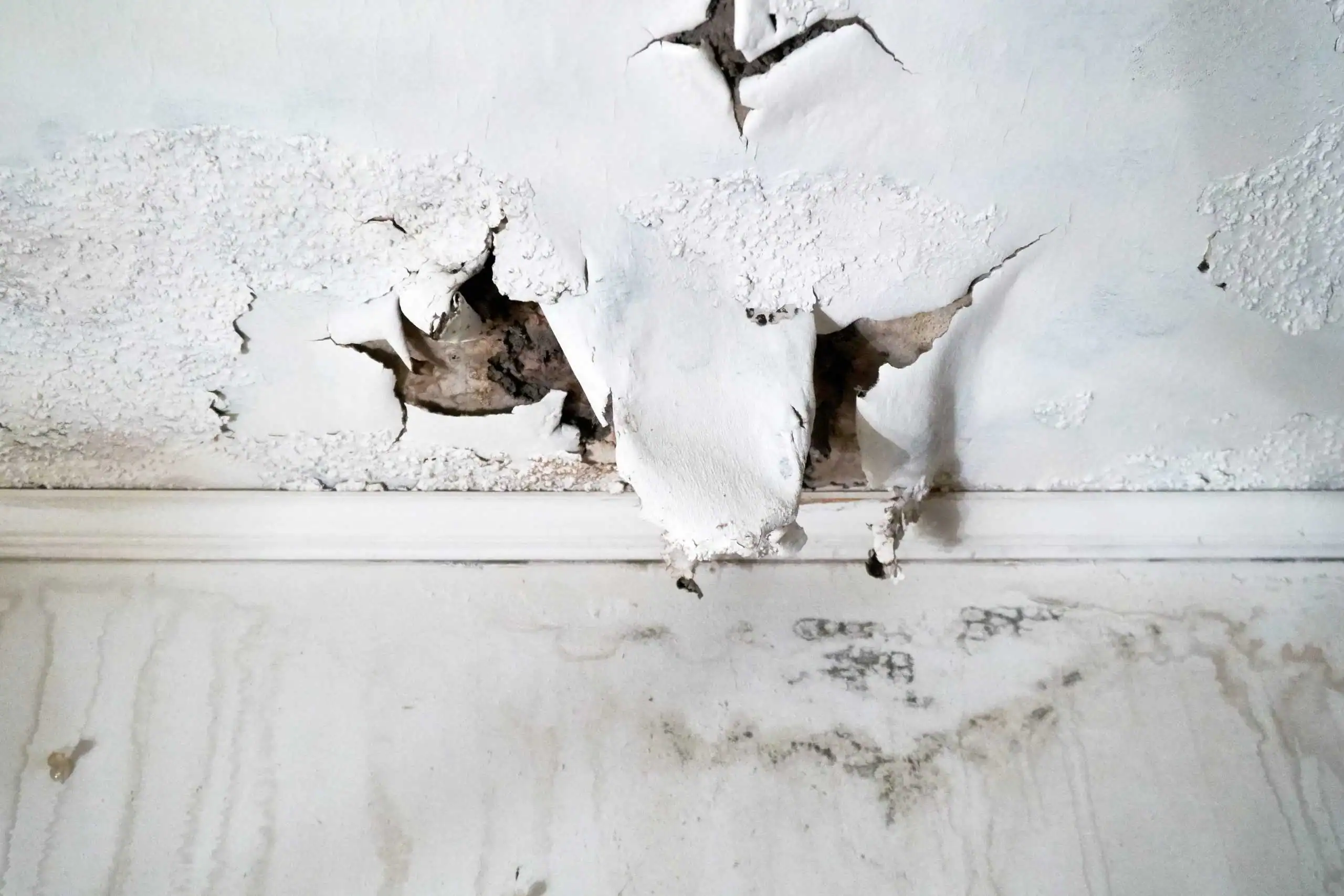
The most common signs are things people tend to dismiss at first: a musty smell that comes and goes, paint bubbling or peeling on basement walls, white chalky deposits on concrete or block walls (called efflorescence), or flooring that feels slightly soft or uneven underfoot. By the time any of these are visible, moisture has usually been present for a while.
In New Hempstead, finished basements are common — and finished spaces make hidden moisture harder to detect because the water is behind drywall or under flooring rather than sitting in an open concrete space. The area’s spring snowmelt season and history of heavy rainfall events create sustained hydrostatic pressure on basement walls, which can force water through foundation cracks slowly over time. A professional moisture assessment uses meters and thermal tools to find what you can’t see from the surface. If there’s any question about what’s behind your walls or under your floors, getting that answered before it becomes a mold problem is significantly cheaper than addressing it after.