Your 1950s Merrick Home Deserves More Than a Quick Cleanup
Most homes in Merrick were built before asbestos and lead paint were banned. Fire damage restoration here isn’t just cleanup — it’s a licensed process that protects your family and your investment. When flames touch your walls in a home built in the 1950s or earlier, there’s a real chance asbestos-containing floor tiles, pipe insulation, or joint compound have been disturbed. That’s not a scare tactic — it’s the reality of owning a pre-1978 home on Long Island’s South Shore.
I needed a professional consultation explanation of procedure for safe removal of Asbestos in my apartment complex. Without having an account yet, I was very impressed with the caring, knowledgeable and generous advice offered by Jessica, and will look forward to doing business in the future. Thank you so much! I feel much more informed about a sometimes scary endeavor. Peace. Nancy Silva Mineola, NY.
Mia Munoz
Used this company to clean up some water flood in my house. They were fast and easy to work with.very professional, Would recommend to anyone!
Nini Valle
Great company, had a flood and they responded quickly and efficiently. Billed my insurance company directly. I highly recommend this company!
joe colapietro, jr
I had pipe freeze in my basement right before a snow storm and they made to within an hour to help start the clean up process. They we by our side throughout the entire process and even helped with the insurance company. They did such a great job with the cleanup, repair, remidiation, I contracted them to perform the repairs and finishes in the basement. They came with enough manpower and material to get the job done. Leo and Jessica were nothing but a pleasure to deal with!!
Cristian Arredondo c
I had some water damage in my home and Green Island was able to take care of my issue quickly and effectively. I am very pleased with the work they did. They responded quickly and were very professional.
Michael M
Outstanding service! From the office to the field crew everyone was friendly, helpful and responsive. I highly recommend Green Island Group.
What Getting It Right Actually Looks Like in Merrick
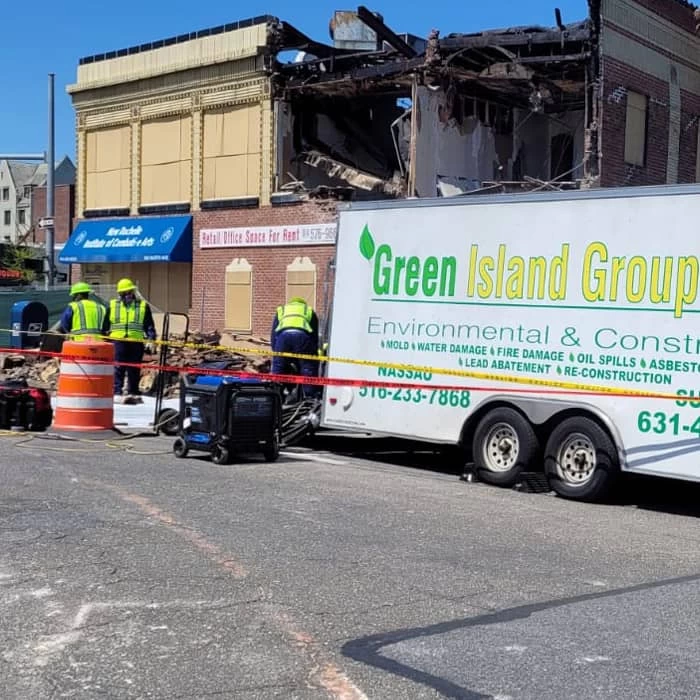
A fire in a Merrick home isn’t just a fire. The majority of homes in this community were built in the 1950s or earlier — which means the moment flames touch your walls, there’s a real chance asbestos-containing floor tiles, pipe insulation, or joint compound have been disturbed. Add lead paint to that picture, and what looks like a smoke cleanup job is actually a hazardous materials situation that requires specific state and county licenses to handle legally. That’s just the reality of owning a pre-1978 home on the South Shore.
When we handle fire damage restoration the right way, you get more than a cleaned-up house. The smoke that traveled through your HVAC system gets addressed. The soot that started bonding to your metal fixtures within hours of the fire gets removed before it causes permanent corrosion. The water our fire department used to put out the flames — which can trigger mold growth within 24 to 48 hours — gets extracted and dried properly. You don’t get handed off to three different contractors. You get one team, from the emergency call to the final walkthrough.
For a Merrick home worth $800,000 to over a million dollars, that level of thoroughness isn’t optional. It’s what protects the asset, protects your family’s health, and protects the equity you’ve spent decades building in a community where homes don’t turn over often — because people don’t leave.
Every License This Job Actually Requires — We Have It
We are a Long Island-based restoration company headquartered in Bohemia, NY. We hold a Nassau County General Contractor license, IICRC certification for fire and smoke damage restoration, NYS DOL Asbestos licensure, and USEPA Lead/RRP certification. In Nassau County — where Merrick sits — the 2016 Fire Prevention Ordinance requires restoration companies to be licensed with the Nassau County Fire Marshal. That means IICRC FSRT certification, valid lead and asbestos abatement credentials, and 170 hours of required training across all categories. We meet every one of those requirements. A lot of companies operating in this market don’t.
With over 5,000 completed restoration projects across New York State, we’ve worked extensively in Nassau County’s older housing stock — the Cape Cods, split-levels, and colonials that line the streets between Merrick Road and the Great South Bay. We know what these homes contain, how they’re built, and what it takes to restore them correctly. We also bill insurance directly and have a documented track record of advocating for homeowners throughout the claims process — not just handing you a report and walking away.
No Handoffs, No Gaps — Here's How We Handle It in Merrick
The first call triggers an immediate response. We stage equipment locally on Long Island and commit to being on-site within one hour, around the clock, every day of the year. When we arrive, the priority is stabilization — securing the structure, boarding up openings, and stopping any active water intrusion from firefighting efforts before it has a chance to become a mold problem. In Merrick’s southern neighborhoods near the Great South Bay, where ambient humidity is already elevated, that window matters more than it does in drier inland communities.
From there, we conduct a full damage assessment — not just the visible burn zone, but the areas smoke traveled through, the HVAC system, and any materials that may have been disturbed. In a pre-1978 Merrick home, that assessment includes identifying potential asbestos-containing materials and lead paint hazards before any demolition or debris removal begins. This step is required by New York State law, and skipping it isn’t just illegal — it can create a health liability that follows the home through future sales.
Once the scope is documented in insurance-standard format, remediation begins: soot and smoke removal, structural drying, HVAC cleaning, hazardous materials abatement where applicable, and odor neutralization. After remediation is complete, our Nassau County General Contractor license allows us to pull the required Town of Hempstead building permits and perform full structural reconstruction — so you’re dealing with one company, one point of contact, and one accountable team from start to finish.
Fire and Smoke Damage Restoration Services Merrick
Built for Merrick's Homes, Not Generic Ones
Fire damage restoration in Merrick covers a wider scope than most homeowners expect when they first make the call. Beyond the visible char and smoke staining, the service includes emergency board-up and structural stabilization, full-structure smoke and soot remediation, HVAC system cleaning, water extraction and structural drying from firefighting suppression, mold prevention treatment, content evaluation and pack-out when needed, and complete reconstruction permitted through the Town of Hempstead. Every element of that scope is handled in-house — no subcontracting the parts that require licenses we don’t hold, because we hold them all.
For Merrick homeowners dealing with an oil burner puff-back — which sends oily black soot through an entire home’s interior and is a recurring reality in a community with this much older heating equipment — the same remediation process applies. Puff-back soot is oilier and harder to remove than post-fire dry soot, and it gets into HVAC ductwork, wall cavities, and contents in ways that require professional equipment to address properly. It’s not a DIY situation, and it’s not a job for a general cleaning company.
If your home is in Merrick South or anywhere near the bay, there’s an additional layer worth knowing: coastal humidity and prior moisture exposure can accelerate both mold growth and smoke odor absorption into porous materials after a fire. We account for those conditions as part of how we scope and execute the work here — not as an add-on, but as standard practice for homes in this part of Nassau County.
Does Nassau County require a license to perform fire restoration in Merrick?
Yes — and this is one of the most important questions you can ask before hiring anyone. The 2016 Nassau County Fire Prevention Ordinance requires all companies performing board-up and restoration services in Nassau County to hold a license issued by the Nassau County Fire Marshal. That license requires a minimum of 16 hours of fire restoration training or IICRC FSRT certification, valid lead and asbestos abatement credentials, and a total of 170 hours of training across all required categories.
This isn’t a technicality — it’s an enforceable county ordinance that applies directly to any restoration company working in Merrick. We satisfy every requirement of that ordinance. Before you sign anything with any contractor after a fire, ask them directly whether they are licensed with the Nassau County Fire Marshal. If they can’t give you a straight answer, that tells you everything you need to know.
My Merrick home was built in the 1950s — does that affect the restoration process?
It does, significantly. The median construction year for homes in Merrick is 1956, and roughly 31% of the housing stock was built before 1950. That means the vast majority of homes here predate both the 1978 federal lead paint ban and the widespread phase-out of asbestos in residential construction around 1980. Asbestos-containing materials in a home of that era can include floor tiles, ceiling tiles, pipe insulation, roofing materials, and joint compound — all of which can be disturbed by fire, heat, and the water used to suppress a fire.
Under New York State law, only contractors holding NYS DOL Asbestos licensure and USEPA Lead/RRP certification can legally perform remediation in a home where these materials may have been disturbed. We hold both. Any contractor who proceeds with demolition or debris removal in a pre-1978 Merrick home without these credentials is operating illegally — and creating a health and legal liability for you as the homeowner. This is not a minor distinction when your home is worth $800,000 or more and you’re planning to live in it or eventually sell it.
How quickly does fire damage get worse if restoration is delayed?
Faster than most people realize. Soot is acidic, and it begins permanently bonding to metal surfaces, appliances, and finishes within hours of a fire. Once that bonding sets, the damage becomes significantly harder — and more expensive — to reverse. Smoke particles are microscopic and travel far beyond the visible burn zone, moving through HVAC systems, wall cavities, and structural gaps into rooms that look completely unaffected. If those areas aren’t addressed early, the odor and contamination become embedded in the structure itself.
The water used to extinguish the fire adds another layer of urgency. Mold can begin developing within 24 to 48 hours of water exposure, and in Merrick’s southern neighborhoods near the Great South Bay — where baseline humidity is already higher than inland communities — that timeline can compress. Every day you wait is compounding damage to a high-value asset. The goal of an immediate response isn’t just to be fast — it’s to stop the clock on losses that are actively growing.
Will my homeowners insurance cover fire damage restoration in Merrick, NY?
In most cases, yes — fire damage is one of the core covered perils under standard homeowners insurance policies. But the scope of what gets approved, and how quickly, depends heavily on how the damage is documented and presented to your insurer. Merrick homes carry high coverage limits that reflect local property values, which means these claims involve meaningful dollar amounts — and insurance companies scrutinize them accordingly.
We bill insurance directly and document every element of the damage in insurance-standard format from the moment we arrive on-site. Our clients have specifically noted that we attend material selection appointments with them to make sure replacement materials are priced fairly — not just at whatever the insurer’s preferred vendor offers. If there’s a dispute about scope or pricing, we’ve navigated that process hundreds of times across Nassau County and know how to advocate for a fair outcome. You shouldn’t have to fight that battle alone while you’re also displaced from your home.
What is a puff-back, and is it common in Merrick homes?
A puff-back happens when an oil-fired furnace or boiler backfires — sending a burst of combustion gases and soot back through the system and into your home. It can happen during startup, after a period of inactivity, or when a burner malfunctions. The result is oily, black soot coating walls, ceilings, HVAC ductwork, furniture, and contents throughout the entire home — sometimes in rooms far from the furnace itself.
Puff-backs are genuinely common on Long Island, which has one of the highest concentrations of oil-heated homes in the country. In Merrick, where a large share of the housing stock dates to the 1950s and many homes still run on aging oil burner systems, puff-backs are a recurring service call — especially during cold-weather startup periods in the fall and early winter. The cleanup requires the same professional soot remediation process as a structural fire, including HVAC cleaning, surface decontamination, and content treatment. It is not a job for a general cleaning service or a shop vac.
How long does fire damage restoration typically take for a Merrick home?
The timeline depends on the extent of the damage, but for a typical single-family home in Merrick — which is almost certainly a detached house given that 96% of the housing stock here is detached single-family — you’re generally looking at one to two weeks for remediation and drying, followed by a reconstruction phase that can range from a few weeks to several months depending on how much structural work is needed.
A few factors specific to Merrick can affect that timeline. Because most homes here predate 1978, asbestos and lead testing and abatement may need to be completed before demolition or debris removal can begin — that’s a required step under New York State law, not an optional one. Reconstruction also requires building permits through the Town of Hempstead, and permit processing timelines vary. Having a contractor who holds a Nassau County General Contractor license and can pull those permits directly — rather than waiting for a separate GC to come on board — keeps the project moving without unnecessary gaps between the remediation and rebuild phases.