Water Damage Restoration in Cooperative Village, NY
When a Pipe Fails in Your Cooperative Village Co-op, the Clock Runs for Every Floor Below You
In a high-rise co-op on FDR Drive or Grand Street, water doesn’t stay in your unit. We respond in two hours with the licenses NYC actually requires including mold and asbestos.
I needed a professional consultation explanation of procedure for safe removal of Asbestos in my apartment complex. Without having an account yet, I was very impressed with the caring, knowledgeable and generous advice offered by Jessica, and will look forward to doing business in the future. Thank you so much! I feel much more informed about a sometimes scary endeavor. Peace. Nancy Silva Mineola, NY.
Mia Munoz
Used this company to clean up some water flood in my house. They were fast and easy to work with.very professional, Would recommend to anyone!
Nini Valle
Great company, had a flood and they responded quickly and efficiently. Billed my insurance company directly. I highly recommend this company!
joe colapietro, jr
I had pipe freeze in my basement right before a snow storm and they made to within an hour to help start the clean up process. They we by our side throughout the entire process and even helped with the insurance company. They did such a great job with the cleanup, repair, remidiation, I contracted them to perform the repairs and finishes in the basement. They came with enough manpower and material to get the job done. Leo and Jessica were nothing but a pleasure to deal with!!
Cristian Arredondo c
I had some water damage in my home and Green Island was able to take care of my issue quickly and effectively. I am very pleased with the work they did. They responded quickly and were very professional.
Michael M
Outstanding service! From the office to the field crew everyone was friendly, helpful and responsive. I highly recommend Green Island Group.
Dry Walls, Clean Air, and Documentation Your Co-op Board Can Use
Water damage in Cooperative Village isn’t just a wet floor problem. When a supply line fails in a 20-story East River Housing tower, water moves through shared plumbing chases and concrete floor assemblies before most people even know there’s a leak. By the time you see it, it’s already traveled. The question isn’t whether damage happened it’s how much, and where.
What you need after the water stops isn’t just fans running in your hallway. You need moisture readings that show exactly where saturation is hiding inside your walls. You need photographs and written documentation that your HO-6 insurer and your co-op board can both use to figure out who’s responsible for what. And in buildings constructed between 1930 and 1962 which is every building in this community you need a contractor who can legally handle whatever the opened walls reveal, whether that’s mold, asbestos-containing materials, or both.
That’s the real outcome of doing this right: you get your unit back, you get documentation that holds up, and you don’t get a call three months later about mold growing behind the drywall that was put back too soon.
Water Restoration Companies Serving Cooperative Village
Every License the Job Needs, Under One Contractor
We are a New York-based environmental remediation and restoration contractor. We hold the NYC General Contractor license, the NYS DOL Mold Remediation license, the NYS DOL Asbestos license, the NYC BIC Trade Waste license, and USEPA Lead and RRP certifications. That’s not a list of credentials for a brochure it’s the actual legal stack required to complete a full water damage restoration job in a pre-1980 Manhattan building without stopping mid-project to bring in a separate subcontractor.
We serve residential, commercial, and municipal clients across New York City, including the co-op and high-rise buildings along the Lower East Side waterfront. We’ve worked in Cooperative Village buildings including Amalgamated Dwellings, the Hillman buildings, and East River Housing towers addressed on FDR Drive. We understand co-op board protocols, building management requirements, and how to document a claim so it actually moves through the insurance process instead of getting stuck in a dispute over who’s responsible.
Water Restoration Service Process, Cooperative Village
What Happens From Your First Call to Final Inspection in a Cooperative Village Building
When you call, a technician is dispatched immediately typically on-site within two hours. The first priority is stopping any active water intrusion at the source, which in a Cooperative Village co-op high-rise often means coordinating with building management to shut off the affected plumbing stack. That step alone requires someone who knows how NYC co-op buildings work, because the shutoff may be in a mechanical room that building staff controls, not something you can access from your unit.
Once the source is contained, we use professional moisture meters and thermal imaging to map exactly where water has traveled inside your walls, subfloor, and ceiling assemblies. This isn’t a visual inspection it’s a systematic read of the building materials, because in mid-century concrete construction, moisture hides in places that look completely dry on the surface. Every reading is documented and photographed for your insurance claim.
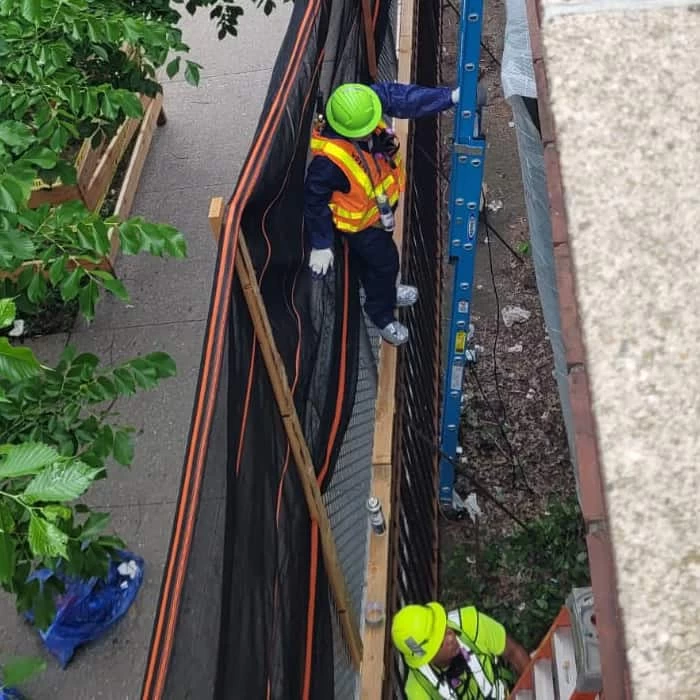
From there, industrial drying equipment is set up and monitored over the following days until moisture levels return to acceptable ranges. If the walls need to come open and in many cases they do we’re already licensed to handle what’s inside: mold, asbestos pipe insulation, lead-based joint compound. In Cooperative Village buildings, those aren’t edge cases. They’re common findings in structures of this age, and having a contractor who can address them without stopping the job is the difference between a two-week project and a two-month one.
Water Damage Restoration Service, Lower East Side Manhattan
Built for Cooperative Village Co-op Buildings, Not Suburban House Calls
Water damage restoration in Cooperative Village covers more ground than it does in most places, and that’s a function of the buildings themselves. Emergency water extraction and structural drying are the starting point. But because every building in this community predates 1980, the scope almost always extends further. Opening a wall in a 1953 East River Housing tower means working with materials that may include asbestos floor tiles, pipe insulation, and joint compound all of which require licensed abatement before restoration can continue. We handle that under the same contract, with no handoff to a separate company.
Our service also includes full moisture documentation written reports, thermal imaging results, and photographic records organized for both your personal HO-6 policy and your co-op’s master policy carrier. This matters because water damage in a Cooperative Village co-op building almost always raises the question of which policy applies, and that question gets answered by documentation, not by whoever argues loudest. Beyond that, debris removal from the job site is covered under our NYC BIC Trade Waste license a requirement that many restoration companies operating in this area simply don’t meet.
If mold is found during the process, we handle remediation in-house under the NYS DOL Mold license. No referrals, no delays, no second contractor to schedule. The job gets finished.
Who is responsible for water damage in a Cooperative Village co-op building?
This is one of the most common questions that comes up after a water damage event in a Cooperative Village co-op, and the honest answer is: it depends on where the leak originated. In Cooperative Village buildings, plumbing runs through shared stacks that serve every floor. If the source is within a common element a shared pipe, a roof drain, or building infrastructure maintained by the co-op corporation the corporation’s master policy is typically responsible. If the source is within your unit, your HO-6 policy applies.
The problem is that the source isn’t always obvious, especially in a high-rise where water can travel several floors before appearing. That’s why documentation of the damage origin matters so much. We can trace moisture migration with professional equipment and produce a written report showing exactly where the leak started, giving you the evidence you need whether you’re making a claim, disputing responsibility with a neighbor, or working with your co-op board to assign liability. Getting that documentation right from the beginning is far easier than trying to reconstruct it after the fact.
How fast does mold actually start growing after water damage in my apartment?
Mold can begin colonizing within 24 to 48 hours of water exposure and in the wall assemblies of a mid-century concrete high-rise, it often does so invisibly. The surface may look fine while moisture is trapped inside the wall cavity, feeding mold growth that won’t become visible for weeks. By the time you see discoloration or smell something off, the remediation scope has already grown significantly.
This is especially relevant in Cooperative Village buildings because the construction methods used in the 1950s concrete frames, older insulation materials, dense wall assemblies hold moisture longer than modern wood-frame construction. A contractor who only removes visible water and sets up fans without verifying internal moisture levels is leaving the problem half-solved. We use moisture meters and thermal imaging to confirm that wall assemblies are actually dry before anything gets closed back up, which is the only way to prevent mold from developing behind newly installed drywall.
Does my insurance cover water damage from a burst pipe in a co-op apartment?
In most cases, yes sudden and accidental water damage from a burst pipe is a covered event under a standard HO-6 co-op unit owner policy. What’s typically covered includes damage to your interior finishes, personal property, and the cost of restoration work within your unit. What’s not always covered is damage that resulted from long-term neglect or a slow leak that went unreported.
The key word is documentation. Insurance carriers want to see that the damage was sudden, that you responded promptly, and that the remediation was performed by a licensed contractor. In a Cooperative Village building, where the source of a leak may be in a neighboring unit or a shared building system, your adjuster will also want to see evidence of where the water originated because that determines whether your policy or the building’s master policy is the primary payer. We produce the kind of written, photographed, and moisture-mapped documentation that moves a claim forward instead of getting it stuck in back-and-forth with the carrier.
Can water damage restoration in Cooperative Village buildings uncover asbestos?
Yes, and it’s more common than most people expect. Every building in Cooperative Village was constructed before 1980, which means all of them are presumed under federal and New York State regulations to contain asbestos-containing materials. In practice, that includes floor tiles, pipe insulation, ceiling textures, and joint compound all materials that a water damage restoration job may disturb when walls are opened or flooring is replaced.
When asbestos-containing materials are identified or suspected, work in that area must stop until a licensed asbestos contractor performs testing and, if necessary, abatement. We hold the NYS DOL Asbestos license, which means we don’t have to pause the job and bring in a separate company. We handle it in-house, which keeps the timeline moving and eliminates the coordination problems that come with managing multiple contractors in a Cooperative Village co-op building where scheduling and building access are already tightly controlled.
Is Cooperative Village at higher flood risk than other parts of Manhattan?
Yes, meaningfully so. Cooperative Village sits directly west of FDR Drive along the East River waterfront one of the highest coastal flood-risk corridors in Manhattan. Hurricane Sandy sent a storm surge of over 14 feet past the Battery in 2012, and the Lower East Side waterfront, including the area around the East River Housing towers, was among the hardest-hit residential zones in the borough.
The city has acknowledged this risk with two major infrastructure investments: the Brooklyn Bridge-Montgomery Coastal Resilience project, currently under construction along the adjacent Two Bridges waterfront, and the $1.45 billion East Side Coastal Resiliency project, which completed its first section in October 2024 but won’t be fully operational until 2026. Until that system is in place, buildings in Cooperative Village remain exposed to storm surge, street flooding from heavy rainfall events, and the ongoing risk of water main failures like the documented break under FDR Drive that flooded streets near Catherine Slip and caused water discoloration in nearby buildings. Flood damage restoration is a real and recurring need here, not a theoretical one.
Why are there carpet cleaning companies showing up when I search for water damage restoration near me?
It’s a fair thing to notice. Several carpet and rug cleaning companies have created location-specific landing pages targeting searches like “water damage restoration Cooperative Village” but their actual scope of work is surface water extraction from rugs and carpets. That’s a very different service from licensed water damage restoration, and the gap matters significantly in a building like yours.
In a Cooperative Village co-op built in the 1950s, a complete water damage restoration job almost always involves moisture mapping inside wall assemblies, documentation for insurance and co-op board review, and the real possibility of mold or asbestos behind the walls. A carpet cleaner cannot legally perform mold remediation in New York State that requires a NYS DOL Mold license. They cannot handle asbestos-containing materials that requires a NYS DOL Asbestos license. And they cannot perform structural restoration work in a Manhattan building that requires an NYC General Contractor license. Hiring a company without those credentials doesn’t save money; it creates a situation where the job stops partway through and you’re left finding a second contractor to finish what the first one legally couldn’t.