When the Great South Bay Pushes Water Into Your Bay Shore Basement, You Need Someone There Now
Bay Shore’s location on the north shore of the Great South Bay means flooding here isn’t just possible it’s a recurring reality. We respond within the hour, bill your insurance directly, and handle everything from water extraction to full restoration. When a nor’easter pushes bay water into streets and basements overnight, that response time is the difference between a cleanup and a mold remediation project.
I needed a professional consultation explanation of procedure for safe removal of Asbestos in my apartment complex. Without having an account yet, I was very impressed with the caring, knowledgeable and generous advice offered by Jessica, and will look forward to doing business in the future. Thank you so much! I feel much more informed about a sometimes scary endeavor. Peace. Nancy Silva Mineola, NY.
Mia Munoz
Used this company to clean up some water flood in my house. They were fast and easy to work with.very professional, Would recommend to anyone!
Nini Valle
Great company, had a flood and they responded quickly and efficiently. Billed my insurance company directly. I highly recommend this company!
joe colapietro, jr
I had pipe freeze in my basement right before a snow storm and they made to within an hour to help start the clean up process. They we by our side throughout the entire process and even helped with the insurance company. They did such a great job with the cleanup, repair, remidiation, I contracted them to perform the repairs and finishes in the basement. They came with enough manpower and material to get the job done. Leo and Jessica were nothing but a pleasure to deal with!!
Cristian Arredondo c
I had some water damage in my home and Green Island was able to take care of my issue quickly and effectively. I am very pleased with the work they did. They responded quickly and were very professional.
Michael M
Outstanding service! From the office to the field crew everyone was friendly, helpful and responsive. I highly recommend Green Island Group.
What a Properly Dried Basement Actually Means for Your Home
Most homeowners think a flooded basement is fixed when the water is gone. It’s not. The real damage the kind that costs you more later is what stays behind in the walls, under the subfloor, and inside the insulation after everything looks dry on the surface. In Bay Shore, where the Great South Bay keeps ambient humidity elevated and many homes were built in the 1950s and 60s, that hidden moisture has ideal conditions to become a mold problem fast.
Mold can begin colonizing within 24 to 48 hours of a flooding event. You can’t see it forming inside a wall cavity. You won’t smell it until it’s already spread. And by the time it’s visible, you’re no longer dealing with a water cleanup you’re dealing with a remediation project that costs significantly more and takes significantly longer.
When flooded basement cleanup is done right, you get a basement that’s structurally dry confirmed with moisture meters and thermal imaging, not just a visual check. You get documentation our insurance adjuster can work with. You get the peace of mind that the job was actually finished, not just started and handed off.
Licensed Basement Flooding Remediation in Bay Shore
Every License Required. One Company. One Call.
We’ve been handling restoration work across Long Island and New York City for over 12 years, with more than 5,000 completed projects across the state. In Suffolk County including Bay Shore and the surrounding Town of Islip communities we hold the General Contractor license, the NYS DOL Mold certification, NYS DOL Asbestos certification, and USEPA Lead credentials required to handle whatever a flooded basement uncovers.
That last part matters more in Bay Shore than people realize. A lot of homes here were built before 1980. When water gets into walls and floors have to come up, there’s a real chance you’re dealing with asbestos floor tiles, pipe insulation, or lead paint. Most water damage companies aren’t licensed for that. We are.
We’re also an approved emergency response contractor for the NYS Office of General Services independently vetted by New York State to respond to public emergencies. That same standard applies to every residential job we take on in Bay Shore.
From the First Call to a Dry, Documented, Restored Basement
When you call, someone answers not a voicemail, not a callback queue. We dispatch within the hour, around the clock. In Bay Shore, where a nor’easter can push Great South Bay water into streets and basements overnight, that response time isn’t a selling point. It’s the difference between a cleanup and a mold remediation.
Once on-site, the first step is assessing the water source and category. That matters more than most people know. Water from a sump pump failure is handled differently than water that came in from outside during a storm surge event, and both are handled differently than a sewage backup which is a Category 3 contamination event requiring licensed environmental handling, containment, and proper disposal. Bay Shore’s aging municipal drainage infrastructure makes sewage backup a real possibility during heavy rain events, and it’s not something a shop vac and bleach can legally or safely address.
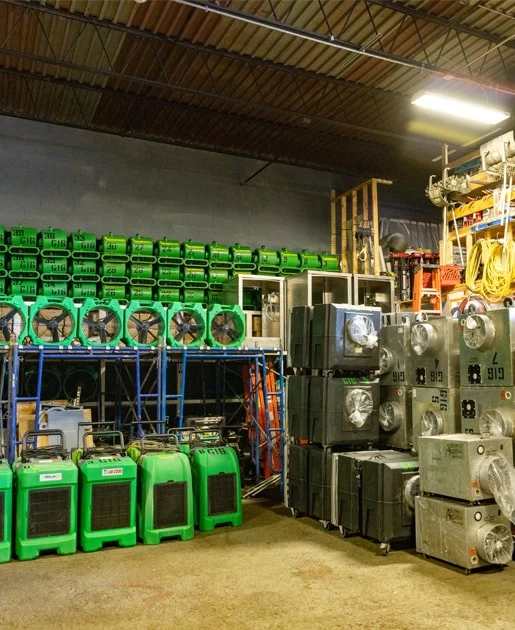
After extraction, industrial drying equipment goes in calibrated dehumidifiers, air movers, and monitoring sensors that track moisture levels in real time. Thermal imaging identifies saturation hiding inside walls before it becomes a mold colony. Nothing gets signed off until the readings confirm structural dryness. If there’s mold, asbestos, lead, or structural damage, we handle it under the same contract no subcontractors, no handoffs, no gaps in accountability. And throughout the entire process, we’re documenting everything your insurance carrier needs to process the claim.
Built for South Shore Homes, Not Generic Restoration Checklists
Bay Shore’s flooding profile is specific. You’re on the north shore of the Great South Bay, in a community where Category 1 hurricane storm surge models show inundation of the immediate south shore and where Superstorm Sandy put this exact stretch of the South Shore underwater in 2012. The flooded basement cleanup service we provide here is built around that reality, not a one-size-fits-all template.
Every job starts with water extraction and a full moisture assessment using thermal imaging and calibrated meters because in a mid-century Bay Shore home, the water you can see is rarely the whole story. From there, the scope is determined by what’s actually present: Category 1 clean water, Category 2 grey water, or Category 3 sewage contamination. Each requires a different protocol, different equipment, and in the case of Category 3, licensed environmental handling that most contractors in this market simply aren’t equipped to provide.
If mold is found or if conditions indicate it will form we hold NYS DOL Mold licensure and follow the requirements of NYS Article 32, which mandates a licensed assessor and a separate licensed remediator for any mold project over 10 square feet. If the work requires permits from the Town of Islip Building Department, our Suffolk County General Contractor license covers that too. And if the water disturbed asbestos-containing materials in your pre-1980 Bay Shore home, we’re licensed to handle that without bringing in a third party.
Does homeowners insurance cover flooded basement cleanup in Bay Shore, NY?
It depends on the source of the water, and that distinction matters a lot in Bay Shore. Standard homeowners insurance typically covers sudden and accidental water damage like a burst pipe or a sump pump that failed without warning. It generally does not cover flooding from outside sources, including storm surge from the Great South Bay or heavy rainfall that overwhelms the ground and enters through foundation walls. That type of flooding is typically only covered by a separate flood insurance policy through the National Flood Insurance Program (NFIP).
Many Bay Shore homeowners carry both policies, especially those in FEMA-designated Special Flood Hazard Areas which cover a meaningful portion of the community given its Great South Bay frontage. The coverage gap between the two policies is where claims get complicated. We document the damage thoroughly from the moment we arrive, identify the water source, and communicate directly with your adjuster so the claim is filed correctly and completely. If you’re unsure what your policies cover, that conversation is worth having before you need it but if your basement is already flooded, call first and sort the insurance details while our team is on-site.
How quickly does mold grow after a basement floods in Bay Shore?
Mold can begin colonizing within 24 to 48 hours of a flooding event and in Bay Shore, where ambient humidity is naturally elevated due to the proximity of the Great South Bay, those conditions are even more favorable for rapid mold growth. The critical window is the first 72 hours. If professional drying equipment isn’t running within that timeframe, the probability of mold forming inside wall cavities, under flooring, and in insulation increases significantly.
The reason this matters beyond the health concern is financial. A flooded basement that’s professionally dried within the response window is a water damage claim. A flooded basement where mold has already established itself is a water damage claim plus a mold remediation project and that can add thousands of dollars to the total cost. It also complicates the insurance process, because adjusters can identify evidence of delayed mitigation. Getting someone there fast isn’t just about convenience. It’s about keeping the scope of the job and the cost from expanding while you wait.
What's the difference between water extraction and actually drying out a basement?
Water extraction removes the standing water. Drying the basement is an entirely separate process, and it’s the one that most DIY attempts miss. Once the visible water is gone, moisture remains absorbed into concrete, drywall, wood framing, insulation, and subfloor materials. You can run a box fan for a week and still have wall cavities that are saturated enough to grow mold.
Professional drying uses industrial dehumidifiers and air movers calibrated to achieve specific air exchange rates in the space. More importantly, it uses thermal imaging cameras and moisture meters to find saturation that isn’t visible behind drywall, under flooring, inside wall assemblies. In a Bay Shore home with a mid-century build, those hidden moisture pockets are common, because older construction methods used materials that absorb and hold water differently than modern building products. The job isn’t done when the floor feels dry. It’s done when the readings confirm structural dryness throughout the affected area and that confirmation is documented for your insurance file.
Is sewage backup in my Bay Shore basement treated differently than regular flooding?
Yes significantly. Sewage backup is classified as Category 3 water, which means it’s grossly contaminated and carries bacteria, pathogens, and waste that pose real health risks. It cannot be treated the same way as a burst pipe or rainwater intrusion, and in most cases it cannot legally be handled by a contractor without proper environmental licensing and OSHA-compliant protocols.
In Bay Shore, sewage backup is a real risk during heavy rainfall events. The community’s municipal stormwater and sewer infrastructure was largely built in the mid-20th century, and during significant storms, aging drain systems can be overwhelmed and push sewage back through basement floor drains. When that happens, the affected materials flooring, drywall, insulation, anything porous that came into contact with the water typically need to be removed and disposed of properly, not just dried. The space requires antimicrobial treatment and containment during the cleanup process. Our environmental licensing covers Category 3 events fully, which is not something every restoration company in this market can say.
My Bay Shore home was built in the 1960s. Does that change anything about basement flood cleanup?
It does, and it’s worth knowing before work starts. Homes built before 1980 in Bay Shore frequently contain asbestos-containing materials pipe insulation, floor tiles, ceiling tiles, and joint compound were all common applications. They may also have lead-based paint on walls and trim. Under normal conditions, these materials aren’t a hazard. But when a basement floods and walls have to come out, flooring has to be removed, or pipe insulation gets disturbed by water damage, those materials become a potential exposure risk and a regulatory issue.
Most water damage contractors are not licensed to handle asbestos or lead. If they encounter these materials and continue working without proper protocols, they can create a liability problem for the homeowner and a health risk for everyone in the building. We hold NYS DOL Asbestos certification and USEPA Lead and RRP certification so if the work uncovers either material in your Bay Shore home, we can handle it legally and safely without stopping the job to bring in a separate contractor. It keeps the project moving and keeps you protected.
How does Green Island Group handle the insurance claim process for basement flooding?
We bill insurance directly and manage the documentation and adjuster communication on your behalf. That means you’re not responsible for compiling damage reports, tracking down moisture readings, or explaining the scope of work to your carrier our team handles that as part of the job.
In Bay Shore, where many homeowners carry both a standard homeowners policy and a separate NFIP flood insurance policy, the claims process can get complicated quickly. The two policies cover different water sources, have different deductibles, and are handled by different adjusters. Having a contractor who understands the distinction and who documents the damage in a way that supports both claims accurately can be the difference between a fully paid claim and a partial one. From the moment we arrive on-site, everything is documented: water source, category, affected materials, moisture readings, thermal imaging results, and remediation steps. That paper trail exists for your protection, not just as a formality.