When the Bay Pushes Back, Your Basement Pays the Price
Brookhaven homes sit between the Great South Bay and the Carmans River and when a storm hits, that geography matters. We respond fast, handle everything, and get your basement back to normal before the damage compounds.
I needed a professional consultation explanation of procedure for safe removal of Asbestos in my apartment complex. Without having an account yet, I was very impressed with the caring, knowledgeable and generous advice offered by Jessica, and will look forward to doing business in the future. Thank you so much! I feel much more informed about a sometimes scary endeavor. Peace. Nancy Silva Mineola, NY.
Mia Munoz
Used this company to clean up some water flood in my house. They were fast and easy to work with.very professional, Would recommend to anyone!
Nini Valle
Great company, had a flood and they responded quickly and efficiently. Billed my insurance company directly. I highly recommend this company!
joe colapietro, jr
I had pipe freeze in my basement right before a snow storm and they made to within an hour to help start the clean up process. They we by our side throughout the entire process and even helped with the insurance company. They did such a great job with the cleanup, repair, remidiation, I contracted them to perform the repairs and finishes in the basement. They came with enough manpower and material to get the job done. Leo and Jessica were nothing but a pleasure to deal with!!
Cristian Arredondo c
I had some water damage in my home and Green Island was able to take care of my issue quickly and effectively. I am very pleased with the work they did. They responded quickly and were very professional.
Michael M
Outstanding service! From the office to the field crew everyone was friendly, helpful and responsive. I highly recommend Green Island Group.
Mold can begin to establish itself within 24 to 48 hours of a flooding event. In a humid, coastal environment like Brookhaven’s South Shore, that window can be even tighter. Every hour your basement stays wet, the scope of the problem grows, and so does the cost of fixing it. The goal isn’t just removing the water. It’s stopping what comes next.
For homes in Brookhaven hamlet, that urgency is real in a specific way. This is a coastal floodplain community. The Great South Bay sits at your southern boundary, the Carmans River runs along the east, and the water table here stays high year-round. When a nor’easter rolls through or a summer storm drops eight inches in a day the way one did in August 2024, triggering a Suffolk County Disaster Emergency basements in this area don’t just get damp. They flood fast, and they flood with water that may have traveled through ground, storm drains, or worse.
There’s also what’s inside the walls to think about. Roughly 71% of homes in the hamlet were built before 1980. That means your basement’s insulation, floor tiles, or pipe wrap may contain asbestos or lead. When that material gets wet and disturbed, you need more than a shop vac and a dehumidifier. You need a contractor licensed to handle it and most aren’t.
Basement Flooding Remediation Experts, Suffolk County
Licensed for the Whole Job Not Just the Easy Part
We’ve been handling environmental restoration and remediation across Long Island and New York City for over 12 years, with more than 5,000 completed projects behind us. Our CEO Jessica Dussan and VP Leo Torres run the operation directly and our names show up in customer reviews because we’re actually involved, not just on the website.
What sets us apart in a market like Brookhaven isn’t just experience. It’s the licensing stack. NYS DOL Asbestos, NYS DOL Mold, USEPA Lead, USEPA RRP, Suffolk County General Contractor these aren’t checkboxes. They’re the reason we can legally and safely handle a flooded basement in an older South Shore home without stopping the job when something hazardous turns up. Most water damage companies operating in this area can’t say the same.
We’re also a NYS-certified MBE and WBE, and an approved emergency response contractor for the NYS Office of General Services the same state-level vetting used for public disaster response. For a community that’s watched storm surges come in off the bay and flood the streets around Squassux Landing, that credential means something.
No Guesswork Here's What Actually Happens on the Job
The first call starts the clock. We operate 24/7, and response times are measured in minutes, not business days. When our crew arrives, we assess the source and category of the water first because bay surge or storm drain overflow coming into a Brookhaven basement is Category 3 contaminated water, and it requires a completely different protocol than a burst pipe. That distinction matters for your health, for your insurance claim, and for what gets saved versus removed.
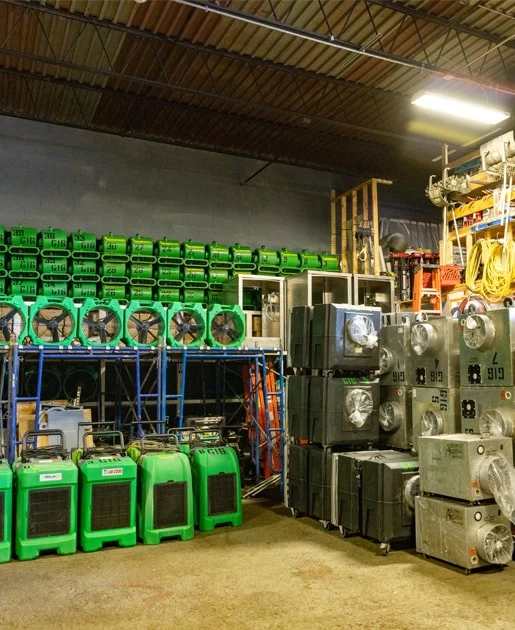
Once the water is extracted, we deploy industrial drying equipment air movers, dehumidifiers, and moisture meters to track what’s happening inside walls and under flooring, not just on the surface. Thermal imaging can identify hidden moisture that would otherwise turn into a mold problem weeks later. In homes built before 1980, we test materials before removal. If asbestos or lead is present, it’s handled under proper containment and disposed of legally no shortcuts.
From there, we apply antimicrobial treatment, remove damaged materials, and build the documentation for your insurance claim in real time. If reconstruction is needed and a floodplain development permit is required by the Town of Brookhaven which applies to many homes in the hamlet’s coastal flood zones our Suffolk County General Contractor license covers that too. One contractor, start to finish.
What's Included When Brookhaven's Conditions Demand More
Flooded basement cleanup in Brookhaven isn’t a one-size-fits-all job. The combination of coastal flood exposure, older housing stock, and a persistently high water table means the work here regularly goes deeper than basic extraction and drying. We’re built for that.
Every job we handle includes water extraction, structural drying with professional-grade equipment, moisture monitoring throughout the process, antimicrobial treatment, and full insurance documentation. When contaminated water is involved storm surge, sewage backup, or outside floodwater we handle the job under OSHA-compliant containment protocols with licensed disposal. That’s not standard practice for most restoration companies working in Suffolk County. It is for us.
For pre-1980 homes which represent the majority of properties in the hamlet material testing is part of our scope before anything gets torn out. If asbestos or lead is found, we continue remediation under the appropriate NYS and USEPA licenses without subcontracting or delays. And if post-flood reconstruction brings your home into floodplain development permit territory under the Town of Brookhaven’s Flood Damage Prevention ordinance, we handle that process as well. We bill insurance directly. Multiple customers have specifically called that out in reviews it’s not a promise, it’s how the job runs.
Does homeowner's insurance cover flooded basement cleanup in Brookhaven, NY?
It depends on the source of the water and this is where a lot of Brookhaven homeowners get caught off guard. Standard homeowners insurance typically covers sudden, internal water damage like a burst pipe or a failed water heater. It does not cover flooding from outside sources, which includes storm surge from the Great South Bay, ground saturation from the Carmans River overflowing, or water entering through foundation walls during a heavy rain event.
For that type of damage, you’d need a separate flood insurance policy typically through the National Flood Insurance Program (NFIP). Given that much of the hamlet sits in a documented coastal floodplain, many Brookhaven homeowners carry both policies. The challenge is that navigating two separate claims simultaneously, with two different adjusters and two different coverage scopes, adds real stress to an already difficult situation. We handle insurance documentation and bill directly so you’re not managing that paperwork on top of everything else.
How fast does mold actually start growing after a basement floods?
Mold can begin to establish itself within 24 to 48 hours of a flooding event and in a humid, coastal environment like Brookhaven’s South Shore, that window can be even tighter. The combination of warm summer temperatures, high ambient humidity off the bay, and the moisture already present in older building materials creates near-ideal conditions for mold growth. Waiting to “see if it dries out on its own” is one of the most common mistakes homeowners make, and it’s also one of the most expensive.
What makes this worse in older homes is that mold doesn’t just grow on visible surfaces. It gets behind drywall, under flooring, and into insulation places you won’t see until the smell shows up or the air quality test comes back. By that point, what could have been a $3,000 to $5,000 cleanup has become a significantly larger remediation job. The best thing you can do after a basement flood is get professional extraction and drying started as quickly as possible. That’s exactly why we operate around the clock.
My Brookhaven home was built in the 1960s does that change anything about the cleanup?
Yes, and it’s one of the most important questions you can ask. Homes built before 1980 which accounts for the majority of properties in the hamlet of Brookhaven commonly contain asbestos in pipe insulation, floor tiles, ceiling tiles, and some drywall compounds. Lead-based paint is also prevalent in walls, trim, and window frames of homes from this era. Under normal conditions, these materials are generally stable. But when a basement floods and materials get wet, swollen, or physically disturbed during cleanup, they can release hazardous particles.
Most water damage companies are not licensed to handle asbestos or lead. If they encounter it during a job, they either stop work and leave you to find a separate contractor, or worse they proceed without the proper licensing and create a liability and a health hazard. We hold NYS DOL Asbestos and USEPA Lead certifications, which means we can legally identify, contain, and remediate those materials as part of the same job. No stopping, no subcontracting, no gap in the work.
Do I need a permit to repair my basement after a flood in Brookhaven?
Possibly, and it’s worth knowing before work starts rather than after. The Town of Brookhaven maintains a Flood Damage Prevention ordinance that applies to properties in designated FEMA flood zones. If your home is in one of those zones and a meaningful portion of the hamlet’s developed areas are any reconstruction work involving the basement or lowest floor may require a floodplain development permit from the town. That permit comes with specific requirements, including elevation standards relative to base flood elevation.
This isn’t a bureaucratic technicality. It’s a requirement that affects how reconstruction is designed and executed. A contractor without a Suffolk County General Contractor license can’t legally navigate that permitting process on your behalf. We hold that license and handle the permitting side of post-flood reconstruction as part of the job scope. If you’re unsure whether your property falls within a flood zone, the Town of Brookhaven’s building department can confirm your designation, and we can walk you through what that means for the repair process.
What's the difference between water damage restoration and just drying out a basement?
Drying out a basement means removing standing water and running some fans. Water damage restoration means verifying that the structure is actually dry inside the walls, under the slab, behind the framing and that no secondary damage like mold, structural compromise, or contamination has been left behind. These are not the same thing, and the difference matters significantly in a home that’s been exposed to coastal floodwater.
Professional restoration follows the IICRC S500 standard, which includes moisture monitoring with meters and thermal imaging, not just surface-level drying. It also involves categorizing the water source because Category 3 contaminated water from storm surge or sewage backup requires antimicrobial treatment, proper containment, and licensed disposal that basic drying simply doesn’t address. In Brookhaven, where flooding events frequently involve water that’s traveled through saturated coastal soils or compromised drainage infrastructure, cutting corners on the restoration process creates problems that show up months later in air quality, in structural integrity, and in your home’s resale value.
How much does flooded basement cleanup typically cost in Brookhaven, NY?
Most flooded basement cleanups fall somewhere between $2,000 and $8,000, with the average landing around $4,000 to $5,000 for a small to mid-sized basement with moderate water damage. What drives the cost higher in Brookhaven specifically is the nature of the flooding. Storm surge or ground saturation events involve contaminated water that requires a more involved protocol than a clean-water pipe burst. Add in the age of the housing stock if asbestos or lead materials need to be tested and remediated and the scope expands accordingly.
The most important cost factor to understand is timing. Delaying cleanup by even 48 to 72 hours can add $2,000 to $8,000 or more in mold remediation costs on top of the base restoration bill. What starts as a manageable cleanup becomes a much larger job once mold establishes itself behind walls or under flooring. Most homeowners with flood coverage through NFIP or standard homeowners insurance will have the majority of eligible costs covered, and we bill insurance directly so the out-of-pocket experience is simpler than most people expect going in.