When Centerport's Harbor Humidity Gets Into Your Basement, Every Hour Counts
Mold starts growing within 24 to 48 hours of a flood. We respond fast, document everything, and handle your insurance so your Centerport home gets fully restored, not just dried out.
I needed a professional consultation explanation of procedure for safe removal of Asbestos in my apartment complex. Without having an account yet, I was very impressed with the caring, knowledgeable and generous advice offered by Jessica, and will look forward to doing business in the future. Thank you so much! I feel much more informed about a sometimes scary endeavor. Peace. Nancy Silva Mineola, NY.
Mia Munoz
Used this company to clean up some water flood in my house. They were fast and easy to work with.very professional, Would recommend to anyone!
Nini Valle
Great company, had a flood and they responded quickly and efficiently. Billed my insurance company directly. I highly recommend this company!
joe colapietro, jr
I had pipe freeze in my basement right before a snow storm and they made to within an hour to help start the clean up process. They we by our side throughout the entire process and even helped with the insurance company. They did such a great job with the cleanup, repair, remidiation, I contracted them to perform the repairs and finishes in the basement. They came with enough manpower and material to get the job done. Leo and Jessica were nothing but a pleasure to deal with!!
Cristian Arredondo c
I had some water damage in my home and Green Island was able to take care of my issue quickly and effectively. I am very pleased with the work they did. They responded quickly and were very professional.
Michael M
Outstanding service! From the office to the field crew everyone was friendly, helpful and responsive. I highly recommend Green Island Group.
What a Complete Cleanup Actually Means for Your Centerport Home
Most cleanup jobs stop at the surface. The floor gets dried, a fan gets set up, and someone hands you a report. But if you’re in one of Centerport’s older bungalows on the west side of the harbor homes built in the 1930s, 40s, and 50s what’s behind the walls and under the floor matters just as much as what you can see. Moisture hides in insulation, in subfloor cavities, in the spaces between old framing. If it stays there, mold follows. And in Centerport’s coastal environment, where ambient humidity from Huntington Bay and Long Island Sound is already elevated, that timeline moves faster than it does inland.
A real cleanup means thermal imaging to find hidden moisture, industrial drying equipment that pulls water from inside the structure not just the surface and a full mold assessment before the job is called done. It also means knowing what you’re dealing with before anyone starts tearing things apart. Pre-1980 homes in this area frequently contain asbestos pipe insulation and lead paint. Disturbing those materials without the right licensing isn’t just a liability issue it’s a health risk. That’s the difference between a company that handles water and a company that handles everything water brings with it.
When the job is done right, you’re not just dry. Your home is documented, cleared, and back to where it was with no hidden damage waiting to surface six months from now during a home inspection or a sale.
Licensed Basement Flood Remediation, Centerport NY
12 Years, 5,000+ Jobs, One Company That Handles It All
We’ve been doing environmental restoration work across Long Island and New York City for over 12 years. More than 5,000 completed projects. The kind of track record that only comes from doing the work consistently and doing it right. Our CEO Jessica Dussan and VP Leo Torres are directly involved in operations their names show up in independent customer reviews because they’re actually accountable for what happens on every job, not just the ones that go smoothly.
For Centerport specifically, that matters. This is a community with real stakes median home values above $770,000, property taxes over $10,000 a year, and a housing stock that ranges from waterfront colonials near the peninsula to mid-century bungalows on the west side of the harbor. We hold a Suffolk County General Contractor license, NYS DOL Mold and Asbestos certifications, USEPA Lead and RRP certifications, and are an approved emergency response contractor for the New York State Office of General Services. That’s not a list of credentials for the sake of it it’s the specific combination required to legally handle what a flooded basement in this area can involve.
From the First Call to a Fully Restored Basement Here's the Honest Walkthrough
It starts with the call. We operate 24 hours a day, 365 days a year, and the goal is always to have someone on-site within the hour. That response window isn’t arbitrary it’s built around the mold clock. The faster water is extracted and drying begins, the more of your home can be saved and the lower your total remediation cost ends up being.
Once on-site, our team does a full assessment before any work begins. That includes moisture readings, thermal imaging to locate water that’s migrated behind walls or into the subfloor, and a visual inspection for any signs of pre-existing mold or hazardous materials. In Centerport’s older housing stock, this step isn’t optional it determines what the job actually requires. If asbestos or lead-containing materials are present and have been disturbed by flooding, those need to be handled under specific NYS and EPA protocols before standard drying and restoration work can proceed. Skipping that step doesn’t make the problem go away; it just creates a bigger one later.
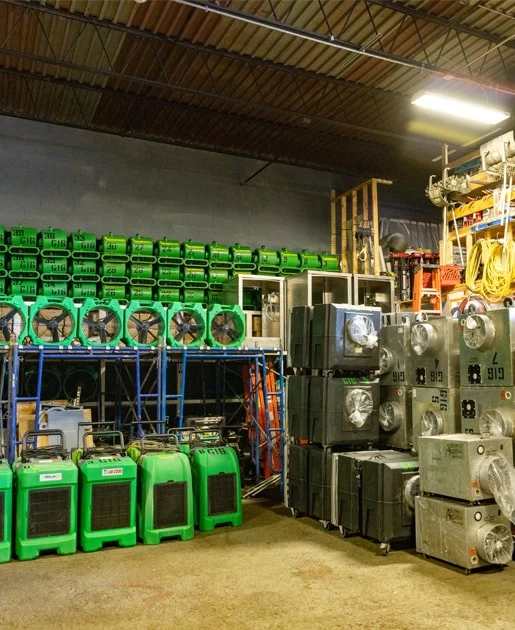
From there, industrial extraction equipment removes standing water, commercial-grade drying systems are placed throughout the affected area, and we monitor moisture levels daily until the structure reaches safe readings. Throughout the entire process, we document everything photos, moisture logs, material reports in the format your insurance carrier needs. We communicate with your adjuster directly and bill the carrier, so you’re not managing a claims process on top of managing a damaged home. Once the space is dry and cleared, reconstruction drywall, flooring, insulation, structural repairs is handled in-house under our Suffolk County General Contractor license. No handoffs, no waiting for a second company to become available.
Basement Flooding Remediation Services, Centerport NY
What's Included When Centerport Homes Need More Than a Dry-Out
Flooded basement cleanup in Centerport isn’t a one-size situation. A burst pipe in a newer construction home near Harborfields High School is a different job than a sewage backup in a 1940s bungalow on the west side of Centerport Harbor. Our scope covers both and everything in between.
Water extraction and structural drying is the foundation of every job. Beyond that, the scope expands based on what’s actually present: mold remediation under NYS DOL certification if growth is found or the conditions are right for it, asbestos assessment and abatement if pre-1980 materials have been disturbed, lead-safe work practices under USEPA RRP certification for homes built before 1978, and Category 3 sewage cleanup which requires full containment, decontamination, and proper disposal for backup events that involve blackwater. These aren’t add-ons. They’re the parts of the job that most companies can’t legally do themselves and quietly subcontract out, which creates gaps in liability and timeline that end up costing you more.
For Centerport homeowners dealing with sump pump failure during a nor’easter the kind of storm that knocked out power to over 4,200 homes here during Hurricane Sandy the situation can escalate quickly. Extended outages mean extended flooding, which means deeper saturation and a faster mold timeline. Our emergency response protocol is designed for exactly that scenario: rapid deployment, full documentation, and a clear path from water extraction through complete restoration, handled by one licensed team under one contract.
Does homeowners insurance cover flooded basement cleanup in Centerport, NY?
It depends on the source of the water, and that distinction matters more than most people realize. Standard homeowners insurance typically covers sudden, accidental water damage a burst pipe, a washing machine overflow, a water heater failure. It generally does not cover flooding from an external source, like storm surge or groundwater rising through your foundation. For that type of flooding, you’d need a separate flood insurance policy through FEMA’s National Flood Insurance Program, which has a 30-day waiting period before coverage kicks in meaning it needs to be in place well before a storm event.
The other piece that trips people up is documentation. Insurance carriers have specific requirements for how damage is recorded, what gets photographed, and how materials are categorized. A claim that’s poorly documented or where the cause of loss is described incorrectly can result in a reduced payout or a denial. We handle the documentation and adjuster communication directly, which removes that risk and keeps the process moving without you having to manage it on top of an already stressful situation.
How quickly does mold start growing after a basement floods in Centerport?
Mold can begin colonizing within 24 to 48 hours of water exposure and that timeline is not forgiving. In Centerport specifically, the ambient humidity from Huntington Bay and Long Island Sound creates conditions that are already more favorable to mold growth than what you’d find in an inland community. That means the clock moves faster here, particularly in the summer months when temperatures are higher and moisture levels are elevated.
The other factor is where the water goes. Standing water on a concrete floor is visible and easier to address. Water that migrates into wall cavities, under subfloor materials, or into insulation is not visible and if it isn’t found and dried out completely, mold can establish itself in those spaces and continue growing long after the surface appears dry. That’s why moisture readings and thermal imaging matter on every job, not just the ones with obvious visible damage. Finding the water you can’t see is often the difference between a clean remediation and a recurring mold problem.
What's the difference between water mitigation and full basement water damage restoration?
Mitigation is the emergency phase stopping the damage from getting worse. That includes water extraction, placing drying equipment, and stabilizing the environment. It’s critical and it needs to happen fast, but it’s not the whole job. Restoration is everything that comes after: repairing or replacing the materials that were damaged, addressing any mold or environmental hazards that were found, and returning the space to its pre-loss condition.
The reason this distinction matters is that some companies only do one or the other. A mitigation-only company extracts the water and leaves. A restoration company handles the rebuild. When those are two separate contractors, you end up with scheduling gaps, liability questions between the two parties, and a longer overall timeline. We handle both under one roof mitigation through full reconstruction which keeps the process cleaner, faster, and under one point of accountability from start to finish.
My Centerport home was built in the 1950s does flooding create an asbestos or lead risk?
Yes, and it’s worth taking seriously. Homes built before 1980 and there are quite a few of them on the west side of Centerport Harbor, where the original summer bungalows were converted to year-round residences over the decades commonly contain asbestos in pipe insulation, floor tiles, and joint compound, as well as lead-based paint on walls, trim, and window components. When flooding occurs, it can disturb these materials: saturating floor tiles, compromising pipe insulation, or causing wall surfaces to deteriorate.
Once those materials are disturbed, you’re no longer dealing with just a water problem. NYS DOL requires a licensed asbestos contractor to handle any abatement work, and USEPA’s RRP rule requires certified contractors for any renovation work that disturbs lead paint in pre-1978 homes. A standard water damage company that isn’t licensed for this work legally cannot touch those materials which means either they skip it and leave you with an unaddressed hazard, or they subcontract it and you’re waiting on a second company. We hold both the NYS DOL Asbestos certification and USEPA Lead and RRP certifications, so this is handled in-house as part of the same job.
How much does flooded basement cleanup typically cost in Suffolk County?
For most residential basement flooding events, the range runs from roughly $2,000 on the low end for a straightforward water extraction and drying job, up to $8,000 or more when mold remediation, material replacement, or structural repairs are involved. If environmental hazards like asbestos or lead are present and need to be addressed which is a real possibility in Centerport’s older housing stock costs can go higher depending on the scope.
The single biggest cost driver is timing. Every hour that water sits in a structure increases saturation depth, raises the likelihood of mold growth, and expands the scope of what needs to be remediated. A job that costs $3,000 if addressed within the first 12 hours can become a $10,000 or $15,000 job if it sits for 72 hours. Getting a licensed team on-site quickly is genuinely the most cost-effective decision you can make in the first hours after a basement floods, regardless of what your final insurance settlement looks like.
What should I do in the first hour after my basement floods in Centerport?
The first thing is safety. If there’s standing water near your electrical panel, outlets, or any appliances, don’t go into the basement until the power has been shut off at the breaker and if you’re not certain it’s safe, don’t go in at all. Water and live electricity in the same space is the most immediate risk, and it’s not worth the exposure.
Once it’s safe to be in the space, call a licensed remediation company before you do anything else. Resist the urge to start mopping, running a shop vac, or pulling up flooring on your own. Moving water around without proper extraction equipment can spread contamination especially if the flooding involves any sewage backup, which is a real possibility during heavy rain events when Centerport’s older residential sewer lines get overwhelmed. It also makes it harder to document the original scope of damage for your insurance claim, which can affect your payout. Take photos of everything as it is, note when the flooding started and what you think caused it, and let the remediation team do the assessment before anything is moved or removed. That documentation is the foundation of your insurance claim, and getting it right from the start matters.