When East Farmingdale's Drains Back Up, Your Basement Pays the Price
Flat terrain, aging infrastructure, and South Shore storm seasons are a bad combination for basements in this area. We respond 24/7, handle your insurance directly, and clean up the whole thing start to finish.
I needed a professional consultation explanation of procedure for safe removal of Asbestos in my apartment complex. Without having an account yet, I was very impressed with the caring, knowledgeable and generous advice offered by Jessica, and will look forward to doing business in the future. Thank you so much! I feel much more informed about a sometimes scary endeavor. Peace. Nancy Silva Mineola, NY.
Mia Munoz
Used this company to clean up some water flood in my house. They were fast and easy to work with.very professional, Would recommend to anyone!
Nini Valle
Great company, had a flood and they responded quickly and efficiently. Billed my insurance company directly. I highly recommend this company!
joe colapietro, jr
I had pipe freeze in my basement right before a snow storm and they made to within an hour to help start the clean up process. They we by our side throughout the entire process and even helped with the insurance company. They did such a great job with the cleanup, repair, remidiation, I contracted them to perform the repairs and finishes in the basement. They came with enough manpower and material to get the job done. Leo and Jessica were nothing but a pleasure to deal with!!
Cristian Arredondo c
I had some water damage in my home and Green Island was able to take care of my issue quickly and effectively. I am very pleased with the work they did. They responded quickly and were very professional.
Michael M
Outstanding service! From the office to the field crew everyone was friendly, helpful and responsive. I highly recommend Green Island Group.
There’s a difference between a basement that looks dry and a basement that is dry. Water hides in wall cavities, under flooring, inside insulation and if it stays there, mold follows within 24 to 48 hours. By the time you smell it, you’re already dealing with a much bigger problem than the original flood.
East Farmingdale sits on a flat glacial outwash plain, and that geography matters. When heavy rain overwhelms the storm drains along Route 110 or backs up through municipal lines in residential neighborhoods, the water that enters your basement isn’t just rainwater it’s Category 2 or Category 3 contaminated water that requires proper extraction, containment, and treatment. A shop vac and a few box fans won’t cut it.
A significant portion of homes in East Farmingdale were built between the 1940s and 1960s, which means there’s a real chance your basement contains asbestos floor tiles, pipe insulation, or lead-based paint. When flooding disturbs those materials, the cleanup stops being a water removal job and becomes an environmental one. Most water damage companies operating in this market aren’t licensed to handle that. We are and that distinction protects both your home and your family.
Licensed Basement Flooding Remediation, East Farmingdale
Every License This Job Could Possibly Require We Hold Them
We’ve been doing restoration work across Long Island and New York City for over 12 years, with more than 5,000 completed projects across the state. We hold NYS DOL Mold and Asbestos licenses, USEPA Lead and RRP certifications, and General Contractor licenses in Suffolk County, Nassau County, and New York City. We’re also a certified NYS MBE and WBE, and an approved emergency response contractor through the New York State Office of General Services which means the state has independently vetted us, not just our marketing.
For East Farmingdale specifically, that licensing stack matters more than it might in other towns. The older housing stock throughout the Town of Babylon the Cape Cods, hi-ranches, and colonials built decades before modern environmental regulations means flooded basements here can reveal hazards that require more than a water damage technician. We handle the full scope, from emergency extraction through complete reconstruction, without handing your job off to someone else halfway through.
Flooded Basement Cleaning Process, East Farmingdale NY
No Handoffs, No Guesswork Here's Exactly What We Do
When you call, we dispatch immediately 24 hours a day, every day of the year, including during active storms. Our crews arrive with industrial extraction equipment, moisture meters, and thermal imaging cameras. The thermal imaging is important: it shows us where water has migrated behind walls or under flooring that looks dry on the surface. What you can’t see is usually what causes the mold problem three weeks later.
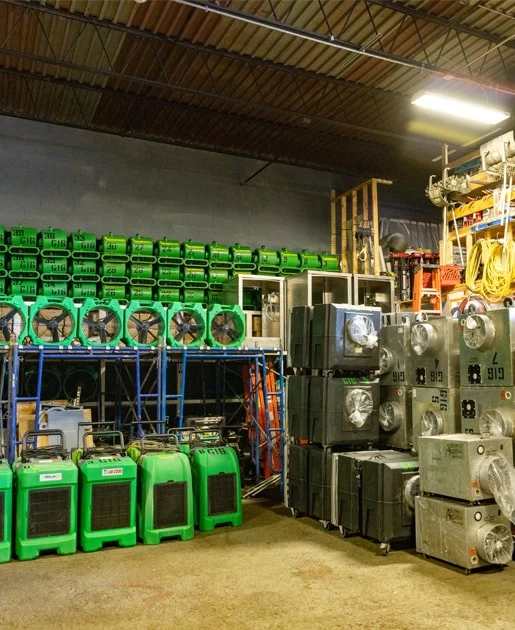
Once extraction is complete, we set up professional drying equipment not household fans and monitor moisture levels scientifically until the space meets dry standard. If we find asbestos-containing materials or lead paint that the flooding has disturbed, we handle that under our NYS DOL and USEPA licenses before any reconstruction begins. This matters in East Farmingdale, where a large portion of homes predate federal hazmat regulations by decades. Permits for any structural reconstruction are pulled through the Town of Babylon Building Division, and we manage that process for you.
Throughout the job, we document everything photos, moisture readings, scope of work and we communicate directly with your insurance carrier. You don’t have to figure out whether your homeowners policy, your NFIP flood policy, or your sewer backup rider applies. We handle that conversation and make sure the damage is documented in a way that supports your claim.
Basement Flooding Remediation Services, East Farmingdale NY
From Storm Drain Backup to Fully Restored One Company Does It All
Flooded basement cleanup in East Farmingdale covers a lot of ground depending on how the water got in and what it touched. Storm drain backups along the Route 110 corridor, sump pump failures during nor’easters, frozen pipe bursts in winter, and groundwater infiltration through aging foundation walls are all common scenarios here and each one requires a different response. We assess the water source first, because the category of water determines the entire cleanup protocol.
From there, the work includes water extraction, structural drying, antimicrobial treatment, odor control, and moisture verification. If materials need to come out drywall, flooring, insulation we remove them safely, with proper containment if hazardous materials are present. If asbestos or lead is identified in a pre-1980 home, that abatement happens under licensed protocols before anything else moves forward. We don’t skip that step to save time, because cutting corners there creates liability for you long after we’re gone.
Once the space is clean, dry, and cleared, we can handle full reconstruction under our Suffolk County General Contractor license. New drywall, flooring, framing, whatever the basement needs to be fully functional again. The goal is that you end up with one point of contact, one contract, and a finished basement not a series of contractors you have to coordinate yourself while dealing with an insurance claim.
Does homeowners insurance actually cover basement flooding in East Farmingdale, NY?
It depends on how the water got in, and this is where a lot of East Farmingdale homeowners get surprised. Standard homeowners insurance typically covers sudden and accidental water damage like a pipe that bursts or a washing machine that overflows. What it usually does not cover is flooding from outside the home, meaning groundwater that rises and seeps through your foundation walls or storm drain backup that pushes water in through floor drains.
For that type of flooding, you’d need either a separate flood insurance policy through FEMA’s National Flood Insurance Program or a sewer and drain backup rider on your homeowners policy. Many Long Island homeowners have one but not the other, and some have neither. The good news is that we handle insurance documentation and billing directly, so we can help you understand what your specific policy covers before the work begins. We document the damage in a way that supports your claim and communicate with your adjuster so you don’t have to navigate that process alone while your basement is still wet.
How quickly does mold start growing after a basement floods?
Mold can begin developing within 24 to 48 hours of a flooding event and that clock starts the moment water contacts porous materials like drywall, wood framing, carpet, or insulation. It doesn’t wait for the water to fully recede. In a basement that stays humid and warm, you can have active mold growth before the space even looks or smells like a problem.
This is why response time matters as much as it does on South Shore Long Island. East Farmingdale’s flat terrain means water spreads quickly across a basement floor and wicks laterally into walls faster than most homeowners expect. The longer extraction is delayed, the more material gets saturated, and the more expensive the remediation becomes. A job that costs $3,000 to $5,000 if addressed within the first few hours can escalate to $8,000 to $15,000 or more once mold has established itself in wall cavities and subfloor material. Getting someone there fast isn’t just about convenience it’s the single biggest factor in controlling your total cost.
My East Farmingdale basement flooded from a storm drain backup is that different to handle?
Yes, and it’s an important distinction. Storm drain backup water is classified as Category 2 or Category 3 contaminated water under IICRC industry standards, depending on the source. That means it can contain bacteria, sewage, and other contaminants that make it genuinely unsafe to handle without proper protective equipment and containment protocols. It’s not the same as a clean water pipe burst, and it can’t be treated the same way.
This specific flooding scenario is well-documented in the Farmingdale area. When heavy rain overwhelms the municipal stormwater system particularly along the Route 110 corridor and in older residential sections of East Farmingdale that backed-up water enters basements through floor drains, sump pits, and foundation cracks. Cleaning it up properly means full extraction, antimicrobial treatment of all affected surfaces, removal of any porous materials that absorbed contaminated water, and verification that no residual contamination remains. If that process is skipped or done incompletely, the health risk to your household doesn’t disappear just because the water does.
My home was built in the 1950s should I be worried about asbestos in my flooded basement?
It’s a legitimate concern, and one that’s more relevant in East Farmingdale than in newer suburban communities. Homes built before 1980 and a large portion of the housing stock throughout the Town of Babylon falls into that category commonly contain asbestos in floor tiles, pipe insulation, joint compound, and ceiling texture. Lead-based paint is also common in homes from that era. When flooding disturbs those materials, whether by saturating floor tiles, damaging insulated pipes, or requiring drywall removal, those hazards can become active.
The problem is that most water damage contractors are not licensed to handle asbestos or lead. They’ll either ignore it, which creates a liability for you, or stop work entirely and tell you to hire someone else. We hold NYS DOL Asbestos and USEPA Lead certifications, which means we can legally assess, contain, and abate those materials as part of the same job without you having to coordinate a separate contractor or wait for another company to come out before restoration can continue. If you’re in an older home and your basement has flooded, having one licensed company handle the full scope is not just more convenient, it’s the safer approach.
How much does flooded basement cleanup typically cost in East Farmingdale?
The honest answer is that it varies, and anyone who gives you a flat number before seeing the space is guessing. That said, most residential flooded basement cleanups in the East Farmingdale area fall somewhere between $2,000 and $8,000 for water extraction, drying, and basic remediation on a small to medium basement. If mold has already developed, add another $2,000 to $8,000 depending on the extent. If hazardous materials like asbestos or lead are involved which is a real possibility in pre-1980 homes throughout the Town of Babylon that adds cost as well.
What drives cost up more than anything else is delay. Every hour water sits in a basement, it’s saturating more material, spreading further, and creating better conditions for mold. A job that’s addressed within the first few hours is almost always cheaper than the same job addressed 24 or 48 hours later. The other major cost variable is reconstruction if walls, flooring, or structural elements need to come out and be replaced, that’s a separate scope from the remediation itself, though we handle both under our Suffolk County General Contractor license. Getting an on-site assessment is the only way to get a number that actually means something.
What should I do the moment I discover my basement is flooding?
The first thing is to cut power to the basement if you can do so safely and without entering standing water electricity and water in the same space is a serious hazard. If the water is still actively coming in and you can identify a source like a burst pipe, shut off the water main. Don’t enter the basement if the water is deep or if you’re not sure whether the electrical panel has been compromised.
Once you’re safe, call a professional immediately not tomorrow morning, not after you’ve tried to shop vac it yourself. In East Farmingdale, where storm drain backups and sump pump failures during nor’easters are common enough that local homeowners have dealt with this more than once, the instinct to handle it yourself is understandable. But contaminated water, hidden moisture, and the 24-to-48-hour mold window make DIY cleanup genuinely risky both for your health and your home’s long-term condition. Document what you can with photos before anything is moved or touched that documentation matters for your insurance claim. Then let a licensed crew handle the extraction, drying, and assessment. The faster that process starts, the better your outcome and the lower your total cost.