When Your West Hills Basement Floods, Every Hour Counts
Mold starts growing in 24 hours. We respond to West Hills emergencies fast and handle everything from water extraction to full reconstruction under one roof.
I needed a professional consultation explanation of procedure for safe removal of Asbestos in my apartment complex. Without having an account yet, I was very impressed with the caring, knowledgeable and generous advice offered by Jessica, and will look forward to doing business in the future. Thank you so much! I feel much more informed about a sometimes scary endeavor. Peace. Nancy Silva Mineola, NY.
Mia Munoz
Used this company to clean up some water flood in my house. They were fast and easy to work with.very professional, Would recommend to anyone!
Nini Valle
Great company, had a flood and they responded quickly and efficiently. Billed my insurance company directly. I highly recommend this company!
joe colapietro, jr
I had pipe freeze in my basement right before a snow storm and they made to within an hour to help start the clean up process. They we by our side throughout the entire process and even helped with the insurance company. They did such a great job with the cleanup, repair, remidiation, I contracted them to perform the repairs and finishes in the basement. They came with enough manpower and material to get the job done. Leo and Jessica were nothing but a pleasure to deal with!!
Cristian Arredondo c
I had some water damage in my home and Green Island was able to take care of my issue quickly and effectively. I am very pleased with the work they did. They responded quickly and were very professional.
Michael M
Outstanding service! From the office to the field crew everyone was friendly, helpful and responsive. I highly recommend Green Island Group.
A Dry Basement Isn't Enough Here's What Complete Restoration Looks Like for West Hills Homes
Water in your basement is one problem. What it leaves behind is another. Once the visible water is gone, moisture hides inside wall cavities, beneath subfloors, and behind the drywall in finished spaces the kind of hidden damage that turns a manageable cleanup into a mold remediation six weeks later. Getting the water out is step one. Knowing what came with it is the whole job.
In West Hills, that second part matters more than most people realize. The homes here were built predominantly between the late 1940s and 1969 the era of asbestos pipe wrap, asbestos floor tile adhesive, and lead paint. When floodwater moves through a West Hills basement of that age, it doesn’t just damage drywall. It can disturb materials that require licensed environmental handling. Most water damage companies operating in the area aren’t equipped for that. They extract the water and leave. What happens next is your problem.
When we clear a West Hills basement, the job doesn’t end at dry. Moisture readings are documented throughout the drying process, hidden dampness is found with thermal imaging, and if hazardous materials are present, they’re handled by the same crew under the same contract not handed off to a separate company you have to find yourself. You get one point of contact from the first pump to the final inspection, and documentation your insurance adjuster can actually use.
Licensed Basement Flood Cleanup Company West Hills
5,000 Projects In. Still Answering Our Own Phones.
Green Island Group has been handling environmental restoration and remediation across New York State for over 12 years, with more than 5,000 completed projects. CEO Jessica Dussan and VP Leo Torres are reachable by name not through a franchise call center routing your emergency to whoever’s available that night. When customers in West Hills leave reviews, they mention Jessica and Leo by name. That’s not an accident. It’s how we operate.
New York State has independently vetted Green Island Group as an approved emergency response contractor through the NYS Office of General Services. That’s not a self-declared credential it’s a public record that required documented licensing, insurance, and operational capability to earn. No competitor currently serving West Hills holds that status.
The licensing stack matters here specifically. West Hills homes built in the post-war era carry real hazmat risk when they flood. We hold NYS DOL Asbestos, NYS DOL Mold, USEPA Lead, and USEPA RRP certifications alongside General Contractor licenses in Suffolk County, Nassau County, and NYC. That means one company can legally and safely take your West Hills basement from flooded to finished no gaps, no handoffs, no surprises mid-project.
Basement Flooding Remediation Process West Hills NY
What Actually Happens After You Call Us at 2 AM in West Hills
You call, someone answers. Not a voicemail. Not a callback promise. A real person who takes your information and dispatches a crew. We operate 24/7/365, and customers in West Hills have confirmed in real reviews that crews arrive within the hour including during storm events. Given that the Town of Huntington has dealt with documented basement flooding events significant enough to temporarily waive its street pumping prohibition, fast response in this area isn’t a marketing line. It’s the difference between a manageable cleanup and a mold problem.
When the crew arrives, the first step is assessment not just how much water is present, but what kind. Clean water from a burst pipe is handled differently than sewage backup from an overwhelmed lateral line, and both are handled differently than groundwater seepage through a foundation wall. In West Hills, where homes sit on hilly terrain that channels runoff toward foundations during heavy rain, and where the housing stock is old enough to carry asbestos and lead risk, that initial assessment shapes everything that follows. If hazardous materials are identified, the job doesn’t stop it expands to include licensed abatement under the same contract.
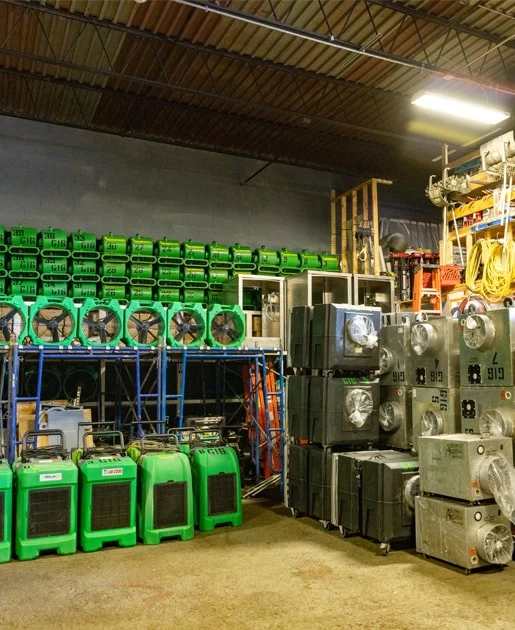
From there, extraction, structural drying, and moisture documentation proceed in sequence. Industrial dehumidifiers and air movers run until readings confirm the space is genuinely dry not just visually dry. If mold is found, we handle remediation in-house under our NYS DOL Mold license. If reconstruction is needed, our Suffolk County General Contractor license covers it. Your insurance carrier is billed directly, with documentation prepared throughout the process so your claim moves forward without you having to chase your adjuster.
Built for What West Hills Basements Actually Throw At You
A flooded basement in a 1950s or 1960s West Hills home is not the same job as a flooded basement in newer construction. The older homes here colonials, ranches, splits, and capes built on what was once the Otto Kahn estate carry a specific risk profile that requires specific licensing. Our scope of work covers the full range: water extraction, structural drying, mold remediation under NYS DOL Mold certification, asbestos abatement under NYS DOL Asbestos certification, lead-safe renovation under USEPA Lead and RRP certifications, and full reconstruction under the Suffolk County General Contractor license. That’s the complete sequence, handled by one company.
Sewage backups are treated as the Category 3 hazmat events they legally are proper containment, PPE, and disposal, not just disinfectant and a fan. For West Hills homes on aging lateral sewer lines, this distinction matters during heavy rain events that overwhelm the municipal system.
Every job includes moisture documentation with thermal imaging, insurance-grade reporting, and direct billing to your carrier. For homeowners carrying policies on properties valued above $1 million which describes much of the West Hills real estate market that documentation isn’t optional. It’s what protects your claim and your investment. You’re not left managing paperwork while your basement is still drying.
Does basement flooding in West Hills typically involve more than just water removal?
In many cases, yes and the age of the West Hills housing stock is the main reason. The dominant homes here were built between the late 1940s and 1969, which puts them squarely in the era of asbestos-containing building materials and lead paint. When floodwater saturates a basement in a West Hills home of that age, it can disturb pipe wrap insulation, floor tile adhesive, or wall materials that require licensed environmental handling before any drying or reconstruction work can safely proceed.
This isn’t a worst-case scenario it’s a realistic one for a significant portion of West Hills homes. Most water damage companies are not licensed to identify or handle those materials. We hold NYS DOL Asbestos, USEPA Lead, and USEPA RRP certifications, which means if hazardous materials are present, the job doesn’t stop while you search for a second contractor. The assessment happens upfront, and the scope expands to cover whatever is actually there.
How quickly does mold start growing after a basement floods?
Mold can begin growing within 24 to 48 hours of a flooding event. That window is not forgiving, and it’s one of the reasons response time matters as much as it does. A basement that sits wet for three or four days even if the standing water is eventually removed has likely already created conditions for mold growth behind drywall, inside wall cavities, and beneath flooring materials where air circulation is limited.
In a finished West Hills basement, that’s particularly relevant. Many of the larger colonials and split-levels in this area have finished lower levels used as living space, home offices, or recreation rooms. Those finished surfaces trap moisture and hide mold growth far more effectively than an unfinished utility basement would. We use thermal imaging to locate hidden moisture that visual inspection misses, and moisture readings are documented throughout the drying process both to confirm the space is genuinely dry and to support your insurance claim with objective data. Waiting to see if it dries on its own is how a manageable cleanup becomes a $10,000 to $15,000 mold remediation.
Will my homeowners insurance cover flooded basement cleanup in New York?
It depends on the cause of the flooding, and the distinction matters. Most standard homeowners insurance policies in New York cover sudden and accidental water damage a burst pipe, a failed water heater, a sump pump failure but they typically do not cover flooding from external sources like groundwater or surface water intrusion, which requires a separate flood insurance policy. Sewage backup coverage is also usually a separate rider, not included by default.
For West Hills homeowners, sump pump failure is one of the more common causes of basement flooding particularly during the summer storm events that hit the Town of Huntington. If your policy includes sump pump or water backup coverage, that event is likely covered. The documentation your insurance adjuster needs moisture readings, photos, scope of work, cause of loss is exactly what we prepare throughout every job. Direct insurance billing means your carrier is billed directly, and we handle communication with the adjuster so the claim process doesn’t fall entirely on you while the cleanup is still underway.
What causes basement flooding in West Hills, and is it a recurring problem?
West Hills has a specific flooding profile that sets it apart from other Long Island communities. The hamlet sits on elevated, hilly terrain Jayne’s Hill in West Hills County Park reaches 400 feet, making it the highest natural point on Long Island and that terrain channels significant surface runoff toward residential foundations during heavy rain events. Homes built on the lower slopes and valley areas carry particular vulnerability to foundation seepage and surface water intrusion when the ground is already saturated.
Groundwater pressure is another consistent factor. Suffolk County’s glacial geology creates a relatively shallow water table in many areas, and extended wet seasons push that table upward against basement walls and floors. For homes built in the 1940s through 1960s before modern waterproofing standards that hydrostatic pressure finds every crack and joint in the foundation. Add sump pump failure during a power outage, which frequently coincides with the same storms causing the flooding, and you have a scenario that repeats across West Hills every wet season. The August 2024 storm event that prompted the Town of Huntington to temporarily waive its street pumping prohibition is one documented example of how significant and widespread that flooding can be.
What's the difference between water mitigation and water restoration, and do I need both?
Water mitigation is the emergency phase stopping the damage from getting worse. That includes water extraction, removing saturated materials, and setting up drying equipment to bring moisture levels down as quickly as possible. Restoration is what comes after: repairing or replacing what was damaged, which can range from drywall and flooring to full structural reconstruction depending on how extensive the damage was and how long the water sat.
In practice, most flooded basements in West Hills require both. The mitigation phase needs to move fast within the first 24 to 48 hours to prevent mold growth and limit structural damage. The restoration phase follows once the space is confirmed dry and any hazardous materials have been addressed. Because we hold both environmental remediation licenses and a Suffolk County General Contractor license, both phases are handled under one contract. You’re not finishing the emergency work and then starting over with a separate contractor who has no context for what was found during mitigation. The job moves forward as a single continuous process, which saves time and reduces the chance that something gets missed in the handoff.
How much does flooded basement cleanup typically cost in West Hills, NY?
The range is wide because the variables are wide. A straightforward water extraction and drying job in a smaller, unfinished basement might run $2,000 to $3,500. A more involved cleanup in a finished basement with structural drying, mold remediation, and partial reconstruction typically falls in the $5,000 to $8,000 range. If hazardous materials like asbestos or lead are identified and require licensed abatement, that adds to the scope and the cost, though it also adds to what your insurance claim may cover.
For West Hills specifically, the age of the housing stock means the higher end of that range is a realistic possibility in many homes. A 1950s or 1960s West Hills basement that floods has a meaningful chance of involving materials that require licensed environmental handling and cutting corners on that to save money upfront creates liability and health risk that costs far more to address later. The more useful number to focus on is what your insurance covers, which is why we prepare detailed documentation from the start and bill your carrier directly. Most homeowners in this area end up paying far less out of pocket than the total project cost once the claim is properly documented and submitted.