I needed a professional consultation explanation of procedure for safe removal of Asbestos in my apartment complex. Without having an account yet, I was very impressed with the caring, knowledgeable and generous advice offered by Jessica, and will look forward to doing business in the future. Thank you so much! I feel much more informed about a sometimes scary endeavor. Peace. Nancy Silva Mineola, NY.
Mia Munoz
Used this company to clean up some water flood in my house. They were fast and easy to work with.very professional, Would recommend to anyone!
Nini Valle
Great company, had a flood and they responded quickly and efficiently. Billed my insurance company directly. I highly recommend this company!
joe colapietro, jr
I had pipe freeze in my basement right before a snow storm and they made to within an hour to help start the clean up process. They we by our side throughout the entire process and even helped with the insurance company. They did such a great job with the cleanup, repair, remidiation, I contracted them to perform the repairs and finishes in the basement. They came with enough manpower and material to get the job done. Leo and Jessica were nothing but a pleasure to deal with!!
Cristian Arredondo c
I had some water damage in my home and Green Island was able to take care of my issue quickly and effectively. I am very pleased with the work they did. They responded quickly and were very professional.
Michael M
Outstanding service! From the office to the field crew everyone was friendly, helpful and responsive. I highly recommend Green Island Group.
One Contractor Handles It All — No Stops, No Handoffs
Here’s what most property owners in East Garden City find out the hard way: their demolition contractor isn’t licensed to touch what’s behind the walls. The project stalls. A second company gets called in. Weeks go by. We’re built to prevent exactly that. Assessment, abatement, and demolition happen under one contract, with one team accountable from start to finish.
The commercial and institutional buildings in East Garden City — many of them built on the former Mitchel Air Force Base campus in the 1950s through 1970s — were constructed during the peak years of asbestos use. Pipe insulation, floor tiles, fireproofing compounds, ceiling materials — it’s common in buildings of that era. When your project is in or around the Mitchel Field complex, near Nassau Community College, or anywhere along the Old Country Road corridor, the probability of encountering asbestos-containing materials is high. You need a contractor who can handle it legally, not one who stops the job when something turns up.
For the residential neighborhoods surrounding East Garden City — Uniondale, East Meadow, Carle Place — the story is the same. Homes built in the postwar boom years routinely contain hazardous materials. A gut kitchen renovation or a basement buildout in a 1960s ranch isn’t just a demolition job. It’s an environmental project that requires licensed abatement before a single wall comes down. When you hire us, that’s already included.
Licensed Where It Counts, Experienced Where It Matters
We are a full-service demolition and environmental contracting company serving East Garden City, Long Island, and the greater New York metro area. We hold a NYS Department of Labor Asbestos Handling Contractor License — the credential required by law to legally disturb, remove, and dispose of asbestos-containing materials in New York State. That’s not a marketing claim. It’s a legal requirement, and most contractors in this market don’t have it.
East Garden City sits in the Town of Hempstead, which means permits flow through the Town of Hempstead Building Department — not a village office, not Nassau County directly. We know that process. We know what documentation is required, how to pull the permit correctly, and what inspections need to happen before and after the work. For commercial clients managing a retail buildout near Roosevelt Field or a facility renovation at one of the Mitchel Field office parks, that kind of operational fluency isn’t a bonus. It’s the baseline.
With a 4.7-star rating built on reviews that consistently name specific staff members, our service record speaks for itself.
What Actually Happens From First Call to Final Walkthrough
It starts with a site assessment. Before any work begins, we evaluate the structure — what’s there, what needs to come out, and whether hazardous materials are present. In East Garden City’s commercial and institutional building stock, this step is especially important. Buildings from the Mitchel Field era often contain asbestos in places that aren’t obvious: inside HVAC systems, beneath floor tiles, wrapped around pipes. The assessment tells you exactly what you’re dealing with before you’re committed to anything.
Once the scope is clear, permitting comes next. Since East Garden City is an unincorporated hamlet in the Town of Hempstead, demolition permits are pulled through the Town of Hempstead Building Department. We handle that process — including utility disconnection verification, which is required before a permit is issued. You don’t have to navigate the building department on your own.
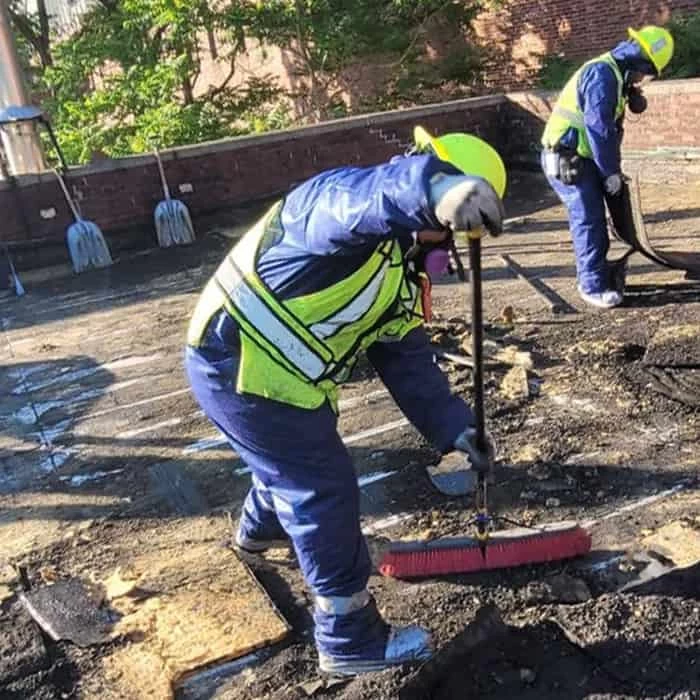
Then the work begins. If abatement is required, it happens first — materials are contained, removed, and disposed of with full chain-of-custody documentation. Demolition follows. When the job is done, you receive disposal manifests and clearance documentation that protects you at closing, satisfies future permit applications, and gives you a clean paper trail for whatever comes next. In Nassau County’s high-value real estate market, that documentation matters long after the crew is gone.
Commercial and Residential Demolition East Garden City
Built for East Garden City's Commercial Core and the Neighborhoods Around It
East Garden City is not a typical residential suburb. It’s the Nassau Hub — a commercial, institutional, and retail corridor that generates demolition demand at a scale most towns don’t see. Retail tenant turnover at Roosevelt Field and the surrounding Old Country Road strip means interior demolition work is constant. Office renovations in the Mitchel Field complex, facility upgrades at Nassau Community College, buildouts in the corporate parks along Stewart Avenue — this is the work we’re set up to handle. Commercial interior demolition in this environment requires scheduling coordination with property managers, compliance documentation that satisfies building management requirements, and a crew that can work within operational constraints without disrupting neighboring tenants.
On the residential side, the communities surrounding East Garden City — Uniondale, East Meadow, Carle Place — are full of homes built between the 1940s and 1970s. Gut renovations, pre-sale demolition, and post-storm remediation are the most common calls. Approximately 80 percent of homes in the New York metro area were built before 1978, which means lead paint and asbestos are the rule, not the exception. We handle both — testing, abatement, and demolition — so you’re not coordinating between multiple contractors or hoping the demo crew stops when they should.
Every project, commercial or residential, comes with the documentation you need: permits, disposal manifests, asbestos clearance certificates. That’s the job done right.
Do I need a permit for demolition work in East Garden City, NY?
Yes — and because East Garden City is an unincorporated hamlet within the Town of Hempstead, your permit comes from the Town of Hempstead Building Department, not a village office. This is a detail that trips people up, especially if they’ve done work in an incorporated village like Garden City or Westbury, which have their own building departments with separate processes. The Town of Hempstead requires a building permit before any demolition work begins, and part of that process involves verifying that utilities have been properly disconnected before the permit is issued.
The permit needs to be pulled in the contractor’s name — not the homeowner’s. If a contractor asks you to pull your own permit, that’s often a sign they’re not licensed to pull it themselves. We handle the permitting process as part of every project, including the documentation and inspection coordination that the Town of Hempstead requires. You don’t have to figure out the building department on your own.
What happens if asbestos is found during a demolition or renovation project?
Work stops until it’s handled — that’s the law. In New York State, only contractors holding a NYS Department of Labor Asbestos Handling Contractor License are legally permitted to disturb, remove, and dispose of asbestos-containing materials. If your demolition contractor doesn’t hold that license, they cannot legally proceed once asbestos is identified. That means the project goes on hold while you find a licensed abatement company, negotiate a new contract, and wait for their schedule to open up.
We hold the NYS DOL Asbestos Handling Contractor License. When asbestos turns up mid-project — and in East Garden City’s older commercial and residential building stock, it often does — the same team handles it. The abatement happens first, materials are removed and disposed of with full documentation, and demolition continues without the project going into limbo. For a retail tenant with a lease start date or a homeowner who’s already moved out, that continuity is worth a great deal.
How do I know if my East Garden City property has asbestos before demolition starts?
The most reliable way is a professional assessment before any work begins. Asbestos isn’t visible to the naked eye — it has to be sampled and tested by a qualified inspector. In East Garden City specifically, the risk is higher than many property owners realize. The commercial and institutional buildings developed on the former Mitchel Air Force Base campus in the 1950s through 1970s were built during the peak years of asbestos use. Pipe insulation, floor tiles, ceiling materials, HVAC insulation, and fireproofing compounds in buildings from that era routinely contain asbestos-containing materials.
For residential properties in the surrounding neighborhoods — Uniondale, East Meadow, Carle Place — homes built before 1978 carry a similar risk. An assessment before demolition begins tells you exactly what’s there, what needs to be abated, and what the project scope looks like before you’re committed to a contract. We can conduct that assessment and fold the abatement into the overall project if materials are found, so you’re not starting over with a new contractor.
What's the difference between interior demolition and full structural demolition?
Interior demolition means removing what’s inside a structure — walls, ceilings, flooring, fixtures, cabinetry — while leaving the building’s shell intact. This is the most common type of demolition work in East Garden City’s commercial corridor, where retail tenants turn over, office spaces get reconfigured, and institutional facilities get updated without tearing the whole building down. It’s also what most residential gut renovations involve: stripping a kitchen or bathroom down to the studs, or opening up a basement for a buildout.
Full structural demolition means taking the entire building down to the foundation. This comes up in residential contexts when a structure is beyond repair or when a property owner wants to start fresh, and in commercial contexts when a site is being redeveloped entirely. Both types of work require permits through the Town of Hempstead Building Department, and both require an assessment for hazardous materials before work begins. The scope of the abatement work — and the cost — depends on what the building contains and how much of it needs to come out.
How long does a demolition project typically take in East Garden City?
Timeline depends on the scope, the permitting process, and whether hazardous materials are involved. A straightforward interior demolition — one room, no asbestos, no lead complications — can often be completed in a day or two once permits are in hand. A larger commercial gut renovation or a full residential demolition with abatement involved will take longer, and the abatement phase has its own regulatory timeline: EPA NESHAP regulations require advance notification of at least ten working days before demolition begins on structures containing asbestos above threshold quantities.
The permitting process through the Town of Hempstead adds time at the front end, which is why it matters to work with a contractor who knows the process and can move through it efficiently. We handle permitting as part of the project, so you’re not losing weeks because paperwork was submitted incorrectly or documentation was missing. The clearest way to get an accurate timeline is to start with a site assessment — once the scope is defined, the schedule becomes much more predictable.
What documentation should I receive when a demolition project is complete?
At minimum, you should receive the closed building permit, asbestos clearance documentation if abatement was performed, and hazardous waste disposal manifests. The disposal manifest is the chain-of-custody record that tracks removed materials from your property to a licensed disposal facility. It’s the document that proves the work was done legally — not just that someone says it was. In Nassau County’s real estate market, where mean housing values in the East Garden City area exceed one million dollars, this documentation matters well beyond the day the crew leaves.
If you’re planning to sell the property, refinance, or apply for future permits, buyers’ attorneys and lenders increasingly ask for proof that any hazardous materials work was handled properly. A contractor who doesn’t provide disposal manifests and clearance certificates is leaving you exposed — because if questions come up later, the liability falls on the property owner, not the contractor. We provide complete post-project documentation as a standard part of every job, not as an add-on.