Brooklyn Manor's Pre-War Buildings Need More Than a Sledgehammer
When over half the neighborhood was built before 1939, demolition isn’t just breaking things down it’s knowing what’s inside the walls before you touch them. We handle the full scope: hazardous material assessment, licensed abatement, and demolition, so you’re not juggling three contractors to get one job done in Brooklyn Manor.
I needed a professional consultation explanation of procedure for safe removal of Asbestos in my apartment complex. Without having an account yet, I was very impressed with the caring, knowledgeable and generous advice offered by Jessica, and will look forward to doing business in the future. Thank you so much! I feel much more informed about a sometimes scary endeavor. Peace. Nancy Silva Mineola, NY.
Mia Munoz
Used this company to clean up some water flood in my house. They were fast and easy to work with.very professional, Would recommend to anyone!
Nini Valle
Great company, had a flood and they responded quickly and efficiently. Billed my insurance company directly. I highly recommend this company!
joe colapietro, jr
I had pipe freeze in my basement right before a snow storm and they made to within an hour to help start the clean up process. They we by our side throughout the entire process and even helped with the insurance company. They did such a great job with the cleanup, repair, remidiation, I contracted them to perform the repairs and finishes in the basement. They came with enough manpower and material to get the job done. Leo and Jessica were nothing but a pleasure to deal with!!
Cristian Arredondo c
I had some water damage in my home and Green Island was able to take care of my issue quickly and effectively. I am very pleased with the work they did. They responded quickly and were very professional.
Michael M
Outstanding service! From the office to the field crew everyone was friendly, helpful and responsive. I highly recommend Green Island Group.
What You Get When Demolition in Brooklyn Manor Is Done Right
Most demolition projects in Brooklyn Manor don’t fail because of the demolition itself. They fail because nobody accounted for what was already there. Asbestos floor tiles. Lead paint on every surface. Pipe insulation that hasn’t been touched since the Truman administration. When those materials get disturbed without proper handling, the project stops and the liability lands on you, not the contractor who missed it.
When the process is done correctly, you get a clean, permit-closed site that’s actually ready for the next phase of construction. No stop-work orders from the NYC Department of Buildings. No surprise abatement bills halfway through a gut renovation. No air quality violations that freeze your timeline for weeks.
Brooklyn Manor’s housing stock is almost entirely pre-war, and that changes what demolition looks like here compared to newer neighborhoods. The density matters too when you’re working in an attached building or a multi-family structure where other units are occupied, containment and sequencing aren’t optional extras. They’re the difference between a smooth project and a neighbor complaint that shuts everything down. Getting that right from day one is what actually moves the job forward.
One Company Handles What Most Contractors Hand Off
We’ve been working across Queens and Long Island for over 12 years. In that time, we’ve completed more than 340 demolition projects enough to know that the buildings throughout Brooklyn Manor and the Richmond Hill corridor come with their own set of challenges that generic contractors aren’t prepared for.
What makes the difference here isn’t just licensing, though that matters. It’s the fact that asbestos abatement, lead remediation, and structural demolition all happen under one contract. You’re not coordinating between an abatement company and a demo crew and a permit expediter. We hold NYC DOB licensing, NYS DOL compliance, and NYC DEP certification meaning we can legally handle every phase of the work and pull every permit required.
Our 4.7-star rating didn’t come from doing the easy jobs. It came from showing up on the hard ones the pre-war apartment gut renovations in Brooklyn Manor, the fire-damaged multi-family buildings, the projects where the first inspection turned up more than anyone expected and still delivering a clean, compliant result.
It starts before anyone picks up a tool. Under NYC Local Law 76, every renovation or demolition project in a building constructed before 1987 requires a mandatory asbestos investigation before a DOB permit can be issued. In Brooklyn Manor, that applies to virtually every building on every block. We coordinate the pre-demolition assessment with a DEP-Certified Asbestos Investigator, handle the compliance documentation, and submit the permit application all before work begins.
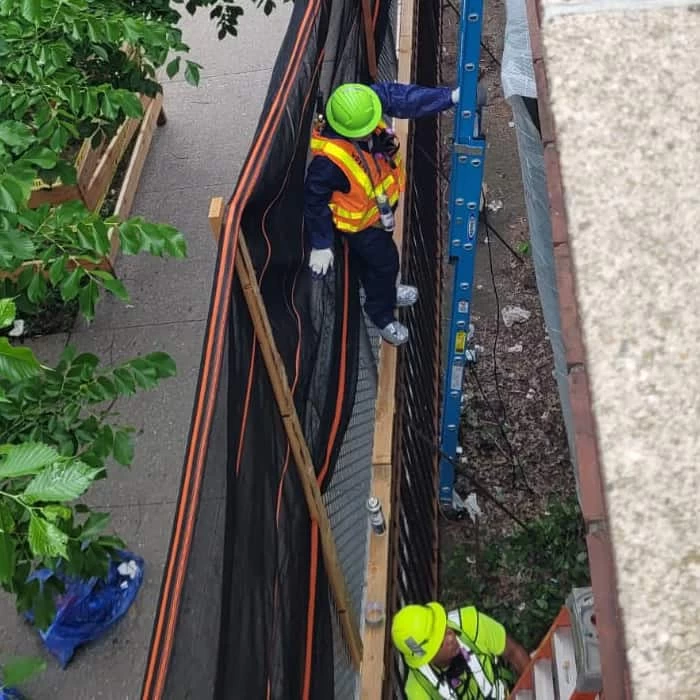
Once the assessment is complete and permits are in hand, the abatement phase comes first if hazardous materials are confirmed. That means licensed removal, proper containment, air monitoring, and disposal according to NYS Industrial Code Rule 56 and NYC DEP requirements. You don’t move forward until clearance is confirmed. This isn’t a formality it’s what keeps the project legal and keeps the people in adjacent units safe.
After clearance, demolition proceeds. In Brooklyn Manor’s dense, attached-building environment, that means careful structural sequencing, dust control, and protection of neighboring properties throughout the work. Debris is sorted, removed, and disposed of properly. When the site is clear, you get a clean, documented, permit-closed result ready for whatever comes next, whether that’s a full rebuild, a gut renovation, or a new construction project.
Residential and Commercial Demolition in Brooklyn Manor
Full-Scope Demo Built for Brooklyn Manor's Building Stock
We handle interior demolition, selective demolition, and full structural teardown but in a neighborhood where nearly every building predates World War II, the service always starts with what’s inside the walls. Pre-demolition hazardous material surveys, asbestos abatement, lead paint remediation, and mold removal are integrated into the scope, not added as afterthoughts when something turns up mid-project.
For residential work gut renovations of pre-war apartments, multi-family building upgrades, single-family attached homes throughout the Brooklyn Manor and Richmond Hill corridor the process is designed around the reality of occupied adjacent units and tight lot lines. Containment systems, air quality monitoring, and careful debris management are standard, not upgrades. For commercial work along Jamaica Avenue or in mixed-use buildings, the same regulatory compliance applies, with the added coordination that active commercial spaces require.
We offer emergency demolition 24 hours a day, 7 days a week. In aging multi-family buildings throughout Brooklyn Manor, a pipe burst or fire event can’t wait until Monday morning mold begins growing within 24 to 48 hours of water intrusion, and the damage compounds fast. We also bill insurance companies directly, which removes one significant burden from property owners who are already managing a stressful situation. From the first assessment to the final debris removal, the entire scope stays with one company.
Do I need an asbestos test before demolishing walls in Brooklyn Manor?
Yes and it’s not optional. Under NYC Local Law 76, any renovation or demolition project in a building constructed before 1987 requires a mandatory asbestos investigation before the NYC Department of Buildings will issue a permit. In Brooklyn Manor, where more than half the residential buildings were constructed before 1939, this requirement applies to virtually every project in the neighborhood.
The investigation has to be conducted by a DEP-Certified Asbestos Investigator not a general contractor, not a home inspector. If asbestos-containing materials are identified, licensed abatement must be completed and air clearance must be confirmed before demolition can proceed. Skipping this step doesn’t just create health risks; it exposes you as the property owner to stop-work orders, fines, and personal liability. We coordinate the entire assessment and compliance process as part of every project scope.
How do I get a demolition permit for a property in Queens, NY?
Demolition permits in Queens are issued by the NYC Department of Buildings, and the application process involves more than just filling out a form. The PW1 permit application requires documentation confirming whether asbestos abatement is required which means the pre-demolition hazardous material assessment has to happen first. If asbestos is present and abatement is needed, the permit won’t be issued until compliance is demonstrated.
Beyond the DOB permit, depending on the scope of work, you may also need to coordinate with NYC DEP for asbestos notifications and comply with USEPA NESHAP regulations for projects above certain material thresholds. For most property owners in Brooklyn Manor, navigating this multi-agency process alone is where projects get delayed or derailed. We handle all permit applications and regulatory notifications as part of the project you don’t need to become an expert in NYC environmental law to get your job done.
What happens if asbestos is found during a demolition project in Brooklyn Manor?
Work stops until it’s properly handled that’s the short answer. Under NYS Industrial Code Rule 56 and NYC DEP requirements, asbestos-containing materials have to be removed by licensed abatement contractors before demolition can continue. The abatement process involves setting up proper containment, removing the materials using approved methods, and conducting air monitoring throughout. Once the work is complete, a third-party air clearance test confirms the area is safe before anyone proceeds.
For property owners in Brooklyn Manor, finding asbestos mid-project is genuinely common given the age of the building stock. The difference between a manageable discovery and a project-killing delay is whether your contractor was prepared for it. When we scope a project, we account for the likelihood of hazardous materials in pre-war buildings and build the abatement process into the timeline from the start so a positive test result is a planned step, not an emergency.
Can a demolition contractor work in an occupied multi-family building in Brooklyn Manor, NY?
Yes, but it requires a specific approach that not every contractor is equipped to handle. In Brooklyn Manor’s dense residential environment where attached buildings and multi-family structures are the norm, not the exception demolition work in one unit or on one floor can directly affect neighboring units that are still occupied. That means containment barriers, negative air pressure systems, dust control protocols, and careful structural sequencing are all required to protect the people living next door or above and below the work area.
NYC DOB and DEP both have requirements governing how demolition and abatement work is conducted in occupied or partially occupied buildings. Beyond the regulatory requirements, there’s a practical reality: a complaint from an adjacent tenant or a neighboring property owner can result in a stop-work order that freezes the entire project. Our process in multi-family settings throughout Brooklyn Manor is built around protecting the people who live nearby which also happens to be what keeps the job moving without interruption.
How much does interior demolition typically cost in Queens, NY?
Interior demolition costs in Queens vary based on the size of the space, the scope of work, and critically in Brooklyn Manor whether hazardous materials are present. A straightforward interior gut of a single apartment unit might run anywhere from a few thousand dollars on the low end to significantly more once asbestos abatement, air monitoring, licensed disposal, and permit fees are factored in. Projects in pre-war buildings almost always require at least an asbestos assessment, and frequently require abatement, which adds to the total.
The more important thing to understand is what’s included in the quote you’re looking at. A low headline number that excludes the asbestos survey, abatement if needed, air clearance testing, debris disposal, and permits is not a real number it’s a starting point that will inflate mid-project. We provide comprehensive, itemized quotes that account for the full scope, including the regulatory requirements that are legally mandatory in Brooklyn Manor’s pre-1987 building stock. That transparency upfront is what prevents budget surprises later.
Does Green Island Group handle emergency demolition for fire or water damage in Brooklyn Manor?
Yes and response time genuinely matters in these situations. In Brooklyn Manor’s aging multi-family buildings, a pipe burst or fire event in one unit can spread damage to adjacent units within hours. Mold begins growing within 24 to 48 hours of water intrusion, and once it takes hold in walls and subfloor materials, what started as a water damage claim becomes a mold remediation project on top of everything else.
We operate 24 hours a day, 7 days a week for emergency demolition calls. We also bill insurance companies directly, which removes the administrative burden from property owners who are already managing a difficult situation. For landlords and property owners in Brooklyn Manor who are responsible for multi-unit buildings, having a contractor who can respond at any hour, handle the insurance billing, and manage the full scope from hazardous material compliance through debris removal is a meaningful difference from calling a general contractor who subcontracts the hard parts out.