IBM-Era Homes Deserve More Than a Generic Abatement Crew
A lot of Armonk’s older homes were built during the same decade IBM moved its headquarters to Route 22 and those homes are still carrying what was standard back then. We handle asbestos abatement in Armonk with the licensing, process, and documentation that actually protects your home, your family, and your sale.
I needed a professional consultation explanation of procedure for safe removal of Asbestos in my apartment complex. Without having an account yet, I was very impressed with the caring, knowledgeable and generous advice offered by Jessica, and will look forward to doing business in the future. Thank you so much! I feel much more informed about a sometimes scary endeavor. Peace. Nancy Silva Mineola, NY.
Mia Munoz
Used this company to clean up some water flood in my house. They were fast and easy to work with.very professional, Would recommend to anyone!
Nini Valle
Great company, had a flood and they responded quickly and efficiently. Billed my insurance company directly. I highly recommend this company!
joe colapietro, jr
I had pipe freeze in my basement right before a snow storm and they made to within an hour to help start the clean up process. They we by our side throughout the entire process and even helped with the insurance company. They did such a great job with the cleanup, repair, remidiation, I contracted them to perform the repairs and finishes in the basement. They came with enough manpower and material to get the job done. Leo and Jessica were nothing but a pleasure to deal with!!
Cristian Arredondo c
I had some water damage in my home and Green Island was able to take care of my issue quickly and effectively. I am very pleased with the work they did. They responded quickly and were very professional.
Michael M
Outstanding service! From the office to the field crew everyone was friendly, helpful and responsive. I highly recommend Green Island Group.
You stop guessing. That’s the most honest way to put it. Whether you found out during a renovation or a home inspection flagged something before closing, the anxiety of not knowing what’s in your walls or your floor tiles, or your ceiling is its own kind of burden. Once it’s properly removed and cleared, that weight is gone. You have documentation. You have proof. And you can move forward.
For Armonk homeowners specifically, that matters in a few concrete ways. The mid-century homes in and around the hamlet’s older streets the ranches and Colonials built during the 1960s and 70s when Armonk was growing fast were constructed during the peak years of asbestos use in American residential building. Floor tiles, pipe insulation, popcorn ceiling texture, joint compound these materials were standard. They’re still in a lot of homes here. And Armonk’s winters don’t help. The freeze-thaw cycles that hit northern Westchester every year accelerate the deterioration of older insulation and siding, making materials that were once stable increasingly fragile over time.
If you’re planning a renovation, preparing to list your home, or dealing with water damage that disturbed something it shouldn’t have, clearance documentation from a licensed contractor isn’t optional it’s what protects your investment in one of Westchester’s most valuable real estate markets. Buyers’ attorneys in this price range ask for it. Real estate agents expect it. And in the Byram Hills school district, where families move specifically for the community, health documentation in the home matters more than most sellers realize.
Green Island Group is a New York-based environmental remediation contractor with over 5,000 completed abatement projects across the metro area including throughout Westchester County and Armonk. Every project is handled in-house by our own licensed, individually certified crew. No subcontracting. No handoffs. The people who show up to your Armonk home are our employees who hold active NYS Department of Labor asbestos handler or supervisor certifications.
That distinction matters more than it might seem. Some contractors serving this area manage the process and coordinate through licensed subs which creates gaps in accountability that you don’t want on a job like this. We hold the full credential stack required for New York State work: NYS DOL Asbestos Handling License, EPA certification, and NYS DEC disposal compliance. We’re also M/WBE certified by the NYS Office of General Services and an approved contractor for New York State agencies a level of vetting that goes well beyond standard licensing.
Whether your project is a pre-sale abatement in Cedar Mills, a post-flood emergency in the historic town center, or a whole-home renovation uncovering materials in a 1968 Colonial off Old Route 22, we’ve handled it.
It starts with a free on-site inspection. One of our licensed team members comes to your property, walks through the areas of concern, and assesses the materials. If sampling is needed, we handle that too. You get a clear picture of what you’re dealing with before anyone asks you to commit to anything.
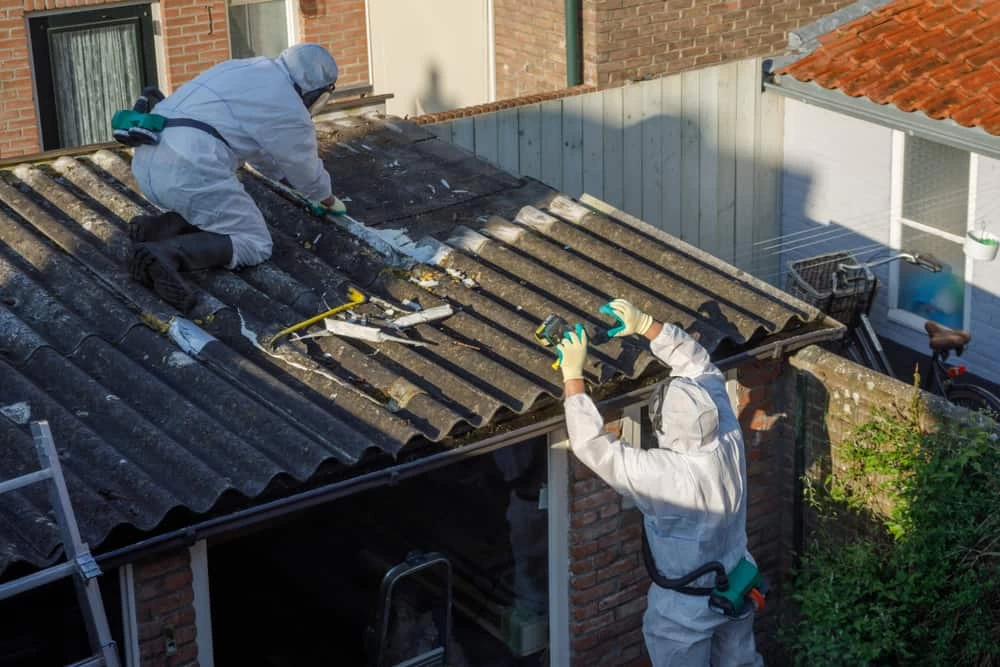
Once the scope is confirmed and the project is scheduled, we set up containment before any material is touched. That means polyethylene sheeting, negative air pressure systems, and HEPA-filtered air scrubbers the engineering controls that keep asbestos fibers isolated to the work zone and out of the rest of your home while the job is underway. For occupied homes in Armonk, this is not a minor detail. It’s the difference between a safe abatement and one that creates new exposure in the rooms your family is still using.
The removal itself follows NYS Industrial Code Rule 56, which is New York State’s asbestos abatement regulation and is more stringent than federal OSHA standards in several areas. All waste is bagged, labeled, and transported to a NYS DEC-approved disposal facility with a signed manifest maintained through the full chain of custody. After the work is complete, air clearance testing is conducted. You receive formal post-abatement clearance documentation the certified record that the job passed and the space is safe. That document is what your real estate attorney, your general contractor, and your insurance carrier will ask for, and it’s a standard deliverable on every project we complete.
Every Material Type. One Contractor. Full Documentation.
Armonk’s older housing stock tends to present asbestos in layers not just one material, but several, often discovered together during a renovation or inspection. We handle the full range of asbestos-containing materials found in Westchester County homes: vinyl asbestos floor tiles (the 9×9 and 12×12 tiles common in mid-century basements and kitchens), acoustic spray ceiling texture, pipe and duct insulation, drywall joint compound, roofing felt, and exterior transite siding. If a whole-home renovation in a 1970s Armonk Colonial turns up multiple material types across different rooms, we handle all of it under one project one scope, one set of documentation, one clearance certification at the end.
We also assess whether removal or encapsulation is the right call for your specific situation. Encapsulation sealing intact, non-friable materials so fibers can’t be released is an EPA-approved method that’s appropriate in certain conditions. We’ll tell you honestly which approach fits your material and your plans, not which one generates more work.
For Armonk homeowners dealing with water damage events a pipe burst during a freeze, a Nor’easter that got into the basement we work directly with insurance carriers and handle billing on your behalf. You’re already managing enough. If asbestos abatement is part of a larger restoration claim, we take the carrier coordination off your plate entirely.
Does my older Armonk home actually need asbestos testing before I renovate?
If your home was built before 1980, the honest answer is yes you should have it assessed before any renovation work disturbs the existing materials. New York State’s asbestos regulations don’t leave much room for assumption here. Under NYS Industrial Code Rule 56, renovation and demolition work that disturbs asbestos-containing materials requires a licensed contractor to handle the abatement. The problem is that you often don’t know what’s there until someone looks.
Armonk’s mid-century housing stock the ranches, split-levels, and Colonials built during the 1960s and 70s commonly contains asbestos in vinyl floor tiles, pipe insulation, ceiling texture, and joint compound. These materials aren’t always visible or obvious. A licensed inspection before your contractor starts demo work is the step that prevents a renovation from becoming a regulated abatement emergency mid-project. It’s also the step that keeps your general contractor’s timeline intact, because an unexpected asbestos discovery mid-demo can halt a job entirely until a licensed abatement crew steps in.
How much does asbestos removal typically cost for a home in Armonk, NY?
The range is wide because the scope varies significantly from project to project. A single-room asbestos tile removal in a basement might run $2,000 to $4,000. A larger project involving multiple material types pipe insulation, ceiling texture, and floor tiles across several rooms in a larger Armonk Colonial can reach $10,000 to $20,000 or more depending on square footage, material condition, and access.
What drives cost in Armonk specifically is the size and complexity of the homes here. Large-lot properties with finished basements, older HVAC systems, and multi-room mid-century construction tend to have asbestos in more locations than a smaller, simpler structure. The free on-site inspection we provide gives you an accurate scope and a real number before you commit to anything. There’s no charge for the assessment, and the estimate you receive will be itemized not a vague ballpark that changes once the job starts.
What asbestos-containing materials are most common in Armonk homes built in the 1960s and 70s?
The most frequently encountered materials in Armonk’s IBM-era homes are vinyl asbestos floor tiles particularly the 9×9 inch tiles common in basements, laundry rooms, and kitchens acoustic spray ceiling texture (commonly called popcorn ceiling), pipe and duct insulation on older heating systems, and drywall joint compound used throughout. Exterior transite siding and roofing felt are also found on homes from this period, though less commonly than the interior materials.
The challenge with these materials is that they’re not always in bad condition. Asbestos-containing materials that are intact and undisturbed are generally not an immediate health risk. The risk comes when they’re disturbed during a renovation, a repair, or a water damage event. A pipe burst in a 1965 Armonk ranch that soaks the original basement floor tiles is exactly the kind of event that turns a water damage claim into a mandatory abatement situation. Knowing what you have before something disrupts it is always the better position to be in.
Do I need to leave my Armonk home during asbestos abatement, and for how long?
For most residential abatement projects, yes you’ll need to vacate the work area, and in many cases the home, during active removal. The duration depends on the scope of the project. A single-room job might be completed in one day. A larger multi-room project in a bigger Armonk home could take two to four days. Your project timeline will be confirmed before work begins so you can plan accordingly.
The containment setup we use negative air pressure systems, HEPA filtration, and full polyethylene sheeting is specifically designed to isolate the work zone from the rest of the structure. But until air clearance testing confirms that fiber levels have returned to safe thresholds after the work is complete, re-occupancy of the abated area isn’t appropriate. That clearance test is conducted after every project, and you receive the documentation confirming the results. For families with children a significant portion of Armonk households that clearance documentation is the specific answer to “is it actually safe to come back.”
Can asbestos abatement be completed before I list my Armonk home for sale?
Yes, and in Armonk’s real estate market, it’s often one of the smarter moves a seller can make before listing. Buyers purchasing homes in the $1.5 million to $4 million range which covers a substantial portion of Armonk’s market are represented by attorneys and agents who scrutinize environmental disclosures carefully. An asbestos disclosure without accompanying abatement documentation creates negotiating leverage for the buyer, and the resulting price reduction or remediation credit can easily exceed what professional abatement would have cost.
Pre-sale abatement with formal clearance documentation puts you in a different position. You’re disclosing a resolved issue, not an open one. We provide post-abatement air clearance documentation as a standard deliverable the certified record that the work was completed to regulatory standard and that air testing passed. That document travels with the transaction and answers the question before a buyer’s attorney can make it a problem. Scheduling a free inspection well before your listing date gives you enough lead time to complete the work without compressing your timeline.
What makes Green Island Group different from other asbestos contractors serving the Armonk area?
The most concrete difference is that we perform the work directly every person on a project is our employee holding an active NYS DOL asbestos handler or supervisor certification. Some contractors operating in Westchester County manage projects and coordinate through licensed subcontractors, which means the people actually doing the work in your home aren’t directly accountable to the company you hired. That’s a meaningful distinction on a job where the quality of containment, the integrity of the waste chain, and the accuracy of the clearance documentation all depend on the crew executing correctly.
Beyond that, we’re M/WBE certified by the NYS Office of General Services and an approved contractor for New York State agencies credentials that reflect a formal vetting process, not just a license application. With over 5,000 completed projects across the New York metro area, including throughout Westchester County, the range of scenarios we’ve handled pre-sale abatement, post-flood emergency response, occupied residential projects, multi-material whole-home abatement means your situation isn’t new to us. And if your project involves an insurance claim, we handle carrier billing directly so that piece of the process doesn’t fall on you.