Your 1920s Armour Villa Home Deserves a Clean Bill of Health
Most pre-war homes in Armour Villa are carrying asbestos somewhere and most owners don’t find out until a renovation is already underway. We offer free on-site inspections, full abatement, and the clearance documentation your Armour Villa property needs.
I needed a professional consultation explanation of procedure for safe removal of Asbestos in my apartment complex. Without having an account yet, I was very impressed with the caring, knowledgeable and generous advice offered by Jessica, and will look forward to doing business in the future. Thank you so much! I feel much more informed about a sometimes scary endeavor. Peace. Nancy Silva Mineola, NY.
Mia Munoz
Used this company to clean up some water flood in my house. They were fast and easy to work with.very professional, Would recommend to anyone!
Nini Valle
Great company, had a flood and they responded quickly and efficiently. Billed my insurance company directly. I highly recommend this company!
joe colapietro, jr
I had pipe freeze in my basement right before a snow storm and they made to within an hour to help start the clean up process. They we by our side throughout the entire process and even helped with the insurance company. They did such a great job with the cleanup, repair, remidiation, I contracted them to perform the repairs and finishes in the basement. They came with enough manpower and material to get the job done. Leo and Jessica were nothing but a pleasure to deal with!!
Cristian Arredondo c
I had some water damage in my home and Green Island was able to take care of my issue quickly and effectively. I am very pleased with the work they did. They responded quickly and were very professional.
Michael M
Outstanding service! From the office to the field crew everyone was friendly, helpful and responsive. I highly recommend Green Island Group.
You stop guessing. That’s the first thing. If you own a Victorian or Tudor Revival home in Armour Villa built in the 1920s, maybe updated a few times since there’s a real chance asbestos is sitting in your floor tiles, your pipe insulation, your boiler wrap, or your walls. Not because something went wrong, but because that’s how homes were built back then. The materials were standard. The problem is that nobody documented what was removed, what was left behind, or what’s still intact beneath three layers of flooring.
Once abatement is done correctly and cleared by independent air testing, you get something most Armour Villa homeowners don’t have: a paper trail. In this market where buyers and their attorneys are increasingly asking for environmental records before closing on any pre-war property in the Bronxville postal area that documentation is real financial protection. It removes one of the most common deal-killers in Westchester real estate transactions and keeps your sale price where it belongs.
And if you’re not selling, you’re renovating. Armour Villa homes are constantly being updated, restored, and modernized walls opened, floors pulled, heating systems replaced. Every one of those projects risks disturbing asbestos-containing materials if no one has confirmed what’s there. Knowing what you’re working with before the first tool hits the wall isn’t just smart. In New York, it’s required.
Every License, Every Layer of New York Regulation We've Got You Covered
We’ve been handling asbestos abatement across Westchester County and the greater New York area for years, with over 5,000 completed projects across the residential and commercial market. We’re not a referral network. Every phase of the job inspection, containment, removal, disposal, and clearance is handled directly by our own certified crew.
What makes this relevant to Armour Villa specifically is the licensing picture. Your neighborhood sits inside Yonkers city limits but carries a Bronxville ZIP code, which means the regulatory layers can stack up fast: Yonkers building department permits, NYS DOL Industrial Code Rule 56, potential NYC DEP requirements depending on the project scope. We hold the full set NYS DOL Asbestos Handling License, NYC DEP Asbestos Contractor License, EPA certification, and NYS DEC disposal compliance so there’s no gap regardless of which jurisdiction applies to your property.
We’re also NYS M/WBE certified through the Office of General Services. That’s a government-issued credential, not a self-designation and it’s one no competitor serving this area currently holds.
No Surprises Here's Exactly How We Handle Your Armour Villa Home
It starts with a free on-site inspection. One of our professionals comes to your home, walks the property, and assesses what asbestos-containing materials are present, where they are, and what condition they’re in. For homes in Armour Villa where you might have original 9×9 vinyl asbestos tile under newer flooring, pipe insulation on an original steam heating system, and joint compound in original plaster walls all in the same structure this step matters more than it does in a newer home. You need someone who knows what to look for in a pre-war building, not someone running a checklist designed for a 1990s suburban ranch.
Once the inspection is complete, you get a clear scope of work. Before any abatement begins, we file the required notifications and permits with the Yonkers building department and the NYS DOL Asbestos Control Bureau because in New York, abatement without proper notification isn’t just a code violation, it’s a liability that follows the property.
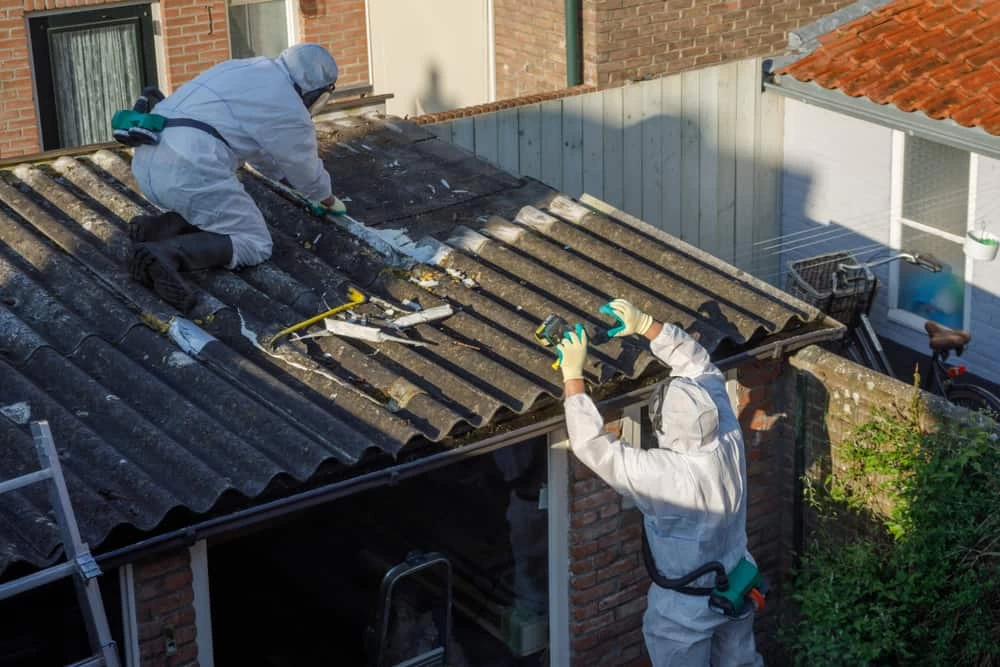
On the job itself, the work area is sealed under negative air pressure containment with HEPA filtration. Air flows in, not out. That’s what protects the rest of your home including the original hardwood floors, period millwork, and plaster details that make an Armour Villa property worth what it is. When the removal is complete, independent air clearance testing is conducted. You receive the documentation. That’s the finish line.
Asbestos Tile and Popcorn Ceiling Removal, Westchester
Every Material Type Found in Armour Villa Homes We Handle Them All
Pre-war homes in Armour Villa don’t have one asbestos problem. They typically have several, spread across different materials and different decades of renovation. We handle the full range: asbestos floor tile removal including the 9×9 and 12×12 vinyl asbestos tile common in kitchens and bathrooms of homes built in the 1920s and 1930s along with pipe and boiler insulation, duct wrap, asbestos popcorn ceiling removal, plaster and joint compound, roofing felt, and exterior siding materials. You don’t need a different contractor for each material type. One team handles the complete inventory of your property.
For homeowners on streets like Gard Avenue or Bronxville Road who are working through a full restoration not just a cosmetic update this matters. You want a contractor who can assess everything in one visit and execute everything under one project scope, with one set of permits and one clearance certification at the end.
If your abatement is connected to a water damage event a pipe burst in a home with original steam heating infrastructure, which is a real and recurring risk in this neighborhood’s older housing stock we work directly with insurance carriers and handle billing coordination on your behalf. You deal with the restoration. We deal with the paperwork.
How do I know if my Armour Villa home actually contains asbestos?
If your home was built before 1980 and most homes in Armour Villa were built between the 1890s and the 1930s there’s a statistically high probability that asbestos-containing materials are present somewhere in the structure. The Westchester County Department of Health specifically lists steam pipes, boilers, furnace ducts, resilient floor tiles, and asbestos cement roofing as common ACMs in Westchester homes of this era. The only way to know for certain is to have a licensed professional collect samples and send them to a certified laboratory for analysis.
You can’t identify asbestos by looking at it. A floor tile that looks perfectly ordinary can contain up to 70% chrysotile asbestos. Pipe insulation that’s been painted over for decades may still be intact and hazardous if disturbed. The free on-site inspection we offer is the right starting point it gives you an honest assessment of what’s present before any renovation work begins, and before you’re legally required to act on it.
Do I need a permit for asbestos removal in Yonkers before starting renovation work?
Yes. Any renovation or demolition project in Yonkers that involves disturbing building materials in a structure built before 1980 triggers asbestos inspection and notification requirements under NYS DOL Industrial Code Rule 56. This means that before permits are issued for your renovation project, you typically need documentation confirming either that no asbestos-containing materials are present in the affected areas, or that any ACMs have been properly abated by a licensed contractor.
The NYS DOL Asbestos Control Bureau also requires advance notification before abatement work begins this is a state-level requirement separate from the Yonkers building department permit process. Skipping either step doesn’t just create a code violation. It creates a liability that stays attached to the property and can surface during a future sale or refinancing. We handle both the Yonkers permit coordination and the NYS DOL notification filing as part of every project, so you’re not navigating two separate bureaucracies on your own.
What does asbestos abatement actually cost for a pre-war home in Armour Villa?
Cost depends on the scope how many materials are involved, where they’re located, and how much square footage is affected. A single-room asbestos floor tile removal in an Armour Villa home typically starts in the range of $1,500 to $3,000. A more comprehensive project covering pipe insulation, floor tile, and ceiling materials across multiple rooms in a pre-war home can run $5,000 to $15,000 or more depending on the extent of the work.
For Armour Villa homeowners, the more relevant question is often what the cost of not doing it looks like. In the Bronxville postal area real estate market, a buyer’s inspector or attorney who flags undisclosed asbestos during a transaction can trigger price reductions, delayed closings, or deals that fall apart entirely on homes valued in the $500,000 to $1.5 million range. The cost of professional abatement with documented clearance is modest relative to that exposure. We provide itemized estimates after the free on-site inspection, so you know exactly what you’re looking at before committing to anything.
Is asbestos abatement safe to do while my family is still living in the house?
It can be, depending on the scope and location of the work. For a contained project like asbestos tile removal in a single room or basement pipe insulation we use negative air pressure containment that physically isolates the work area from the rest of your home. Air is drawn into the work zone, not out of it, and HEPA-filtered air scrubbers capture airborne fibers at the source. Independent air clearance testing is conducted before the containment is removed and the space is reoccupied.
For larger projects full-floor tile removal, multiple rooms, or work that involves opening walls temporary relocation during the active abatement phase is sometimes the more practical choice, especially for households with children. The inspection and scoping conversation will clarify what makes sense for your specific project. In Armour Villa, where homes are close together and many are actively occupied during renovations, the containment protocol isn’t just a regulatory requirement it’s what protects your neighbors as much as your own household.
What happens after asbestos removal what documentation do I actually receive?
After abatement is complete, independent air clearance testing is conducted by a certified industrial hygienist not by the same contractor who performed the removal. This separation matters. The clearance test measures airborne fiber concentrations in the treated area and confirms they fall below the regulatory threshold before the containment is removed and the space is cleared for reoccupancy or continued renovation.
Once the area passes, you receive formal post-abatement clearance documentation: the air sampling results, the clearance certification, and the waste disposal manifests confirming that all asbestos-containing materials were transported and disposed of at a licensed facility in compliance with NYS DEC requirements. For Armour Villa homeowners navigating a real estate transaction, this documentation package is what your attorney, the buyer’s attorney, and the title company are looking for. It’s the permanent legal record that the work was done correctly, and it travels with the property.
Can we handle asbestos abatement tied to a pipe burst or water damage in my older Armour Villa home?
Yes, and this is a situation that comes up regularly in Armour Villa’s pre-war housing stock. Homes with original or partially updated steam heating systems are at elevated risk for pipe failures during cold snaps and when a pipe bursts in a home with original pipe insulation or asbestos floor tiles beneath the affected area, the water damage response and the asbestos abatement have to happen in coordination. You can’t fully restore the space until the asbestos is properly handled, and delays in that sequence extend the timeline and the disruption.
We work directly with homeowners’ insurance carriers and handle billing coordination on your behalf in these situations. That means you’re not caught in the middle between your insurer and your abatement contractor during an already stressful event. We document the scope, communicate with the carrier, and move the project forward. If you’re in Armour Villa and dealing with an emergency involving suspected asbestos materials, the free inspection is the right first call it establishes what you’re working with quickly so the restoration timeline doesn’t stall.