Bedford's Historic Homes Deserve More Than a Guess
If your Bedford home was built before 1980, asbestos abatement isn’t a maybe it’s a real conversation worth having before your renovation begins or your listing goes live.
I needed a professional consultation explanation of procedure for safe removal of Asbestos in my apartment complex. Without having an account yet, I was very impressed with the caring, knowledgeable and generous advice offered by Jessica, and will look forward to doing business in the future. Thank you so much! I feel much more informed about a sometimes scary endeavor. Peace. Nancy Silva Mineola, NY.
Mia Munoz
Used this company to clean up some water flood in my house. They were fast and easy to work with.very professional, Would recommend to anyone!
Nini Valle
Great company, had a flood and they responded quickly and efficiently. Billed my insurance company directly. I highly recommend this company!
joe colapietro, jr
I had pipe freeze in my basement right before a snow storm and they made to within an hour to help start the clean up process. They we by our side throughout the entire process and even helped with the insurance company. They did such a great job with the cleanup, repair, remidiation, I contracted them to perform the repairs and finishes in the basement. They came with enough manpower and material to get the job done. Leo and Jessica were nothing but a pleasure to deal with!!
Cristian Arredondo c
I had some water damage in my home and Green Island was able to take care of my issue quickly and effectively. I am very pleased with the work they did. They responded quickly and were very professional.
Michael M
Outstanding service! From the office to the field crew everyone was friendly, helpful and responsive. I highly recommend Green Island Group.
Know What's in Your Walls Before It Becomes a Problem
Bedford is one of the oldest towns in Westchester County. That history is part of what makes it special and part of what makes asbestos a real concern for anyone renovating, selling, or simply trying to understand what’s inside their home. Colonial-era structures, mid-century estate homes, carriage houses, and horse barns built during the peak asbestos-use decades of 1940 through 1978 are all over this town. If you’re pulling permits with the Bedford Building Department on Cherry Street and your contractor hasn’t asked about asbestos yet, that’s worth paying attention to.
When asbestos-containing materials are left undisturbed, they’re generally not an immediate hazard. But the moment a renovation starts demo work, flooring removal, a gut kitchen, a basement overhaul disturbed asbestos becomes a health and legal issue fast. The same goes for water damage. Bedford’s terrain puts roughly 16% of properties at elevated flood risk, and when water gets into an older home, it often disturbs the exact materials that contain asbestos: floor tiles, pipe insulation, ceiling texture.
Getting a proper inspection and clearance documentation before work begins doesn’t just protect your family. In a market where Bedford homes routinely sell at or above $1.5 million, documented abatement protects the deal too. Buyers, lenders, and title companies increasingly want proof not just assurances.
The License Stack That Bedford Buyers Actually Check
We hold a current NYS Department of Labor Asbestos Handling License, EPA certification, and NYS DEC compliance for waste disposal every credential required to legally perform asbestos abatement in Westchester County. We’re also M/WBE certified through the NYS Office of General Services, an approved contractor for New York State agencies, and have completed more than 5,000 abatement projects across the metro area. These aren’t marketing claims. They’re public records you can verify.
Bedford homeowners are thorough and they should be. Whether you’re renovating a historic property near the Bedford Village Green, preparing a Katonah estate for sale, or dealing with an outbuilding on a horse farm off Route 22, you deserve a contractor who’s been in this environment before and knows exactly what they’re looking at. We have. We do. And we offer free on-site inspections so you can find out what you’re dealing with before you commit to anything.
From First Call to Clearance Here's What to Expect
It starts with a free on-site inspection. A certified assessor walks your property, identifies any suspected asbestos-containing materials floor tiles, pipe insulation, popcorn ceilings, drywall joint compound, roofing on outbuildings and gives you a straight assessment of what you’re working with. No pressure, no inflated scope. Just an honest look.
If abatement is needed, we handle the permitting coordination with the Town of Bedford Building Department and ensure full compliance with NYS Industrial Code Rule 56, which governs containment, worker protection, air monitoring, and waste disposal for all asbestos work in New York State. For properties in or near the Bedford Village Historic District, we understand that renovation work often runs through both asbestos regulations and the Town’s Historic Building Preservation Law simultaneously and we plan accordingly. Every worker on your property holds an individual NYS DOL certification, not just a company-level license.
During the work itself, we use negative air pressure containment and HEPA-filtered air scrubbers to make sure fibers don’t migrate to unaffected areas of your home. When the job is done, we conduct post-abatement air clearance testing and provide you with formal clearance documentation the paper trail your real estate agent, lender, or contractor will need, and the peace of mind you deserve.
Every Material Type Found in Bedford Properties, Covered
Bedford’s housing stock isn’t uniform. You’ve got colonial-era structures in the Historic District, mid-century estate homes with original floor tiles and plaster ceilings, agricultural outbuildings with asbestos-cement roofing that was standard in barn construction through the 1970s, and late-19th-century buildings in Katonah that were relocated in the 1890s and subsequently renovated with mid-century materials. Each of these building types presents asbestos in different forms and in different places.
We handle the full range: vinyl and 9×9 asbestos floor tile removal, popcorn and acoustic ceiling texture, pipe and duct insulation, drywall joint compound, roofing and exterior transite siding, and boiler insulation systems. If you’re managing a multi-building estate main house, carriage house, pool house, guest cottage we can assess and abate across the entire property without you coordinating multiple contractors for different material types.
We also work directly with insurance carriers when water damage or another covered event triggers an abatement requirement. If flooding or a pipe failure has disturbed older materials in your home, we handle the billing communication with your insurer directly, so that part of the process doesn’t fall on you. Every project ends with full clearance documentation standard, not optional.
Does my older Bedford home actually need an asbestos inspection before renovating?
If your home was built before 1980 and in Bedford, a significant portion of the housing stock predates that cutoff by decades an asbestos inspection before any major renovation is the right move, not just a precaution. Under NYS Industrial Code Rule 56, licensed contractors are required to identify and address asbestos-containing materials before demolition or renovation work begins. That means if you’re pulling a permit with the Town of Bedford Building Department for a gut renovation, addition, or structural alteration, asbestos assessment is part of the pre-construction process.
Beyond the regulatory piece, there’s a practical one. Asbestos in undisturbed floor tiles, ceiling texture, or pipe insulation poses minimal risk as long as it stays intact. The moment that material gets cut, sanded, scraped, or broken during renovation work, the risk changes. An inspection before work begins tells you exactly what you’re dealing with, where it is, and what needs to happen before your contractor picks up a demo tool. That’s a much better position than discovering it mid-project.
How much does asbestos abatement typically cost for a home in Bedford, NY?
Cost varies depending on the scope what materials are present, how much of them there are, and how accessible they are within the structure. A targeted removal of asbestos floor tiles in a single room will cost significantly less than a full basement pipe insulation abatement or a whole-home assessment across a multi-building estate. For most residential projects in the Bedford area, you’re looking at a range that can run from a few thousand dollars for a limited scope up to $15,000 or more for larger or more complex jobs.
Given that Bedford homes routinely trade at $1 million and above, the cost of professional abatement is modest relative to what’s at stake. A home with undisclosed or unresolved asbestos can lose $50,000 or more in negotiated price reduction during a sale or lose the deal entirely when a buyer’s inspector flags it. We offer free on-site inspections, so you get an accurate scope and a real number before you commit to anything.
What asbestos materials are most commonly found in Bedford's older homes and outbuildings?
In Bedford’s pre-1980 residential and estate properties, the most common asbestos-containing materials tend to show up in a handful of predictable places. Vinyl floor tiles particularly the 9×9 inch format common in mid-century construction are one of the most frequent finds, along with the adhesive used to set them. Popcorn and acoustic ceiling texture applied through the 1970s often contains asbestos, as does the joint compound used in drywall finishing from that era. Pipe insulation and boiler wrap in older heating systems is another common location, especially in homes with original steam or hot water systems.
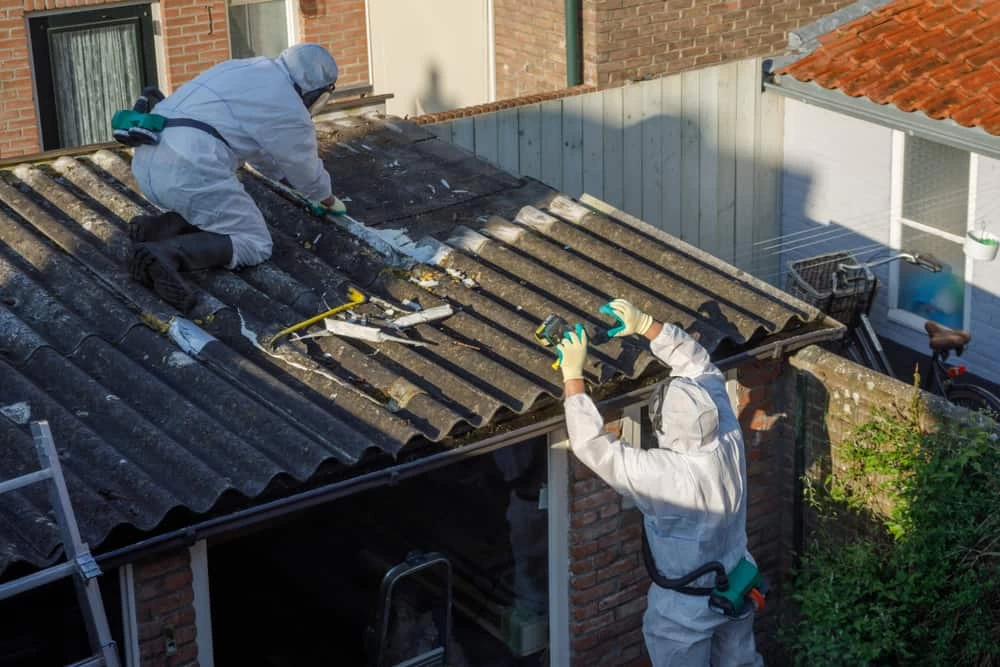
Bedford’s equestrian properties add a category that’s less common in suburban towns: agricultural outbuildings barns, carriage houses, equipment sheds built or re-roofed in the mid-20th century frequently used corrugated asbestos-cement sheeting as roofing material, along with transite panels for exterior siding. If you’re planning to renovate or demolish an older outbuilding on a horse farm or estate property, that roofing and siding material is worth testing before any work begins. It’s a scenario that comes up regularly in Bedford and the surrounding northern Westchester area.
Can asbestos abatement in Bedford be done while my family stays in the home?
In some cases, yes but it depends on the scope of the work and where it’s located within the home. For contained, limited-area abatements where the work zone can be properly isolated from the rest of the living space, families sometimes remain on the property in unaffected areas. For larger or more invasive projects full basement abatements, whole-floor tile removal, or work near HVAC systems temporary relocation during the active work phase is typically the safer and more practical approach.
We use negative air pressure containment systems and HEPA-filtered air scrubbers on every project, which means the work area is engineered to keep fibers from migrating to other parts of your home. That’s not a promise made verbally it’s a physical system that creates airflow into the containment zone rather than out of it. We’ll give you a straight answer during the inspection about whether staying on-site is realistic for your specific project, so you can plan accordingly rather than find out the day work starts.
Do I need asbestos clearance documentation when selling a home in Bedford, NY?
Technically, New York State does not mandate a specific asbestos disclosure form for residential real estate transactions the way some states do. But in practice, especially in Bedford’s high-value market, it matters a great deal. Buyers’ attorneys, home inspectors, and lenders are increasingly flagging suspected asbestos-containing materials in pre-1980 homes and when that happens mid-transaction, it almost always results in a price negotiation, a delayed closing, or a deal that falls apart.
If you’ve had asbestos abatement done on your property, having formal post-abatement clearance documentation signed air testing results confirming the work was completed correctly puts you in a much stronger position. It’s proof, not just a claim. In a market where a Bedford home might be listed at $1.5 million or more, that documentation can be the difference between a clean close and a contentious renegotiation. We provide clearance documentation as a standard deliverable on every abatement project, not as an add-on.
How does the Katonah relocation history affect asbestos risk in those older homes?
It’s a genuinely interesting local wrinkle. Katonah’s entire hamlet was physically relocated in the 1890s to make way for the New Croton Reservoir the structures were moved to a new site and rebuilt. That means many of Katonah’s older-looking buildings are actually late-19th-century construction, which predates the widespread use of asbestos in building materials. On the surface, that might seem like good news.
The complication is what happened after. Many of those relocated structures were subsequently renovated, expanded, or updated during the 1940s, 1950s, and 1960s the decades when asbestos use in construction was at its peak. Pipe insulation added to an older heating system, new floor tiles laid over original wood floors, acoustic ceiling texture applied during a mid-century update these are all common renovation-era additions that can introduce asbestos into a building that wasn’t originally constructed with it. If you own an older home in Katonah and you’re planning any renovation work, the age of the original structure doesn’t tell the whole story. What matters is when the last significant renovation or update was done and whether those materials were tested.