Bethpage Homes Carry History — Some of It Hazardous
If your Bethpage home was built in the 1950s or ’60s, there’s a real chance asbestos is somewhere inside it. We remove it safely, legally, and completely.
I needed a professional consultation explanation of procedure for safe removal of Asbestos in my apartment complex. Without having an account yet, I was very impressed with the caring, knowledgeable and generous advice offered by Jessica, and will look forward to doing business in the future. Thank you so much! I feel much more informed about a sometimes scary endeavor. Peace. Nancy Silva Mineola, NY.
Mia Munoz
Used this company to clean up some water flood in my house. They were fast and easy to work with.very professional, Would recommend to anyone!
Nini Valle
Great company, had a flood and they responded quickly and efficiently. Billed my insurance company directly. I highly recommend this company!
joe colapietro, jr
I had pipe freeze in my basement right before a snow storm and they made to within an hour to help start the clean up process. They we by our side throughout the entire process and even helped with the insurance company. They did such a great job with the cleanup, repair, remidiation, I contracted them to perform the repairs and finishes in the basement. They came with enough manpower and material to get the job done. Leo and Jessica were nothing but a pleasure to deal with!!
Cristian Arredondo c
I had some water damage in my home and Green Island was able to take care of my issue quickly and effectively. I am very pleased with the work they did. They responded quickly and were very professional.
Michael M
Outstanding service! From the office to the field crew everyone was friendly, helpful and responsive. I highly recommend Green Island Group.
You stop guessing. That’s the first thing. When asbestos-containing materials are properly identified, contained, and removed by a licensed contractor, you’re not just clearing out old building material — you’re removing a health risk that’s been sitting inside your walls, floors, or ceiling since the Eisenhower administration. For Bethpage homeowners, that’s not hypothetical. Most of the housing stock here went up during the postwar boom, and the materials used back then — vinyl floor tiles, pipe insulation, popcorn ceiling texture, boiler wrap — routinely contained asbestos. It was standard. It wasn’t questioned.
What changes after abatement is real and practical. You can move forward with your renovation without stopping every five minutes to wonder if you’re disturbing something dangerous. You can list your home without a buyer’s inspection turning into a negotiation over remediation credits. With Bethpage median home values sitting near $880,000, that’s not a small thing — one asbestos flag during a sale can cost you thousands in concessions or kill the deal entirely.
And if you’ve lived in Bethpage long enough to remember the Grumman contamination story — the plume, the water treatment systems, the buried drums found at Bethpage Community Park — you already know what it looks like when hazardous materials get ignored. Proper asbestos abatement is the same principle applied to your own home: document it, contain it, remove it, and clear it. No shortcuts.
We Know Bethpage Homes — And the Rules That Govern Them
We’re a fully licensed asbestos abatement contractor serving Bethpage and the surrounding communities in the Town of Oyster Bay. We hold both the New York State Department of Labor asbestos abatement contractor license required under Industrial Code Rule 56 and the Nassau County Environmental Hazard Remediation Provider (EHRP) license — the county-specific credential that many out-of-area contractors simply don’t carry.
That distinction matters in Bethpage. Nassau County has its own licensing layer on top of state requirements, and working without it puts homeowners at risk of non-compliant work that won’t pass inspection. We already serve the Bethpage area through our established Old Bethpage service coverage, so we’re not learning your neighborhood — we already know the housing stock, the permit process through the Town of Oyster Bay building department, and the regulatory expectations that apply to every project in this hamlet.
When you call us, you’re talking to a team that has done this work in Bethpage and Nassau County, not one that’s figuring it out as they go.
No Guesswork — Here's Exactly What the Process Looks Like
It starts with an inspection. Before anything is touched, a licensed inspector surveys your home and collects bulk samples from suspected materials — floor tiles, ceiling texture, pipe insulation, drywall compound, whatever applies to your property. Those samples go to an accredited laboratory. You get real results, not assumptions.
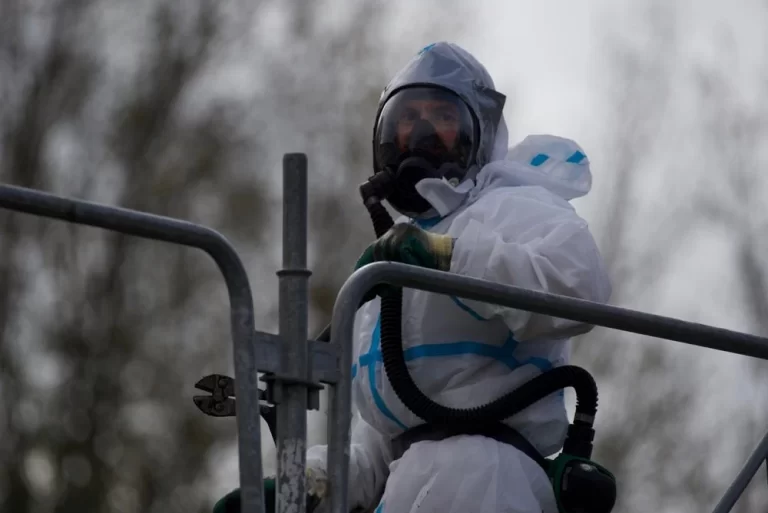
Once asbestos-containing materials are confirmed, we file the required pre-project notification with the New York State Department of Labor — a mandatory step under Code Rule 56 that many homeowners don’t know exists. From there, the work area is fully contained: plastic sheeting, negative air pressure, HEPA filtration. The goal is to make sure fibers stay inside the containment zone and don’t migrate into the rest of your home during removal. Every worker on-site holds a valid NYS asbestos handler or supervisor certification. Nassau County’s EHRT requirements apply here, and we meet them.
After removal, regulated waste is packaged and transported to an approved disposal facility — it doesn’t just go in a dumpster. Then comes independent air monitoring by a licensed industrial hygienist, followed by a formal clearance air test. You don’t get a verbal “looks good.” You get documentation. That paperwork matters for your Town of Oyster Bay building permits, for Nassau County health department records, and for any future real estate transaction involving your property.
The Materials Most Common in Bethpage Homes — and How We Handle Them
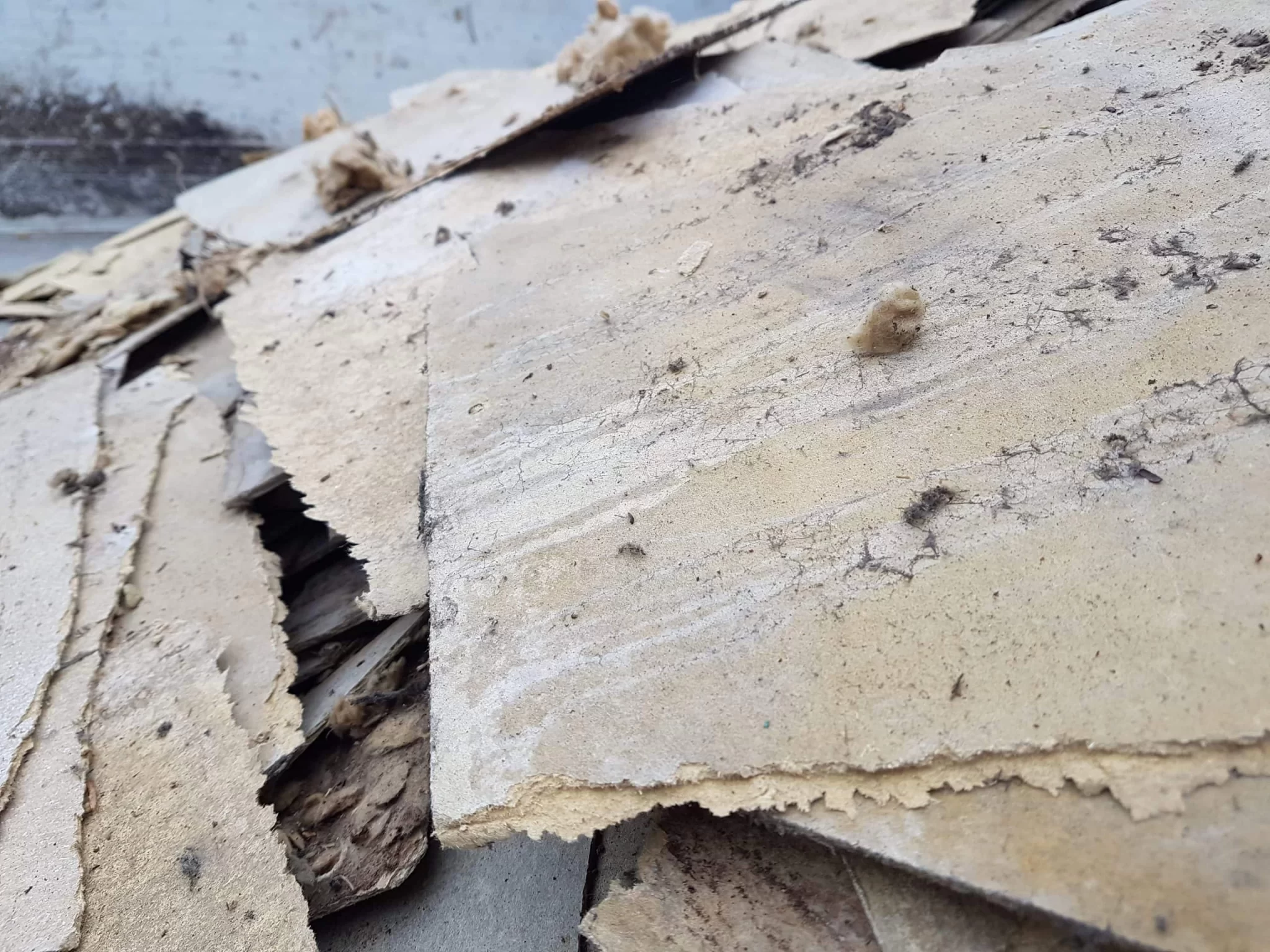
The 9-by-9-inch vinyl floor tiles found in so many Bethpage split-levels and ranch homes from the 1950s and ’60s are one of the most common asbestos-containing materials we encounter in Nassau County. The tiles themselves often contain chrysotile asbestos — and so does the black mastic adhesive underneath them. Asbestos tile removal in an occupied home requires full containment, careful extraction, and proper disposal. It’s not a Saturday afternoon project, and in New York, it’s illegal to attempt it without a licensed contractor.
Popcorn ceiling removal is the other call we get constantly in Bethpage and the surrounding area. Acoustic ceiling texture applied before 1978 frequently contains asbestos, and scraping it without containment releases fibers that can stay airborne for hours and settle throughout your home. Our asbestos popcorn ceiling removal service includes negative air pressure enclosures, HEPA vacuuming, and a clearance air test before any painting or new ceiling work begins.
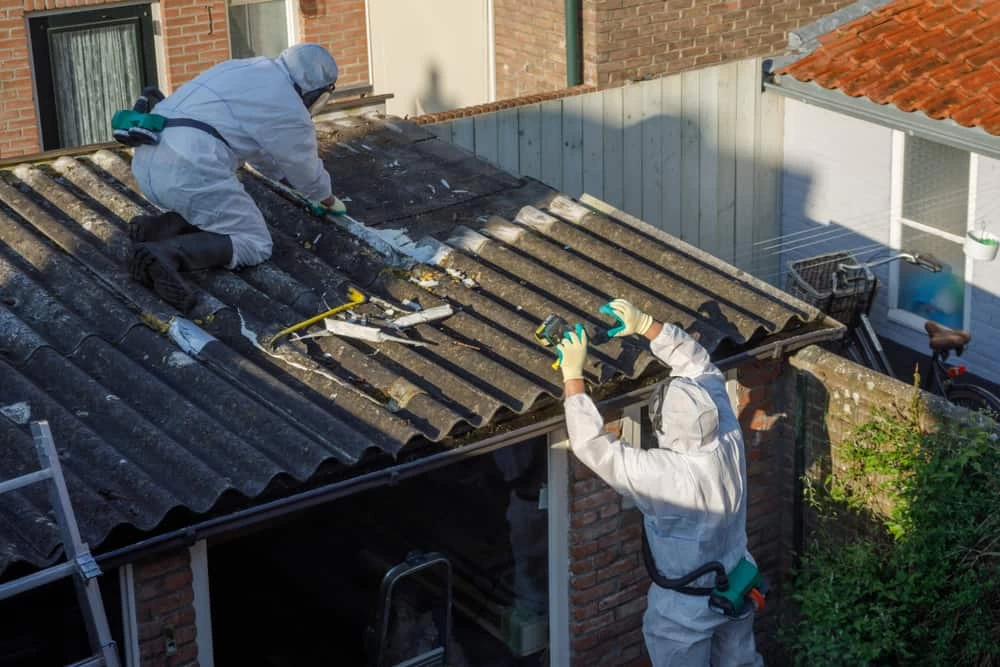
Beyond tile and ceilings, we handle pipe and boiler insulation — particularly relevant in older Bethpage homes with original heating systems — as well as drywall joint compound, exterior transite siding, and roofing materials. Whatever the material, the process follows the same standard: full Code Rule 56 compliance, independent air monitoring, and complete documentation from start to clearance. Every project we complete in Bethpage meets both NYS DOL and Nassau County EHRP requirements.
Does my Bethpage home built in the 1950s likely contain asbestos?
Very possibly, yes. Bethpage’s housing stock is heavily concentrated in the postwar era — homes built between roughly 1945 and 1975 — and asbestos-containing materials were standard practice throughout that entire period. Manufacturers used asbestos in vinyl floor tiles, ceiling texture, pipe and boiler insulation, drywall joint compound, roofing shingles, and exterior siding because it was cheap, durable, and fire-resistant. Nobody thought twice about it at the time.
The only way to know for certain is to have a licensed inspector collect bulk samples and send them to an accredited lab. Visual inspection alone is not enough — asbestos fibers are microscopic and can’t be identified by looking at the material. If your Bethpage home hasn’t been tested and you’re planning any renovation that involves disturbing floors, ceilings, walls, or mechanical systems, getting an inspection done first is the right move. It protects your health, keeps you on the right side of New York State law, and prevents a renovation from turning into an emergency abatement situation mid-project.
What licenses should an asbestos abatement contractor in Bethpage, NY have?
In Bethpage, you need a contractor who holds two separate credentials — not just one. The first is a New York State Department of Labor asbestos abatement contractor license, which is required under Industrial Code Rule 56 for any asbestos project in the state. The second is a Nassau County Environmental Hazard Remediation Provider (EHRP) license, which is a county-specific requirement that applies to all abatement work in Nassau County — including Bethpage.
Individual workers on-site must also hold valid NYS asbestos handler or supervisor certifications, and Nassau County requires technicians to carry an Environmental Hazard Remediation Technician (EHRT) credential. If a contractor you’re speaking with can’t confirm both the state and county licensing, that’s a red flag. Hiring someone without the full credential set can leave you with work that doesn’t pass inspection, potential legal exposure, and a project that may need to be redone by a licensed contractor anyway. Always ask for license numbers and verify them before signing anything.
How much does asbestos abatement typically cost for a Nassau County home?
Cost varies depending on what materials are involved, how much square footage needs to be addressed, and how accessible the work area is. For a single room of asbestos floor tile removal, you might be looking at $1,500 to $3,000. Popcorn ceiling removal in a standard-sized room typically runs $2,000 to $4,000 when done properly with full containment and air monitoring. Larger projects — whole-house tile removal, pipe insulation in a basement, or multiple material types — can run $5,000 to $15,000 or more depending on scope.
What you’re paying for isn’t just labor. A compliant asbestos abatement project in Nassau County includes licensed supervision, containment materials, HEPA filtration equipment, independent air monitoring by a licensed industrial hygienist, regulated waste disposal, and formal clearance documentation. Cutting corners on any of those steps isn’t just a health risk — it’s a legal one. In a market where Bethpage homes are selling near $880,000, the cost of proper abatement is a small fraction of what a failed buyer inspection or a remediation concession could cost you.
Can I remove asbestos floor tiles myself in New York State?
No — not legally, and not safely. New York State Industrial Code Rule 56 requires that all asbestos abatement work be performed by a licensed contractor with certified workers and a licensed supervisor on-site. DIY removal of asbestos-containing materials is not permitted under state law, regardless of how small the area is or how intact the tiles appear to be.
Beyond the legal issue, there’s a practical one. Asbestos floor tiles that look solid and undisturbed can still release fibers when they’re cut, broken, or pried up — and the mastic adhesive beneath them is often just as hazardous as the tiles themselves. Without proper containment, negative air pressure, and HEPA filtration, those fibers can spread through your home’s HVAC system and settle in areas far from where you were working. The NYS DOL Asbestos Control Bureau actively inspects abatement projects and investigates complaints. The risk — to your health, your family’s health, and your legal standing — is not worth attempting this without a licensed team.
How long does asbestos abatement take, and can I stay in my home during the work?
The timeline depends on the scope of the project. A single-room tile or ceiling abatement typically takes one to three days from setup through clearance testing. Larger projects involving multiple material types or whole-floor removal can take a week or more. The containment and clearance process adds time on both ends — setup before work begins and independent air monitoring after removal is complete.
Whether you can stay in your home depends on where the work is happening and how the containment is configured. In many cases, residents can remain in unaffected parts of the home while abatement is contained to a specific area. In others — particularly whole-house projects or situations where HVAC systems are involved — temporary relocation during the active work phase is the safer call. We’ll walk you through what makes sense for your specific project during the estimate. The one thing that doesn’t change regardless of scope: you cannot reoccupy the work area until the clearance air test comes back clean and the documentation is issued. That’s a New York State requirement, not a suggestion.
Does the Grumman contamination in Bethpage have anything to do with asbestos in my home?
The Grumman contamination — the trichloroethylene plume in the groundwater, the buried chemical drums at Bethpage Community Park, the decades of cleanup activity — is a separate issue from residential asbestos. The Grumman/NWIRP contamination involves industrial solvents and volatile organic compounds that affected groundwater and soil. Asbestos in Bethpage homes is a construction materials issue, not a result of the Grumman site.
That said, living in Bethpage means you’ve grown up in a community that takes environmental hazards seriously — and for good reason. The same instinct that led residents here to push for accountability on the groundwater contamination applies to asbestos: don’t ignore it, don’t minimize it, and don’t let someone handle it carelessly. The two issues aren’t connected, but the mindset that says “get it tested, get it documented, get it done right” is exactly the right one to bring to an asbestos concern in your home. If you’ve been wondering whether your house has asbestos and you’ve been putting off the call, the Bethpage community’s history of environmental awareness is a pretty good reason to stop waiting.