Lower Manhattan's Oldest Buildings Deserve More Than a Guess
If you’re renovating, converting, or just found something suspicious behind a wall in a pre-war Financial District building near Bowling Green, asbestos abatement starts with a licensed team that actually knows what NYC requires.
I needed a professional consultation explanation of procedure for safe removal of Asbestos in my apartment complex. Without having an account yet, I was very impressed with the caring, knowledgeable and generous advice offered by Jessica, and will look forward to doing business in the future. Thank you so much! I feel much more informed about a sometimes scary endeavor. Peace. Nancy Silva Mineola, NY.
Mia Munoz
Used this company to clean up some water flood in my house. They were fast and easy to work with.very professional, Would recommend to anyone!
Nini Valle
Great company, had a flood and they responded quickly and efficiently. Billed my insurance company directly. I highly recommend this company!
joe colapietro, jr
I had pipe freeze in my basement right before a snow storm and they made to within an hour to help start the clean up process. They we by our side throughout the entire process and even helped with the insurance company. They did such a great job with the cleanup, repair, remidiation, I contracted them to perform the repairs and finishes in the basement. They came with enough manpower and material to get the job done. Leo and Jessica were nothing but a pleasure to deal with!!
Cristian Arredondo c
I had some water damage in my home and Green Island was able to take care of my issue quickly and effectively. I am very pleased with the work they did. They responded quickly and were very professional.
Michael M
Outstanding service! From the office to the field crew everyone was friendly, helpful and responsive. I highly recommend Green Island Group.
When asbestos is properly removed and cleared, your project moves forward. Permits get issued. Tenants come back. The renovation timeline you’ve been protecting doesn’t fall apart because of a regulatory surprise. That’s what a clean abatement looks like not just the material gone, but the paperwork closed and the air tested.
The buildings surrounding Bowling Green Park many of them built between the 1890s and 1930s weren’t constructed with today’s health standards in mind. Pipe insulation, floor tiles, ceiling materials, and fireproofing compounds from that era almost always contain asbestos. If you’re managing a pre-war commercial building on Broadway or overseeing a conversion project near Wall Street, you’re likely dealing with it whether you know it yet or not.
Lower Manhattan also sits in a coastal flood zone. Hurricane Sandy made that clear in 2012 when storm surge hit basements and mechanical rooms throughout the Financial District. When water gets into a building with asbestos-insulated pipes or old floor systems, it doesn’t just create a water damage problem it creates an exposure risk. Handling both under one contractor isn’t a convenience. In a building like that, it’s the only approach that actually makes sense.
We are a fully licensed environmental remediation company serving New York City and the surrounding region, 24 hours a day, every day of the year. We hold the NYS Department of Labor asbestos contractor license, NYC DEP asbestos contractor certification, and carry full general liability and workers’ compensation insurance the non-negotiable requirements for legal asbestos work in the five boroughs.
Working in the Financial District isn’t like working anywhere else. The buildings near Bowling Green Park including century-old commercial landmarks and recently converted office towers require contractors who understand NYC’s layered regulatory environment, not ones who figure it out mid-project. We’ve worked on pre-war apartments and large commercial buildings throughout Manhattan, and that experience shows up in how efficiently we move through the DEP filing process.
We also handle mold remediation, water damage restoration, and demolition under the same roof. For a property manager dealing with a burst steam pipe in an 1890s building a block from Stone Street, that matters more than it might sound.
No Surprises Here's Exactly What the Process Looks Like
It starts with an inspection. A Certified Asbestos Investigator assesses the materials in question and determines whether an ACP-5 or ACP-7 filing is required with the NYC Department of Environmental Protection. In New York City, this step isn’t optional no DOB permit gets issued for renovation work in a pre-1980 building without it. If you’re in the middle of a conversion project near Bowling Green and you haven’t cleared this yet, this is where you start.
If the assessment confirms asbestos-containing materials that will be disturbed, the ACP-7 project notification gets filed with the DEP at least seven days before work begins. For more complex projects particularly those in occupied multi-tenant buildings or landmark structures an Asbestos Technical Review Unit permit may also be required before abatement can proceed. We manage that coordination directly, so you’re not chasing down agencies while your construction schedule waits.
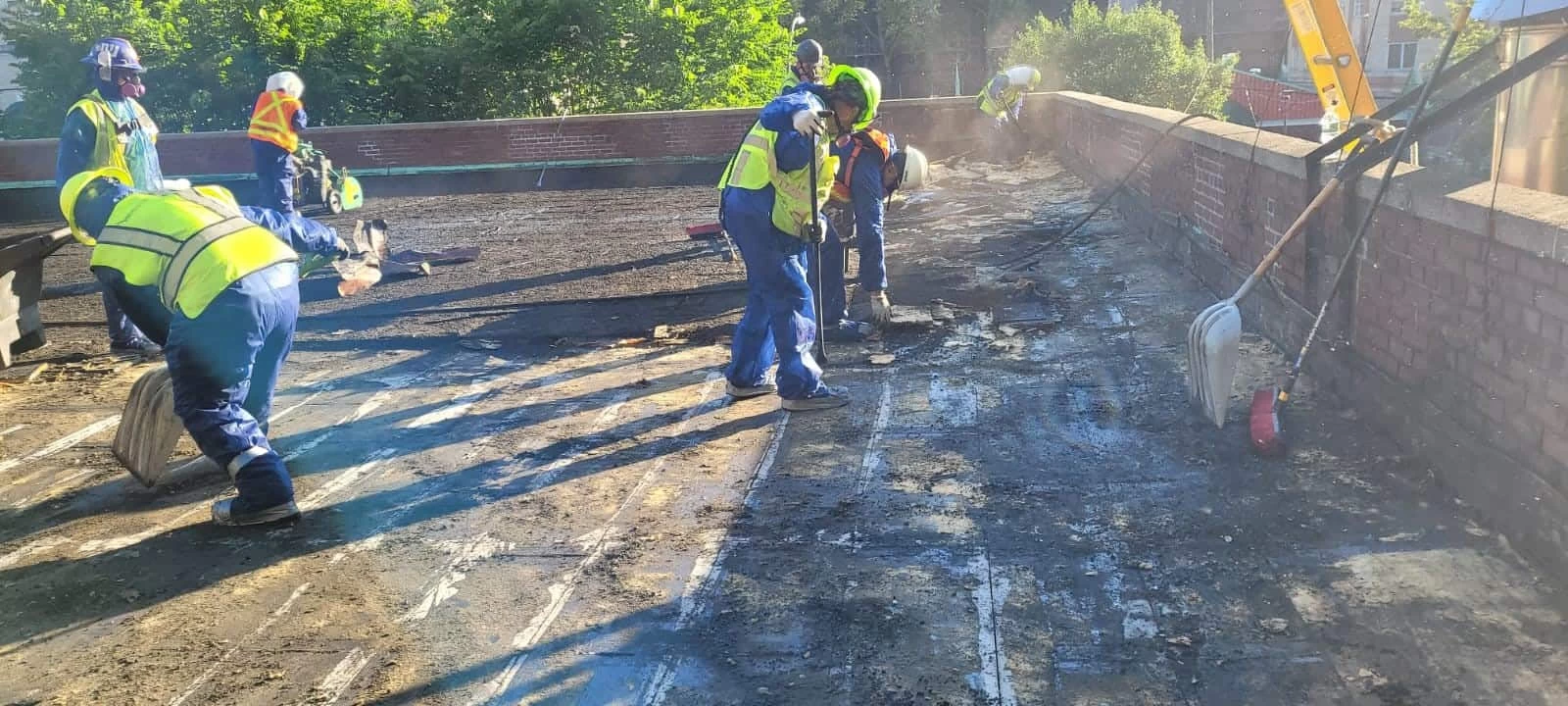
The abatement itself involves full containment of the work area, removal by certified technicians, and proper disposal through licensed channels. Once the work is done, post-abatement air clearance testing confirms that fiber levels are back within safe limits and the DEP ACP-21 completion form closes the project officially. That clearance isn’t just a formality. It’s what lets your building reopen, your tenants return, and your next contractor walk in without liability hanging over the job.
Asbestos abatement in Bowling Green covers the full range of materials common to Lower Manhattan’s pre-war and mid-century building stock pipe and duct insulation, floor tiles, ceiling tiles, plaster, fireproofing compounds, and textured coatings. Asbestos tile removal and asbestos popcorn ceiling removal are among the most common requests in residential co-op and condo renovations within the 10004 ZIP code, where unit owners are often discovering what’s underneath decades of renovation layers for the first time.
For commercial projects tenant improvements, full-floor renovations, or the kind of large-scale office-to-residential conversions happening right now in the Financial District the scope goes further. We provide pre-renovation asbestos surveys, comprehensive remediation plans, and full DEP compliance management for projects of that scale. If you’re working on a conversion building anywhere between Bowling Green and Fulton Street, the asbestos chapter of that project needs to be handled before the DOB will let anything else move forward.
Emergency asbestos removal is also available around the clock. Aging infrastructure in this part of Manhattan fails without warning a steam line, a water main, a mechanical system that’s been in place since the building opened. When that happens and it exposes insulation or other ACMs, you don’t have the luxury of waiting until Monday morning. Our documented response time runs thirty minutes to an hour, and that availability is real, not a marketing line.
Does every renovation in a Bowling Green building require an asbestos inspection first?
In New York City, yes if the building was constructed before 1987, any renovation work that could disturb building materials requires an asbestos assessment before the Department of Buildings will issue a permit. This is governed by the NYC DEP’s asbestos control program, and it applies to everything from a single unit bathroom gut renovation to a full-floor commercial buildout. The assessment is completed by a Certified Asbestos Investigator, who determines whether an ACP-5 form (confirming no ACMs will be disturbed) or an ACP-7 notification (confirming an asbestos project is required) needs to be filed with the DEP.
For buildings in and around Bowling Green most of which were built between the 1890s and the 1960s this step almost always uncovers something. Pipe insulation, floor tile adhesive, ceiling plaster, and fireproofing materials from that era are the most common sources. Skipping the assessment doesn’t make the asbestos go away. It just means the DOB won’t issue your permit, and if work proceeds anyway, both the contractor and the building owner face significant fines.
How long does asbestos abatement typically take in a commercial Manhattan building?
It depends heavily on the scope how many materials are involved, how many floors, and whether the building is occupied during the work. A single-unit residential abatement in a Financial District co-op might take one to three days. A full-floor commercial abatement in a pre-war office building near Wall Street could run one to two weeks, especially if containment needs to be staged around active tenants on adjacent floors.
The regulatory timeline adds to this. The ACP-7 filing with the NYC DEP must be submitted at least seven days before work begins, and if an A-TRU permit is required which is common in buildings where abatement affects means of egress or fire protection systems that review and approval process adds additional lead time. The practical advice here is to build the abatement phase into your project schedule early, not as an afterthought. Contractors who know the NYC DEP process can move through it efficiently, but the minimum filing windows are fixed by regulation and can’t be compressed.
What materials in older Bowling Green and Lower Manhattan buildings most commonly contain asbestos?
The most frequently encountered asbestos-containing materials in pre-war and mid-century buildings in Lower Manhattan fall into a few consistent categories. Pipe and duct insulation is the most common steam and hot water systems in buildings from the early 1900s were almost universally insulated with asbestos-containing materials, and the Financial District has no shortage of those systems still in operation. Floor tiles and the adhesive beneath them (often called “black mastic”) are another major source, particularly in buildings renovated between the 1950s and 1970s.
Ceiling tiles, spray-applied fireproofing on structural steel, textured plaster coatings, and certain types of drywall joint compound also commonly test positive in buildings of this age. In the buildings immediately surrounding Bowling Green Park including structures that date to the 1890s and early 1900s it’s reasonable to assume asbestos is present somewhere until a Certified Asbestos Investigator confirms otherwise. That assumption isn’t alarmist. It’s just what the construction history of this neighborhood reflects.
Does asbestos abatement in Bowling Green, NY include post-removal air clearance testing?
It should, and with us it does. Post-abatement air clearance testing is a required step under NYC DEP regulations before a work area can be reoccupied after an asbestos project. An independent air monitor collects samples after the abatement is complete and the containment is still in place, and those samples are analyzed to confirm that airborne asbestos fiber levels have returned to acceptable limits. Only after that confirmation is the ACP-21 project completion form issued by the DEP.
This matters beyond just regulatory compliance. In an occupied commercial building near Bowling Green where tenants, employees, and building visitors are returning to the space the air clearance result is the documented proof that the work was done correctly and the environment is safe. Some contractors treat this as a separate line item or leave it to the building owner to arrange. We include it as part of the abatement process, which means you get the DEP completion form and the clearance documentation together, not as separate follow-up steps you have to chase down.
Can water damage in a Financial District building trigger an asbestos emergency?
Yes, and it happens more often than people expect in this part of Manhattan. When aging pipe infrastructure fails which is a real and recurring issue in pre-war buildings throughout Lower Manhattan the water intrusion itself is only part of the problem. If the affected pipes are insulated with asbestos-containing materials, the water can disturb that insulation and create an active exposure risk in the same event. What starts as a water damage call becomes a simultaneous remediation situation.
This is exactly why having a contractor who handles both water damage restoration and asbestos abatement under one license matters in a neighborhood like this. Coordinating two separate companies in an emergency one for the water, one for the asbestos adds time, creates gaps in accountability, and slows down the response when speed is most critical. We respond to emergency calls around the clock, and our ability to assess and address both hazards in a single mobilization is a practical advantage that becomes very real at 2 a.m. when a steam line fails in a basement mechanical room.
What should a co-op or condo board in the Financial District know before approving a unit renovation?
The most important thing a board or managing agent needs to confirm before approving any renovation in a pre-1987 building is whether the unit owner has completed the required asbestos assessment. In New York City, the building owner which in a co-op structure means the cooperative corporation itself bears shared responsibility for ensuring that work within the building complies with NYC DEP asbestos regulations. Approving a renovation without confirming that step has been taken creates liability exposure for the board, not just the individual unit owner.
In practical terms, this means the alteration agreement process for co-ops and condos in the Financial District should include a requirement that the unit owner provide an ACP-5 or ACP-7 filing confirmation before any permitted work begins. For buildings in the 10004 ZIP code where virtually every structure predates the widespread awareness of asbestos risks this isn’t an edge case. It’s a standard part of responsible building management. We work directly with property managers and building boards to handle the assessment and filing process, so the board has documentation in hand before a contractor sets foot in the unit.