Bronxville's Pre-War Homes Deserve More Than a Guess
Most homes in Bronxville were built before 1940 which means asbestos abatement isn’t a maybe, it’s a real conversation worth having before your next renovation or sale.
I needed a professional consultation explanation of procedure for safe removal of Asbestos in my apartment complex. Without having an account yet, I was very impressed with the caring, knowledgeable and generous advice offered by Jessica, and will look forward to doing business in the future. Thank you so much! I feel much more informed about a sometimes scary endeavor. Peace. Nancy Silva Mineola, NY.
Mia Munoz
Used this company to clean up some water flood in my house. They were fast and easy to work with.very professional, Would recommend to anyone!
Nini Valle
Great company, had a flood and they responded quickly and efficiently. Billed my insurance company directly. I highly recommend this company!
joe colapietro, jr
I had pipe freeze in my basement right before a snow storm and they made to within an hour to help start the clean up process. They we by our side throughout the entire process and even helped with the insurance company. They did such a great job with the cleanup, repair, remidiation, I contracted them to perform the repairs and finishes in the basement. They came with enough manpower and material to get the job done. Leo and Jessica were nothing but a pleasure to deal with!!
Cristian Arredondo c
I had some water damage in my home and Green Island was able to take care of my issue quickly and effectively. I am very pleased with the work they did. They responded quickly and were very professional.
Michael M
Outstanding service! From the office to the field crew everyone was friendly, helpful and responsive. I highly recommend Green Island Group.
What Changes When Asbestos Is Handled Right in Bronxville
When asbestos is handled properly not just removed, but documented, cleared, and certified you stop carrying a liability and start owning a clean record. That matters everywhere, but it matters especially in Bronxville. In a village where homes regularly sell for $2 million, $3 million, or more, an undocumented asbestos situation doesn’t just create a health risk. It creates a deal-killing disclosure, a price reduction demand, or a title issue that follows the property for years.
Bronxville’s housing stock is almost entirely pre-World War II. The Tudor Revivals in Masterton Wood, the Colonial Revivals in Lawrence Park, the co-ops along Pondfield Road virtually every structure in this village was built during the decades when asbestos was standard in floor tile, pipe insulation, ceiling texture, and boiler wrap. That’s just the reality of owning a pre-war home in Bronxville, and it’s why so many renovation projects uncover something that needs to be addressed before work can continue.
There’s also the flood factor. About 30% of Bronxville properties carry an elevated long-term flood risk from the Bronx River corridor. When water gets into a pre-1940 home and it does, repeatedly it disturbs the materials that contain asbestos. That’s when abatement stops being optional and becomes a required step before any restoration can happen. Having a licensed contractor who can move quickly, document everything, and work directly with your insurance carrier makes a genuinely difficult situation a lot more manageable.
We hold the full compliance stack required for legal asbestos abatement in New York NYS Department of Labor Asbestos Handling License, EPA certification, NYS DEC disposal compliance, and individual NYS DOL certification for every worker on every job. Not just the company. Every person who walks into your home. That’s a meaningful distinction, and it’s one most contractors don’t bother to explain.
Beyond the credentials, we carry NYS Office of General Services M/WBE certification and are an approved contractor for New York State agencies both of which require formal vetting that goes beyond a standard license application. With more than 5,000 completed projects and an established presence serving the Town of Eastchester the municipality that contains Bronxville we’re not a contractor who lists your zip code on a landing page and hopes for the best.
The inspection is free. The estimate is written. The clearance documentation comes standard on every project in Bronxville, not as an add-on. For a homeowner with a pre-war home and a real estate transaction or renovation on the line, that’s the baseline you should expect from anyone you hire.
It starts with a free on-site inspection. We come to your home, look at what’s actually there, and give you a written assessment not a ballpark, not a phone estimate based on square footage. Pre-war homes in Bronxville often have layered renovation histories: original pipe insulation around a steam heating system, period floor tile in the kitchen or basement, acoustic ceiling texture added in the 1960s, joint compound from multiple eras. The only way to know what you’re dealing with is to look.
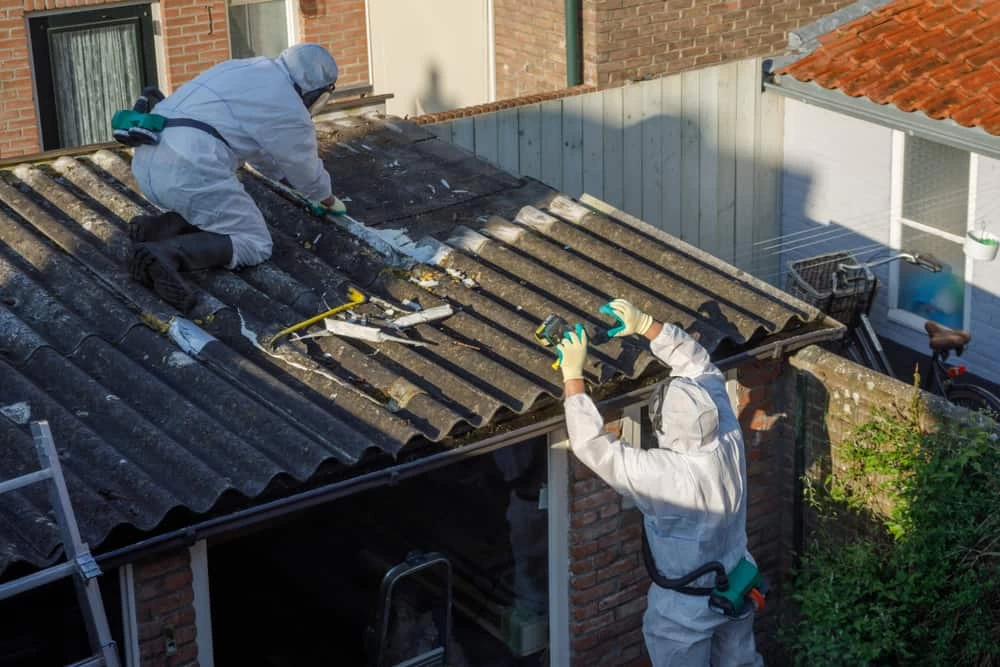
Once the scope is confirmed, the project is scheduled in compliance with Bronxville Village’s construction ordinance work runs Monday through Friday, 8:00 a.m. to 6:00 p.m. only. No weekend work is permitted under Village code, so timeline planning matters. Containment goes up before anything is disturbed. Negative air pressure is maintained throughout the removal. Every material is handled, packaged, and transported according to NYS Industrial Code Rule 56 and EPA NESHAP standards not approximately, not mostly, but fully.
After removal, air clearance testing is conducted by a certified industrial hygienist. You receive the results in writing. The waste disposal manifest is documented. You walk away with a complete compliance record the kind that holds up in a real estate transaction, satisfies an insurance carrier, and gives you something concrete to show the next buyer, lender, or building inspector who asks.
Asbestos Tile and Popcorn Ceiling Removal, Bronxville
The Full Scope, Handled Under One Roof
Bronxville’s pre-war homes don’t typically have one asbestos issue. They have several, spread across different materials and different decades of renovation. We handle the complete inventory: asbestos floor tile removal including the 9×9 vinyl asbestos tile commonly found in Bronxville kitchens, bathrooms, and basements asbestos popcorn ceiling removal, pipe and boiler insulation, duct wrap, joint compound, roofing materials, and transite siding. One contractor, one chain of custody, one clearance certificate.
For water-damage situations which are a recurring reality in the Bronx River flood zone that runs through the village we work directly with insurance carriers and handle billing on your behalf. You don’t have to be the go-between during an already stressful event. For pre-sale and pre-renovation projects, the timeline is built around your schedule, and the documentation delivered at the end is formatted to satisfy both Westchester County requirements and the due diligence standards of a high-value real estate transaction.
Because Bronxville is not within New York City, the NYC DEP ACP-5 process doesn’t apply here but NYS DOL licensing and NYS Industrial Code Rule 56 notification requirements do. We are fully compliant with both, and the fact that we also hold the NYC DEP contractor license signals a level of regulatory rigor that most Westchester-only operators simply don’t maintain.
Does my pre-war Bronxville home likely have asbestos-containing materials?
If your home was built before 1980 and in Bronxville, the overwhelming majority of single-family homes were built before 1940 there’s a reasonable probability that asbestos-containing materials are present somewhere in the structure. The question isn’t really whether it’s there. It’s where, in what condition, and whether any planned work would disturb it.
The most common materials found in Bronxville’s pre-war housing stock include floor tile (especially the 9×9 vinyl asbestos tile used in kitchens, bathrooms, and basements), pipe insulation wrapped around original steam heating systems, boiler wrap, acoustic ceiling texture applied in mid-century updates, and drywall joint compound. The Tudor Revival and Colonial Revival homes that define neighborhoods like Masterton Wood and Lawrence Park often retain original heating infrastructure where asbestos pipe wrap is a standard finding. A professional inspection is the only way to know for certain what’s present and whether it poses a risk.
Do I need asbestos testing before renovating or selling my Bronxville house?
For renovation, the practical answer is yes and in many cases it’s legally required. Under NYS Industrial Code Rule 56, any renovation or demolition work that will disturb a threshold amount of suspect material in a pre-1980 building requires a survey by a licensed asbestos inspector before work begins. If asbestos-containing materials are identified, a licensed abatement contractor must handle the removal before the general contractor can proceed. Skipping this step doesn’t make the liability disappear it just shifts it onto you.
For a home sale in Bronxville, the stakes are even more direct. Buyers in this market conduct thorough due diligence, and a home selling for $2–5 million will be scrutinized carefully. An undisclosed asbestos situation can kill a deal, trigger a significant price reduction demand, or create post-closing legal exposure. Sellers who address asbestos proactively and have the clearance documentation to prove it remove that variable entirely. In a village where the financial stakes of a single transaction are this high, that documentation is worth far more than the cost of the abatement itself.
Can flood damage in my Bronxville home trigger an asbestos abatement requirement?
Yes, and this is a scenario that plays out regularly in Bronxville. Approximately 30% of properties in the village carry an elevated long-term flood risk tied to the Bronx River corridor and the Midland Valley Drainage Basin. When water intrudes into a pre-1940 home which describes virtually every single-family home in Bronxville it can saturate and disturb materials that contain asbestos, including floor tile, pipe insulation, and basement materials. Once those materials are disturbed, they become a regulated abatement situation, not just a water damage cleanup.
Before any restoration contractor can begin drying out walls, replacing flooring, or repairing structural elements, the asbestos-containing materials that were disturbed need to be properly removed and documented. This sequence matters legally and practically. We work directly with insurance carriers in these situations and handle the billing on your behalf, so you’re not managing two separate processes during what is already a disruptive event. The faster the abatement is completed and cleared, the faster the restoration can begin.
What license should an asbestos contractor hold to legally work in Bronxville, NY?
In New York State, any contractor performing asbestos abatement must hold a valid NYS Department of Labor Asbestos Handling License. This is a company-level license, but it’s not sufficient on its own every individual worker and supervisor on the job must also hold their own NYS DOL certification. Both the company license and individual worker certifications are public records that can be verified directly on the NYS DOL website. If a contractor can’t give you a license number you can look up, that’s a problem.
Because Bronxville is in Westchester County rather than New York City, the NYC DEP contractor license and ACP-5 form process don’t apply to residential projects here but the NYS DOL framework and Industrial Code Rule 56 notification requirements do. Any contractor who tells you otherwise, or who can’t demonstrate compliance with Rule 56, should not be working in your home. We hold the NYS DOL license, individual worker certifications, EPA certification, and NYS DEC disposal compliance the complete set required for legal abatement in Bronxville.
How long does asbestos removal typically take in a Bronxville pre-war home?
The timeline depends on what’s present, how much of it there is, and where it’s located in the home. A single-room floor tile removal in a Bronxville basement might be completed in one to two days. A more complex project involving pipe insulation throughout a steam heating system, multiple rooms of floor tile, and ceiling texture in a large pre-war Colonial could run five to seven days or longer. The scope is determined during the initial inspection, and a realistic timeline is part of the written estimate.
One scheduling factor specific to Bronxville is the Village’s construction ordinance, which restricts all renovation and abatement work to Monday through Friday, 8:00 a.m. to 6:00 p.m. No weekend work is permitted. If your project is connected to a renovation timeline or a real estate closing date, that weekday-only window needs to be factored into the schedule from the start. We account for this in every Bronxville project plan, so there are no surprises when the calendar gets tight.
Is asbestos removal covered by homeowners insurance in Westchester County?
It depends on the trigger. Asbestos abatement that’s required because of a sudden, covered event a burst pipe, a flood, storm damage is often at least partially covered under a standard homeowners policy, because the abatement is a necessary step before the covered restoration work can proceed. Abatement that’s initiated proactively for a renovation or pre-sale project is typically not covered, because it’s not tied to a sudden loss event.
For Bronxville homeowners dealing with water intrusion from the Bronx River flooding or storm damage which is a documented, recurring situation in this village the insurance angle is worth exploring before assuming you’re paying out of pocket. We work directly with insurance carriers and handle the billing process on your behalf, which removes the burden of coordinating between your insurer and your abatement contractor during an already difficult situation. The first step is the free inspection, which establishes the scope and gives you something concrete to submit to your carrier.