Lower Manhattan's Oldest Buildings Deserve More Than a Guess
If your building went up before 1987 and most along Canal Street did asbestos isn’t a maybe. We handle the inspection, removal, and NYC DEP compliance so your renovation doesn’t stall.
I needed a professional consultation explanation of procedure for safe removal of Asbestos in my apartment complex. Without having an account yet, I was very impressed with the caring, knowledgeable and generous advice offered by Jessica, and will look forward to doing business in the future. Thank you so much! I feel much more informed about a sometimes scary endeavor. Peace. Nancy Silva Mineola, NY.
Mia Munoz
Used this company to clean up some water flood in my house. They were fast and easy to work with.very professional, Would recommend to anyone!
Nini Valle
Great company, had a flood and they responded quickly and efficiently. Billed my insurance company directly. I highly recommend this company!
joe colapietro, jr
I had pipe freeze in my basement right before a snow storm and they made to within an hour to help start the clean up process. They we by our side throughout the entire process and even helped with the insurance company. They did such a great job with the cleanup, repair, remidiation, I contracted them to perform the repairs and finishes in the basement. They came with enough manpower and material to get the job done. Leo and Jessica were nothing but a pleasure to deal with!!
Cristian Arredondo c
I had some water damage in my home and Green Island was able to take care of my issue quickly and effectively. I am very pleased with the work they did. They responded quickly and were very professional.
Michael M
Outstanding service! From the office to the field crew everyone was friendly, helpful and responsive. I highly recommend Green Island Group.
Canal Street sits at the intersection of some of the oldest continuously occupied buildings in New York City. The cast-iron structures of SoHo to the north, the converted warehouse lofts of Tribeca to the south, and the tenement buildings running through Chinatown to the east virtually every one of them predates the era when asbestos was phased out of building materials. When you’re renovating, remodeling, or dealing with unexpected damage in one of these Canal Street buildings, asbestos isn’t a distant concern. It’s usually already there, in the floor tiles, the pipe insulation, the ceiling materials, the plaster.
What changes after a proper abatement isn’t just the air quality it’s your ability to move forward. Your DOB permit process can proceed. Your contractor can get back to work. Your tenants aren’t exposed. And you’re not sitting on a liability that could surface in an inspection, a sale, or a legal dispute down the road.
For mixed-use buildings on or near Canal Street where a restaurant or retail space might be operating on the ground floor while residents live above that continuity matters. Asbestos remediation done correctly means the building keeps running. It means the people inside are protected. And it means you have the ACP-21 documentation in hand to prove the work was done to code.
We’re a full-service environmental remediation and restoration company serving all five boroughs, Long Island, and the Hudson Valley including the Canal Street corridor and the neighborhoods it connects: Chinatown, Tribeca, SoHo, and the Civic Center. We’re available 24 hours a day, every day of the year, because emergencies in older Manhattan buildings don’t follow a business schedule.
What separates us from a single-trade asbestos contractor is scope. When a pipe bursts in a Chinatown tenement near Canal Street and disturbs decades-old insulation, you’re not dealing with one problem you’re dealing with three. We handle the asbestos containment, the water damage, and any resulting mold in one coordinated response. No separate crews, no scheduling gaps, no finger-pointing between contractors.
We also work directly with insurance carriers, handling the billing and documentation on your behalf. For a Canal Street building owner managing a claim while keeping a ground-floor business running, that’s not a small thing.
From First Call to Final Clearance Here's the Sequence
It starts with an inspection. A certified asbestos investigator surveys the affected area and collects samples for testing. If asbestos-containing materials are confirmed, the next step is filing an ACP-7 notification with NYC DEP which must happen at least one week before abatement work begins. This isn’t optional paperwork. It’s a legal requirement, and skipping it creates real problems for your DOB permit process down the line.
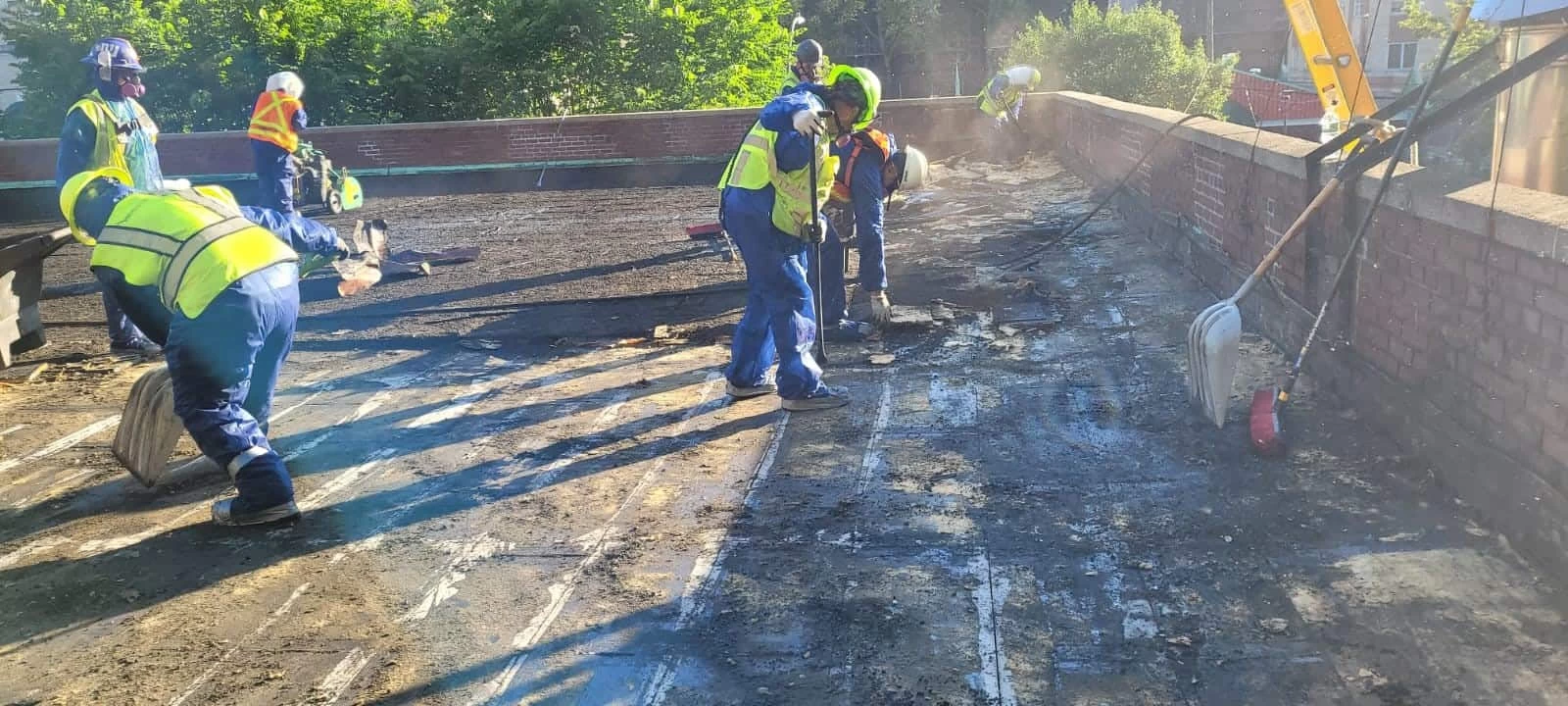
Once the notification period clears, our abatement crew establishes a contained work zone. In an occupied Canal Street building especially one with active retail or restaurant tenants on the lower floors this containment work is critical. Negative air pressure, sealed barriers, and proper PPE keep the rest of the building safe while the removal happens. Every step follows NYC DEP, NYS Department of Labor, EPA NESHAP, and OSHA standards.
After removal, post-abatement air clearance testing confirms the space is clean. That testing produces the ACP-21 completion documentation your DOB permit requires. When we hand you that paperwork, the job is done not just physically, but on paper, in the way the city actually needs it.
What's Covered in a Canal Street Abatement Project
Asbestos shows up differently in different buildings, and the buildings along Canal Street are as varied as they come. In a SoHo cast-iron building, you might be dealing with asbestos floor tiles, pipe insulation, and plaster sometimes in multiple layers from multiple renovation eras. In a Chinatown tenement, it’s often pipe wrap, ceiling materials, and old joint compound. In a Tribeca warehouse conversion, fireproofing and ductwork insulation are common culprits. Our team knows where to look in each building type and how to handle what we find.
The full scope of services we offer includes asbestos inspection and testing, asbestos tile removal, asbestos popcorn ceiling removal, pipe insulation abatement, containment and clean-up, and post-removal air clearance verification. For buildings in the SoHo-Cast Iron Historic District, where NYC Landmarks Preservation Commission requirements add another layer to any renovation project, we work within those constraints not around them.
If your project also involves water damage, mold, demolition, or storm damage, those are handled under the same roof. One call, one team, one point of contact from start to finish. For property owners managing complex, multi-issue projects in dense, occupied buildings near Canal Street, that’s not a convenience it’s the difference between a project that moves and one that stalls.
Do I need an ACP-5 form before renovating my Canal Street building?
Yes if your building was constructed before April 1, 1987, and your renovation requires a NYC Department of Buildings permit, you need an ACP-5 form before that permit can be processed. An ACP-5 is completed by a DEP-Certified Asbestos Investigator who surveys the affected areas and certifies either that no asbestos-containing materials will be disturbed, or that abatement is required before work begins.
Almost every building on or near Canal Street falls into the pre-1987 category. The cast-iron buildings of SoHo, the warehouse conversions of Tribeca, the tenement blocks of Chinatown the building stock along this corridor is among the oldest in Manhattan. If you skip this step and your contractor disturbs asbestos without the proper documentation, you’re looking at stop-work orders, fines, and a permit process that can be set back by months. Getting the ACP-5 handled upfront is not bureaucratic overhead it’s what keeps your Canal Street project on schedule.
What is the difference between an ACP-5 and an ACP-7 in New York City?
An ACP-5 is the form your certified asbestos investigator files after completing a pre-renovation survey. It either clears the project (certifying no asbestos will be disturbed) or triggers the need for abatement. An ACP-7 formally called an Asbestos Project Notification is what gets filed with NYC DEP when abatement is actually required. It must be submitted at least one week before any abatement work begins, along with the associated filing fee through NYC DEP’s ARTS online portal.
Think of it this way: the ACP-5 is the investigation result, and the ACP-7 is the abatement notice. Both are required at different stages, and neither can be skipped. Once the abatement is complete, NYC DEP issues an ACP-21 or ACP-20 completion form, which is what you’ll need to submit to DOB to move your permit forward. We manage this documentation sequence as part of the project you’re not left figuring out the filing process on your own.
How much does asbestos removal typically cost in Lower Manhattan?
Costs vary based on the size of the project, the type of materials involved, and the complexity of the building. For a pre-renovation asbestos survey conducted by a certified investigator, you’re generally looking at $650 to $2,200. A small residential abatement a single room, limited scope typically runs $2,200 to $6,500 all-in. Larger residential or commercial projects, or anything involving multiple material types across multiple floors, can run from $5,000 to $30,000 or more depending on scope.
It’s worth knowing that NYC and Long Island asbestos removal costs increased 8 to 12 percent in 2025 and 2026, driven by updated NYS Department of Labor licensing requirements and higher disposal fees. Post-abatement air clearance testing is mandatory in New York City and should be factored into any quote you receive if a contractor isn’t including it, ask why. For SoHo and Tribeca renovation projects where asbestos abatement is one line item in a much larger budget, the emphasis is usually on compliance certainty and schedule reliability. For Chinatown building owners managing tighter margins, transparent pricing and direct insurance billing become the priority.
Can my tenants stay in the building during asbestos abatement near Canal Street?
It depends on the scope of the work and where it’s happening within the building. For small, contained projects a single apartment unit, a limited area of pipe insulation it’s often possible for other occupants to remain in unaffected parts of the building, provided proper containment protocols are in place. For larger projects involving multiple floors or common areas, temporary relocation may be necessary.
In Canal Street’s mixed-use buildings where ground-floor retail or restaurant tenants may be operating while residents live above this question comes up constantly. The answer depends on how well the work zone is contained. We use negative air pressure systems, sealed barriers, and full HEPA filtration to isolate the abatement area from the rest of the building. The goal is always to keep disruption to a minimum without compromising the safety of anyone in the building. Before work begins, our team will walk through the specific layout with you and give you a clear picture of what’s realistic for your building’s occupancy situation.
Is asbestos common in SoHo cast-iron buildings and Tribeca loft conversions?
Yes and it’s not unusual to find it in multiple materials within the same building. SoHo’s cast-iron structures were built primarily between the 1850s and 1880s, and many went through industrial use and early renovation phases in the 20th century, when asbestos was widely used in floor tiles, pipe insulation, ceiling materials, plaster, and fireproofing. By the time those buildings were converted to artist lofts in the 1960s and 70s and then to luxury residences in the 80s and 90s additional asbestos-containing materials may have been added in layers on top of what was already there.
Tribeca warehouse conversions follow a similar pattern. The original industrial use often meant heavy asbestos application in fireproofing and ductwork. Subsequent renovations may have covered those materials rather than removed them. When you’re doing a gut renovation in one of these buildings today, you’re often uncovering materials from two or three different eras, each with its own asbestos risk profile. A thorough pre-renovation survey by a certified investigator is the only way to know what you’re actually dealing with before your contractor starts opening walls.
Does the September 11th contamination affect asbestos concerns in Canal Street buildings today?
The September 11, 2001 attacks released an estimated 400 tons of pulverized asbestos and other hazardous materials across Lower Manhattan in a toxic dust cloud that reached Canal Street and beyond. EPA testing conducted in the weeks following found asbestos levels exceeding the AHERA standard in more than a third of samples collected in September 2001. Canal Street was within the documented contamination zone, and up to 500,000 people were exposed.
For buildings in this area, that event is part of the environmental history and it’s one reason why Lower Manhattan residents and property owners tend to take airborne hazard concerns seriously. That said, the 9/11 contamination does not change the standard asbestos abatement process for building materials inside your property. The regulatory requirements ACP-5 surveys, ACP-7 notifications, certified abatement, post-clearance air testing apply the same way they do anywhere else in New York City. What it does reinforce is why post-abatement air clearance testing matters here. When the job is done, you want documentation confirming the air is clean not just an assumption.