Your 1960s East Northport Home Deserves an Honest Answer
Most homes in East Northport were built right in the middle of peak asbestos use and if yours hasn’t been fully renovated yet, there’s a good chance it’s still there. We give you the straight answer, the licensed removal, and the paperwork to move forward clean.
I needed a professional consultation explanation of procedure for safe removal of Asbestos in my apartment complex. Without having an account yet, I was very impressed with the caring, knowledgeable and generous advice offered by Jessica, and will look forward to doing business in the future. Thank you so much! I feel much more informed about a sometimes scary endeavor. Peace. Nancy Silva Mineola, NY.
Mia Munoz
Used this company to clean up some water flood in my house. They were fast and easy to work with.very professional, Would recommend to anyone!
Nini Valle
Great company, had a flood and they responded quickly and efficiently. Billed my insurance company directly. I highly recommend this company!
joe colapietro, jr
I had pipe freeze in my basement right before a snow storm and they made to within an hour to help start the clean up process. They we by our side throughout the entire process and even helped with the insurance company. They did such a great job with the cleanup, repair, remidiation, I contracted them to perform the repairs and finishes in the basement. They came with enough manpower and material to get the job done. Leo and Jessica were nothing but a pleasure to deal with!!
Cristian Arredondo c
I had some water damage in my home and Green Island was able to take care of my issue quickly and effectively. I am very pleased with the work they did. They responded quickly and were very professional.
Michael M
Outstanding service! From the office to the field crew everyone was friendly, helpful and responsive. I highly recommend Green Island Group.
Your renovation doesn’t have to stay on hold. When asbestos is identified and removed the right way permitted, contained, cleared your contractor can get back to work, your timeline gets back on track, and you’re not sitting on a liability that follows the house forever. That’s the real outcome most people are looking for when they call us.
East Northport’s housing stock is almost entirely made up of detached single-family homes, the majority built between the late 1940s and early 1970s. That’s not a coincidence it’s a pattern. And it means that nearly every kitchen gut renovation, bathroom remodel, or basement project in this community has a real chance of uncovering asbestos-containing materials before the demo crew even gets to lunch. Knowing that going in and having a licensed team ready is what keeps a renovation from turning into a three-week standstill.
Once the abatement is done and clearance testing confirms the space is clean, you walk away with documentation. That matters more than people realize. New York State requires asbestos disclosure in real estate transactions, and with median home values approaching $675,000 in East Northport, the last thing you want is an undocumented removal clouding a future sale. Getting it done right the first time protects the home, the project, and the investment.
We’re a Suffolk County environmental services company. We work in the same North Shore communities as our East Northport clients the same post-war colonials off Pulaski Road and Larkfield Road, the same split-levels near Fifth Avenue Elementary that make up the fabric of East Northport. This isn’t a franchise model where someone dispatches a crew from three counties over it’s a local team that knows exactly what homes built in this era look like from the inside out.
Every project we take on in the Town of Huntington is handled by NYS DOL-licensed contractors using certified asbestos workers. We pull the required permits, manage the containment, coordinate with your general contractor if one’s already on site, and deliver the full clearance documentation the Town of Huntington building department expects before a certificate of occupancy goes out.
We’re not the right call if you want the cheapest number on the page. We’re the right call if you want the job done in a way that holds up legally, medically, and on paper.
It starts with an inspection. Before anything gets removed, we identify where asbestos-containing materials are present or suspected and collect bulk samples for laboratory testing. In East Northport’s older homes, that typically means checking the obvious spots: the 9″x9″ vinyl floor tiles in the kitchen or basement, the popcorn ceiling texture in the bedrooms, the joint compound behind the drywall, and the pipe insulation wrapped around the boiler or steam heating system. We don’t skip steps here because the testing phase is what determines the scope of everything that follows.
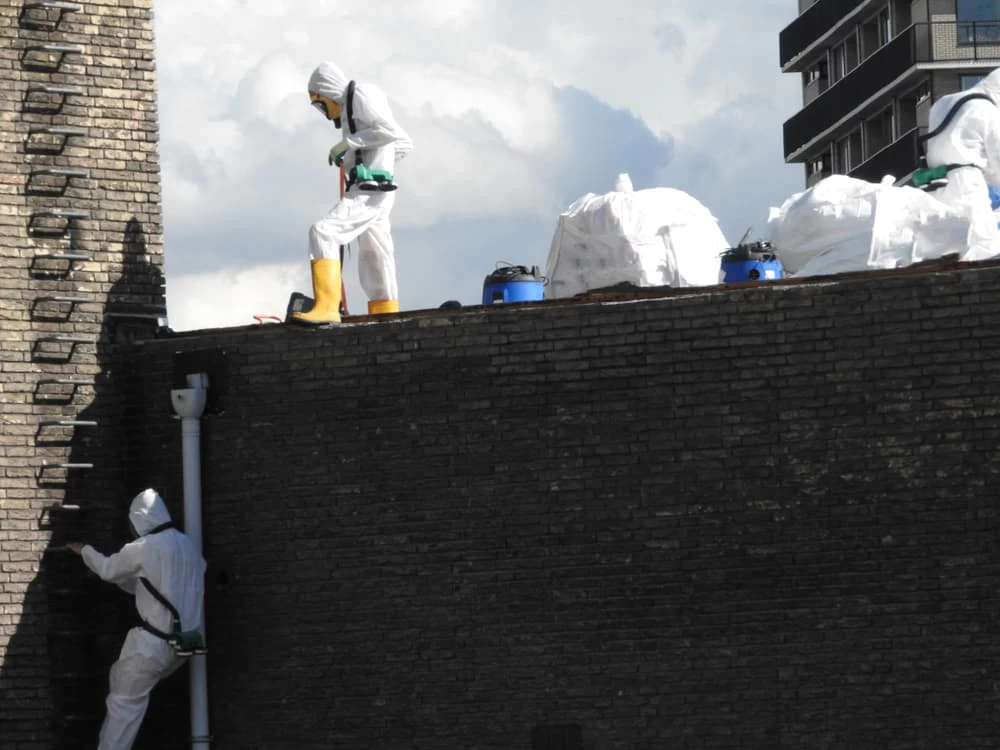
Once results are back and the scope is confirmed, we file for the required permit with the NYS Department of Labor’s Asbestos Control Bureau before any abatement work begins that’s not optional under New York State Industrial Code Rule 56, and any contractor who skips it is putting you at risk. The abatement itself involves full containment of the work area, negative air pressure to prevent fiber migration, HEPA filtration, and removal by certified workers following ICR-56 protocols. All material is disposed of at a licensed facility not a standard dumpster.
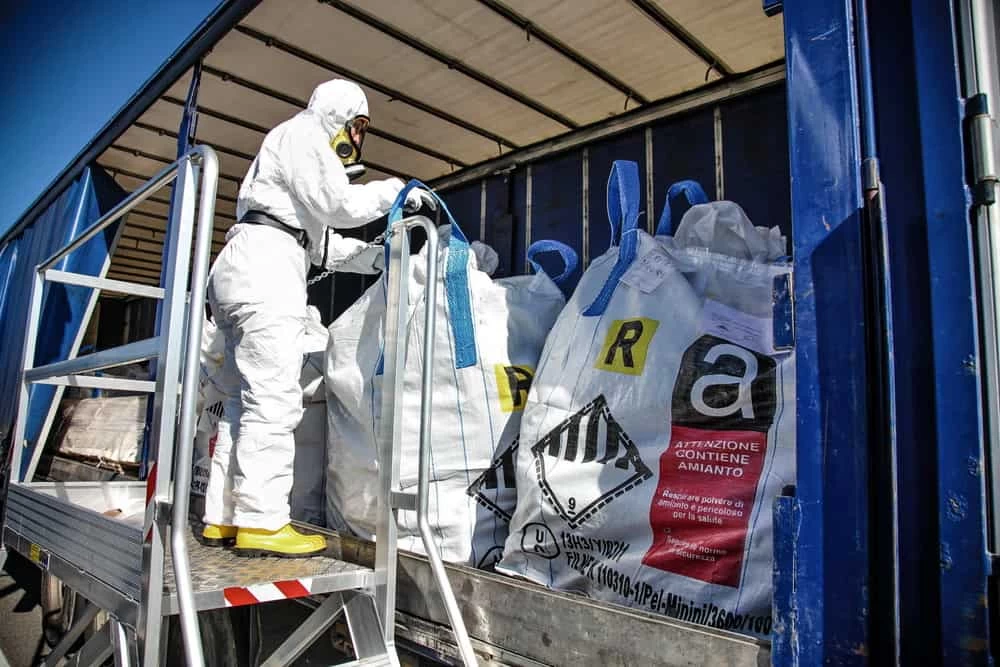
After the work is complete, we conduct post-abatement air monitoring to confirm the space is clear. You receive the full documentation package: the permit, the lab results, the disposal records, and the clearance test. That file is what your contractor needs to resume work, what the building department needs to close out your permit, and what a future buyer’s attorney will ask for if this comes up in a sale.
Asbestos Tile and Popcorn Ceiling Removal East Northport
The Materials We Find Most in Homes Like Yours
East Northport’s post-war homes have a predictable set of asbestos-containing materials predictable because we’ve seen them repeatedly in homes built during the same era, using the same materials, across the same North Shore Long Island neighborhoods. The most common are the 9″x9″ vinyl floor tiles installed in kitchens, bathrooms, and finished basements throughout the 1950s and 1960s, along with the black adhesive mastic beneath them. Both the tile and the mastic frequently contain asbestos, and both require licensed removal and proper disposal not a crowbar and a garbage bag.
Asbestos popcorn ceiling removal is another service we handle regularly in this area. The acoustic spray texture applied to ceilings throughout the 1960s and 1970s was widely used precisely because it was cheap, fast, and effective and it commonly contained chrysotile asbestos. Scraping it without containment releases fibers that can stay airborne for hours. We set up a fully sealed work area, use negative air pressure and HEPA filtration, and remove the material safely before handing the ceiling back to your contractor.
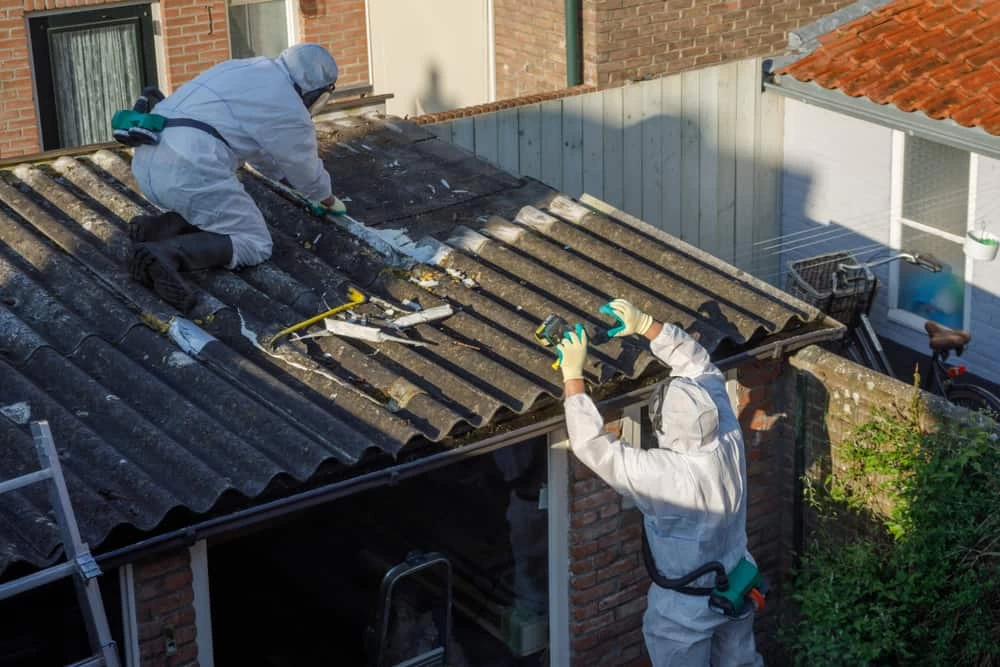
Beyond tile and ceilings, we also handle pipe insulation removal around steam and hot water heating systems extremely common in East Northport homes that still have original or partially updated oil-fired boilers as well as joint compound, ceiling tiles, and roofing or siding materials where applicable. Whatever the scope, the process is the same: test, permit, contain, remove, clear, document.
How do I know if my East Northport home actually has asbestos?
The honest answer is: you don’t know for certain until you test. But if your home was built between the late 1940s and the mid-1970s which describes the majority of East Northport’s housing stock there’s a meaningful probability that asbestos-containing materials are present somewhere in the structure. The most common locations are vinyl floor tiles and the mastic beneath them, popcorn ceiling texture, pipe and boiler insulation, and the joint compound used on drywall seams.
Visual inspection alone won’t tell you. Asbestos fibers are microscopic, and the materials that contain them often look identical to their non-asbestos counterparts. The only way to confirm presence is through bulk sampling and laboratory analysis. We collect samples from suspected materials, send them to an accredited lab, and give you a clear answer based on actual results not a guess. If testing comes back negative, you have documentation that says so. If it comes back positive, you know exactly what you’re dealing with and can make an informed decision about next steps.
What happens if a contractor already disturbed suspected asbestos during demo?
This happens more often than people expect, especially in East Northport where general contractors working on kitchen or bathroom renovations sometimes hit asbestos-containing materials before anyone realizes what they’re dealing with. If work has already started and you suspect asbestos was disturbed, the first step is to stop work in that area immediately and limit access to the space. Don’t run the HVAC system, don’t sweep or vacuum, and don’t let anyone continue demo until the situation is assessed.
We can come in, evaluate what was disturbed, and determine whether an emergency abatement response is needed. In some cases, the disturbance is minor and contained. In others, remediation of the surrounding area is required before work can safely continue. Either way, you need a licensed professional to make that call not a general contractor who isn’t certified to handle asbestos. Under NYS Industrial Code Rule 56, work involving asbestos-containing materials must be performed by licensed abatement contractors, and that requirement exists for good reason.
Does asbestos abatement require a permit in East Northport, NY?
Yes and this is one of the most important things to understand before hiring anyone for this work. New York State Industrial Code Rule 56 requires that a permit be obtained from the NYS Department of Labor’s Asbestos Control Bureau before any asbestos abatement work begins. This applies to residential projects in East Northport just as it does to commercial and industrial work. There are no carve-outs for small jobs or single-family homes.
The permit requirement exists because the ACB uses it to track abatement activity, conduct inspections, and ensure that the work is being done by licensed contractors using certified workers. If a contractor tells you a permit isn’t necessary for your job, that’s a red flag. Unpermitted abatement work can result in fines, can create problems when you go to sell the home, and most importantly leaves you with no verified documentation that the work was done correctly. We handle the permit filing as part of every project, so you’re not left navigating that process on your own.
How long does asbestos abatement typically take for a Long Island home renovation?
The timeline depends on the scope of the work, but for a typical East Northport home renovation say, a kitchen remodel where floor tiles and mastic need to be removed, or a bathroom update where popcorn ceiling texture is involved abatement often takes one to three days for the physical removal work itself. That doesn’t include the time needed for lab results before the job starts, or the post-abatement air monitoring and clearance testing that happens after.
From initial inspection to final clearance documentation, the full process typically runs one to two weeks, depending on lab turnaround times and permit processing. That timeline can feel frustrating when your contractor is standing by, but it’s not something that can be safely compressed. The clearance air test has to happen after the work is done and the area has settled rushing it defeats the purpose. We communicate clearly with both you and your contractor throughout the process so no one is left guessing where things stand.
Is asbestos popcorn ceiling removal something I can do myself in New York?
Technically, New York State law does not prohibit a homeowner from disturbing asbestos-containing materials in their own single-family residence but that legal technicality doesn’t make it safe or smart. Popcorn ceiling texture that contains asbestos releases airborne fibers when it’s scraped or sanded, and those fibers are what cause mesothelioma and asbestosis. The health risk is real, and it doesn’t come with immediate symptoms the consequences show up decades later.
Beyond the health risk, there’s a practical problem: if you remove the material yourself without documentation, you have no proof the work was done correctly. That matters when you go to sell your East Northport home, when you apply for a building permit for the next phase of your renovation, or when your contractor needs clearance to continue. A licensed abatement with proper air monitoring and clearance testing gives you a paper trail that protects you legally and financially. The cost of doing it right is a fraction of what it costs to deal with the consequences of doing it wrong.
How much does asbestos abatement cost for a home in East Northport, NY?
Cost varies based on what materials are present, how much of it needs to be removed, and where it’s located in the home. A localized removal one room of vinyl floor tile and mastic, or a single popcorn ceiling typically runs in the range of $1,500 to $4,000. Larger scopes that involve multiple materials across several areas of the home, or projects that include pipe insulation removal around a boiler system, can run $5,000 to $10,000 or more depending on the complexity.
In East Northport, where home values are close to $675,000 and most residents are investing significant money into renovations, the cost of abatement is usually a straightforward line item rather than a dealbreaker. What tends to matter more to homeowners here is knowing exactly what they’re getting: a licensed contractor, certified workers, proper permits, and documentation they can actually use. We provide a clear scope and price before any work begins so there are no surprises mid-project. If you’re in the middle of a renovation and need to understand what you’re dealing with, the best starting point is a conversation not a guess.