Hamilton Grange's Pre-War Buildings Deserve More Than a Guess
Most buildings in Hamilton Grange were built before asbestos restrictions existed. If you’re renovating, dealing with water damage, or just found out your DOB permit is on hold asbestos abatement starts with getting the right certified team in quickly.
I needed a professional consultation explanation of procedure for safe removal of Asbestos in my apartment complex. Without having an account yet, I was very impressed with the caring, knowledgeable and generous advice offered by Jessica, and will look forward to doing business in the future. Thank you so much! I feel much more informed about a sometimes scary endeavor. Peace. Nancy Silva Mineola, NY.
Mia Munoz
Used this company to clean up some water flood in my house. They were fast and easy to work with.very professional, Would recommend to anyone!
Nini Valle
Great company, had a flood and they responded quickly and efficiently. Billed my insurance company directly. I highly recommend this company!
joe colapietro, jr
I had pipe freeze in my basement right before a snow storm and they made to within an hour to help start the clean up process. They we by our side throughout the entire process and even helped with the insurance company. They did such a great job with the cleanup, repair, remidiation, I contracted them to perform the repairs and finishes in the basement. They came with enough manpower and material to get the job done. Leo and Jessica were nothing but a pleasure to deal with!!
Cristian Arredondo c
I had some water damage in my home and Green Island was able to take care of my issue quickly and effectively. I am very pleased with the work they did. They responded quickly and were very professional.
Michael M
Outstanding service! From the office to the field crew everyone was friendly, helpful and responsive. I highly recommend Green Island Group.
Your Permit Gets Unstuck. Your Building Stays Safe.
If you’re a building owner or property manager in Hamilton Grange, you already know how fast a renovation can stall. One asbestos flag during a DOB review and everything stops the contractor, the timeline, the permit. What changes after proper asbestos abatement isn’t just the air quality. It’s the ability to move forward.
Hamilton Grange’s housing stock is almost entirely pre-war. Brownstones and apartment buildings from the 1890s through the 1940s line nearly every block between 135th and 155th Streets. That means steam pipe insulation, floor tiles, plaster walls, and ceiling materials that were installed when asbestos was standard practice. It’s not a maybe it’s a near-certainty in this neighborhood, and treating it like a maybe is how projects get shut down and landlords end up with DEP violations.
When the abatement is done right contained, removed, documented, and cleared with post-abatement air testing you get something more valuable than a clean space. You get a compliance record that protects you from tenant complaints, future buyers raising flags, and agency enforcement. In a neighborhood with this much renovation activity and this much rental density, that documentation matters more than most people realize until they need it.
We’re a full-service environmental remediation and restoration company serving Hamilton Grange and the broader West Harlem corridor including Manhattanville, Washington Heights, and Morningside Heights. Every job we handle is completed in compliance with NYC DEP, NYS Department of Labor, EPA, and OSHA requirements. That’s not a tagline it’s the baseline for doing this work legally in New York City.
What sets us apart in a neighborhood like Hamilton Grange is our multi-service capability. A burst steam pipe in a 1920s apartment building doesn’t just mean water damage it means disturbed asbestos insulation and potential mold growth within 72 hours. Most contractors handle one of those problems. We handle all of them, under one license, one point of contact, and one invoice.
We’re available 24 hours a day, every day of the year, with verified response times of 30 minutes to one hour. When a building emergency hits at 2 a.m. on a January night and in Hamilton Grange’s aging building stock, they do you need someone who actually answers.
What the Process Looks Like Before Your Contractor Can Start
The first step is an assessment by a NYC DEP Certified Asbestos Investigator. For any building in Hamilton Grange constructed before April 1, 1987 which covers nearly every building in the neighborhood this assessment is required before the NYC Department of Buildings will issue a renovation permit. If asbestos-containing materials are found, an ACP-7 notification must be filed with NYC DEP at least 10 business days before abatement work begins. That window is fixed, and it affects your timeline whether you plan for it or not.
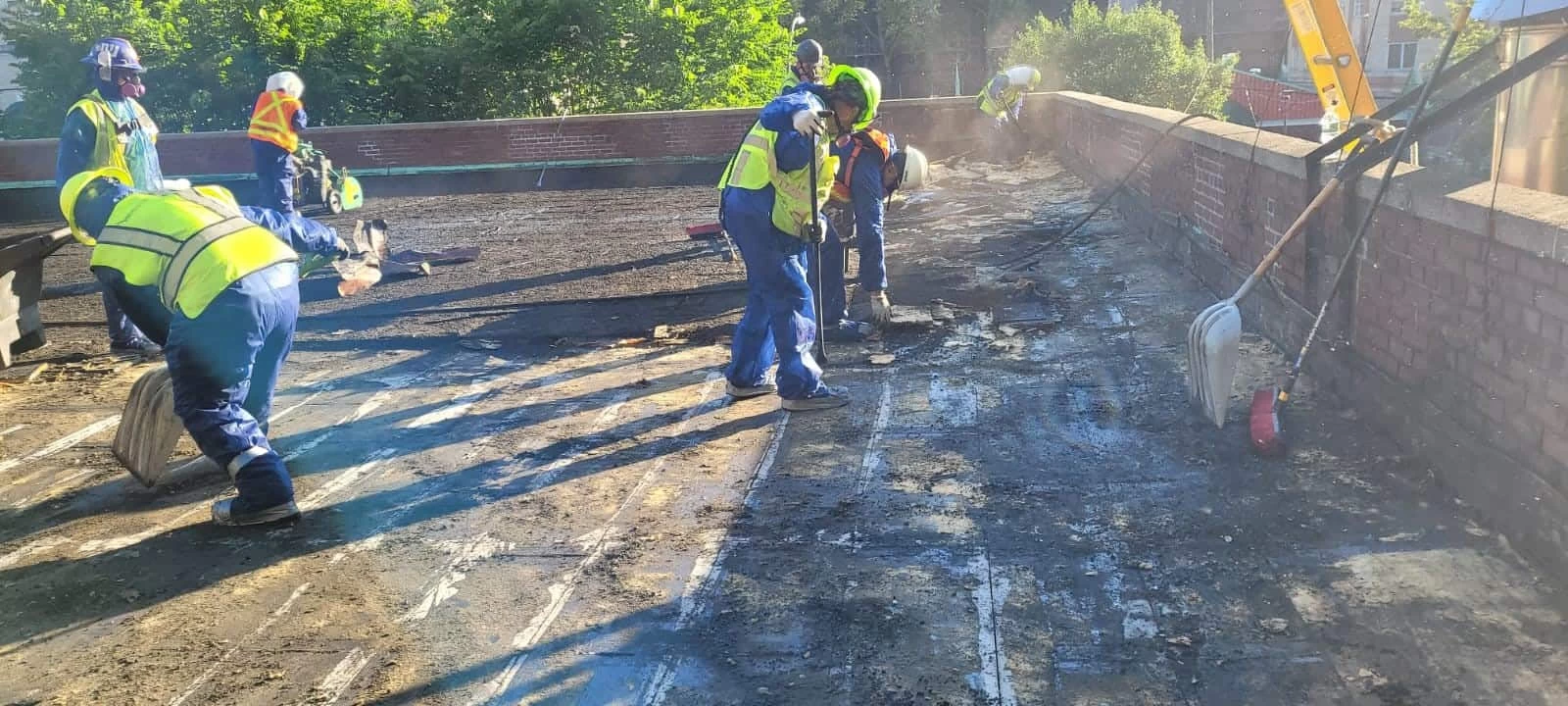
Once the notification period clears, our abatement team moves in. The work area is fully contained using negative air pressure and sealed barriers to prevent fiber migration into the rest of the building. Our certified technicians remove the materials whether that’s pipe insulation wrapping a steam system, floor tiles in a pre-war apartment, or textured ceiling material following strict NYSDOL Part 56 protocols. Disposal is handled through approved facilities, fully documented.
Before anyone re-enters the space, post-abatement air clearance testing is conducted by a certified project monitor. This isn’t optional in New York City it’s required, and it’s the proof that the job was done correctly. You get that documentation, which matters for your DOB permit, your insurance file, and your own records as a building owner in a neighborhood where tenant rights awareness runs high.
Asbestos abatement in Hamilton Grange isn’t a single task it’s a regulated sequence, and every step has to be done in the right order by the right licensed people. We handle the full scope: initial inspection and certified assessment, ACP-5 or ACP-7 filing with NYC DEP, full containment setup, material removal, licensed disposal, and post-abatement air clearance testing. Nothing gets handed off to a subcontractor mid-project.
The most common materials we find in Hamilton Grange’s pre-war building stock include steam pipe insulation the single most prevalent asbestos risk in this neighborhood’s aging heating infrastructure along with 9×9 and 12×12 floor tiles, joint compound, plaster, popcorn and textured ceilings, and roof shingles. If your building is in the Hamilton Heights Historic District, we’re also familiar with how abatement work intersects with Landmarks Preservation Commission requirements for exterior and structural projects.
For projects triggered by a covered event water damage from a burst pipe, storm infiltration, or fire we bill insurance carriers directly and walk you through the claims process. That’s not a perk, it’s a documented part of how we operate, confirmed in multiple verified customer reviews. Whether you’re managing one brownstone on Convent Avenue or a multi-unit building near City College, the process is the same: thorough, documented, and fully compliant.
Do I need an asbestos inspection before renovating my Hamilton Grange building?
Yes and it’s not optional. Under NYC Department of Buildings rules, any renovation, alteration, or demolition requiring a permit in a building constructed before April 1, 1987 requires an asbestos assessment first. That covers virtually every residential and commercial building in Hamilton Grange. Before a DOB permit can be issued, you’ll need either an ACP-5 Asbestos Certification Form confirming the project area is asbestos-free, or an ACP-7 notification filed with NYC DEP confirming that abatement has been or will be completed.
The assessment must be conducted by a NYC DEP Certified Asbestos Investigator not just any inspector, and not a general contractor making a visual judgment call. Skipping this step doesn’t save time. It typically results in a stop-work order, a DEP violation, and a longer delay than if you’d started the assessment process from the beginning. If your renovation is already in motion and this requirement caught you off guard, the right move is to call us immediately and get the assessment scheduled.
How long does the asbestos abatement process take in a Hamilton Grange apartment building?
The timeline depends on scope, but the single biggest fixed factor in New York City is the 10-business-day notification window. Once an ACP-7 is filed with NYC DEP, work legally cannot begin until that window closes. That’s two full calendar weeks minimum from the time the notification is submitted and it doesn’t start until the assessment is complete and the filing is in. For building owners in Hamilton Grange who are managing tenant schedules, contractor timelines, or a real estate closing date, this window needs to be factored in from day one.
The actual removal work, depending on the size and location of the affected area, typically takes one to three days for a standard residential scope a single apartment, a section of pipe insulation, or a ceiling in one unit. Larger projects covering multiple units or building-wide systems take longer. Post-abatement air clearance testing adds time after removal before reoccupancy is permitted. The honest answer is: start the process earlier than you think you need to, because the regulatory timeline in New York City doesn’t flex.
Is asbestos common in the steam pipe insulation in pre-war Manhattan buildings?
Extremely common. Steam heating systems were the standard in New York City apartment buildings constructed from the late 1800s through the mid-20th century, and asbestos was the insulation material of choice for steam pipes throughout that era. In Hamilton Grange, where the majority of the residential building stock dates to the 1890s through the 1940s, asbestos-wrapped steam pipes are one of the most frequently encountered asbestos-containing materials in the neighborhood.
The risk increases as these systems age. Pipe insulation that was intact and non-friable decades ago becomes brittle and damaged over time particularly in buildings where boilers have been replaced, pipes have been repaired, or sections of the heating system have been accessed for maintenance. Any disturbance of deteriorating pipe insulation releases asbestos fibers into the air. If your building has aging steam infrastructure and you’re planning any mechanical work, a certified assessment before that work starts is the right call not an afterthought.
What happens if asbestos is discovered during a Hamilton Grange real estate transaction?
It’s more common than most buyers and sellers expect, especially in Hamilton Grange’s active co-op and brownstone market. When asbestos is identified during a pre-purchase inspection or building survey, the transaction doesn’t automatically fall apart but it does create a decision point. The buyer, seller, or both need to determine whether the material is in a condition that requires immediate abatement, or whether it’s intact and can be managed in place with proper documentation.
If abatement is required before closing, the 10-business-day NYC DEP notification window becomes a direct factor in the closing timeline. That’s why getting us involved immediately not after a few rounds of negotiation is the move that actually protects the deal. We can assess the scope quickly, file the required notifications, and complete the abatement with post-clearance documentation in hand before closing. For Hamilton Grange properties, where the real estate market moves and closing timelines are real, speed and regulatory fluency matter.
Does homeowner's or building insurance cover asbestos removal in Manhattan?
It depends on how the asbestos was disturbed. Insurance coverage for asbestos abatement in New York City is typically triggered when the disturbance is the result of a covered event a burst pipe, storm water infiltration, or fire damage that damages or exposes asbestos-containing materials in the process. In those cases, the abatement is often covered as part of the broader damage restoration claim. Standalone asbestos removal for example, as part of a planned renovation is generally not covered by standard building or homeowner’s policies.
In Hamilton Grange’s pre-war building stock, the most common insurance-triggered scenario is a burst steam pipe during winter. The pipe itself causes water damage, and the disturbed asbestos insulation around it becomes an abatement requirement that’s part of the same claim. We handle both water damage restoration and asbestos abatement and bill insurance carriers directly. If you’re not sure whether your situation qualifies as a covered event, calling us first and letting us help you work through the claim is often faster than starting with the insurance company alone.
How much does asbestos abatement typically cost for a building in Hamilton Grange, NY?
Costs in New York City run higher than national averages, and that gap widened in recent years as NYC DEP licensing requirements were updated and disposal fees increased. For a Hamilton Grange property, a pre-renovation asbestos survey or assessment typically runs between $650 and $2,200. A small residential project one room of floor tiles or a popcorn ceiling generally comes in between $2,200 and $6,500 all-in, including containment, removal, disposal, and post-abatement air clearance testing. Steam pipe insulation removal, which is one of the most common scopes in this neighborhood’s pre-war buildings, is typically priced at $35 to $55 per linear foot. Larger multi-room or building-wide projects range from $5,000 to $30,000 or more depending on the extent of affected materials.
The NYC premium driven by DEP permitting, certified project monitor requirements for larger jobs, higher labor costs, and limited regional disposal capacity adds roughly 15 to 25 percent above what you’d pay in a suburban market. For building owners in Hamilton Grange, the more relevant number is usually what a DEP violation or a DOB stop-work order costs compared to doing the abatement correctly the first time. We provide free inspections and estimates, so you can get a real number for your specific property before committing to anything.