What Belleayre-Area Homeowners Find Behind the Walls
Highmount’s oldest properties were built for a resort era that didn’t ask questions about what was in the walls. We handle licensed asbestos abatement for homeowners and property owners along the Route 28 corridor who need answers and a clear path forward.
I needed a professional consultation explanation of procedure for safe removal of Asbestos in my apartment complex. Without having an account yet, I was very impressed with the caring, knowledgeable and generous advice offered by Jessica, and will look forward to doing business in the future. Thank you so much! I feel much more informed about a sometimes scary endeavor. Peace. Nancy Silva Mineola, NY.
Mia Munoz
Used this company to clean up some water flood in my house. They were fast and easy to work with.very professional, Would recommend to anyone!
Nini Valle
Great company, had a flood and they responded quickly and efficiently. Billed my insurance company directly. I highly recommend this company!
joe colapietro, jr
I had pipe freeze in my basement right before a snow storm and they made to within an hour to help start the clean up process. They we by our side throughout the entire process and even helped with the insurance company. They did such a great job with the cleanup, repair, remidiation, I contracted them to perform the repairs and finishes in the basement. They came with enough manpower and material to get the job done. Leo and Jessica were nothing but a pleasure to deal with!!
Cristian Arredondo c
I had some water damage in my home and Green Island was able to take care of my issue quickly and effectively. I am very pleased with the work they did. They responded quickly and were very professional.
Michael M
Outstanding service! From the office to the field crew everyone was friendly, helpful and responsive. I highly recommend Green Island Group.
Your Highmount Renovation Doesn't Have to Stay Stopped
Finding asbestos mid-project is one of the most frustrating things that can happen to a property owner. The work stops, the timeline shifts, and suddenly you’re trying to figure out who’s licensed, what the rules are, and how long this is going to take. We’re here to cut through that uncertainty.
Highmount’s housing stock is largely a product of the resort era boarding houses, private estates, and summer cottages built from the 1880s through the 1930s when asbestos was standard in pipe insulation, floor tiles, roofing, and plaster. If you’re renovating one of these properties, the odds that you’re dealing with asbestos-containing materials somewhere in the structure are high. It’s just the reality of buildings that age.
For the significant number of Highmount property owners who manage their Catskills homes from New York City, there’s an added layer of complexity. You can’t always be on-site. You need a contractor who communicates clearly, handles the permits, and delivers documentation you can actually use whether that’s for your insurance company, a future buyer, or your own peace of mind. That’s what a properly executed asbestos abatement job looks like when it’s done right.
We hold the NYS Department of Labor Asbestos Handling License the state-mandated credential that legally authorizes asbestos abatement work in New York. That’s not a detail buried in the fine print. It’s the single most important thing to verify before any contractor touches asbestos in your Highmount home, and it’s something you can look up in the NYS DOL database yourself.
Beyond the license, we carry USEPA Lead and RRP certifications, NYS MBE and WBE designations, and General Contractor licenses that allow for full-scope project work. For properties in the Town of Shandaken which covers Highmount, Pine Hill, Big Indian, and the surrounding hamlets along Route 28 that full-service capability matters. Older mountain properties rarely have just one issue, and having one credentialed team handle asbestos, mold, water damage, or structural work keeps your project moving instead of stalled between vendors.
From Discovery to Clearance, Here's What to Expect
It starts with a site assessment. Before any removal happens, the affected materials need to be properly identified and sampled by a certified asbestos investigator. If asbestos-containing materials are confirmed in the work area, abatement has to happen before your renovation contractor can proceed that’s not optional under NYS Industrial Code Rule 56, and skipping it creates serious legal and financial exposure.
Once the scope is confirmed, we handle the project notification required under state law, coordinate with the Town of Shandaken’s building department as needed, and set up proper containment before work begins. For properties in Highmount, that often means working around older heating systems with asbestos pipe insulation, floor tiles common to mid-century boarding house construction, or roofing and attic materials disturbed by ice dam damage all of which require specific handling protocols.
When the removal is complete, post-abatement air monitoring is conducted to confirm the space is clear. You get the clearance documentation in writing. That report is what proves the job was done not just started, not just finished, but verified. For anyone managing a Highmount property remotely, that paperwork is the proof of work you can hold onto long after the crew has left.
Asbestos abatement isn’t one thing it depends on what’s in your property and where. In Highmount, the most common scenarios involve pipe and boiler insulation in older heating systems, 9×9 floor tiles from mid-century renovations, popcorn ceiling texture applied during the 1960s and 70s, and roofing or attic insulation materials disturbed by the freeze-thaw stress and ice damming that Highmount’s high-elevation winters routinely produce. Each of those materials requires a different approach, and all of it falls under the same regulatory framework.
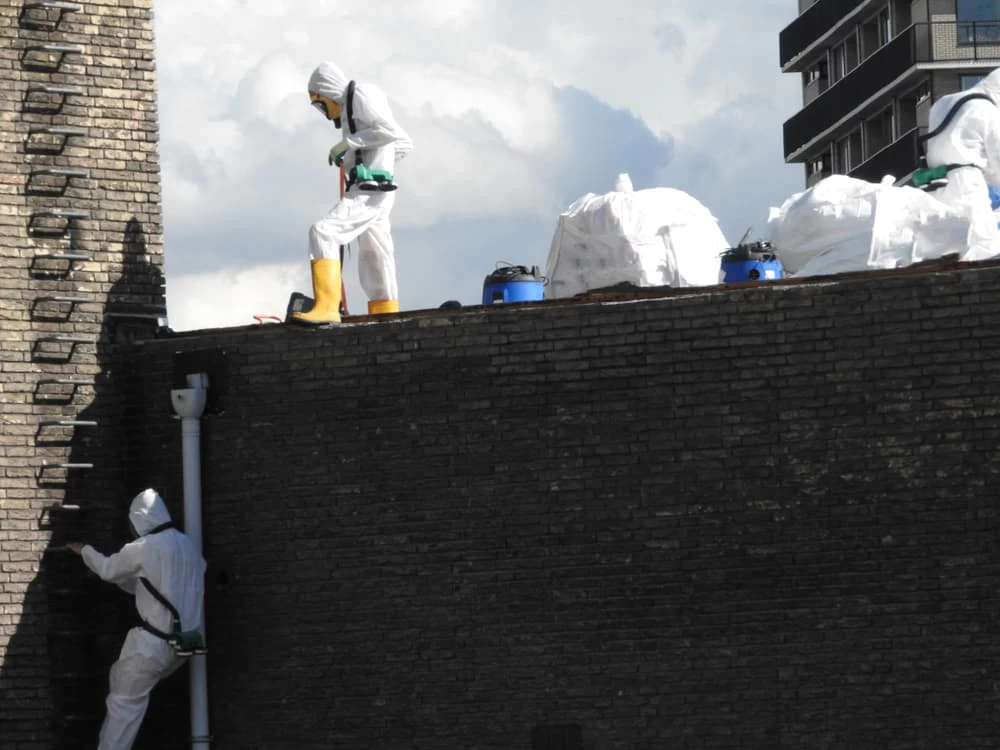
Our process covers the full scope: initial assessment and sampling, NYS DOL-compliant removal with proper containment and negative air pressure, licensed waste transport and disposal, and post-abatement air clearance testing with written documentation. If your project also involves mold, water intrusion, or fire damage which is common in Catskills properties that have been through hard winters or deferred maintenance that work can be handled under the same roof without bringing in a separate contractor.
For property owners dealing with an insurance claim, we bill insurance directly. If you’re managing a ski chalet off Belleayre Ridge Road or a historic home on Galli Curci Road from a few hours away, not having to front the cost and chase reimbursement is one less thing on your plate. The goal is to get your property cleared, documented, and ready for whatever comes next whether that’s a renovation, a sale, or simply getting back to using it.
Do I need an asbestos test before renovating my Highmount property?
In New York State, any renovation or demolition work that disturbs more than 10 square feet or 25 linear feet of material in a pre-1980 building requires an asbestos survey before work begins. That threshold is lower than most people expect, and it applies whether you’re pulling up old floor tiles, opening a wall, or replacing pipe insulation on a boiler system. If asbestos-containing materials are found in the affected area, a NYS DOL-licensed abatement contractor has to remove them before your renovation contractor can proceed.
For Highmount specifically, this matters more than it might in a newer suburb. The overwhelming majority of structures in the hamlet were built during the resort era the 1880s through the 1930s when asbestos was used in nearly every component of large-scale construction. If you’re working on a property that hasn’t been fully gutted and updated since then, assume the survey is going to find something until proven otherwise. Getting that testing done upfront is far less disruptive than stopping a renovation mid-demo because something unexpected turns up.
How long does asbestos abatement typically take for a residential property?
For a standard residential abatement say, pipe insulation in a basement mechanical room or floor tiles in a single room the removal work itself typically takes one to three days once the project is properly set up. The full timeline from initial assessment to final air clearance documentation is usually one to two weeks, depending on the scope, the permit processing time, and scheduling.
In Highmount, the timeline can be influenced by local factors. Properties with more complex building histories former boarding houses, multi-room resort-era structures, or homes that have had multiple renovation layers added over the decades tend to have more material to assess and potentially more to remove. If you’re managing the project remotely from the city and can’t be on-site every day, we coordinate directly with your renovation contractor and keep you updated so you’re not left guessing about where things stand. The goal is to get the clearance documentation in your hands as quickly as the process legitimately allows.
What happens if a contractor disturbs asbestos without a license in New York?
The consequences are serious and they fall on multiple parties. In New York, performing asbestos abatement without a NYS DOL Asbestos Handling License is a violation of Industrial Code Rule 56 and can result in significant fines, stop-work orders, and mandatory remediation at the property owner’s expense even if the property owner didn’t know the contractor was unlicensed. If the improperly disturbed material spread fibers through the property, a full re-remediation may be required before the building can be occupied or sold.
The Catskills region, including the Shandaken area around Highmount, has seen unlicensed contractors take advantage of remote property owners who aren’t on-site to verify credentials. If you’re hiring for any work that might disturb building materials in a pre-1980 structure, ask the contractor for their NYS DOL Asbestos Handling License number and verify it directly in the state’s online database before work begins. It takes five minutes and it protects you from a situation that can cost tens of thousands of dollars to clean up correctly.
Can ice dam damage to my roof trigger an asbestos problem?
Yes, and it’s more common in Highmount than most property owners realize. Highmount sits at one of the highest elevations in Ulster County, which means heavier snowfall, longer winters, and more severe freeze-thaw cycles than lower-elevation communities along Route 28. Ice dams form when heat escapes through the roof, melts snow at the ridge, and refreezes at the eaves and when they’re severe enough, they force water under roofing materials and into attic spaces.
If your roof or attic was built or last renovated before 1980, the roofing felts, insulation, or attic materials disturbed by that water intrusion may contain asbestos. Once those materials are wet and damaged, they can become friable meaning they’re capable of releasing fibers into the air. If you’ve had ice dam damage and you’re now dealing with a wet attic, damaged insulation, or deteriorating roofing materials in an older structure, getting an asbestos assessment before any repair work starts is the right call. It’s a straightforward step that prevents a repair project from becoming a much larger problem.
Is asbestos abatement covered by homeowner's insurance?
It depends on the circumstances. Standard homeowner’s insurance policies typically don’t cover asbestos removal as a standalone maintenance or renovation item if you’re renovating and discover asbestos, that’s generally considered a pre-existing condition and falls outside most policy coverage. However, if asbestos-containing materials are disturbed or damaged as a direct result of a covered event a storm, a pipe burst, structural damage from ice dam intrusion the abatement required to address that damage may be covered as part of the overall claim.
For Highmount property owners, the storm damage scenario is particularly relevant given the area’s climate. Winter storms, ice dam damage, and the flooding events that have become more frequent in the Catskills can all trigger situations where asbestos abatement is part of a legitimate insurance claim. We bill insurance directly and handle the documentation required to support the claim, which simplifies the process considerably especially for property owners who aren’t local and can’t manage the paperwork in person. The best starting point is always to call your insurer and ask specifically whether the triggering event is covered before assuming it isn’t.
How do I know the asbestos abatement job was actually done correctly?
The honest answer is: you need documentation, not just a verbal confirmation. Under NYS Industrial Code Rule 56, post-abatement air monitoring is required after asbestos removal to confirm that airborne fiber levels meet clearance standards before the containment is removed and the space is reopened. That monitoring is conducted by an independent certified industrial hygienist, and the results are documented in a written clearance report. That report is your proof not the contractor’s word, not a handshake, but a third-party verified air sample result showing the space is clear.
We provide post-abatement air clearance documentation as a standard part of every project. For Highmount property owners managing a vacation home or short-term rental from out of town, that report is especially important. It’s what you show a future buyer’s inspector, what satisfies your insurance company, and what protects you from liability if a guest or tenant ever raises a concern. NYS law also requires that project records be maintained for 30 years, so the documentation from a properly executed abatement job has long-term value well beyond the day the work is finished.