If your Hillside home was built before 1980, there’s a real chance asbestos is somewhere inside it. We handle licensed asbestos abatement in Hillside, NY from the first assessment to final air clearance.
I needed a professional consultation explanation of procedure for safe removal of Asbestos in my apartment complex. Without having an account yet, I was very impressed with the caring, knowledgeable and generous advice offered by Jessica, and will look forward to doing business in the future. Thank you so much! I feel much more informed about a sometimes scary endeavor. Peace. Nancy Silva Mineola, NY.
Mia Munoz
Used this company to clean up some water flood in my house. They were fast and easy to work with.very professional, Would recommend to anyone!
Nini Valle
Great company, had a flood and they responded quickly and efficiently. Billed my insurance company directly. I highly recommend this company!
joe colapietro, jr
I had pipe freeze in my basement right before a snow storm and they made to within an hour to help start the clean up process. They we by our side throughout the entire process and even helped with the insurance company. They did such a great job with the cleanup, repair, remidiation, I contracted them to perform the repairs and finishes in the basement. They came with enough manpower and material to get the job done. Leo and Jessica were nothing but a pleasure to deal with!!
Cristian Arredondo c
I had some water damage in my home and Green Island was able to take care of my issue quickly and effectively. I am very pleased with the work they did. They responded quickly and were very professional.
Michael M
Outstanding service! From the office to the field crew everyone was friendly, helpful and responsive. I highly recommend Green Island Group.
Most Hillside homeowners don’t go looking for asbestos. They find it mid-renovation a contractor pulls up old flooring, cuts into a wall, or spots crumbling insulation wrapped around a basement boiler, and suddenly the project stops. That moment is stressful, and it’s exactly when having the right team on call makes a real difference.
When the abatement is done correctly, you get your project back. The renovation moves forward, the inspection clears, and you have written documentation proving the work was completed by a licensed contractor under New York State oversight. That paperwork isn’t just a formality in an active real estate market where Hillside home values are pushing well past $500,000, it’s protection for your investment.
Hillside’s housing stock is predominantly mid-century construction, and Ulster County’s freeze-thaw winters accelerate the breakdown of older building materials. Pipe insulation, floor tiles, popcorn ceilings these don’t stay stable forever. Addressing them before they become friable, before a water event makes them worse, or before a buyer’s inspector finds them first, is the kind of decision that pays off long after the job is done.
In New York State, asbestos abatement above a certain threshold must be performed by a contractor holding a specific NYS Department of Labor Asbestos Handling License. Not a general contractor license this one. It’s enforced by the NYS DOL’s Asbestos Control Bureau, and the Albany district office covers Ulster County directly. We hold that license, and you can verify it through the NYS DOL’s public contractor database before you ever pick up the phone.
Beyond the asbestos credential, we carry IICRC certification, USEPA Lead and RRP certifications, NADCA certification for HVAC cleaning, and NYS MBE, WBE, and MWBE designations. That’s not a list for the sake of a list it’s the difference between a company that handles asbestos on the side and one that’s built its entire operation around environmental remediation done to code.
We serve Hillside as part of an established Ulster County service area, with documented project history throughout the region and teams that understand the local building stock, the Town of Ulster’s permitting process, and what mid-century homes along the Route 9W corridor are actually hiding.
No Guesswork Here's Exactly What the Process Looks Like
It starts with an assessment. Before any work begins, the material in question gets identified whether that’s 9×9 vinyl floor tiles and the black mastic adhesive beneath them, pipe insulation around an older boiler system, a popcorn ceiling that’s been there since the 1960s, or something else entirely. You’ll know what you’re dealing with and what the scope of work actually is.
From there, we handle the project notification required under NYS Industrial Code Rule 56 the filing that goes to the NYS DOL Asbestos Control Bureau before abatement begins. For Hillside homeowners, that means the Albany district office is in the loop before a single piece of material is disturbed. You don’t navigate that process yourself. We manage it.
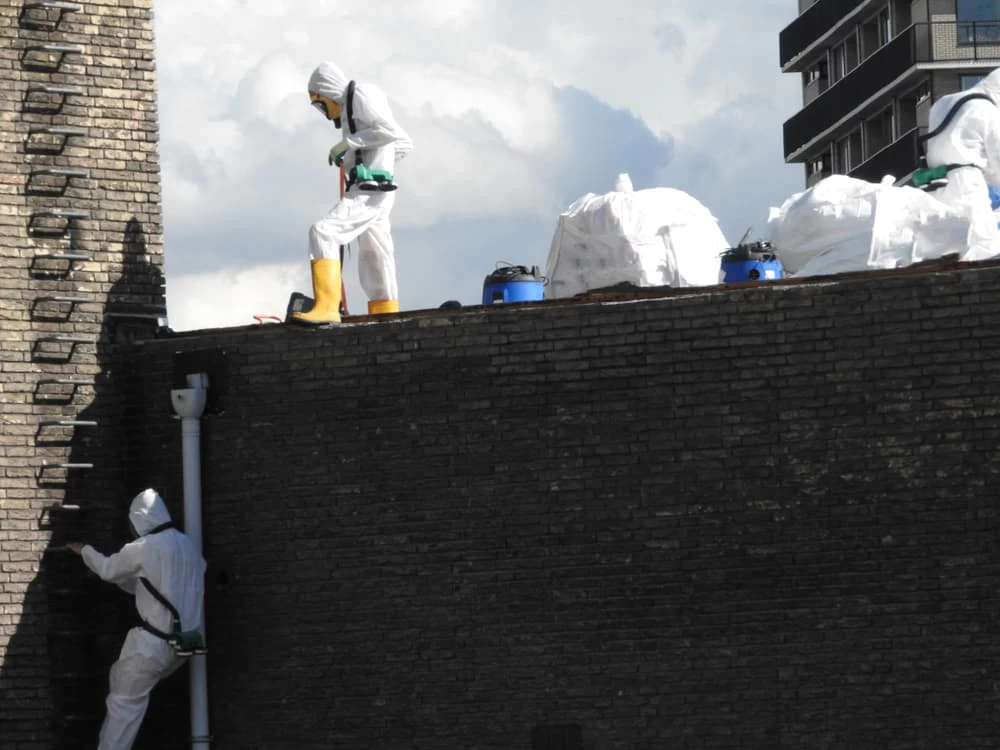
The abatement itself follows strict containment and removal protocols. Workers are certified, the work area is sealed, and disposal follows regulated waste handling requirements. When the physical removal is complete, post-abatement air monitoring is conducted not as an optional add-on, but as a standard part of the job. You receive written clearance documentation showing the air in your home meets state standards. That’s the paper you hand to a home inspector, a real estate buyer, or an insurance adjuster. It’s the proof the job was done right.
The most common asbestos-containing materials in Hillside’s pre-1980 housing stock follow a predictable pattern. The 9×9 vinyl floor tiles in kitchens, basements, and utility rooms and the black adhesive mastic underneath are among the most frequent finds. Popcorn and acoustic textured ceilings applied through the late 1970s are another. Pipe and boiler insulation in basement mechanical rooms is often the highest-risk material because it’s frequently friable by the time it’s discovered. Drywall joint compound, vermiculite attic insulation, and asbestos cement siding round out the list for homes built in that era.
We handle all of it asbestos tile removal, popcorn ceiling removal, pipe insulation abatement, and full interior remediation under one licensed roof. Because we also offer mold remediation, water damage restoration, and demolition services, you’re not managing multiple contractors when a water event exposes pipe insulation or a renovation uncovers more than one hazard. One team, one project manager, one process.
For Hillside homeowners preparing to sell, we can move quickly and deliver the documentation your transaction requires. For those mid-renovation, the focus is getting you back on schedule without cutting corners on the state compliance steps that protect you legally and financially. Free estimates are available, and you can reach us 24 hours a day.
Does my Hillside home actually need a licensed contractor for asbestos removal?
Yes and this is one of the most important things to understand before you hire anyone. Under New York State Industrial Code Rule 56, any asbestos disturbance involving 10 square feet or more of material, or 25 linear feet or more of pipe insulation, must be performed by a contractor holding a specific NYS Department of Labor Asbestos Handling License. A general contractor license does not qualify. This isn’t a gray area it’s a legal requirement enforced by the NYS DOL’s Asbestos Control Bureau.
For Hillside homeowners, that enforcement falls under the Albany district office, which covers all of Ulster County. If an unlicensed contractor removes asbestos-containing material from your home even with good intentions you’re left with no compliant documentation, potential liability, and no proof the work was done to code. Before you sign anything, ask for the NYS DOL license number and verify it through the state’s public contractor database. Our license is verifiable and current.
How much does asbestos removal typically cost for a home in Hillside, NY?
The range is genuinely wide because scope varies so much. A single-room project removing asbestos floor tiles in a kitchen or a popcorn ceiling in one bedroom typically runs somewhere between $1,500 and $5,000. Larger projects involving pipe insulation, multiple rooms, or full interior remediation can run significantly higher, with interior work generally priced in the range of $5 to $20 per square foot depending on material type, accessibility, and containment requirements.
What’s worth knowing for Hillside specifically is that post-abatement air monitoring which is now a standard requirement on New York State projects adds to the total cost but also adds something real: written clearance documentation. For a home valued at over $500,000 in an active real estate market, that paperwork has genuine financial value. It satisfies buyers, lenders, and inspectors. The best way to get an accurate number for your specific situation is a direct assessment we offer free estimates, and the scope can be confirmed on-site.
What are the most common places asbestos hides in older Hillside homes?
The materials that show up most often in Hillside’s mid-century housing stock follow a consistent pattern. The 9×9 inch vinyl floor tiles in kitchens, basements, and utility rooms are one of the most frequent finds and the black mastic adhesive used to install them is often asbestos-containing as well, even when the tiles themselves test negative. Popcorn and acoustic textured ceilings applied through the late 1970s are another common discovery, usually surfacing when homeowners plan to repaint, retexture, or install recessed lighting.
Pipe and boiler insulation in basement mechanical rooms tends to be the highest-risk material because it’s often already deteriorating by the time it’s found especially in homes that have gone through multiple winters of freeze-thaw cycling in Ulster County. Drywall joint compound used through the mid-1970s, vermiculite in attic insulation, and asbestos cement roof and siding materials round out the list. If your home was built before 1980 and you’re planning any renovation that opens walls, floors, or ceilings, an assessment before work starts is the right call.
Do I need an asbestos survey before renovating or demolishing part of my Hillside property?
For any demolition work in New York State, yes an asbestos survey is required before the work begins, regardless of when the building was constructed. The NYS Department of Labor clarified this requirement in September 2025: even buildings constructed after 1974 must either be surveyed or presumed to contain asbestos prior to demolition. This applies to full demolitions as well as partial ones, including interior gut renovations that involve removing walls, ceilings, or floors.
For Hillside homeowners pulling a permit from the Town of Ulster’s building department, the asbestos question needs to be addressed before renovation work proceeds. Discovering asbestos mid-project after walls are already open and dust has already spread is a more complicated and more expensive situation than identifying it upfront. Getting an assessment scheduled before your contractor starts is the cleaner path, and it keeps your project timeline intact rather than creating a forced stop.
How long does asbestos abatement take for a typical Hillside residential project?
For a contained residential project one or two rooms, floor tiles, or a single ceiling the abatement work itself typically takes one to three days. Larger projects involving pipe insulation, multiple floors, or more extensive material removal can take longer, sometimes a week or more depending on scope and the complexity of containment requirements.
What extends the overall timeline is the regulatory process, not the physical work. NYS Code Rule 56 requires project notification to the NYS DOL Asbestos Control Bureau before abatement begins, and post-abatement air monitoring has to be completed and cleared before the space is released for reoccupation or further renovation. We manage the notification filing on your behalf, which keeps the process moving without you having to navigate state paperwork. For Hillside homeowners who are mid-renovation and working against a contractor schedule, communicating that timeline upfront is part of how we manage the project not an afterthought.
Can asbestos abatement be billed through my homeowner's insurance in Hillside, NY?
It depends on how the asbestos was disturbed or discovered. If the material was damaged as a result of a covered event a pipe burst that soaked insulation, storm damage that compromised exterior materials, or a water event that made previously stable asbestos-containing materials friable there’s a reasonable basis for an insurance claim, and many policies do cover remediation costs in those scenarios. Asbestos discovered during a planned renovation, on the other hand, is typically not a covered loss under standard homeowner’s policies.
When insurance does apply, we bill the insurance company directly. That’s documented in client reviews and it’s a standard part of how we handle qualifying projects. For Hillside homeowners dealing with a water damage situation in an older home where asbestos and moisture problems often surface together having a contractor who can manage both the remediation and the insurance coordination in one conversation is a practical advantage. If you’re not sure whether your situation qualifies, the free estimate conversation is a good place to start.