1950s Homes in Johnson Are Built on Asbestos Here's What That Means
Most homes in Johnson were built in the 1950s the peak decade for asbestos use. We provide licensed asbestos abatement for Town of Minisink homeowners who need it done right, documented, and finished. When asbestos is properly removed and cleared, you stop carrying the risk. No more wondering what’s under the floor tiles, inside the pipe insulation, or behind the popcorn ceiling you’ve been meaning to deal with.
I needed a professional consultation explanation of procedure for safe removal of Asbestos in my apartment complex. Without having an account yet, I was very impressed with the caring, knowledgeable and generous advice offered by Jessica, and will look forward to doing business in the future. Thank you so much! I feel much more informed about a sometimes scary endeavor. Peace. Nancy Silva Mineola, NY.
Mia Munoz
Used this company to clean up some water flood in my house. They were fast and easy to work with.very professional, Would recommend to anyone!
Nini Valle
Great company, had a flood and they responded quickly and efficiently. Billed my insurance company directly. I highly recommend this company!
joe colapietro, jr
I had pipe freeze in my basement right before a snow storm and they made to within an hour to help start the clean up process. They we by our side throughout the entire process and even helped with the insurance company. They did such a great job with the cleanup, repair, remidiation, I contracted them to perform the repairs and finishes in the basement. They came with enough manpower and material to get the job done. Leo and Jessica were nothing but a pleasure to deal with!!
Cristian Arredondo c
I had some water damage in my home and Green Island was able to take care of my issue quickly and effectively. I am very pleased with the work they did. They responded quickly and were very professional.
Michael M
Outstanding service! From the office to the field crew everyone was friendly, helpful and responsive. I highly recommend Green Island Group.
When asbestos is properly removed and cleared, you get a written clearance certificate the kind that satisfies lenders, buyers, and building inspectors and you can move forward with your renovation, your sale, or your life.
For homes along County Route 22 and the Route 284 corridor in Johnson, asbestos risk is more common than most people realize. ZIP code 10933 housing stock is predominantly 1950s construction, which means vinyl asbestos floor tiles, asbestos-wrapped pipe insulation in basements, and joint compound with asbestos content are standard features not rare exceptions. Orange County’s freeze-thaw winters make this worse. A burst pipe in January doesn’t just cause water damage. If that pipe was insulated with asbestos, you now have a disturbance event on your hands.
The outcome of proper abatement isn’t just a cleaner home. It’s documented proof that the hazard was handled by a licensed contractor, air-tested by an independent industrial hygienist, and cleared to a standard that holds up legally. That documentation matters whether you’re renovating, selling, or simply trying to stop worrying.
We are a fully licensed asbestos abatement contractor serving Johnson, the Town of Minisink, and the broader Orange County region. We hold the NYS Department of Labor Asbestos Contractor License required by state law to legally perform this work and that license is publicly searchable on the NYS DOL website. You don’t have to take anyone’s word for it.
Beyond the license, we have performed abatement for the NYS Office of General Services, the Dormitory Authority of the State of New York, and the NYS Office of Mental Health. State agencies verify credentials, insurance minimums, and safety records before awarding contracts. That vetting process is more rigorous than any review platform, and it’s already been done.
We are also a NYS and NYC certified M/WBE contractor a government-audited designation, not a self-awarded one. For Johnson homeowners who want to know the company they’re trusting with their family’s health is genuinely accountable, that dual certification means two separate government bodies have already checked.
It starts with an assessment. A certified inspector walks the property and identifies any suspected asbestos-containing materials floor tiles, pipe insulation, ceiling texture, roofing felt, joint compound, whatever applies to your specific home. In a 1950s-era Johnson property, that usually means checking the basement first, then the main living areas, then any areas where renovation work is planned or already underway. Samples are collected and sent to an accredited lab. You get a clear report of what’s there and what needs to come out.
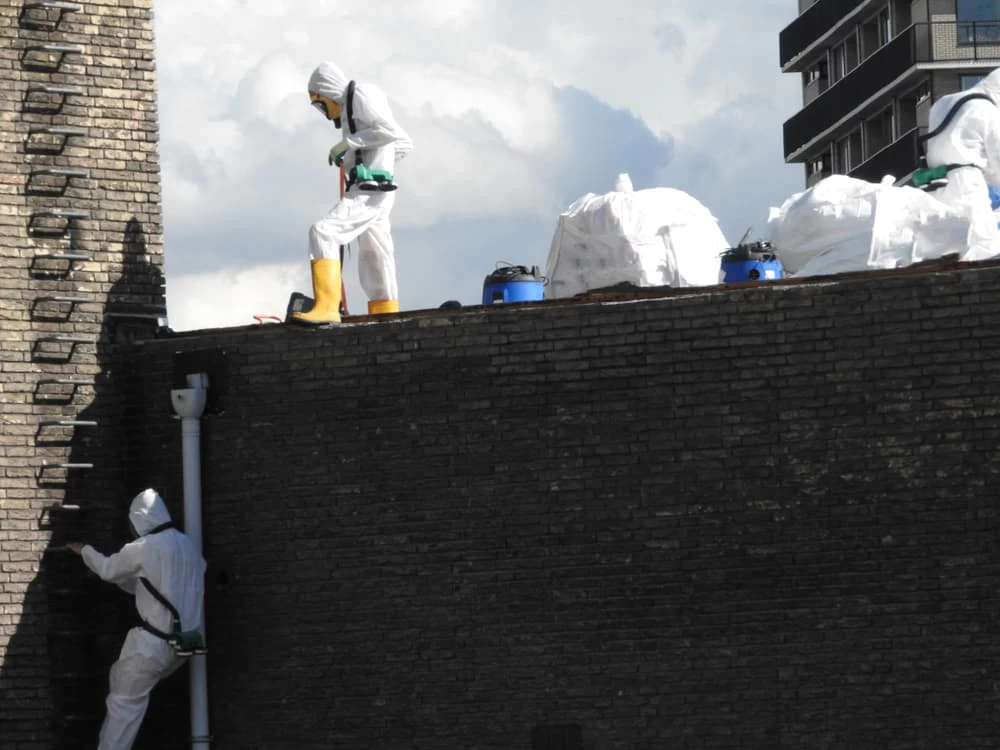
Once the scope is confirmed, the abatement work is planned in compliance with NYS Department of Labor 12 NYCRR Part 56 the state regulation that governs all asbestos removal in New York, including Orange County. The work area is contained, negative air pressure is established, and removal is performed by trained, licensed workers in full protective equipment. Nothing gets disturbed without containment in place. Asbestos waste is double-bagged in 6-mil poly, labeled, manifested, and transported to a licensed Class II disposal facility which is a legal requirement, not an optional step.
After removal, an independent industrial hygienist conducts post-abatement air monitoring. If the air clears, you receive a written clearance certificate. That certificate is what your general contractor, your real estate attorney, or your lender needs to see. We are available 24 hours a day if your situation is urgent and in a rural community like Johnson where contractor options are limited, that availability matters.
Asbestos abatement in a Johnson home isn’t a one-size situation. The materials vary, the scope varies, and the documentation requirements depend on what you’re doing with the property afterward. We handle the full range asbestos tile removal for those 9×9 vinyl floor tiles that are almost universal in 1950s Orange County homes, pipe and duct insulation removal in basements and crawlspaces, asbestos popcorn ceiling removal, roofing material abatement, and full-structure surveys before renovation or demolition. Whatever your situation requires, the process starts with an honest assessment, not a sales pitch.
Because many Johnson properties also have lead paint another standard feature of pre-1978 construction we handle lead abatement under the same project when needed. If water damage has introduced mold alongside the asbestos, that gets addressed too. One contractor, one project manager, one clearance process. For homeowners in a rural hamlet where coordinating multiple specialty contractors is genuinely difficult, that matters.
We also offer 0% APR financing up to $200,000 for qualifying projects and bill insurance companies directly for damage-related abatement work. If your asbestos situation is connected to a burst pipe, a storm event, or another covered loss common in Orange County’s winter climate we handle the insurance communication so you don’t have to. Real estate closings with asbestos disclosure requirements are also a regular part of our work here, and the documentation we produce meets lender and buyer standards.
Is asbestos common in Johnson, NY homes built in the 1950s?
Yes and not just common. In homes built during the 1950s, asbestos-containing materials were essentially standard. The most frequently found materials in that era include 9×9 vinyl floor tiles, pipe and duct insulation, popcorn or textured ceiling finishes, roofing felt, and joint compound used in walls and ceilings. ZIP code 10933 housing stock is predominantly 1950s construction, which means the odds are high that your Johnson home has at least one of these materials and possibly several.
The important thing to understand is that asbestos in place and undisturbed isn’t always an immediate emergency. The risk comes when materials are damaged, deteriorating, or disturbed during renovation work. Orange County’s freeze-thaw winters create pipe failures that can disturb asbestos-wrapped insulation without any renovation activity at all. If you’re planning any work on a home of this age in Johnson, a professional assessment before you start is the right move not after something gets torn out.
Can I legally remove asbestos myself in New York State?
No. New York State law requires that asbestos abatement be performed by a contractor holding a valid NYS Department of Labor Asbestos Contractor License. This applies in Orange County and the Town of Minisink just as it does anywhere else in the state. Unlicensed asbestos removal is a criminal violation under New York law, and the liability doesn’t fall only on the contractor it can fall on the property owner who authorized the work.
Beyond the legal issue, unlicensed removal typically produces no clearance documentation. That means no post-abatement air monitoring, no written clearance certificate, and no proof the work was done safely. If you later try to sell your Johnson property, refinance, or pull a permit for additional renovation work, the absence of that documentation becomes a serious problem. Doing it right the first time with a licensed contractor and independent air testing costs less in the long run than trying to fix a situation where unlicensed work was done.
What does asbestos abatement actually cost in Orange County, NY?
Cost depends on the scope what materials are present, how much square footage is involved, and what the post-abatement documentation requirements are. A single-room floor tile removal in a Johnson home will cost significantly less than a full-basement pipe insulation removal combined with ceiling abatement. Most residential projects in the Orange County area fall somewhere between a few hundred dollars for limited, contained work and several thousand for larger or multi-material scopes.
What drives cost up is scope, not contractor choice. The licensing, containment, disposal, and air monitoring requirements are the same regardless of who does the work those costs are built into every legitimate abatement project. What varies is whether the contractor is actually compliant with those requirements. A quote that seems unusually low is often a sign that containment, proper disposal, or post-abatement clearance testing is being skipped. We offer 0% APR financing up to $200,000 for qualifying projects, which means cost doesn’t have to be the reason a Johnson homeowner defers necessary work.
How long does asbestos abatement take in a Town of Minisink home?
The timeline depends on the scope of the project, but most residential abatement work in a Johnson-area home takes between one and three days for the removal itself. Smaller, contained jobs a single room of floor tiles or a section of pipe insulation can often be completed in a day. Larger projects involving multiple materials or multiple areas of the home take longer, and scheduling the independent post-abatement air monitoring adds time to the overall process before you receive your clearance certificate.
One thing that affects timing in the Town of Minisink specifically is that renovation permits may require asbestos survey documentation before they’re issued. If you’re mid-project and discover asbestos after work has already started, the general contractor typically has to stop until abatement is complete and cleared. Our 24/7 availability means you’re not waiting days just to get someone on the phone which matters when a project is on hold and a crew is idled.
What happens after the asbestos is removed do I need a clearance certificate?
Yes, and this is one of the most commonly misunderstood parts of the process. Removing the asbestos-containing material is not the final step. After abatement is complete, an independent industrial hygienist not the abatement contractor conducts post-abatement air monitoring to confirm that airborne fiber levels have returned to acceptable levels. If the air clears, a written clearance certificate is issued. That document is what legally confirms the space is safe to reoccupy and the work was done properly.
For Johnson homeowners involved in a real estate transaction, that clearance certificate is typically what a buyer’s lender or attorney will require before closing. For those pulling renovation permits through the Town of Minisink, it’s the documentation that closes out the abatement phase of the project. We include post-abatement air monitoring coordination as a standard part of every project not as an add-on you have to ask about separately. You get a complete, documented result, not just a crew that shows up and leaves.
Does homeowner's insurance cover asbestos abatement in Orange County?
It depends on how the asbestos was disturbed and what your specific policy covers. In many cases, if asbestos-containing materials were disturbed as a direct result of a covered loss a burst pipe in a Johnson basement that damaged asbestos-wrapped insulation, or storm damage to a roof with asbestos-containing felt the abatement may be covered as part of the broader claim. Policies vary significantly, and the language around environmental hazards is often buried in the fine print.
We bill insurance companies directly and work through the claims process on your behalf. That means if your situation is potentially covered, we handle the documentation and communication with your insurer you’re not left trying to translate abatement scope into insurance language on your own. Orange County’s winters create the exact conditions pipe failures, ice damage, water intrusion that most commonly lead to incidental asbestos disturbance in older homes. If that’s your situation in Johnson, it’s worth having someone who knows how to navigate the claim make the call before you assume you’re paying out of pocket.