Gold Coast Homes Deserve More Than a Generic Abatement Crew
Kings Point’s older estate homes carry history in their walls — and sometimes, hazardous materials too. We handle asbestos abatement the right way, with the licensing and local knowledge this village actually requires.
I needed a professional consultation explanation of procedure for safe removal of Asbestos in my apartment complex. Without having an account yet, I was very impressed with the caring, knowledgeable and generous advice offered by Jessica, and will look forward to doing business in the future. Thank you so much! I feel much more informed about a sometimes scary endeavor. Peace. Nancy Silva Mineola, NY.
Mia Munoz
Used this company to clean up some water flood in my house. They were fast and easy to work with.very professional, Would recommend to anyone!
Nini Valle
Great company, had a flood and they responded quickly and efficiently. Billed my insurance company directly. I highly recommend this company!
joe colapietro, jr
I had pipe freeze in my basement right before a snow storm and they made to within an hour to help start the clean up process. They we by our side throughout the entire process and even helped with the insurance company. They did such a great job with the cleanup, repair, remidiation, I contracted them to perform the repairs and finishes in the basement. They came with enough manpower and material to get the job done. Leo and Jessica were nothing but a pleasure to deal with!!
Cristian Arredondo c
I had some water damage in my home and Green Island was able to take care of my issue quickly and effectively. I am very pleased with the work they did. They responded quickly and were very professional.
Michael M
Outstanding service! From the office to the field crew everyone was friendly, helpful and responsive. I highly recommend Green Island Group.
You stop guessing. That’s the first thing. When you’re living in or renovating a home built during Kings Point’s mid-century boom — the era that took this village from 1,247 residents in 1940 to nearly 5,000 by the 1960s — there’s a real chance that asbestos is somewhere in the building. Popcorn ceilings, vinyl floor tiles, pipe insulation, boiler wrap. These weren’t rare materials back then. They were standard.
Once we’ve completed professional abatement and cleared the space, you can move forward. Renovation timelines stop being held hostage. Real estate transactions stop stalling. And if you’ve been putting off a basement conversion or kitchen gut because you weren’t sure what was behind those walls, that hesitation goes away.
Kings Point’s position on Long Island Sound matters here too. The year-round humidity, salt air, and moisture exposure that come with waterfront living don’t just affect your landscaping — they accelerate the deterioration of older building materials. Asbestos that’s been sitting in a damp basement or crawlspace for 50 years doesn’t stay intact forever. When it starts to break down, it becomes friable, meaning it releases fibers. That’s when the risk goes from theoretical to real. Getting ahead of it, especially in a waterfront property along East Shore Road or Toms Point, is the smarter move.
Licensed, Local, and Familiar with What Kings Point Homes Actually Contain
We’re a New York State licensed asbestos abatement contractor serving Nassau County, including Kings Point and the broader Great Neck Peninsula. We’re not a national chain dispatching crews from across the county. We already work in this area, and we understand the housing stock here — the layered construction history of pre-war estates, the mid-century colonials, the older mechanical systems in large basements that haven’t been touched in decades.
Kings Point’s Village Building Department is specific about asbestos compliance. Their own permit application states that remediation must comply with all applicable laws — and that’s not language you can navigate with an unlicensed contractor. When you hire us, you’re hiring a team that produces the documentation your building department, your real estate attorney, and your general contractor actually need.
We’ve worked alongside homeowners, renovation crews, and estate executors throughout the Great Neck area. We know how these projects run, what gets complicated, and how to keep things moving without cutting corners.
No Surprises — Here's Exactly How the Process Works
It starts with an inspection. Before anything gets removed, a certified inspector collects material samples from the areas of concern — ceiling finishes, floor tiles, pipe insulation, duct wrap, whatever is relevant to your project. Those samples go to an accredited laboratory, and you get results that tell you exactly what you’re dealing with and where.
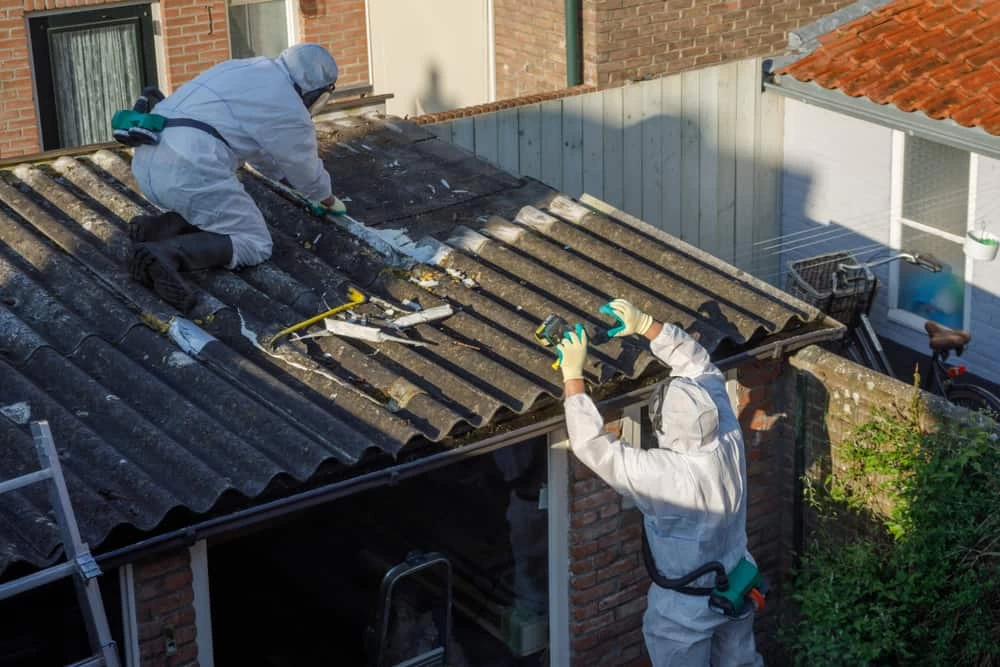
If abatement is needed, we build a scope of work based on those results. The work area gets fully contained with barrier systems and negative air pressure to prevent fiber migration into the rest of your home. HEPA-filtered air scrubbers run throughout the process. Removal is performed by certified asbestos handlers under New York State Industrial Code Rule 56, which governs every licensed abatement project in this state. For Kings Point homeowners pulling renovation permits through the village, this compliance documentation isn’t optional — it’s what the building department expects to see before your general contractor picks up a hammer.
After removal, post-abatement air clearance testing confirms that fiber levels are below regulatory limits. You receive a complete documentation package: the inspection report, lab results, waste disposal manifests, and clearance testing results. Whether you’re renovating a Gold Coast estate, closing a real estate transaction, or managing a family property on Bayview Avenue, that paperwork is what closes the loop and lets the next phase of your project begin.
The Specific Materials We Find Most Often in Kings Point Homes
The homes in Kings Point span a wide construction range — from early-20th-century Gold Coast estates near Gatsby Lane and East Shore Road to mid-century colonials built during the village’s post-WWII growth years. That range means the types of asbestos-containing materials we encounter here are broader than in more uniformly built communities.
Popcorn ceiling removal is one of the most common requests we handle in this area. Acoustic spray ceilings were applied widely from the 1950s through the late 1970s, and many Kings Point homes still have them in bedrooms, basements, and recreation rooms. Asbestos tile removal is another frequent scope — the 9×9 and 12×12 vinyl floor tiles used in mid-century construction, along with the black mastic adhesive underneath them, routinely contained asbestos. Basements and utility rooms are where we find them most often.
For the older estate homes, pipe and boiler insulation abatement is often the more complex piece. Large basements with original or partially-original heating systems frequently have asbestos-wrapped pipes and deteriorating boiler insulation — materials that were standard from the 1920s through the 1970s. We also handle duct wrap insulation, textured wall finishes, and joint compound removal as part of broader renovation prep. Every scope we produce is specific to what’s actually in your home, confirmed by laboratory analysis — not a one-size-fits-all estimate built on assumptions.
Does my Kings Point home likely have asbestos if it was built before 1980?
Statistically, yes — and the older the home, the more likely it is that multiple materials contain asbestos. Kings Point’s housing stock includes properties dating back to the 1910s and 1920s, when the Gold Coast era was at its peak, as well as the large wave of mid-century construction that followed World War II. Asbestos was a standard building material throughout that entire span — used in floor tiles, ceiling finishes, pipe insulation, roofing, siding, and more.
The only way to know for certain is professional testing. Visual inspection alone cannot confirm whether a material contains asbestos. A certified inspector collects physical samples, which are then analyzed by an accredited laboratory. If you’re planning any renovation that will disturb older materials — opening walls, removing flooring, replacing a ceiling, or updating a heating system — testing before you start is not just a good idea, it’s legally required in New York State above certain thresholds.
Do I need a permit for asbestos removal in Kings Point, and who handles that?
The Village of Kings Point requires that asbestos remediation comply with all applicable laws as part of the building permit process. That means if you’re pulling a renovation or demolition permit through the village’s Building Department, you need documented proof that any asbestos-containing materials were properly identified and abated by a licensed contractor before construction work begins.
At the state level, New York’s Industrial Code Rule 56 governs licensed abatement work. Projects above regulatory thresholds require a licensed contractor, certified handlers, proper notification to the New York State Department of Labor, and disposal at approved facilities with documented waste manifests. We handle the compliance side of this process — the notifications, the documentation, and the clearance testing results that your building department and general contractor need to keep the project moving. You don’t have to figure out the paperwork on your own.
How long does asbestos abatement take for a typical Kings Point renovation project?
It depends on the scope, but most residential abatement projects in Kings Point run anywhere from one day to several days. A single-room popcorn ceiling removal or a contained floor tile scope in a basement is typically completed within one to two days. Larger projects — like pipe and boiler insulation abatement in a full basement of a Gold Coast estate, or multi-room abatement ahead of a whole-house renovation — can take longer depending on the square footage and the complexity of the materials involved.
The timeline also includes the post-abatement air clearance testing phase, which must be completed before the work area is reopened and before your general contractor can begin renovation work. That testing typically takes 24 to 48 hours to process. We build realistic timelines upfront so your renovation schedule doesn’t get caught off guard. If you’re coordinating with a general contractor or working against a real estate closing date, let us know early — we can often structure the scope to work around your critical deadlines.
What does asbestos abatement actually cost for a home in Kings Point, NY?
Cost depends on the type of material, the quantity, and the accessibility of the work area. For a single-room popcorn ceiling removal in a standard-sized bedroom or basement, you’re generally looking at a few hundred dollars on the lower end. For larger or more complex scopes — full basement pipe insulation abatement, multi-room tile removal, or whole-house abatement ahead of a major renovation — costs can run into several thousand dollars, and for estate-scale projects, higher.
In the context of Kings Point’s real estate market, where homes routinely sell for $1 million or more and renovation budgets on larger estates can reach six figures, asbestos abatement is typically a modest line item relative to the overall project. What matters more than the abatement cost itself is making sure it’s done with proper documentation — because improperly handled abatement can create legal liability, delay real estate closings, and result in stop-work orders that cost far more than the abatement itself. We provide detailed written estimates before any work begins, so you know exactly what you’re committing to.
Can I just leave asbestos alone if it's not visibly damaged or disturbed?
In some cases, yes — asbestos that is intact, undisturbed, and in good condition poses a lower immediate risk than asbestos that has been damaged or has become friable. This is sometimes called “encapsulation in place,” and it’s a legitimate approach for materials that are not going to be disturbed by renovation or demolition work.
That said, Kings Point’s coastal environment adds a layer of consideration that doesn’t apply in drier inland communities. The year-round humidity, salt air, and moisture exposure from Long Island Sound accelerate the deterioration of older building materials. Pipe insulation, ceiling finishes, and floor tile adhesives that might stay intact for decades in a dry climate can degrade faster in a waterfront home. If you’ve noticed any crumbling, peeling, or water-damaged areas in older sections of your home — especially in basements, crawlspaces, or mechanical rooms — those materials should be professionally inspected before you assume they’re safe to leave alone. The risk profile changes significantly once a material becomes friable.
What happens if I discover asbestos during a renovation already in progress?
Stop work in that area immediately. This is the right call regardless of how far along the project is. Once asbestos-containing materials are disturbed — cut, scraped, drilled, or broken apart — fibers can become airborne and spread through the work area and into adjacent rooms. Continuing work without professional assessment at that point creates both a health risk and a legal liability.
In New York State, disturbing asbestos-containing materials above regulatory thresholds without a licensed contractor is a violation of Industrial Code Rule 56. If this happens on a permitted project in Kings Point, it can result in a stop-work order from the village’s Building Department, which halts the entire renovation — not just the affected area. The practical step is to call a licensed abatement contractor immediately, have the material tested and confirmed, and get a proper abatement scope in place before work resumes. It’s a frustrating interruption, but addressing it correctly protects your home, your family, your renovation timeline, and your legal standing with the village.