Kiryas Joel's Families Deserve Air That's Certified Clean
When asbestos turns up in your building, you need it gone the right way documented, verified, and cleared by an independent inspector. We handle asbestos abatement in Kiryas Joel, NY with full NYS licensing and zero shortcuts.
I needed a professional consultation explanation of procedure for safe removal of Asbestos in my apartment complex. Without having an account yet, I was very impressed with the caring, knowledgeable and generous advice offered by Jessica, and will look forward to doing business in the future. Thank you so much! I feel much more informed about a sometimes scary endeavor. Peace. Nancy Silva Mineola, NY.
Mia Munoz
Used this company to clean up some water flood in my house. They were fast and easy to work with.very professional, Would recommend to anyone!
Nini Valle
Great company, had a flood and they responded quickly and efficiently. Billed my insurance company directly. I highly recommend this company!
joe colapietro, jr
I had pipe freeze in my basement right before a snow storm and they made to within an hour to help start the clean up process. They we by our side throughout the entire process and even helped with the insurance company. They did such a great job with the cleanup, repair, remidiation, I contracted them to perform the repairs and finishes in the basement. They came with enough manpower and material to get the job done. Leo and Jessica were nothing but a pleasure to deal with!!
Cristian Arredondo c
I had some water damage in my home and Green Island was able to take care of my issue quickly and effectively. I am very pleased with the work they did. They responded quickly and were very professional.
Michael M
Outstanding service! From the office to the field crew everyone was friendly, helpful and responsive. I highly recommend Green Island Group.
Most people don’t think about asbestos until something forces them to a renovation, a repair, a contractor who stops mid-job and tells you there’s a problem. At that point, you’re not shopping around. You’re trying to figure out who can actually handle this correctly, how long it’s going to take, and whether your family can stay in the building while it happens. Those are the right questions, and they deserve straight answers.
Kiryas Joel is one of the most densely populated communities in New York State, and the vast majority of its housing was built after 2000 so asbestos isn’t always the first thing residents think about. But the community’s original buildings, the synagogues, schools, and residential complexes built in the 1970s and 1980s when the village was first established, are now approaching 50 years old. That’s exactly the age range where asbestos-containing materials show up in pipe insulation, ceiling tiles, floor tiles, and roofing. And with continuous renovation and construction happening throughout Kiryas Joel to accommodate one of the fastest-growing populations in the country, the chances of disturbing those materials without knowing it are real.
When asbestos abatement is done right, you get more than just removal. You get a written clearance certificate from an independent industrial hygienist confirming the air is clean before anyone re-enters the space. For a community where the average household has more young children than almost anywhere else in the United States, that documentation isn’t a formality it’s the whole point.
We are an independently owned environmental remediation contractor based in Orange County, serving Kiryas Joel and the surrounding region. We hold the NYS Department of Labor Asbestos Contractor License, USEPA Lead and RRP Certification, and all required handler certifications every credential required to legally perform asbestos abatement in New York State, verifiable on the NYS DOL website.
Beyond licensing, we carry NYS and NYC dual M/WBE certification a government-audited designation that requires financial review and ongoing compliance, not just an application. Our government contract portfolio includes the NYS Office of General Services, the Dormitory Authority of the State of New York, the NYS Office of Mental Health, Nassau County, and Suffolk County. These are public institutions that vet contractors before every award. That track record means something when you’re trying to decide who to trust with your building in Kiryas Joel.
We operate 24 hours a day, seven days a week, 365 days a year because asbestos discoveries don’t follow business hours, and neither do construction timelines or school-year maintenance windows.
No Guesswork Here's Exactly What the Process Looks Like
It starts with a thorough inspection and material assessment. Before any removal happens, the affected materials are identified, sampled, and tested. If asbestos-containing materials are confirmed, the scope of work is defined what needs to come out, how the containment will be set up, and what the timeline looks like for your specific building. For multi-unit residential buildings, which make up the majority of Kiryas Joel’s housing stock, this step also includes planning around tenant occupancy which units need to be vacated, for how long, and how residents will be notified.
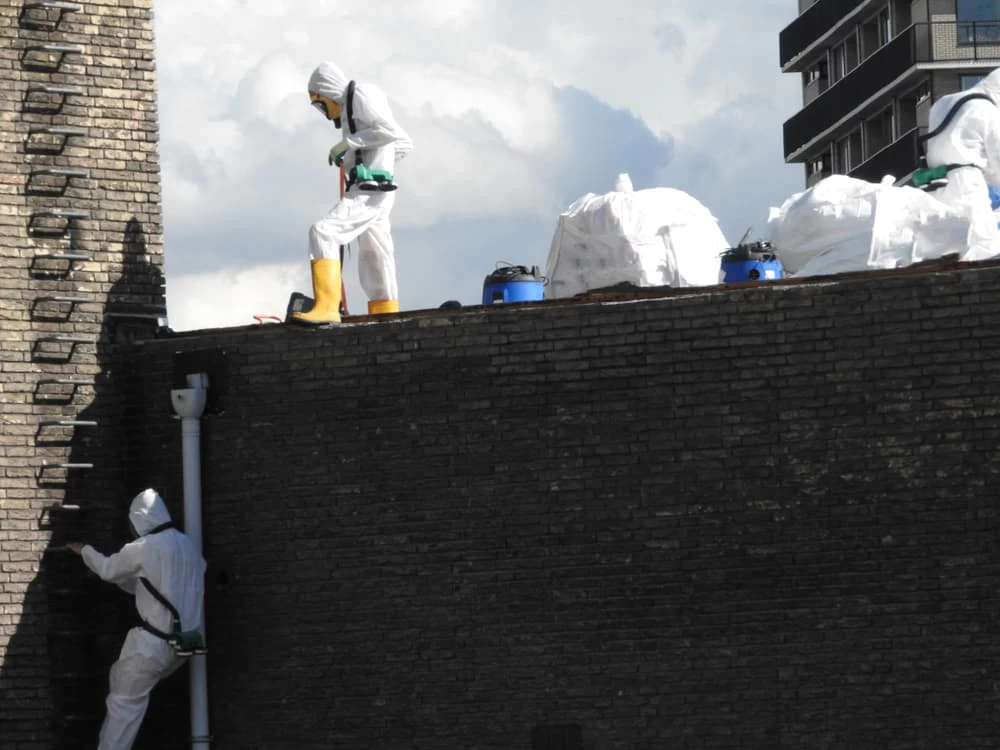
Once the plan is in place, the work begins under full containment. Negative air pressure systems are established to prevent fiber migration into adjacent spaces. Our workers are NYS-certified asbestos handlers. The removal follows NYS Industrial Code Rule 56 exactly no exceptions, no corners cut. For institutional buildings like schools or community centers, pre-project notification to the NYS Department of Labor is filed as required, and AHERA compliance documentation is prepared for any school building covered under federal regulations.
When the removal is complete, an independent industrial hygienist not someone on our payroll conducts post-abatement air monitoring. The space is not cleared for reoccupancy until the air sample results meet the required standards and the clearance certificate is issued in writing. That certificate is your documentation that the job was done completely and correctly. It’s what you’ll need for permits, for insurance, and for the peace of mind that comes with knowing your building is actually safe.
Built for Buildings Like the Ones in This Community
Asbestos abatement isn’t one-size-fits-all, and the buildings in and around Kiryas Joel reflect that. The community’s older institutional structures original school buildings, synagogues, and community centers built in the mid-1970s through 1980s commonly contain asbestos in pipe insulation, ceiling tiles, and floor tiles. Asbestos tile removal and asbestos popcorn ceiling removal are among the most frequent project types in buildings of that era, and both require licensed contractors and proper containment under New York State law, regardless of the size of the affected area.
For residential buildings and apartment complexes, we handle asbestos abatement at scale not just a single unit, but building-wide projects with the coordination, documentation, and tenant communication that multi-unit work requires. If you manage a large residential complex in Kiryas Joel or the surrounding area, the scope of a compliant abatement project is different from a single-family home, and the contractor you hire needs to understand that difference.
We also handle mold remediation, lead paint abatement, water damage restoration, fire damage restoration, and demolition all under one roof. For property managers and institutional facilities teams dealing with overlapping issues in the same building, having one licensed, accountable contractor for all of it reduces coordination time and eliminates the liability gaps that come with using multiple vendors. We offer financing at 0% APR for qualifying projects up to $200,000, because asbestos abatement rarely shows up in anyone’s budget until it has to.
Does newer construction in Kiryas Joel still have asbestos risks to worry about?
Most of Kiryas Joel’s residential housing was built after 2000, and the majority of post-1980 residential construction does not contain the asbestos-containing materials commonly found in older homes things like vinyl floor tiles, popcorn ceilings, and pipe insulation that defined residential construction from the 1940s through the late 1970s. So if you’re living in one of the newer apartment complexes or townhouse developments in the village, your home itself is unlikely to contain asbestos.
The risk in Kiryas Joel is more concentrated in the community’s older institutional buildings schools, synagogues, and community centers built in the 1970s and 1980s when the village was first established. These buildings are now 40 to 50 years old, which puts them squarely in the age range where asbestos-containing materials are a legitimate concern during renovation, repair, or demolition. If you’re managing, renovating, or doing maintenance work on any building in that age range, a professional asbestos survey before the work starts is not optional under New York State law it’s required.
What happens if asbestos is found during a renovation or repair project?
Work stops until the asbestos is properly addressed. That’s not a recommendation it’s the law under NYS Industrial Code Rule 56. Any renovation, remodeling, repair, or demolition that disturbs building materials in a structure that may contain asbestos requires a licensed contractor to assess, contain, and remove those materials before the project can continue. Continuing work after asbestos is identified without going through the proper abatement process exposes the property owner to significant legal liability, and any building permit sign-off will require documentation of compliant abatement.
In practical terms, this means you call us, get the affected area inspected and tested, and if asbestos-containing materials are confirmed have them removed under full containment by certified handlers. We can typically move quickly on initial assessments, and our 24/7 availability means you’re not sitting on a stopped project waiting for business hours. Once abatement is complete and the independent clearance certificate is issued, your renovation can proceed.
How does asbestos abatement work in an occupied apartment building?
Multi-unit abatement in an occupied building is more complex than a single-unit project, and it requires more planning upfront. The first step is determining which units or common areas are affected and whether residents in adjacent units need to be temporarily relocated during the work. Containment is established to isolate the work area from the rest of the building negative air pressure systems prevent fiber migration into hallways, stairwells, or neighboring units. Residents are notified in advance, and the work schedule is coordinated to minimize disruption.
Given that Kiryas Joel’s housing stock is predominantly large apartment complexes and multi-unit buildings with very high occupancy many housing large families with young children the planning and communication around tenant safety is taken seriously on every project. Post-abatement air monitoring is conducted in and around the work area before any residents return, and the written clearance certificate documents that the air quality meets required standards. If you manage a residential building in Kiryas Joel and have concerns about asbestos in common areas or aging building systems, a building-wide inspection is the right starting point.
Are school buildings in Kiryas Joel required to follow specific asbestos rules?
Yes all school buildings, public and private, are subject to AHERA, the Asbestos Hazard Emergency Response Act. AHERA requires schools to have an asbestos management plan on file, conduct periodic inspections of all building materials, and use accredited contractors for any inspection, abatement, or operations and maintenance work. The United Talmudical Academy of Kiryas Joel, with over 9,000 students enrolled, and the Kiryas Joel Union Free School District are both subject to these requirements.
In practical terms, AHERA compliance means that any renovation, repair, or maintenance work in a school building that might disturb building materials requires prior inspection by an accredited inspector and, if asbestos-containing materials are present, abatement by an AHERA-accredited contractor before the work proceeds. The summer months between academic years are the primary window for this type of work abatement in occupied school buildings is heavily restricted. We have experience with institutional asbestos projects and the documentation requirements that come with AHERA compliance. If you’re responsible for facilities at a school or educational institution in Kiryas Joel, getting the inspection and management plan in order before you need it is always the better position to be in.
How much does asbestos abatement typically cost in Orange County, NY?
The honest answer is that cost varies significantly based on the size of the affected area, the type of material being removed, and the complexity of the project. A small residential abatement removing asbestos floor tiles in a single room or addressing a limited section of pipe insulation might run anywhere from $1,500 to $4,000. Larger projects, particularly in multi-unit buildings or institutional facilities, can run substantially higher depending on scope.
What drives cost up is usually one of three things: the volume of material that needs to come out, the accessibility of the affected area, and the complexity of containment in an occupied or densely configured space. In Kiryas Joel, where large apartment buildings house many families in close proximity, multi-unit abatement projects tend to be more involved than single-family residential work. We offer 0% APR financing for qualifying projects up to $200,000, which makes it possible to handle a large or unexpected abatement project without a financial emergency. The more important cost conversation is the one about what happens if asbestos is disturbed without proper abatement the liability, the remediation of a larger affected area, and the regulatory consequences are all significantly more expensive than doing it right the first time.
How do I know the asbestos removal was actually done completely and correctly?
The answer is the clearance certificate and it only means something if it comes from an independent industrial hygienist, not the same contractor who did the removal. After abatement is complete, air samples are collected from the work area and analyzed by an accredited laboratory. If the results meet the required standards under NYS Industrial Code Rule 56, the industrial hygienist issues a written clearance certificate confirming the space is safe for reoccupancy. That document is your proof for your own peace of mind, for your insurance carrier, for any building permit process, and for the families living or working in the building.
We use independent industrial hygienists on every project not in-house staff, not affiliated companies. The separation matters because the hygienist’s job is to confirm the work was done correctly, not to protect the contractor’s reputation. For a community like Kiryas Joel, where the average household includes many young children and buildings house dozens or hundreds of families, the clearance certificate isn’t a technicality. It’s the only acceptable way to close out an abatement project. If a contractor isn’t offering post-abatement air monitoring and a written clearance certificate as a standard part of the job, that’s a significant problem worth asking about before any work begins.