Your 1950s Cape Cod Deserves a Straight Answer About What's In It
Most homes in Malverne Park Oaks were built during the exact decades when asbestos was standard. If you’re renovating, selling, or just finally asking the question — we give you a straight answer and handle it right.
I needed a professional consultation explanation of procedure for safe removal of Asbestos in my apartment complex. Without having an account yet, I was very impressed with the caring, knowledgeable and generous advice offered by Jessica, and will look forward to doing business in the future. Thank you so much! I feel much more informed about a sometimes scary endeavor. Peace. Nancy Silva Mineola, NY.
Mia Munoz
Used this company to clean up some water flood in my house. They were fast and easy to work with.very professional, Would recommend to anyone!
Nini Valle
Great company, had a flood and they responded quickly and efficiently. Billed my insurance company directly. I highly recommend this company!
joe colapietro, jr
I had pipe freeze in my basement right before a snow storm and they made to within an hour to help start the clean up process. They we by our side throughout the entire process and even helped with the insurance company. They did such a great job with the cleanup, repair, remidiation, I contracted them to perform the repairs and finishes in the basement. They came with enough manpower and material to get the job done. Leo and Jessica were nothing but a pleasure to deal with!!
Cristian Arredondo c
I had some water damage in my home and Green Island was able to take care of my issue quickly and effectively. I am very pleased with the work they did. They responded quickly and were very professional.
Michael M
Outstanding service! From the office to the field crew everyone was friendly, helpful and responsive. I highly recommend Green Island Group.
You stop guessing. That’s the first thing. Whether it’s the floor tiles in your kitchen, the textured ceiling in your living room, or the insulation wrapped around the pipes in your boiler room — once it’s properly removed and documented, you’re not carrying that uncertainty anymore. No more wondering every time someone talks about renovating.
For Malverne Park Oaks homeowners specifically, that matters more than most people realize. The housing stock here is almost entirely postwar — Cape Cods, ranches, and split-levels built between the late 1940s and the mid-1960s. That’s the window when asbestos was used in nearly everything: floor tile adhesive, ceiling coatings, pipe wrap, duct insulation, even the siding on some homes. If your house was built in that era, there’s a real chance it has at least one asbestos-containing material. Probably more than one.
The other thing that changes is your position in a real estate transaction. Nassau County buyers’ attorneys know what to look for, and home inspectors on the South Shore flag potential ACMs routinely. When you have a completed abatement with proper documentation — air monitoring results, disposal manifests, a written clearance letter — you’re not scrambling at the closing table. You’re prepared. That’s a different conversation entirely.
Licensed Asbestos Contractor Serving Malverne Park Oaks
We've Worked in These Homes. We Know What We're Looking At.
We are a New York State licensed asbestos abatement contractor — not a restoration franchise that added environmental services to a menu, and not a national call center dispatching whoever’s available. Every technician who walks into your Malverne Park Oaks home holds an individual NYSDOL asbestos handler certification. The crew you meet is the crew that does the work.
We’ve spent years working in the mid-century residential housing stock across Nassau County’s South Shore — the same neighborhoods, the same builders, the same materials. We know what a 1958 ranch in Malverne Park Oaks typically looks like behind the walls and under the floors. That’s not a sales line. It’s just what comes from doing this work in one region long enough to know it well.
Malverne Park Oaks sits within the Town of Hempstead, which means permitting and oversight run through a specific set of channels that we navigate every day. We handle the NYSDOL notification requirements, the air monitoring, the disposal documentation — all of it — so you don’t have to figure it out yourself.
Asbestos Remediation Process in Malverne Park Oaks
No Surprises — Here's Exactly What the Process Looks Like
It starts with an on-site assessment. We come to your home, walk the space, and identify any materials that are suspect or confirmed to contain asbestos. If sampling is needed, we collect it and send it to an accredited lab. You get a clear picture of what you’re dealing with before anything else happens.
From there, we put together a written proposal that defines the scope precisely — which materials are being removed, how the containment will be set up, what the timeline looks like, and what documentation you’ll receive at the end. There’s no vague language and no scope that quietly expands once work begins. Before we start any abatement in Malverne Park Oaks, we submit the required notification to the New York State Department of Labor under Industrial Code Rule 56. That’s a legal requirement, and it’s one of the things that separates a properly run project from one that creates problems down the road.
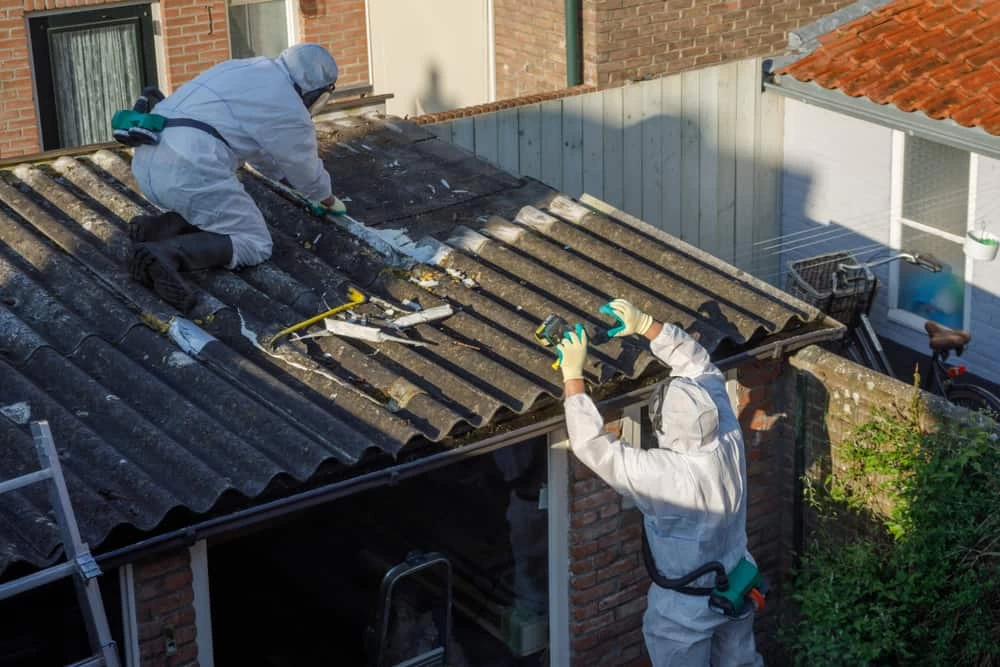
During the work itself, we establish full negative-pressure containment to isolate the work area from the rest of your home. Wet-removal methods keep fiber release to a minimum. A licensed air monitoring technician runs testing throughout and confirms clearance before containment comes down. When the job is complete, you receive the full documentation package — everything a closing attorney, home inspector, or building department would need to see.
Asbestos Tile and Popcorn Ceiling Removal in Nassau County
The Materials Most Common in Malverne Park Oaks Homes — and How We Handle Them
The two most frequently encountered asbestos-containing materials in this area’s housing stock are 9″x9″ vinyl asphalt floor tiles and textured popcorn ceilings. Both were standard in postwar Nassau County construction, and both require specific handling under New York State regulations. With floor tiles, it’s not just the tile itself — the black mastic adhesive underneath frequently contains asbestos too. Removing the tile without addressing the mastic leaves the hazard behind. We remove both, fully, with documentation to match.
Popcorn ceiling removal is often the first thing that comes up when a Malverne Park Oaks homeowner starts planning a kitchen update or living room renovation. If that ceiling was applied before 1980, it needs to be tested before any other contractor touches it. We handle the removal under full containment so your renovation can move forward on schedule without creating a compliance problem.
Beyond tiles and ceilings, we also handle pipe and boiler insulation — which is common in the oil-fired steam heat systems that were standard in homes built in this era — as well as duct wrap, transite siding, and joint compound. Every project includes NYSDOL-compliant notification, certified air monitoring, proper waste disposal at an approved Nassau County facility, and a complete project documentation package. If you’re in the middle of a real estate transaction, that paperwork is exactly what your attorney needs to close clean.
Does my Malverne Park Oaks home actually have asbestos, or is this just a precaution?
If your home was built between the late 1940s and the mid-1970s — which describes the vast majority of homes in Malverne Park Oaks — there is a genuine likelihood that it contains at least one asbestos-containing material. This isn’t alarmism. It’s just what the construction record shows. Asbestos was used widely and legally during that period, and it wasn’t phased out of most residential applications until the late 1970s and early 1980s.
The most common materials in homes of this vintage and this region are 9″x9″ vinyl asphalt floor tiles and their adhesive, textured popcorn ceiling coatings, pipe and boiler insulation on steam heat systems, and sometimes exterior transite siding. The only way to know for certain is to have the materials tested by an accredited lab — visual inspection alone isn’t enough. If you’re planning a renovation or preparing to sell, testing before you disturb anything is the right call.
What does asbestos abatement actually cost for a typical home in Nassau County?
It depends heavily on what’s being removed and how much of it there is. A single room of asbestos floor tile removal in a Malverne Park Oaks home typically runs in the range of $1,500 to $3,500. A full popcorn ceiling removal for a mid-sized living room or kitchen might fall between $1,200 and $2,500. Projects involving pipe insulation, multiple rooms, or a combination of materials will run higher — often $4,000 to $8,000 or more for a whole-house scope.
What affects the price most is the volume of material, the accessibility of the work area, the type of containment required, and the documentation package needed. For real estate transactions in Nassau County, the documentation piece is non-negotiable, and any legitimate contractor will include it in the project cost. Be cautious of quotes that seem unusually low — asbestos work in New York State has real regulatory requirements, and a low bid often means those requirements aren’t being met.
Do I need a permit for asbestos removal in Malverne Park Oaks, and who handles that?
Because Malverne Park Oaks is an unincorporated community, it doesn’t have its own village building department. Permitting falls under the Town of Hempstead, which is one of the largest municipalities in New York State and has its own specific processes. Depending on the scope of work — particularly if asbestos abatement is part of a larger renovation — a building permit from the Town of Hempstead may be required.
Separately from the local permit question, New York State requires that licensed asbestos contractors submit written notification to the NYSDOL before most abatement projects begin. This is a state-level requirement under Industrial Code Rule 56, and it applies regardless of project size above certain thresholds. We handle both the NYSDOL notification and any required Town of Hempstead coordination as part of the project. You don’t need to figure out which office to call or which form to file — that’s part of what you’re hiring a licensed contractor to manage.
Can I just leave the asbestos alone if it isn't damaged or disturbed?
In many cases, yes — asbestos-containing materials that are in good condition and won’t be disturbed can be left in place safely. This is called encapsulation or management-in-place, and it’s a recognized approach under both EPA guidance and New York State regulations. If the floor tiles in your basement are intact and you’re not planning to demo the floor, removal may not be necessary right now.
That said, there are situations where leaving it in place stops being a reasonable option. If you’re renovating — even a partial renovation that involves cutting, sanding, or demolishing materials — anything in the work zone needs to be addressed first. The same applies if materials are showing signs of deterioration. In Malverne Park Oaks homes with original steam heat systems, pipe insulation that’s been through decades of freeze-thaw cycles and humidity can degrade in ways that aren’t always visible from the outside. An assessment helps you understand what you’re actually dealing with before you make that call.
How long does asbestos abatement take, and can my family stay in the house?
For a contained, single-room project — a kitchen floor tile removal or a popcorn ceiling in one room — the active abatement work typically takes one to two days. Larger projects involving multiple rooms or materials in several areas of the home can run three to five days or longer. The timeline also includes the NYSDOL notification period, which for standard projects requires submission at least ten business days before work begins. If you’re working against a real estate closing deadline, the earlier you start the process, the better.
Whether your family needs to vacate depends on the scope and location of the work. For contained projects in a single room with proper negative-pressure isolation, it’s often possible for the rest of the home to remain occupied. For larger scopes — particularly work in central living areas or HVAC-connected spaces — temporary relocation during the active abatement phase is the safer approach. We walk through this with you during the assessment so you can plan accordingly, and we don’t clear containment until air monitoring confirms the space is safe.
Why should I hire a local contractor instead of a national company for asbestos work in Malverne Park Oaks?
The regulatory side of asbestos work in New York State is genuinely specific — NYSDOL licensing, Industrial Code Rule 56 notification requirements, certified air monitoring, approved disposal facilities in Nassau County. A national franchise operating here needs to know all of that just as well as a local contractor does. The difference is that we’ve been doing this work in Malverne Park Oaks and the surrounding South Shore communities for years, so we already know the Town of Hempstead’s permitting channels, the disposal facilities that serve this area, and the specific housing stock we’re walking into.
That last part matters more than it sounds. The homes in Malverne Park Oaks were built by a specific set of builders using materials and methods common to postwar Nassau County construction. Because we’ve worked in dozens of homes on streets like these, we already have a working knowledge of where things are likely to be, what conditions we’re likely to find, and how to scope a project accurately. That translates to fewer surprises, more accurate proposals, and a smoother process — which is exactly what you need when you’re managing a renovation timeline or a real estate closing.