Merrick Homes Were Built With It. We Remove It Safely.
Most homes in Merrick were built during the exact decades when asbestos was standard — and if yours is one of them, there’s a real chance it’s still there. We provide certified asbestos abatement for Merrick homeowners who need it done right, documented, and finished.
I needed a professional consultation explanation of procedure for safe removal of Asbestos in my apartment complex. Without having an account yet, I was very impressed with the caring, knowledgeable and generous advice offered by Jessica, and will look forward to doing business in the future. Thank you so much! I feel much more informed about a sometimes scary endeavor. Peace. Nancy Silva Mineola, NY.
Mia Munoz
Used this company to clean up some water flood in my house. They were fast and easy to work with.very professional, Would recommend to anyone!
Nini Valle
Great company, had a flood and they responded quickly and efficiently. Billed my insurance company directly. I highly recommend this company!
joe colapietro, jr
I had pipe freeze in my basement right before a snow storm and they made to within an hour to help start the clean up process. They we by our side throughout the entire process and even helped with the insurance company. They did such a great job with the cleanup, repair, remidiation, I contracted them to perform the repairs and finishes in the basement. They came with enough manpower and material to get the job done. Leo and Jessica were nothing but a pleasure to deal with!!
Cristian Arredondo c
I had some water damage in my home and Green Island was able to take care of my issue quickly and effectively. I am very pleased with the work they did. They responded quickly and were very professional.
Michael M
Outstanding service! From the office to the field crew everyone was friendly, helpful and responsive. I highly recommend Green Island Group.
Your renovation doesn’t stay on hold. Your sale doesn’t fall through. The contractor who stopped work last week gets the all-clear to come back. That’s what asbestos abatement actually does for you — it removes the thing standing between where you are now and where you’re trying to go.
Merrick’s housing stock is almost entirely post-war construction — cape cods, colonials, and split-levels built between the late 1940s and mid-1970s. That’s the window when asbestos was used in floor tiles, pipe insulation, popcorn ceilings, cement board siding, and boiler wrap. If your home was built during that period, suspect materials aren’t a maybe — they’re a near-certainty. Knowing what’s there, and having it properly removed, is what lets you move forward with confidence.
There’s also a coastal dimension that’s specific to Merrick. Homes in South Merrick, the Lindenmere section, and along the bay-adjacent streets face higher humidity, salt air exposure, and the kind of slow moisture intrusion that accelerates material breakdown. Asbestos-containing materials that are intact pose minimal risk — but when they start to deteriorate from age or moisture, that changes. Catching it before it becomes a bigger problem is always the better outcome.
Nassau County Work, Done by People Who Know Merrick
We’re a Nassau County-based environmental services company, not a national brand routing calls through a 1-800 number. When you reach out, you’re talking to a team that actually works on Long Island — one that knows the South Shore housing stock in Merrick, understands the regulatory requirements under NYS Industrial Code Rule 56, and has handled abatement projects in Merrick and the surrounding communities for years.
That matters more than it might seem. A contractor who’s familiar with the types of homes along Merrick Road, who knows what a Merrick Gables structure looks like versus a post-war split-level off Sunrise Highway, is going to assess your project more accurately than someone reading off a checklist. Local familiarity translates directly into better estimates, fewer surprises, and work that actually fits your situation.
We hold the NYS Department of Labor certifications required to legally perform asbestos abatement in New York. Every project is handled by our certified technicians, documented from start to finish, and completed in full compliance with state requirements.
It starts with an inspection. Before any removal happens, suspect materials need to be identified and tested. Under New York State law, asbestos testing is required before renovation or demolition of any building constructed before 1974 — and strongly recommended for anything built through 1980. If your home falls in that range, which most Merrick homes do, this step isn’t optional. It’s also the step that tells you exactly what you’re dealing with, so nothing comes as a surprise later.
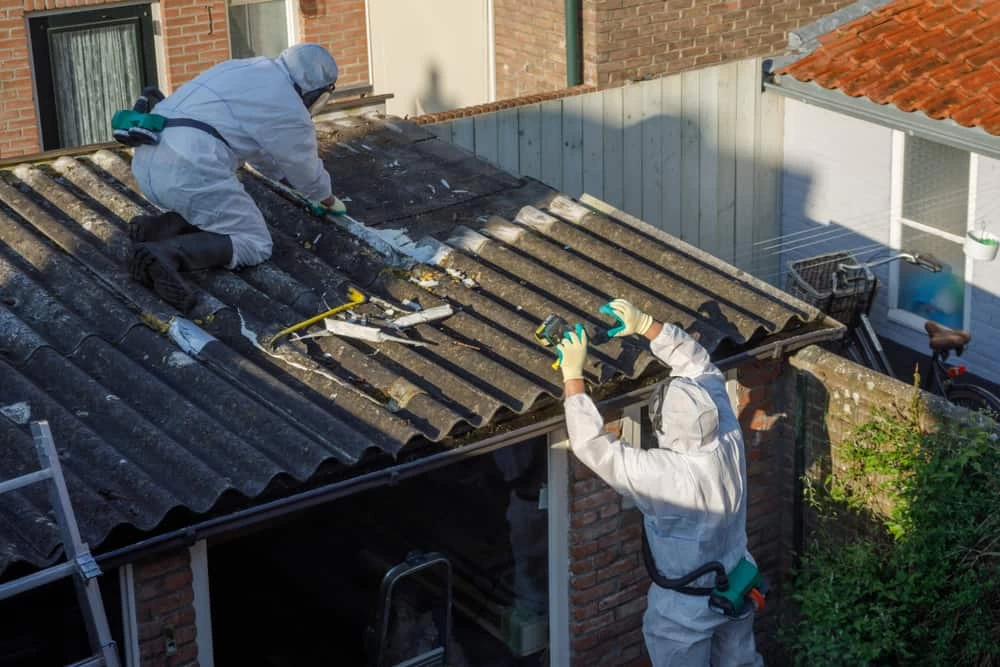
Once testing confirms the presence of asbestos-containing materials, the project gets formally planned and submitted to the NYS Department of Labor before work begins. That’s a legal requirement under Industrial Code Rule 56, and it’s something every legitimate abatement contractor in New York handles as a matter of course. The work area gets fully contained — negative air pressure, HEPA filtration, sealed barriers — and the materials are removed by our certified technicians following strict handling protocols.
After removal, the contained area goes through clearance air testing. This is the step that confirms the space is safe to reoccupy and that the work was done correctly. You receive documentation covering the full project: the inspection findings, the DOL notification, the disposal manifests, and the clearance results. For Merrick homeowners navigating a renovation or a real estate transaction, that paper trail is often just as important as the work itself.
The most common asbestos-containing materials found in Merrick’s mid-century homes tend to follow a predictable pattern. The 9×9 and 12×12 vinyl composition floor tiles in basements, kitchens, and hallways — along with the black mastic adhesive underneath them — frequently test positive. Acoustic popcorn ceiling texture applied through the 1970s is another one that comes up regularly, especially in living rooms and bedrooms where it was used for sound dampening. Pipe insulation around boilers and older heating systems, ceiling tiles, and cement board siding are also common finds in homes of this era.
We handle all of these. Asbestos floor tile removal, asbestos popcorn ceiling removal, pipe and boiler insulation abatement, and full interior remediation for homes undergoing renovation or pre-sale clearance — these are our core services, and they’re all performed under the same certified, fully documented process. If you’re in South Merrick and dealing with a waterfront property that’s had moisture issues, or you’re in Merrick Gables working on a pre-1930 structure with materials that predate the post-war era entirely, those situations get assessed on their own terms.
Every project includes pre-abatement inspection documentation, NYS DOL project notification, certified removal, licensed waste disposal, and post-abatement clearance air testing. Nassau County building permits for renovation work on pre-1980 homes often require asbestos clearance before inspections will pass — that documentation is part of what you receive when the job is done.
Does my Merrick home actually need asbestos testing before I renovate?
If your home was built before 1980, yes — and that covers the overwhelming majority of Merrick’s housing stock. New York State law requires asbestos testing before renovation or demolition of buildings constructed before 1974, and strongly recommends it for anything built through 1980. That’s not a suggestion you can easily work around. Most licensed contractors in Nassau County will stop work and require asbestos clearance before proceeding if they encounter suspect materials — and many will ask upfront before they even start.
The practical reality is that the post-war homes defining Merrick’s neighborhoods — the cape cods, colonials, and split-levels built in the 1950s, 60s, and early 70s — were constructed during the peak years of asbestos use in American residential building. Floor tiles, pipe insulation, ceiling texture, and siding materials from that era routinely contain asbestos. Testing before you renovate is how you find out what you’re dealing with before it becomes a work stoppage, a legal issue, or a health concern.
How long does asbestos abatement take for a typical Merrick home?
It depends on what’s there and how much of it needs to come out. A focused project — removing asbestos floor tiles in a basement or popcorn ceiling texture in one or two rooms — can typically be completed within a day or two once the project is properly set up and the NYS DOL notification period has cleared. Larger projects involving multiple material types, extensive pipe insulation, or whole-floor remediation take longer, sometimes several days to a week.
One thing that affects timing in Merrick specifically is the pre-abatement notification requirement. Under NYS Industrial Code Rule 56, certain projects require formal notification to the Department of Labor before work can begin, and there’s a mandatory waiting period before the crew can start. That’s not something any contractor can skip — it’s built into the legal process. When you’re planning a renovation or working toward a closing date, factoring in that window is important. A straightforward timeline conversation at the start of the project will give you a realistic picture of what to expect.
Can I just remove old floor tiles myself in my Merrick house?
No — and this is one of the most common misunderstandings homeowners run into. In New York State, you cannot legally perform asbestos abatement on your own property if the materials test positive for asbestos. The work must be done by a NYS DOL-licensed asbestos abatement contractor with certified workers, proper containment, and approved disposal procedures. This isn’t a technicality — it’s a legal requirement with real consequences, and it exists because disturbing asbestos-containing materials without proper containment releases fibers that are genuinely hazardous.
The 9×9 vinyl floor tiles found in the basements and kitchens of Merrick’s mid-century homes are among the most commonly mishandled materials on Long Island. They look like ordinary old flooring. Homeowners assume they can pull them up over a weekend. But those tiles — and especially the black mastic adhesive beneath them — frequently test positive for asbestos, and breaking them up without containment is exactly the kind of disturbance that creates an airborne hazard. Have them tested first. If they come back positive, the removal needs to be handled by a licensed contractor.
What does asbestos abatement cost for a home in Merrick, NY?
Cost varies based on the type of material, the quantity, and the complexity of the project. A focused floor tile removal in a single room or basement will run differently than a full popcorn ceiling abatement across an entire floor, or pipe insulation removal throughout a utility room and crawl space. As a general range, smaller residential abatement projects in Nassau County typically start in the $1,500–$3,000 range, while larger or more complex jobs can run $5,000–$10,000 or more depending on scope.
What you’re paying for isn’t just the removal itself — it’s the inspection, the NYS DOL project notification, the certified labor, the containment setup, the licensed waste disposal, and the post-abatement clearance air testing that documents the work was done correctly. For Merrick homeowners with properties valued near or above $850,000, that documentation has real financial value. It protects you in a real estate transaction, satisfies building department requirements when you pull renovation permits, and gives you a clear record of what was done and when. The cost of doing it right is almost always less than the cost of doing it wrong.
My home inspector flagged asbestos before my Merrick home sale — what now?
This is one of the most common situations that brings Merrick homeowners to us. A home inspector flags suspect materials — usually floor tiles, popcorn ceiling texture, or pipe insulation — and suddenly the sale is in question. Buyers get nervous, attorneys get involved, and the closing timeline starts to slip. The good news is that this is a solvable problem, and it’s one that comes up regularly in Merrick’s active real estate market given the age of the housing stock.
The path forward is straightforward: get the suspect materials tested to confirm whether asbestos is actually present, and if it is, have a licensed abatement contractor remove them and provide full documentation. That documentation — the clearance air testing results, the disposal manifests, the DOL project records — is what buyers, attorneys, and title companies need to proceed. In many cases, sellers who handle abatement proactively are in a stronger negotiating position than those who leave it as an open question. The key is moving quickly once the flag is raised, since delays tend to create more anxiety on both sides of the transaction than the abatement itself.
Is asbestos a real concern in Merrick's waterfront and bay-area homes?
It’s worth taking seriously, especially in South Merrick, the Lindenmere section, and other properties close to Merrick Bay. Coastal conditions — persistent humidity, salt air, and the kind of seasonal moisture intrusion that affects homes near the water — accelerate the breakdown of building materials over time. Asbestos-containing materials that are in good condition and left undisturbed are generally considered low-risk. But when those same materials start to deteriorate from age, moisture, or physical damage, they become friable — meaning they can crumble and release fibers into the air.
Waterfront and near-waterfront homes in Merrick also tend to have more renovation history, particularly properties that were affected by storm damage over the years. Any renovation or repair work that disturbs walls, floors, ceilings, or mechanical systems in a pre-1980 home has the potential to encounter asbestos-containing materials. If your South Merrick property has had water intrusion, storm damage, or just the normal wear that comes with decades of coastal exposure, an asbestos assessment before your next renovation project is a reasonable precaution — not an overreaction.