Old Bethpage Homes Built Before 1980 Need More Than a Guess
If your Old Bethpage home was built before 1980, asbestos abatement isn’t a maybe — it’s a conversation worth having before your next renovation or home sale.
I needed a professional consultation explanation of procedure for safe removal of Asbestos in my apartment complex. Without having an account yet, I was very impressed with the caring, knowledgeable and generous advice offered by Jessica, and will look forward to doing business in the future. Thank you so much! I feel much more informed about a sometimes scary endeavor. Peace. Nancy Silva Mineola, NY.
Mia Munoz
Used this company to clean up some water flood in my house. They were fast and easy to work with.very professional, Would recommend to anyone!
Nini Valle
Great company, had a flood and they responded quickly and efficiently. Billed my insurance company directly. I highly recommend this company!
joe colapietro, jr
I had pipe freeze in my basement right before a snow storm and they made to within an hour to help start the clean up process. They we by our side throughout the entire process and even helped with the insurance company. They did such a great job with the cleanup, repair, remidiation, I contracted them to perform the repairs and finishes in the basement. They came with enough manpower and material to get the job done. Leo and Jessica were nothing but a pleasure to deal with!!
Cristian Arredondo c
I had some water damage in my home and Green Island was able to take care of my issue quickly and effectively. I am very pleased with the work they did. They responded quickly and were very professional.
Michael M
Outstanding service! From the office to the field crew everyone was friendly, helpful and responsive. I highly recommend Green Island Group.
Most Old Bethpage homes were built between the late 1940s and the mid-1970s — the exact window when asbestos was worked into nearly every layer of residential construction. Floor tiles, pipe insulation, popcorn ceilings, joint compound, boiler wrap. It was everywhere, and in a lot of these homes, it still is. The difference after a proper abatement isn’t just peace of mind. It’s a home you can renovate, sell, or refinish without a regulatory hold-up or a health risk sitting in the walls.
When you’re dealing with a home valued close to or above $900,000 — which describes a lot of properties throughout Old Bethpage — the cost of cutting corners on asbestos removal isn’t just a health risk. It’s a liability that follows the property. Buyers, lenders, and real estate attorneys in Nassau County are asking harder questions at closing than they were ten years ago. Having documented, licensed abatement on record protects your investment and keeps your transaction moving.
And if you’re renovating rather than selling, the stakes are just as real. A kitchen gut, a bathroom remodel, a basement finish — any of these can disturb materials that have been sitting undisturbed for fifty years. Once those fibers are airborne, containment after the fact is far more complicated and costly than handling it correctly before the first wall comes down.
We Know Old Bethpage's Homes — and Its Requirements
We’re a Long Island-based asbestos abatement company serving Nassau County homeowners throughout Old Bethpage and the surrounding Plainview-Old Bethpage corridor. We’re not a national franchise routing calls through a regional office. The people handling your project know this area, know the Town of Oyster Bay’s permit requirements, and know exactly what Nassau County’s EHRP licensing layer means for your job.
That matters more here than most people realize. New York State already has some of the strictest asbestos regulations in the country under Industrial Code Rule 56. Nassau County adds its own EHRP and EHRT certification requirements on top of that. A contractor who’s licensed in another county or state isn’t automatically qualified to work legally in Old Bethpage — and if they’re not, that becomes your problem, not theirs.
We hold all required state and county credentials, carry full insurance, and have worked throughout the Nassau County housing stock — the same post-war ranch and colonial homes that line the streets off Round Swamp Road and Haypath Road in Old Bethpage. You get a company that already knows what’s in these homes before we walk through the door.
No Handoffs, No Guesswork — Here's the Full Picture
It starts with an inspection. A certified inspector walks your property and collects samples from any materials that may contain asbestos — floor tiles, ceiling texture, pipe insulation, wall compound, whatever applies to your home’s construction era. Samples go to an accredited laboratory, and you get clear results before any decisions are made. In Old Bethpage, where most homes fall squarely in the pre-1980 construction window, this step rarely comes back empty.
If abatement is needed, we handle the regulatory side before a single piece of material is touched. That means filing the required notification with the New York State Department of Labor under Industrial Code Rule 56, coordinating with the Town of Oyster Bay Building Department if your project involves a permit, and ensuring full Nassau County EHRP compliance throughout. You don’t need to know what any of that means — that’s the point.
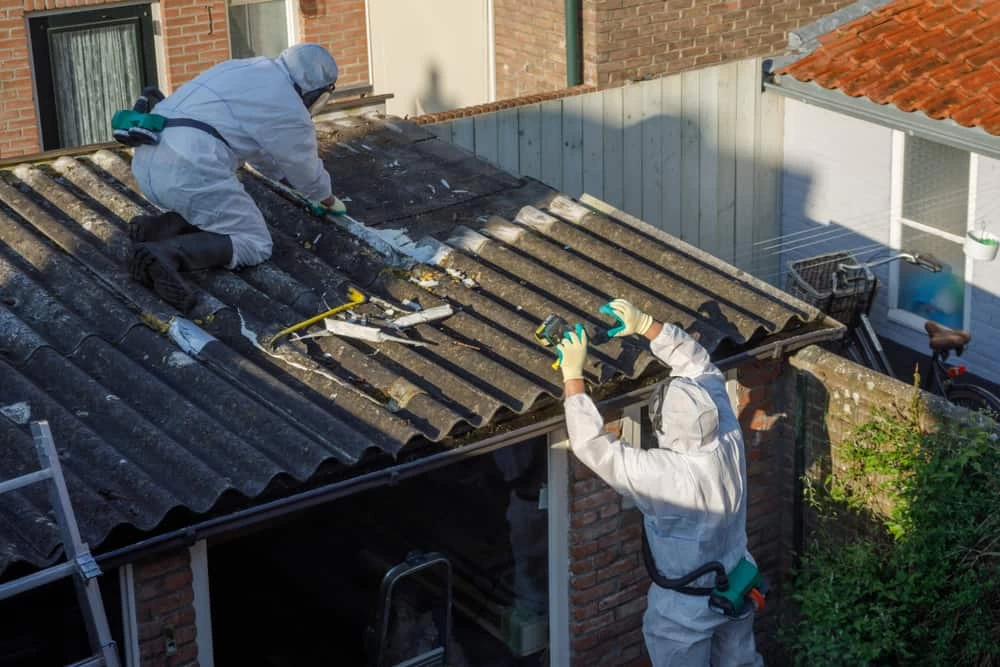
The removal itself uses full containment: sealed work areas, negative air pressure, HEPA filtration, and wet methods to prevent fiber release. When the work is done, independent air clearance testing confirms the space is clean. You receive a complete documentation package — project notifications, waste disposal manifests, and your clearance certificate — so you have everything you need for your records, your contractor, or your closing attorney.
Asbestos abatement in an Old Bethpage home isn’t one-size-fits-all. The materials involved depend on when your home was built, what’s been renovated, and what’s still original. We handle the full range of ACMs commonly found in Nassau County’s post-war housing stock.
Asbestos tile removal is one of the most frequent requests — specifically the 9″x9″ vinyl floor tiles installed throughout the 1950s and 1960s, along with the mastic adhesive underneath them. Both the tile and the adhesive frequently test positive, and both require licensed removal. Popcorn ceiling removal is another common service in Old Bethpage. Homes built through the late 1970s often have original acoustic spray ceilings in bedrooms and living spaces, and testing before any cosmetic work is not optional — it’s required. Pipe and boiler insulation, pre-1977 joint compound, and asbestos-cement roofing materials are also assessed and removed where present.
Every project includes the full scope: initial inspection and lab testing, regulatory notifications, licensed removal with proper containment, certified waste disposal, and final air clearance testing with written documentation. Nothing is handed off to a third party mid-project. Old Bethpage homeowners get one point of contact, start to finish, with a company that understands what the Town of Oyster Bay and Nassau County actually require — not just what the state minimum looks like.
Does my Old Bethpage home actually have asbestos if it was built before 1980?
The honest answer is: probably somewhere, yes. Homes built in Old Bethpage before 1980 were constructed during the period when asbestos was one of the most widely used building materials in the country. It was added to floor tile adhesives, ceiling spray textures, pipe insulation, drywall joint compound, roofing underlayment, and more. Not every material in every home tested positive, but the likelihood is high enough that assuming otherwise before a renovation is a real risk.
The only way to know for certain is to have suspect materials sampled by a certified inspector and tested at an accredited laboratory. Visual inspection alone isn’t enough — asbestos fibers are invisible to the naked eye, and many asbestos-containing materials look identical to their non-asbestos counterparts. If your Old Bethpage home is in the 1950s–1970s construction range, which describes the majority of the area’s housing stock, a pre-renovation survey is the right first step before any demo work begins.
How much does asbestos abatement typically cost for a Nassau County home?
Cost depends heavily on the scope — what materials are involved, how much of them, and where they’re located in the home. Minor asbestos tile removal in a single room can run a few hundred to a few thousand dollars. A larger project involving multiple material types — popcorn ceilings, floor tiles, pipe insulation — across several areas of a home can range from $3,000 to $10,000 or more depending on square footage and complexity.
What drives cost up isn’t just the removal itself — it’s the regulatory requirements that come with it in Nassau County. Proper project notification, air monitoring, certified disposal, and post-clearance testing are all part of a compliant abatement, and they add to the total. That said, in Old Bethpage where homes regularly sell for $900,000 and above, the cost of documented, licensed abatement is a small fraction of your property’s value — and it’s far less than the cost of a failed inspection, a delayed closing, or a liability claim down the road.
Can I remove asbestos-containing materials myself in New York State?
For most materials and project sizes, no — not legally, and not safely. New York State’s Industrial Code Rule 56 requires that asbestos abatement above certain thresholds be performed by a licensed contractor using certified workers. Nassau County adds its own EHRP requirements on top of that. A homeowner who disturbs asbestos-containing materials without proper containment and disposal isn’t just taking a health risk — they’re creating a regulatory and legal exposure that can affect their ability to sell the property later.
There is a narrow exemption in New York State for owner-occupied single-family homes performing their own work, but it comes with strict conditions and doesn’t eliminate the disposal requirements. Even where it technically applies, the practical risks — fiber release without proper containment, improper disposal, no air clearance documentation — make DIY removal a poor choice for most Old Bethpage homeowners. The documentation you get from a licensed abatement is worth as much as the removal itself when it comes time to sell.
Do I need an asbestos inspection before pulling a renovation permit in Old Bethpage?
In many cases, yes. The Town of Oyster Bay Building Department — which governs Old Bethpage — requires documentation related to asbestos when issuing permits for renovation or demolition work that may disturb suspect materials. This is consistent with New York State’s requirements under Industrial Code Rule 56, which mandates pre-renovation asbestos surveys for projects that will disturb materials above certain thresholds.
If you’re planning a kitchen remodel, bathroom gut, basement finish, or any project that involves removing flooring, ceilings, walls, or mechanical systems in a pre-1980 home, it’s worth confirming the permit requirements before you start. Getting a survey done upfront is almost always faster and less expensive than discovering asbestos mid-project, stopping work, and scrambling to bring in an abatement contractor under time pressure. We can walk you through what’s required for your specific project before you ever file a permit application.
How long does asbestos abatement take, and can my family stay in the house?
Timeline depends on the scope of work. A single-room floor tile removal might be completed in one to two days. A larger project involving multiple areas or material types can take several days to a week or more. What affects timing most in Old Bethpage is the regulatory notification requirement — under New York State’s Industrial Code Rule 56, certain projects require advance notice to the NYS Department of Labor before work can begin, and that notice period needs to be factored into your project schedule.
As for occupancy during abatement: in most cases, the affected areas of the home are sealed off and under negative air pressure during the work, and residents are advised to stay out of those areas. Whether the rest of the home is occupiable depends on the scope and location of the project. We’ll give you a clear, specific answer on this before work starts — not a vague “it depends” — so you can make arrangements for your family if needed. For families with children in the Plainview-Old Bethpage school district, minimizing disruption and keeping the timeline predictable is something we take seriously.
What happens if asbestos is discovered during a home sale in Old Bethpage?
It happens more often than people expect, especially in a community where the majority of homes were built in the 1950s through 1970s. A buyer’s inspector flags suspect materials, the buyer requests testing, and suddenly there’s a positive result sitting in the middle of a transaction. At that point, the clock is running and both sides need clarity fast.
The good news is that a positive finding doesn’t automatically kill a deal — but how you respond to it matters. Buyers typically want either a price adjustment or documented abatement completed before closing. If you go the abatement route, the key is speed and documentation. We can move quickly on assessment and scheduling, and the written clearance package you receive at the end — air monitoring results, waste disposal manifests, clearance certificate — is exactly what a buyer’s attorney or lender will ask for. In a market where Old Bethpage homes are transacting at high values, having a clean paper trail on asbestos remediation is a genuine asset, not just a checkbox.