I needed a professional consultation explanation of procedure for safe removal of Asbestos in my apartment complex. Without having an account yet, I was very impressed with the caring, knowledgeable and generous advice offered by Jessica, and will look forward to doing business in the future. Thank you so much! I feel much more informed about a sometimes scary endeavor. Peace. Nancy Silva Mineola, NY.
Mia Munoz
Used this company to clean up some water flood in my house. They were fast and easy to work with.very professional, Would recommend to anyone!
Nini Valle
Great company, had a flood and they responded quickly and efficiently. Billed my insurance company directly. I highly recommend this company!
joe colapietro, jr
I had pipe freeze in my basement right before a snow storm and they made to within an hour to help start the clean up process. They we by our side throughout the entire process and even helped with the insurance company. They did such a great job with the cleanup, repair, remidiation, I contracted them to perform the repairs and finishes in the basement. They came with enough manpower and material to get the job done. Leo and Jessica were nothing but a pleasure to deal with!!
Cristian Arredondo c
I had some water damage in my home and Green Island was able to take care of my issue quickly and effectively. I am very pleased with the work they did. They responded quickly and were very professional.
Michael M
Outstanding service! From the office to the field crew everyone was friendly, helpful and responsive. I highly recommend Green Island Group.
Your Home Is Safe, Documented, and Move-Forward Ready
When asbestos turns up mid-renovation under the floor tiles, above the drop ceiling, wrapped around the basement pipes everything stops. The contractor pauses. The timeline shifts. And suddenly you’re searching for answers at 10pm on a Tuesday. That moment is exactly what we’re built for.
Most homes in Searsville and the surrounding Town of Crawford that were built in the 1960s contain at least one type of asbestos-containing material. The 9×9 vinyl floor tiles alone were standard in nearly every home of that era. But it rarely stops there. Older farmhouses and rural properties along Searsville Road tend to have original mechanical systems still in place and pipe insulation from that period is one of the most common ACM discoveries we make in this area. Knowing what to look for, and where, is half the job.
Once the work is done, you’re not just left with a cleaner space. You walk away with a written clearance certificate from an independent industrial hygienist the document your real estate attorney, your lender, or your buyer will need to see. That paperwork is what turns an abatement project into a closed chapter, not an open question.
We’ve been doing licensed asbestos abatement and environmental remediation in Orange County for over 12 years, including homes throughout Searsville and the Town of Crawford. We’re not a franchise. We’re not a call center that dispatches whoever’s available. We’re an independently owned contractor whose reputation is tied directly to every job we take on including the ones on rural roads in Searsville that most companies won’t bother routing to.
Our license stack covers everything required under New York State’s Industrial Code Rule 56 the framework that governs abatement work in Orange County. We’ve also completed projects for the NYS Office of General Services, the Dormitory Authority of the State of New York, and the NYS Office of Mental Health. Those clients don’t write checks to contractors who haven’t been thoroughly vetted. That track record carries over to every residential job we take, whether it’s a farmhouse off County Route 17 or a recently purchased property near Pine Bush.
It starts with an assessment. Before anything is touched, we identify what materials are present, where they are, and whether they’re in a condition that requires immediate action or can be managed in place. In older homes throughout Searsville and the Town of Crawford, that assessment often turns up more than one type of material floor tiles, pipe insulation, and ceiling materials are frequently found together in homes of that era, and we look for all of it.
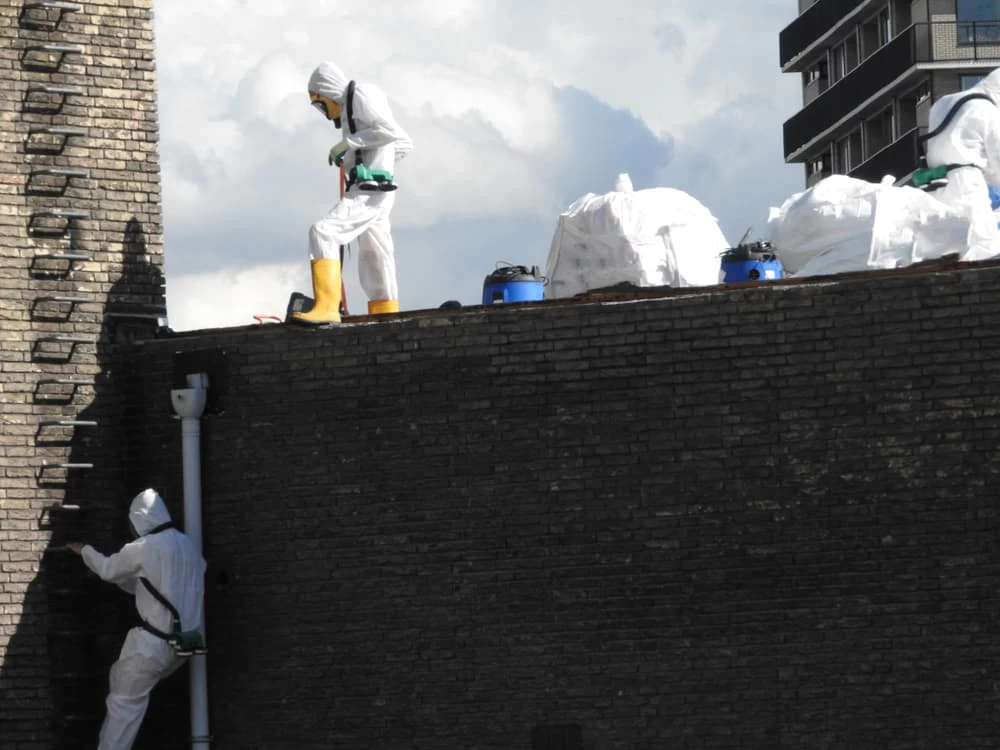
From there, we set up full containment. The work area is sealed and placed under negative air pressure so fibers can’t migrate into the rest of your home while removal is underway. Our workers are NYS-certified asbestos handlers not general laborers handed a respirator. Every step follows the requirements of Industrial Code Rule 56, which is the state regulation that governs this work in Orange County. There’s no shortcutting that process, and we don’t try to.
When removal is complete, post-abatement air monitoring is conducted by an independent industrial hygienist someone with no financial stake in the outcome of the test. If the air clears, you get the written clearance certificate. If something needs attention, we address it before that certificate is issued. Asbestos waste is then packaged and transported to a licensed Class II solid waste facility per NYS DEC regulations. You get documentation of all of it.
The most common materials we remove in Searsville and the surrounding Town of Crawford are vinyl asbestos floor tiles particularly the 9×9 format that was standard in 1960s construction along with popcorn ceiling texture, pipe insulation on basement mechanical systems, roofing felt, and joint compound. These aren’t rare edge cases. They’re the norm in this area’s housing stock, and we’ve handled all of them across Orange County properties for over a decade.
What makes older rural homes in Searsville different from suburban tract housing is the complexity. A farmhouse on Searsville Road might have original hardwood floors over asbestos tile over a concrete slab, a basement with both pipe insulation and a deteriorating floor coating, and a crawlspace with moisture damage that’s accelerated the breakdown of nearby materials. We assess the full picture not just the one thing that triggered the call. And because we also handle mold remediation and lead paint removal, we can address multiple hazards under one project rather than leaving you to coordinate separate contractors.
If your project involves an insurance claim storm damage, water intrusion, fire we bill the insurance company directly and work with your adjuster on your behalf. And if cost is a concern after an unexpected discovery, we offer 0% APR financing up to $200,000 for qualifying projects. The goal is to remove every obstacle between you and a resolved situation.
Does my 1960s Searsville home actually have asbestos in it?
Almost certainly somewhere, yes. Homes built in the 1960s in Searsville and the Town of Crawford were constructed during the peak era of asbestos use in residential materials. The most common places we find it are 9×9 vinyl floor tiles, popcorn ceilings, pipe insulation in the basement, roofing felt, and joint compound behind drywall. You don’t have to have all of them many homes have two or three.
The presence of asbestos doesn’t automatically mean you’re in danger. Asbestos-containing materials that are in good condition and left undisturbed are generally not an immediate hazard. The risk comes when those materials are disturbed during a renovation, a repair, or even routine work like drilling into a wall. That’s when fibers become airborne, and that’s when exposure risk becomes real. If you’re planning any work on an older home in Searsville, getting an assessment before you start is the right move, not an optional one.
Can I legally remove asbestos myself in New York State?
For most situations, no. New York State’s Industrial Code Rule 56 requires that asbestos abatement be performed by a contractor holding a valid NYS Department of Labor Asbestos Contractor License, and individual workers must hold NYS Asbestos Handler Certification which requires a minimum of 32 hours of initial training plus annual refreshers. This isn’t a gray area. Unlicensed asbestos removal in New York is a criminal matter, not just a fine.
There is a limited homeowner exemption that technically allows owner-occupants to perform certain minor work on their own single-family residence, but it comes with strict conditions and does not apply to commercial properties, rental units, or any project involving significant quantities of ACMs. Even when the exemption technically applies, the disposal requirements still apply asbestos waste must go to a licensed Class II facility. Most homeowners in Orange County who look into the exemption closely decide it’s not worth the exposure risk, the liability, or the documentation burden.
How much does asbestos removal cost in Orange County, NY?
It depends on what materials are present, how much of it there is, and where it’s located in the home. A single room of 9×9 vinyl floor tile removal in an Orange County home might run in the $1,500 to $3,500 range. A more complex project involving pipe insulation, popcorn ceilings, and floor tiles across multiple areas of an older farmhouse in Searsville or Crawford can reach $10,000 to $25,000 or more, depending on scope.
The variables that drive cost are containment complexity, the quantity of material, the condition of the material friable asbestos that’s already breaking down requires more stringent handling than intact tile and the post-abatement air monitoring and clearance process. What you should be cautious of is any contractor who quotes a very low number without seeing the property. In this area’s older housing stock, what looks like a simple job often has more material behind it. We provide written estimates after an on-site assessment not ballpark numbers over the phone that end up looking different on the final invoice.
Do I need a permit for asbestos removal in the Town of Crawford?
Asbestos abatement in the Town of Crawford and Searsville falls under New York State jurisdiction not New York City’s regulatory system. That means the NYC-specific forms like the ACP-5 and ACP-7 don’t apply here. What does apply is Industrial Code Rule 56, enforced by the NYS Department of Labor’s Asbestos Control Bureau, and for larger projects involving demolition or significant renovation, NESHAP notification requirements under federal EPA regulations.
Your Orange County building permit process may also require documentation that asbestos has been properly assessed and removed before certain inspections can be passed. The specifics depend on the scope of your renovation project. What this means practically is that the paperwork burden is real, and it matters especially if you’re in the middle of a real estate transaction with a closing date. We handle the regulatory documentation as part of every project, so you’re not left trying to figure out which forms go where while a contractor is waiting on-site.
How long does asbestos abatement take for a typical Searsville home?
A straightforward single-material removal one room of floor tile, for example can often be completed in one to two days. More complex projects involving multiple material types across different areas of the home, which is common in the older farmhouses and rural properties throughout Searsville and the Town of Crawford, typically run three to five days for the physical removal work. Post-abatement air monitoring adds time on top of that, since the independent industrial hygienist needs to conduct sampling after the area has been cleared and cleaned.
The full timeline from first call to clearance certificate depends on how quickly the assessment can be scheduled, the scope of work, and how soon the industrial hygienist can turn around the monitoring results. In real estate transaction situations which are common in the current Orange County market we prioritize getting assessments and written estimates completed quickly because we understand that a closing date doesn’t move just because asbestos showed up. If you have a timeline pressure, tell us upfront and we’ll work around it as best we can.
What happens after asbestos is removed how do I know it's actually safe?
The answer is the clearance certificate, and it matters more than most homeowners realize. After abatement is complete, post-abatement air monitoring is conducted by an independent industrial hygienist a licensed professional who has no connection to our abatement crew and no financial interest in the outcome of the test. That hygienist collects air samples from the work area and compares fiber concentrations to the required safety thresholds under New York State regulations. If the area passes, a written clearance certificate is issued.
That document is not just peace of mind it’s the proof that the job was done correctly, and it’s what your real estate attorney, your buyer, and your lender will ask for if the property is being sold. In the current Orange County real estate market, where buyers are increasingly savvy about older home disclosures and lenders are scrutinizing environmental conditions more carefully, showing up to a closing without clearance documentation is a problem. We coordinate the independent hygienist and deliver the complete documentation package on every project the clearance certificate, the waste disposal manifests, and the project records. You get the full file, not just a verbal confirmation that everything looked fine.