Sherman Park's Older Homes Deserve a Clean Bill of Health
Most homes in Sherman Park were built before 1980 and that means asbestos is more common here than most people realize. We handle the full removal process, start to finish, so you know exactly what you’re dealing with and have the documentation to prove it’s gone.
I needed a professional consultation explanation of procedure for safe removal of Asbestos in my apartment complex. Without having an account yet, I was very impressed with the caring, knowledgeable and generous advice offered by Jessica, and will look forward to doing business in the future. Thank you so much! I feel much more informed about a sometimes scary endeavor. Peace. Nancy Silva Mineola, NY.
Mia Munoz
Used this company to clean up some water flood in my house. They were fast and easy to work with.very professional, Would recommend to anyone!
Nini Valle
Great company, had a flood and they responded quickly and efficiently. Billed my insurance company directly. I highly recommend this company!
joe colapietro, jr
I had pipe freeze in my basement right before a snow storm and they made to within an hour to help start the clean up process. They we by our side throughout the entire process and even helped with the insurance company. They did such a great job with the cleanup, repair, remidiation, I contracted them to perform the repairs and finishes in the basement. They came with enough manpower and material to get the job done. Leo and Jessica were nothing but a pleasure to deal with!!
Cristian Arredondo c
I had some water damage in my home and Green Island was able to take care of my issue quickly and effectively. I am very pleased with the work they did. They responded quickly and were very professional.
Michael M
Outstanding service! From the office to the field crew everyone was friendly, helpful and responsive. I highly recommend Green Island Group.
Sherman Park is a community built on railroad-era roots and postwar expansion and that history lives inside the walls, under the floors, and above the ceilings of nearly every home on the block. The cape cods and bungalows that line Sherman Park streets are the same home types that relied most heavily on asbestos during construction: vinyl floor tiles in the kitchen and basement, acoustic ceiling texture in the living areas, pipe insulation wrapped around the boiler. When those materials are identified, properly contained, and removed by a licensed contractor, the anxiety that came with discovering them is replaced by something concrete a clearance certificate that says the air was tested and the space is safe.
That matters differently here than it does in a newer town. With roughly 84% of homes in Sherman Park built before 1980, asbestos isn’t a rare edge case it’s a realistic part of owning property in this neighborhood. And with median home values approaching $700,000, the stakes of handling it wrong are real. Buyers’ attorneys ask for documentation. Lenders flag undisclosed environmental issues. A home that went through licensed abatement with proper air clearance testing is a home that moves through a sale cleanly. One that didn’t is a liability.
For families with kids in the house and more than a third of households in Sherman Park have children under 18 the outcome that matters most isn’t paperwork. It’s knowing the home is actually safe. That’s what a completed abatement looks like: not just material removed, but air tested, clearance confirmed, and a record in hand that shows every step was done right.
We’ve completed more than 5,000 abatement projects across New York, including homes throughout Westchester County and Sherman Park. That volume means the 1950s ranch on a side street near Route 141, the postwar colonial in Rolling Hills, the cape cod with the crumbling boiler insulation these aren’t new scenarios. They’re familiar ones.
The credentials behind this work aren’t self-declared. We hold the NYS Department of Labor Asbestos Handling License, EPA certification, and NYS M/WBE certification from the Office of General Services a state-issued designation that required formal documentation review, not just an application. Every project comes with proper waste manifests, post-abatement air clearance documentation, and full compliance with NYS Industrial Code Rule 56, which governs every abatement project in Mount Pleasant and throughout the state.
Nothing here is subcontracted. We handle assessment, containment, removal, disposal, and air clearance testing all under one roof one contractor, one chain of custody, one set of documentation when the job is done.
From Free Inspection to Final Clearance Here's the Full Picture
It starts with a free on-site inspection no charge, no obligation. A licensed professional comes to your Sherman Park home, walks the property, and identifies which materials need testing or removal. In a pre-1980 home, that often means looking at more than one material type: floor tiles, ceiling texture, pipe wrap, joint compound. You’ll get a clear written estimate that outlines exactly what the work involves before anything is scheduled.
Once the scope is confirmed, the job begins with proper containment. We set up negative air pressure systems to isolate the work area from the rest of your home, so materials being disturbed in one room don’t affect the air quality in another. This is a specific requirement under NYS Industrial Code Rule 56 not optional, not a premium add-on. It’s how licensed abatement is done in New York State, and it’s how we do it on every job.
After removal, all asbestos-containing material is packaged and transported to a licensed disposal facility with a complete waste manifest a chain-of-custody document required by NYS DEC. Then air clearance testing is conducted. A third-party air sample is taken, analyzed, and if fiber counts meet the required clearance standard, you receive the documentation confirming it. That’s the record that goes with your home the one a buyer’s attorney or building inspector will ask for, and the one that proves the work was done correctly.
Every Material Type, One Contractor, One Clearance Document
The homes in Sherman Park don’t usually have just one type of asbestos-containing material. A 1955 cape cod might have 9×9 vinyl asbestos tiles in the kitchen, popcorn ceiling texture in the bedrooms, and chrysotile pipe insulation around the boiler all in the same house, all requiring licensed removal before a renovation or sale can proceed. We handle all of it under a single contract. No referrals to separate specialists, no fragmented process, no gaps in the chain of custody.
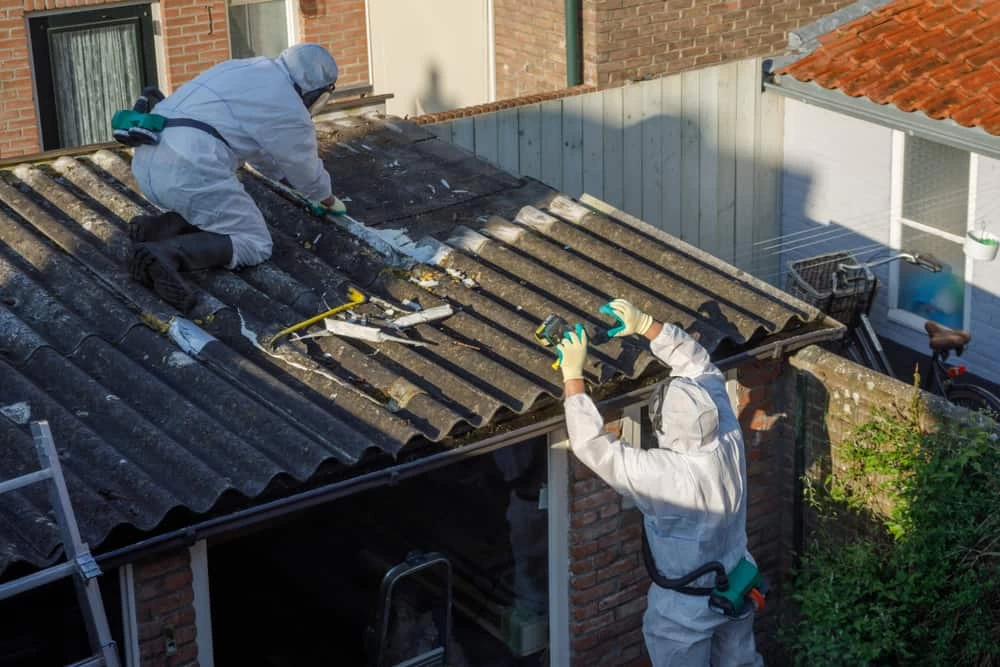
The services we cover include asbestos tile removal, popcorn ceiling removal, pipe and duct insulation abatement, joint compound removal, roofing material abatement, and siding removal. Each project includes initial assessment, full containment setup, licensed removal, certified disposal with waste manifests, and post-abatement air clearance testing. The Town of Mount Pleasant Building Department oversees environmental compliance for all renovation and demolition work in this jurisdiction and the documentation we provide is what satisfies those requirements.
For Sherman Park homeowners dealing with water damage in older homes a real scenario when Westchester winters push pipes past their limit we handle asbestos abatement and water damage restoration together. When a burst pipe disturbs pipe insulation or floor tiles in a pre-1980 home, that’s not just a plumbing issue. We work directly with insurance carriers on those claims, handling billing coordination so you’re not managing two separate processes during an already stressful situation.
Does my 1950s home in Sherman Park definitely have asbestos in it?
Not definitely but the odds are high enough that you should find out before you renovate or sell. The ZIP code 10594 housing stock was primarily built in the 1940s and 1950s, and the home types most common in Sherman Park cape cods, ranches, bungalows, and colonials from that era relied heavily on asbestos-containing materials during construction. That includes 9×9 vinyl floor tiles, acoustic ceiling texture, pipe and boiler insulation, drywall joint compound, and in some cases roofing materials and exterior siding.
The only way to know for certain is to have a licensed professional assess the materials and, where appropriate, take samples for laboratory testing. A visual inspection alone isn’t enough some materials look identical whether they contain asbestos or not. We offer free on-site inspections with no obligation, so you can get a real answer without paying just to find out what you’re dealing with.
Do I need a permit or inspection before starting renovations in Mount Pleasant?
Yes, and this is something Sherman Park homeowners often discover mid-project rather than before it starts. The Town of Mount Pleasant Building Department requires permits for renovation and demolition work, and any project in a pre-1980 building may require asbestos assessment documentation before that permit is issued or work proceeds. NYS Industrial Code Rule 56 enforced by the NYS Department of Labor Asbestos Control Bureau applies to every abatement project in this jurisdiction, and the DOL does conduct inspections of active projects statewide.
If a contractor starts work on a pre-1980 home without an asbestos assessment and disturbs materials that turn out to contain asbestos, the project can be shut down, and the property owner may share liability alongside the contractor. Getting the assessment done before the renovation contractor shows up isn’t just a formality it’s what keeps the project on schedule and keeps you out of a compliance problem you didn’t see coming.
How long does asbestos removal take in a typical Sherman Park home?
It depends on the scope meaning how many material types are involved and how much square footage needs to be addressed. A single-room floor tile removal in a 1950s cape cod might be completed in one to two days. A whole-home project involving ceiling texture, floor tiles, and pipe insulation could run several days to a week. The assessment phase is what gives you an accurate timeline, because that’s when the full scope becomes clear.
One thing that affects scheduling in Sherman Park specifically is the spring renovation season. From March through June, contractor availability across Westchester tightens considerably as homeowners execute the projects they planned over winter. If you’re working toward a renovation start date or a real estate closing, getting the inspection scheduled early gives you the most flexibility. We provide specific start dates not vague windows so you can plan around the abatement rather than scrambling to fit it in.
Is it safe to stay in my home during asbestos abatement?
It depends on where in the home the work is happening and what materials are being removed. For contained single-room projects a basement tile removal, for example it’s sometimes possible to remain in unaffected areas of the home with proper containment in place. For larger projects involving ceiling texture or pipe insulation removal in occupied living spaces, temporary relocation is typically the safer choice, especially for households with young children.
This is a real consideration in Sherman Park, where more than a third of households include children under 18. The containment system negative air pressure units that prevent disturbed fibers from migrating to other parts of the home is a required element of licensed abatement under NYS Industrial Code Rule 56, not an optional upgrade. We’ll be direct with you during the inspection about whether staying in the home during the project is reasonable for your specific situation, and what the containment setup will look like.
What does the air clearance test actually prove after asbestos removal?
The air clearance test is the final step of a licensed abatement project, and it’s what separates documented professional removal from any other approach. After the abatement work is complete and the area has been cleaned, air samples are taken from the work area and analyzed by a laboratory. If fiber counts fall below the required clearance threshold, a clearance certificate is issued confirming that the air in that space meets the standard for safe reoccupancy.
For Sherman Park homeowners, this document does two things. First, it confirms the work was done correctly not just removed, but contained and cleaned to a standard that was then independently verified. Second, it’s the record that follows the property. When you go to sell a home worth $700,000 and a buyer’s attorney asks how the asbestos was handled, the clearance certificate is the answer. It’s not just peace of mind it’s legal and evidentiary documentation that protects your investment and your transaction.
A pipe burst in my older Sherman Park home and disturbed some insulation what do I do now?
The first thing to do is stop any work in that area and avoid disturbing the insulation further. In a pre-1980 home which describes the vast majority of Sherman Park’s housing stock pipe insulation is a common asbestos-containing material. When it’s disturbed by a burst pipe or water damage event, it can release fibers into the air, and at that point you’re dealing with both a water damage situation and a potential asbestos exposure event simultaneously.
This is more common in Westchester winters than most people expect, and it’s exactly the kind of scenario where having one contractor who handles both sides makes a real difference. We manage asbestos abatement and water damage restoration together, and work directly with homeowners’ insurance carriers on billing so you’re not coordinating between two separate vendors while also dealing with a damaged home. Call for an assessment as soon as possible. The faster the situation is evaluated by a licensed professional, the better the outcome on both the remediation and the insurance claim.