Your South Valley Stream Home Was Built in an Era When Asbestos Was Standard — Here's What That Means Now
If your home was built before 1980 and you’re planning a renovation — or you’re still dealing with the aftermath of flood damage — there’s a real chance asbestos is somewhere in that house. Green Island Group helps South Valley Stream homeowners find it, remove it safely, and move forward without the guesswork.
I needed a professional consultation explanation of procedure for safe removal of Asbestos in my apartment complex. Without having an account yet, I was very impressed with the caring, knowledgeable and generous advice offered by Jessica, and will look forward to doing business in the future. Thank you so much! I feel much more informed about a sometimes scary endeavor. Peace. Nancy Silva Mineola, NY.
Mia Munoz
Used this company to clean up some water flood in my house. They were fast and easy to work with.very professional, Would recommend to anyone!
Nini Valle
Great company, had a flood and they responded quickly and efficiently. Billed my insurance company directly. I highly recommend this company!
joe colapietro, jr
I had pipe freeze in my basement right before a snow storm and they made to within an hour to help start the clean up process. They we by our side throughout the entire process and even helped with the insurance company. They did such a great job with the cleanup, repair, remidiation, I contracted them to perform the repairs and finishes in the basement. They came with enough manpower and material to get the job done. Leo and Jessica were nothing but a pleasure to deal with!!
Cristian Arredondo c
I had some water damage in my home and Green Island was able to take care of my issue quickly and effectively. I am very pleased with the work they did. They responded quickly and were very professional.
Michael M
Outstanding service! From the office to the field crew everyone was friendly, helpful and responsive. I highly recommend Green Island Group.
Most homeowners in South Valley Stream aren’t thinking about asbestos until something forces the conversation — a contractor stops mid-job, a home inspection flags a concern, or a buyer’s attorney puts the closing on hold. By that point, the stress is already there. What you actually want is to get past it cleanly, with documentation that holds up and a home that’s been properly cleared — not just visually cleaned up.
South Valley Stream’s housing stock is almost entirely mid-century. The Cape Cods and split-levels that line the streets here were built in the 1940s and 1950s, when asbestos was standard in floor tile adhesive, pipe insulation, ceiling texture, and roofing materials. Many of those materials are still in place — undisturbed, sealed behind walls or under floors that haven’t been touched in decades. That’s not automatically dangerous, but the moment renovation starts, the risk changes.
The flood history here adds another layer. Superstorm Sandy hit South Valley Stream hard — the state identified roughly 900 homes in the hamlet as high-risk flood zone properties and committed $3.7 million specifically to resiliency infrastructure here. When flooded homes get torn open for repair, asbestos-containing materials that were sealed for 60 years suddenly become a real exposure risk. Proper abatement — done before or during that renovation work — is what keeps that risk from becoming a health problem for your family.
We Know South Valley Stream's Houses — And We Carry Every License Nassau County Requires
Green Island Group is a Long Island–based asbestos abatement company serving Nassau County homeowners, including those in South Valley Stream. We hold the New York State DOL certification under Industrial Code Rule 56 and the Nassau County EHRP contractor license — along with EHRT-certified technicians. That two-layer licensing requirement is specific to Nassau County, and not every contractor operating in the broader metro area holds both. In South Valley Stream, which falls under Town of Hempstead jurisdiction rather than the Village of Valley Stream, that distinction matters for how your project is permitted and inspected.
We know the neighborhoods here — Mill Brook, North Woodmere, the creek-adjacent streets along Hook Creek where moisture intrusion has been accelerating material deterioration for years. We’re not applying a generic process to your home. We’re applying one that’s built around what Nassau County requires and what South Valley Stream homes actually look like on the inside.
No Surprises — Here's Exactly What the Process Looks Like
It starts with an assessment. We walk through the property, identify any materials that may contain asbestos, and take bulk samples for laboratory analysis. In South Valley Stream homes — particularly those with post-Sandy renovation histories or original 1940s–1950s finishes still intact — we pay close attention to basement pipe insulation, vinyl floor tiles and their mastic adhesive, and any acoustic ceiling texture that hasn’t been replaced. These are the areas we see most consistently in homes of this era and geography.
Once results come back and we know what we’re dealing with, we give you a written scope of work and a clear estimate before anything starts. If abatement is needed, we set up full containment around the work area, run HEPA air filtration throughout the job, and use wet methods to suppress fiber release during removal. Nothing gets bagged and tossed — all asbestos waste is disposed of according to NYS DOL and Nassau County requirements, with documentation at every step.
When the work is done, we don’t just hand you a receipt. We conduct post-abatement clearance air testing to confirm the space is safe, and we provide the full documentation package — clearance results, waste disposal records, and the regulatory paperwork you’ll need for the Town of Hempstead, your real estate attorney, or your insurance carrier. One company handles all of it, start to finish.
What's Covered — and Why It Matters in This Specific Hamlet
We handle the full range of asbestos abatement services that South Valley Stream homeowners actually need. Asbestos tile removal is one of the most common requests we get here — the 9-inch and 12-inch vinyl floor tiles in mid-century kitchens and basements frequently contain chrysotile asbestos in both the tile and the black mastic adhesive underneath. Improper removal — grinding, sanding, or aggressive scraping — turns a manageable situation into an airborne hazard. We remove tile and mastic using containment and HEPA protocols that leave the substrate ready for new flooring without releasing fibers into the living space.
Asbestos popcorn ceiling removal is another frequent service in this area. Acoustic ceiling texture applied before 1980 in South Valley Stream homes may contain asbestos, and it’s one of the first things a general contractor will flag when a homeowner starts a renovation. We test before anything gets scraped, and if asbestos is confirmed, we handle the removal using wet methods and full containment — so your renovation contractor can come back in and finish the job without a liability hanging over the project.
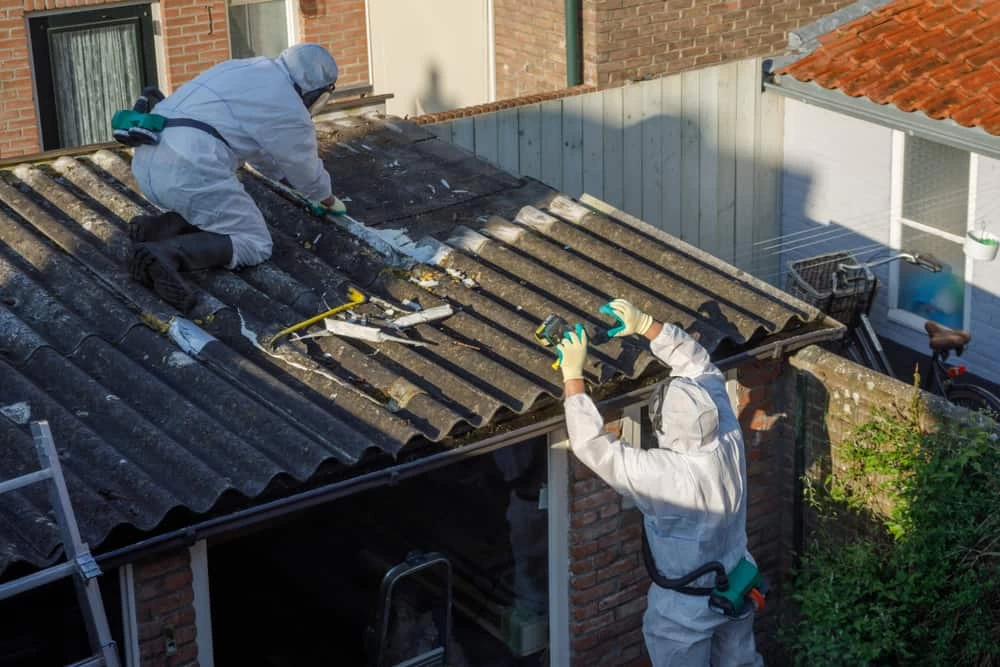
We also handle pipe and boiler insulation removal, roofing material abatement, and full-structure asbestos remediation for homes undergoing major renovation or pre-sale clearance. Because South Valley Stream is an unincorporated hamlet under Town of Hempstead jurisdiction — not the Village of Valley Stream — permitting and inspection coordination goes through the town’s building department, and we manage that process as part of the job. You don’t have to figure out who to call. We already know.
Does my South Valley Stream home actually need asbestos testing before renovation?
If your home was built before 1980 — which describes the vast majority of South Valley Stream’s housing stock — testing before any renovation is the right call, not just a precaution. The homes in this hamlet were primarily built in the 1940s and 1950s, when asbestos was used extensively in floor tile adhesive, pipe insulation, ceiling texture, roofing felt, and joint compound. Many of those materials are still in place, undisturbed, in homes that haven’t been significantly renovated.
The moment you start demo work — pulling up floors, opening walls, scraping ceilings — you risk disturbing materials that were otherwise stable. In South Valley Stream specifically, homes with any post-Sandy flood damage and repair history are worth paying extra attention to, because partial renovations sometimes left original asbestos-containing materials in place in areas that weren’t directly affected by the flooding. Testing before you start is far less disruptive and far less expensive than discovering the issue mid-renovation when your contractor has already stopped work.
How long does asbestos abatement take for a typical home in this area?
It depends on what’s found and how much of it needs to come out. A focused removal — say, asbestos floor tile in one room or pipe insulation around a basement boiler — can often be completed in one to two days. A larger scope, like popcorn ceiling removal across multiple rooms or a full pre-demolition abatement, takes longer, typically three to five days for the abatement itself plus time for clearance air testing results to come back from the lab.
For South Valley Stream homeowners working against a real estate closing deadline, timing matters. The housing market here is tight — median sale prices around $849,000 and a vacancy rate under 3% mean transactions move fast and buyers aren’t patient. We build schedules around your timeline when possible, and we’re upfront from the start about what’s realistic. If you’re working toward a closing date, tell us that when you call — it helps us plan accordingly and avoid delays that could stall your deal.
What does asbestos abatement actually cost in Nassau County?
The honest answer is that it varies based on what materials are present, how much square footage is involved, and the complexity of the containment setup. A targeted removal — single-room tile abatement or a localized pipe insulation job — typically runs in the range of $1,500 to $3,500. Larger projects, like full popcorn ceiling removal across an entire home or a multi-area abatement before a major renovation, can run $5,000 to $10,000 or more depending on scope.
What drives cost in Nassau County specifically is the regulatory overhead. Nassau County requires both EHRP contractor licensing and EHRT-certified technicians on every job — in addition to NYS DOL compliance. Proper waste disposal, clearance air testing, and documentation all add to the cost, but they’re also what gives you a legally defensible clearance record for your real estate transaction or insurance file. Contractors who quote significantly lower are often cutting corners on one of those requirements. In a county with this level of regulatory specificity, that’s a risk that can come back on you as the homeowner.
Is asbestos in floor tiles dangerous if I just leave them alone?
Not necessarily — and this is an important distinction. Asbestos-containing floor tiles that are in good condition, fully intact, and not being disturbed are generally considered non-friable, meaning they’re not actively releasing fibers. In that state, the risk of exposure is low. Many South Valley Stream homeowners have been living with original vinyl floor tiles for decades without any issue, precisely because the tiles were never disturbed.
The risk changes the moment those tiles are cut, sanded, scraped, or broken — which is exactly what happens during a renovation. If you’re planning to update a kitchen, finish a basement, or replace flooring in a home built before 1980, that’s when testing and potentially abatement becomes necessary. It’s also worth noting that the black mastic adhesive beneath the tiles often contains asbestos even when the tiles themselves do not — so removing tiles without testing the adhesive layer is an incomplete assessment. We test both, every time.
Can asbestos abatement be done while my family is still living in the house?
In most cases, yes — with the right containment protocols in place. We set up sealed work zones with negative air pressure and HEPA filtration, which prevents fibers from migrating into the rest of the living space. For smaller, contained jobs like a single-room tile removal or a localized pipe insulation project, families can typically remain in unaffected areas of the home during the work.
For larger projects — full popcorn ceiling removal across multiple rooms, or abatement in central areas like hallways or main living spaces — temporary relocation for the duration of the job is often the more practical and lower-stress option. We’ll be direct with you about what makes sense for your specific project. Post-abatement clearance air testing is conducted before we consider the job complete, and you get those results in writing before anyone re-enters the work area. That’s not a formality — it’s the confirmation that the space is actually safe, not just visually clean.
Do I need a permit for asbestos removal in South Valley Stream specifically?
Because South Valley Stream is an unincorporated hamlet — not an incorporated village — permitting falls under the Town of Hempstead’s building department rather than a village-level authority. This is a meaningful distinction from neighboring Valley Stream, which has its own village building department and code enforcement process. For asbestos abatement conducted as part of a permitted renovation or demolition in South Valley Stream, the work must be coordinated with Town of Hempstead permitting, and the abatement contractor must hold the appropriate NYS DOL and Nassau County EHRP credentials.
For standalone abatement — meaning removal not tied to a broader permitted renovation — the regulatory requirements still apply at the state and county level, but the town permitting trigger may not be activated in the same way. This is one of those areas where the specifics of your project matter, and where working with a contractor who actually knows Nassau County’s regulatory framework saves you from getting it wrong. We handle the permit coordination as part of our process, so you’re not left trying to navigate Town of Hempstead building department requirements on your own while also managing a renovation.