If your building went up before World War II and most in Washington Bridge and the surrounding neighborhoods did asbestos abatement isn’t a maybe. It’s a when. We handle the removal, the NYC DEP filings, and everything in between.
I needed a professional consultation explanation of procedure for safe removal of Asbestos in my apartment complex. Without having an account yet, I was very impressed with the caring, knowledgeable and generous advice offered by Jessica, and will look forward to doing business in the future. Thank you so much! I feel much more informed about a sometimes scary endeavor. Peace. Nancy Silva Mineola, NY.
Mia Munoz
Used this company to clean up some water flood in my house. They were fast and easy to work with.very professional, Would recommend to anyone!
Nini Valle
Great company, had a flood and they responded quickly and efficiently. Billed my insurance company directly. I highly recommend this company!
joe colapietro, jr
I had pipe freeze in my basement right before a snow storm and they made to within an hour to help start the clean up process. They we by our side throughout the entire process and even helped with the insurance company. They did such a great job with the cleanup, repair, remidiation, I contracted them to perform the repairs and finishes in the basement. They came with enough manpower and material to get the job done. Leo and Jessica were nothing but a pleasure to deal with!!
Cristian Arredondo c
I had some water damage in my home and Green Island was able to take care of my issue quickly and effectively. I am very pleased with the work they did. They responded quickly and were very professional.
Michael M
Outstanding service! From the office to the field crew everyone was friendly, helpful and responsive. I highly recommend Green Island Group.
The apartment buildings lining Amsterdam Avenue and University Avenue in Washington Bridge weren’t built with today’s safety standards in mind. They were built fast, built dense, and built with whatever materials worked including asbestos in the pipe insulation, floor tile adhesive, joint compound, and ceiling texture. That’s just what pre-war construction in upper Manhattan and the West Bronx looks like.
When you find it or when a contractor stops mid-demo because they suspect it the clock starts. NYC requires an ACP-7 notification filed at least 10 business days before abatement work begins. If you’re already mid-project, that delay is real money. Getting a certified team in quickly, one that already knows the DEP process cold, is the difference between a two-week pause and a two-month headache.
What changes after the work is done is simple: your renovation moves forward, your building is safe to occupy, and you have the clearance documentation the NYC Buildings Department needs before they’ll issue your permit. No loose ends. No second-guessing what’s behind your walls.
Licensed Asbestos Remediation Washington Bridge NY
NYC's Rules Are Specific So Is Our Experience
We’re a full-service environmental remediation company serving all five boroughs, including Washington Bridge and the surrounding communities on both sides of the Harlem River. This isn’t a Long Island company that occasionally crosses the GWB for a job. The Washington Bridge area is part of our core territory, and the regulatory framework here DEP certifications, ACP-7 filings, ARTS system submissions, post-abatement ACP-21 completion forms is something our team navigates on a regular basis.
The buildings in this corridor are some of the oldest residential stock in the city. Six-story Beaux-Arts walk-ups off 181st Street, rehabilitated tenements along University Avenue, mid-century apartment houses in Morris Heights each one has its own history, and often its own layered construction. Our certified technicians know what to look for and how to handle what they find, legally and completely. We’re available 24 hours a day, every day of the year.
From First Call to DEP Clearance Here's the Sequence
It starts with a free inspection. One of our certified technicians comes to your property, assesses the areas in question, and collects samples for testing. In a pre-war building in Washington Bridge or Morris Heights, that usually means looking at pipe insulation in the boiler room, floor tile adhesive in kitchens and hallways, joint compound in walls, and any textured ceiling surfaces. You get a clear picture of what’s there before any decisions are made.
If asbestos-containing material is confirmed and the scope of work qualifies as an Asbestos Project under NYC DEP rules, the next step is filing the ACP-7 Project Notification Form through the DEP’s ARTS online system. That 10-business-day notification window is mandatory no exceptions so the sooner this gets filed, the sooner work can legally begin. We handle the filing. You don’t have to figure out the ARTS portal or call the DEP’s Asbestos Technical Review Unit yourself.
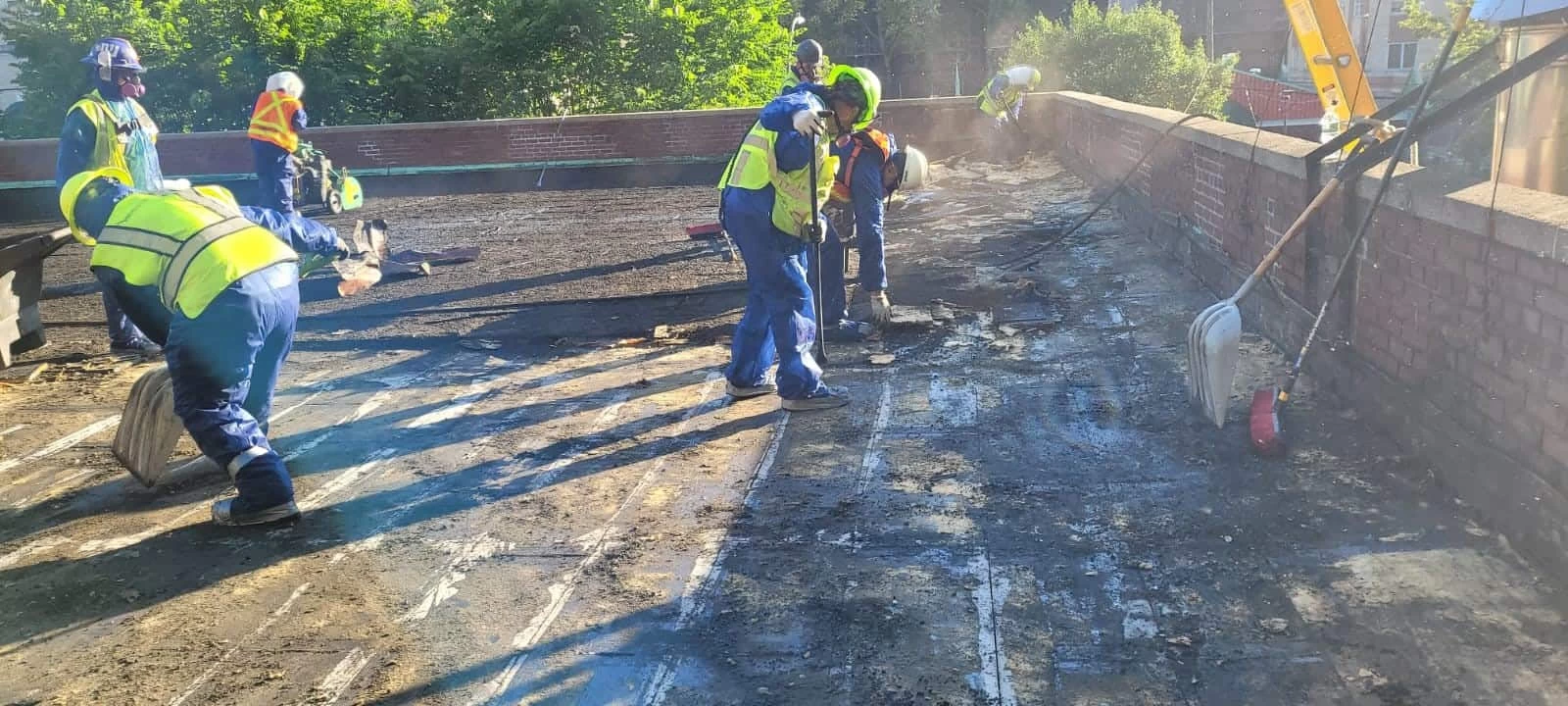
Once the notification window clears, the physical work begins. Containment is set up, materials are removed using wet-method protocols that prevent fiber release, and everything is disposed of at a licensed facility. After removal, post-abatement air clearance testing confirms that fiber levels are back within safe limits. The ACP-21 completion forms are filed with the DEP, and you receive the documentation your contractor and the NYC Buildings Department need to move forward.
Asbestos Testing and Removal Services Washington Heights
What's Actually Included When You Call Us
Asbestos abatement isn’t one thing it’s a chain of steps that each carry their own regulatory requirements in New York City. The inspection and testing phase uses a DEP Certified Asbestos Investigator to determine whether materials in your building qualify as asbestos-containing under NYC standards. That determination drives everything that follows, including whether an ACP-7 needs to be filed and what level of containment is required during removal.
The physical removal side covers the full range of materials commonly found in Washington Bridge and Morris Heights pre-war buildings: asbestos pipe insulation around steam and hot-water systems, vinyl asbestos floor tiles and the black mastic adhesive beneath them, asbestos-containing joint compound in walls and ceilings, textured popcorn ceiling removal, and roofing materials on flat-roof tenement buildings. Each material type has its own handling protocol, and our technicians are certified under NYSDOL, NYSDOH, NYC DEP, EPA, and OSHA standards.
Because the buildings in this area often have layered renovation histories particularly in Morris Heights, where city-led rehabilitation projects in the late 1970s and 1980s added new materials on top of original pre-1940 construction a thorough inspection matters more here than in newer neighborhoods. Post-abatement air clearance testing is included as a standard part of every project, along with the ACP-21 completion documentation filed with the NYC DEP. If your situation involves water damage alongside the asbestos discovery, we handle both under one team and one invoice.
Do I need an asbestos inspection before renovating my Washington Bridge apartment?
Yes and it’s not optional. Under NYC Department of Buildings rules, any renovation or alteration of a pre-1987 building requires an asbestos assessment before a permit will be issued. In Washington Bridge, where the overwhelming majority of residential buildings were constructed between 1904 and the early 1940s, this requirement applies to almost every renovation project in the neighborhood. Kitchen gut renovations, bathroom remodels, boiler replacements, roof work all of it triggers the assessment requirement before the DOB will sign off on your permit.
The assessment needs to be conducted by a DEP Certified Asbestos Investigator, who will evaluate the areas affected by your planned work and determine whether any asbestos-containing materials are present. If they are, and the scope qualifies as an Asbestos Project, an ACP-7 notification must be filed with the NYC DEP at least 10 business days before abatement work can begin. Getting this step done early before your contractor is standing there waiting saves you real time and real money.
What does asbestos abatement actually cost for a pre-war NYC apartment?
Cost depends on what’s there, how much of it there is, and where it’s located in the building. A straightforward asbestos floor tile removal in a single apartment unit will run significantly less than a full pipe insulation abatement in a multi-story building’s mechanical room. In New York City, the regulatory overhead DEP filings, certified investigator fees, licensed disposal, post-abatement air clearance testing is part of every job, and it’s built into the cost regardless of project size.
For most residential asbestos abatement jobs in the Washington Bridge and Morris Heights area, the range can run from a few hundred dollars for limited material testing and minor encapsulation work up to several thousand for full removal of pipe insulation, floor tiles, and ceiling materials in a larger unit or multi-unit scope. The free inspection we offer is the right starting point you get an honest assessment of what’s actually there before any numbers are discussed. There are no surprises after the fact.
Is asbestos common in Morris Heights apartment buildings near the Washington Bridge?
It’s more common than most people expect. In Morris Heights, the median construction year for housing is 1959, and over 41% of housing units were built before 1950. That places the majority of the neighborhood’s residential stock squarely in the highest-risk category for asbestos-containing materials. Pipe insulation, floor tile adhesive, ceiling tiles, and joint compound in buildings from this era routinely contain asbestos it was standard practice in construction through the late 1970s.
There’s an additional layer of risk specific to Morris Heights. Many buildings in the neighborhood went through city-led rehabilitation programs in the late 1970s and 1980s, when the city began restoring abandoned and fire-damaged tenements. In some cases, those projects added new materials on top of original pre-1940 construction without fully removing what was already there. That means today’s buildings can have multiple generations of asbestos-containing materials at different depths in walls, floors, and ceilings not just the obvious surface layer. A thorough inspection by a certified technician is the only way to know what’s actually present.
What is an ACP-7 form and does my contractor file it or do I?
The ACP-7 is the Asbestos Project Notification Form required by the NYC Department of Environmental Protection before any asbestos abatement work can legally begin. It gets filed through the DEP’s online ARTS system the Asbestos Reporting and Tracking System and must be submitted at least 10 business days before abatement starts. That notification window is mandatory. There’s no way around it, and starting work before it clears can result in stop-work orders and significant fines for the property owner.
Technically, the property owner is responsible for ensuring the ACP-7 is filed. In practice, your abatement contractor should handle the filing as part of their service and if they don’t, that’s worth asking about before you hire anyone. We file the ACP-7 as a standard part of every qualifying project. After the work is complete, we also file the ACP-21 completion forms with the DEP, which is the documentation your building’s file needs and what the NYC Buildings Department looks for before issuing renovation permits on pre-1987 properties.
A pipe burst in my building and I think it exposed asbestos insulation what do I do first?
Stop the work and don’t disturb the material further. In pre-war buildings throughout Washington Bridge and Morris Heights, steam and hot-water pipes were routinely wrapped with asbestos-containing insulation it was the standard material for that application from the early 1900s through the 1970s. When a pipe bursts and that insulation gets wet, torn, or disturbed, it can become friable, meaning it’s capable of releasing fibers into the air. That’s when exposure risk becomes real and immediate.
The next step is getting a certified technician to the site as quickly as possible to assess whether the material is asbestos-containing and whether it’s in a friable state. We’re available 24 hours a day, every day, and can respond to emergency situations in upper Manhattan and the Bronx. Because we also handle water damage restoration, you’re not coordinating two separate contractors while a damaged pipe and a potential asbestos situation are both unresolved. One call covers both sides of the problem.
Can I stay in my apartment during asbestos abatement, or do I need to leave?
It depends on the scope of the work and where in the building it’s happening. For limited abatement in a contained area a single room, a section of flooring, or an isolated pipe it may be possible to remain in unaffected parts of the unit or building while work is underway, provided proper containment barriers are in place and air monitoring confirms no fiber migration. For larger-scope projects, or work in common areas and mechanical spaces of multi-family buildings, temporary relocation of residents in adjacent units is sometimes required.
In the multi-family buildings that make up most of the housing stock near Washington Bridge six-story walk-ups, mid-rise apartment houses, rehabilitated tenements this question gets more complicated because you’re dealing with shared walls, shared mechanical systems, and multiple tenants. NYC DEP regulations require that containment meets specific standards before occupied spaces are considered safe during active abatement. Our team assesses relocation needs as part of the project planning process and will give you a straight answer about what’s required for your specific building before work begins not after.