Historic Homes in Douglaston Need More Than a Wrecking Crew
In Douglaston, where nearly 30% of homes predate 1950 and two historic districts come with real permit requirements, you need a demolition contractor who already knows the rules before they show up. We’ve handled 340+ projects across Queens and Long Island, and we know exactly what the Department of Buildings, the Landmarks Preservation Commission, and the New York State Department of Labor require before a single wall comes down in this neighborhood.
I needed a professional consultation explanation of procedure for safe removal of Asbestos in my apartment complex. Without having an account yet, I was very impressed with the caring, knowledgeable and generous advice offered by Jessica, and will look forward to doing business in the future. Thank you so much! I feel much more informed about a sometimes scary endeavor. Peace. Nancy Silva Mineola, NY.
Mia Munoz
Used this company to clean up some water flood in my house. They were fast and easy to work with.very professional, Would recommend to anyone!
Nini Valle
Great company, had a flood and they responded quickly and efficiently. Billed my insurance company directly. I highly recommend this company!
joe colapietro, jr
I had pipe freeze in my basement right before a snow storm and they made to within an hour to help start the clean up process. They we by our side throughout the entire process and even helped with the insurance company. They did such a great job with the cleanup, repair, remidiation, I contracted them to perform the repairs and finishes in the basement. They came with enough manpower and material to get the job done. Leo and Jessica were nothing but a pleasure to deal with!!
Cristian Arredondo c
I had some water damage in my home and Green Island was able to take care of my issue quickly and effectively. I am very pleased with the work they did. They responded quickly and were very professional.
Michael M
Outstanding service! From the office to the field crew everyone was friendly, helpful and responsive. I highly recommend Green Island Group.
No Stop-Work Orders. No Surprise Costs. Just a Clean Site.
The biggest fear with demolition in Douglaston isn’t the demo itself it’s what happens when a contractor opens a wall in a 1930s Douglas Manor Tudor and isn’t prepared for what they find. Asbestos in the floor tiles. Lead paint in the window frames. No asbestos certification on file. Suddenly your project is frozen, your timeline is blown, and you’re calling a second contractor to fix what the first one missed.
When you work with a contractor who handles asbestos assessment, abatement, and demolition together, that scenario doesn’t happen. We identify hazardous materials before anything is touched, abate them correctly, and document everything for the DOB permit all without you managing three separate companies or wondering who’s responsible for what.
If your property is in Douglas Manor or Douglaston Hill, there’s another layer: the NYC Landmarks Preservation Commission requires a permit for any exterior work, including demolition, regardless of whether the DOB also requires one. That’s not a technicality it’s a real compliance step that catches homeowners off guard all the time. We understand both permit tracks, which means your project moves forward instead of stalling at the first inspection.
340 Projects in Douglaston and Beyond. Every License. Zero Guesswork.
We’re a full-service demolition and environmental remediation contractor based in the New York metro area, serving Douglaston, Queens, all five boroughs, and Long Island. With over 12 years in the field and more than 340 completed projects, the work speaks for itself.
What makes us relevant to you in Douglaston specifically is the regulatory environment here. The DOB, the DEP, the NYS Department of Labor, and for properties in Douglas Manor and Douglaston Hill the Landmarks Preservation Commission all have a say in how demolition gets done. We hold verifiable credentials across all of them: NYC DOB licensure, NYS DOL certification under Industrial Code Rule 56, and full USEPA NESHAP compliance. Those aren’t marketing lines they’re the actual licenses you should ask any contractor to produce before they touch your property.
We bill insurance carriers directly, respond 24/7 for emergency situations, and we’ve built a 4.7-star rating on one thing: explaining what’s happening at every step.
What a Douglaston Demolition Project Actually Looks Like
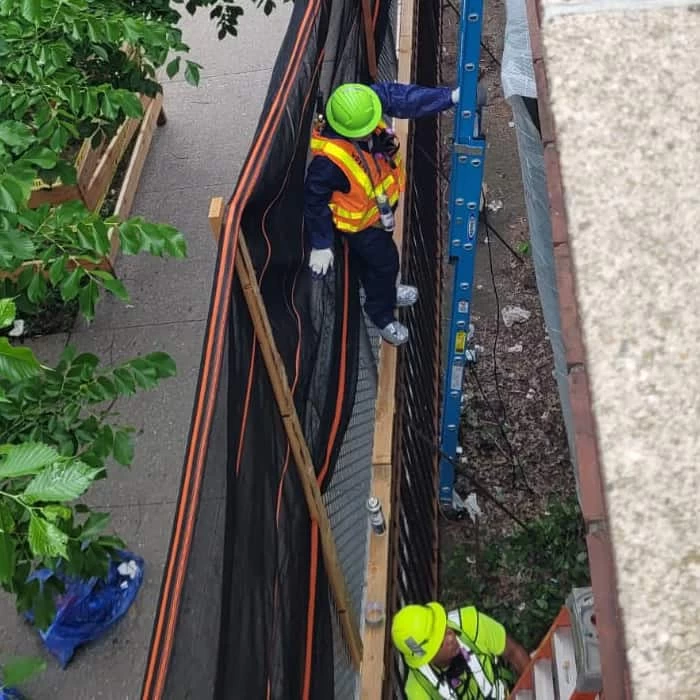
It starts before anything is touched. For any building in Douglaston constructed before April 1, 1987 which covers the vast majority of homes here New York City requires an asbestos assessment before a demolition permit can be issued. We complete that survey first, document the findings, and handle the ACP-5 certification that the DOB requires. If asbestos-containing materials are present, we manage abatement under NYS DOL certification before demolition begins. You don’t coordinate that separately it’s all part of the same project.
Once the hazardous material phase is clear, we pull permits and demolition begins. Whether that’s a selective interior demo removing a deteriorated kitchen or a failing addition while preserving original architectural details or a full structural teardown, the scope is defined before the first wall comes down. For properties in Douglas Manor or Douglaston Hill, the LPC permit process runs alongside the DOB application, so both tracks are moving at the same time rather than sequentially.
When the work is done, we remove and sort debris for proper disposal, and the site is left clean and ready for the next phase of construction. No secondary cleanup. No debris sitting on your property for weeks. The job is finished when the site is genuinely ready for what comes next.
Full-Scope Demolition Built for Douglaston's Older Housing Stock
We handle the full range of residential and commercial demolition services in Douglaston and the surrounding northeastern Queens area interior selective demolition, full structural demolition, and everything in between. Given that the median construction year for Douglaston homes is 1956, and that nearly 30% were built before 1950, almost every project here involves pre-demolition hazardous material considerations. That’s not an add-on it’s built into how we scope every job from the start.
For homeowners in Douglas Manor, where 631 contributing buildings carry historic district status, selective demolition is often the right approach: removing what’s damaged or outdated while protecting the original framing, exterior details, and architectural character that make these homes worth what they are. For properties outside the historic districts in Douglaston Park, Winchester Estates, or the core neighborhood south of I-495 we handle full teardowns and site clearance for new construction with the same permit discipline and site management.
We also offer emergency demolition 24/7 for situations that can’t wait storm damage, water intrusion, or fire damage that requires immediate structural intervention. For waterfront properties in Douglas Bay and Douglas Manor along Little Neck Bay, where nor’easters and coastal storm events can cause rapid structural damage, that response availability matters. We bill insurance directly, so you’re not fronting costs and waiting for reimbursement while your property sits exposed.
Do I need an LPC permit for demolition work in Douglaston's historic districts?
If your property is in Douglas Manor or Douglaston Hill both designated NYC Landmark Historic Districts yes, you need an LPC permit for any exterior work, and that includes demolition of exterior elements. The Douglas Manor Association is explicit about this: the LPC permit is required regardless of whether the Department of Buildings also requires one. These are two separate permit tracks, and both need to be satisfied before exterior demolition can legally proceed.
This catches a lot of homeowners off guard because they assume the DOB permit covers everything. It doesn’t not in a designated historic district. The LPC review process has its own application, its own timeline, and its own standards for what’s approvable. A contractor who isn’t already familiar with how LPC applications work in Douglaston’s historic districts will slow your project down significantly. It’s one of the first questions worth asking any contractor you’re considering.
Is asbestos testing required before demolition in Douglaston, NY?
For any building in New York City constructed before April 1, 1987, an asbestos assessment is legally required before the Department of Buildings will issue a demolition permit. In Douglaston, where the median construction year is 1956 and nearly 30% of homes predate 1950, this applies to the overwhelming majority of properties. The assessment results in an ACP-5 form, which documents the asbestos status of the building and must be submitted as part of the DOB permit application.
If asbestos-containing materials are found which is common in pre-1980 homes in floor tiles, ceiling tiles, pipe insulation, joint compound, and roofing materials a licensed abatement contractor must remove them under NYS Department of Labor certification before demolition begins. Skipping this step isn’t just a permit issue; it’s a health and legal liability. The practical takeaway is that any demolition project in Douglaston should start with a proper hazardous material survey, not after the walls are already open.
What permits are required for residential demolition in Queens, NY?
At minimum, a residential demolition project in Queens requires a DOB demolition permit, and for pre-1987 buildings, an ACP-5 asbestos certification must accompany that application. Depending on the scope of work, the NYC DEP may also need to be notified particularly for asbestos abatement projects that exceed certain material thresholds under USEPA NESHAP regulations. For larger demolitions, a NYS DOL-certified asbestos abatement contractor must be on the job.
If your property is in one of Douglaston’s historic districts, add the LPC permit to that list. And if the project involves any work near the wetland boundaries of Alley Pond Park or tidal areas adjacent to Little Neck Bay, there may be additional environmental review considerations. The permit picture in Douglaston is genuinely more layered than in most Queens neighborhoods which is exactly why working with a contractor who handles the full compliance process, rather than leaving you to figure out which agencies need what, makes a real difference in how smoothly the project moves.
How much does residential demolition typically cost in Douglaston, NY?
Demolition costs in Douglaston vary depending on the scope interior selective demo, partial structural removal, or full teardown and on what the pre-demolition survey finds. A straightforward interior demolition in a mid-century Douglaston home might run a few thousand dollars. A full structural teardown of a larger property, particularly one with confirmed asbestos-containing materials requiring abatement, will be a more substantial investment once survey, abatement, demolition, debris removal, and permit fees are factored in.
What drives unexpected cost increases in this market is usually the discovery of hazardous materials mid-project asbestos or lead that wasn’t assessed upfront, or a scope that wasn’t properly defined before work started. In Douglaston, where a significant portion of the housing stock is pre-1950 and property values average close to $1 million, a mid-project stop-work order or an unplanned abatement scope can be far more expensive than the cost of doing the survey correctly at the start. Getting an accurate, all-in scope before the project begins is the most reliable way to keep costs predictable.
Can a demolition contractor handle both asbestos abatement and demolition together?
Yes and in Douglaston, that’s the arrangement that makes the most sense given the age of the housing stock here. When asbestos abatement and demolition are handled by separate contractors, you’re managing two project timelines, two sets of insurance, two permit processes, and a handoff between companies where accountability can get blurry. If the abatement contractor leaves something behind and the demolition crew disturbs it, the question of who’s responsible becomes complicated fast.
When one contractor handles both licensed for abatement under NYS DOL Industrial Code Rule 56 and licensed by the NYC DOB for demolition the survey, abatement, and demolition are sequenced correctly under a single project plan. There’s no gap between phases, no miscommunication between crews, and no finger-pointing if something unexpected comes up. For a home in Douglas Manor or anywhere else in Douglaston where pre-war construction is the norm, that integrated approach is simply the lower-risk way to run the project.
What should Douglaston homeowners do after storm or flood damage requires emergency demolition?
The first priority is safety don’t enter a structurally compromised area until it’s been assessed. After that, the clock matters more than most people realize. Mold begins growing within 24 to 48 hours of water intrusion, and in an older Douglaston home with original plaster walls, wood framing, and period-era materials, that timeline moves fast. Calling a contractor who can respond immediately and assess what needs to come out versus what can be dried and saved is the difference between a contained remediation and a much larger demolition scope.
For properties in Douglas Bay or Douglas Manor along Little Neck Bay, where coastal storm events and nor’easters can cause significant damage, having a contractor who bills insurance directly removes one major stressor from an already difficult situation. Document the damage thoroughly with photos before any work begins, notify your insurance carrier, and make sure the contractor you call is licensed to handle both the demolition and any hazardous material exposure that storm damage may have uncovered. In Douglaston’s older homes, disturbed materials from storm damage frequently involve asbestos or lead another reason the contractor you call at 2am needs to be equipped for more than just debris removal.