Old Westbury Demolition Done Right — Permits, Abatement, and All
One licensed contractor handles asbestos clearance, Village permits, and full demolition — so your Old Westbury project doesn’t stall before it starts.
I needed a professional consultation explanation of procedure for safe removal of Asbestos in my apartment complex. Without having an account yet, I was very impressed with the caring, knowledgeable and generous advice offered by Jessica, and will look forward to doing business in the future. Thank you so much! I feel much more informed about a sometimes scary endeavor. Peace. Nancy Silva Mineola, NY.
Mia Munoz
Used this company to clean up some water flood in my house. They were fast and easy to work with.very professional, Would recommend to anyone!
Nini Valle
Great company, had a flood and they responded quickly and efficiently. Billed my insurance company directly. I highly recommend this company!
joe colapietro, jr
I had pipe freeze in my basement right before a snow storm and they made to within an hour to help start the clean up process. They we by our side throughout the entire process and even helped with the insurance company. They did such a great job with the cleanup, repair, remidiation, I contracted them to perform the repairs and finishes in the basement. They came with enough manpower and material to get the job done. Leo and Jessica were nothing but a pleasure to deal with!!
Cristian Arredondo c
I had some water damage in my home and Green Island was able to take care of my issue quickly and effectively. I am very pleased with the work they did. They responded quickly and were very professional.
Michael M
Outstanding service! From the office to the field crew everyone was friendly, helpful and responsive. I highly recommend Green Island Group.
What You Actually Get When Compliance Is Handled First
Most demolition headaches in Old Westbury don’t start on demo day — they start weeks before, when a homeowner realizes their contractor doesn’t know what the Village requires. The Village of Old Westbury has its own Building Department, its own permit checklist, and a requirement that no other Long Island municipality commonly enforces: the Village Historian must photograph your structure at least 24 hours before demolition begins. That’s not a technicality you want to discover the morning your crew shows up.
Then there’s the building stock itself. If your home or outbuilding was built before 1980 — and in Old Westbury, a significant number of estate structures date back to the early 1900s — asbestos-containing materials are almost certainly present. The Village won’t issue a demolition permit without an asbestos clearance letter from a licensed abatement company. That means if your demolition contractor can’t perform the abatement themselves, your project is on hold while you track down a second company, wait for their schedule, and restart the permit process.
When we handle abatement and demolition under one roof, that entire bottleneck disappears. You get a single point of contact, a continuous timeline, and documentation at every stage — disposal manifests, air clearance results, permit closure from the Village. For a property worth what yours is worth in Old Westbury, that paper trail matters well beyond demo day.
Green Island Group is a full-service environmental contracting and demolition firm serving Long Island and the New York City metro area. What makes the difference for Old Westbury homeowners specifically is that we hold the NYS Department of Labor Asbestos Handling Contractor License — the same credential the Village of Old Westbury’s own permit application requires before a demolition permit can be issued. You don’t need to find a separate abatement company. You don’t need to coordinate two contractors on the same project. That license is already in place.
We’ve worked across Nassau County’s North Shore communities long enough to know that Old Westbury isn’t like the rest of Long Island. The properties near Old Westbury Gardens, the estate parcels along Old Westbury Road, the carriage houses and outbuildings that come with Gold Coast acreage — these aren’t standard demo jobs, and we don’t treat them like one. We bring the same level of regulatory fluency and project management to a 4,000-square-foot carriage house as we do to a full residential teardown.
No Guesswork — Here's How an Old Westbury Demo Actually Unfolds
It starts with a site assessment. Before anything is scheduled or permitted, the structure gets evaluated for asbestos-containing materials, lead paint, and any other hazardous content. In Old Westbury’s older estate stock, this step almost always turns something up — and that’s exactly why it happens first, not as an afterthought.
From there, the permit process begins with the Village of Old Westbury Building Department. That means submitting the written reason for demolition, confirming electrical termination with PSEG, securing the Nassau County Health Department rodent-free letter, providing proof of water disconnect, and making sure contractor insurance names the Village of Old Westbury specifically. If the structure has historical significance, Board of Historical Review approval is required before the permit moves forward. We coordinate all of it. You’re not chasing paperwork across three agencies on your own.
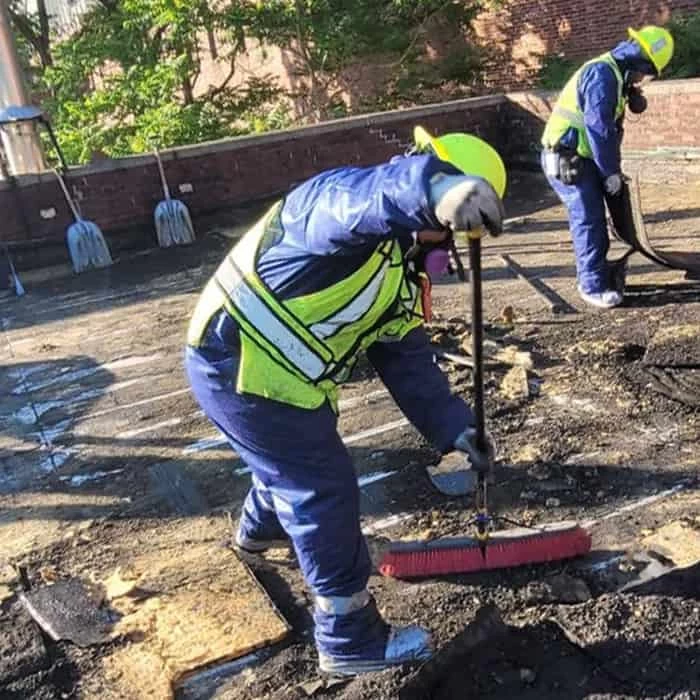
Once permits are in place, abatement comes next — removing and disposing of any hazardous materials with a fully documented chain of custody. Then demolition proceeds, followed by debris removal and site clearing. The Village Historian notification happens 24 hours before work begins, as required. At the end, you receive the full compliance package: disposal manifests, clearance documentation, and permit closure. That’s not extra — that’s the standard.
Built for Estate Properties, Not Quarter-Acre Lots
The demolition work we do in Old Westbury covers the full range of what this community actually needs. Full structural teardowns when an aging estate home has reached the end of its useful life. Accessory structure removal — carriage houses, pool houses, guest cottages, and stabling facilities that are common on the large-lot parcels throughout the village. Interior gut demolition for homeowners modernizing historic structures without touching the exterior envelope. And selective demolition when you need specific elements removed carefully, without disturbing the historic fabric around them.
Every project in Old Westbury involves at least one of the following: asbestos abatement, lead paint removal, or both. Structures built in the early 20th century — which describes a meaningful portion of Old Westbury’s residential and accessory building stock — contain these materials as a near-certainty. We’re licensed to handle all of it in-house, which keeps your project on a single timeline instead of a fragmented one.
For institutional work along Northern Boulevard or near the SUNY Old Westbury and NYIT campuses, we bring the same commercial-grade bonding, insurance, and OSHA-compliant safety protocols. Whether the client is a homeowner managing an estate renovation or a facilities director overseeing a campus building project, the compliance infrastructure is already in place.
What does Old Westbury's demolition permit actually require before work starts?
The Village of Old Westbury has a specific demolition permit checklist that goes beyond what most Long Island municipalities require. Before the permit is issued, you’ll need to submit a written explanation of why the structure is being demolished and what the site will be used for afterward. You’ll also need a letter from PSEG confirming electrical service has been terminated, a letter from the Nassau County Health Department certifying the building is rodent-free, proof that water service has been disconnected, and contractor insurance documentation that names the Village of Old Westbury specifically.
The requirement that catches most people off guard is the asbestos clearance letter — the Village requires written certification from a licensed asbestos removal company confirming the building is free of asbestos-containing materials before the permit moves forward. And separately, the Village Historian must be notified at least 24 hours before demolition begins so the structure can be photographed for the historical record. If your property has historical designation, Board of Historical Review approval is also required. These aren’t optional steps — skipping any one of them stops the permit cold.
Does every demolition project in Old Westbury require asbestos testing first?
Not every project legally requires testing, but in Old Westbury, the practical answer is yes — because the Village won’t issue a demolition permit without an asbestos clearance letter from a licensed abatement company. That letter can only come after the structure has been assessed and any asbestos-containing materials have been properly removed and disposed of.
Beyond the permit requirement, the age of Old Westbury’s housing stock makes this step genuinely important. Estate structures built in the early 1900s through the 1970s almost universally contain asbestos in some form — floor tiles, pipe insulation, plaster, roofing materials, joint compound. The material isn’t dangerous when it’s undisturbed, but demolition disturbs everything. Proceeding without proper assessment and abatement isn’t just a permit violation — it creates real health exposure for workers and anyone on or near the property. The assessment step exists to protect you, not slow you down.
How long does the demolition permit process take in the Village of Old Westbury?
Timeline varies depending on the scope of the project and whether the structure has historical significance, but a realistic window for a straightforward residential demolition permit in Old Westbury is several weeks from application to approval. The multi-agency documentation requirement — Village Building Department, Nassau County Health Department, PSEG, and potentially the Board of Historical Review — means you’re coordinating across multiple offices, each with their own processing timelines.
The abatement phase adds time as well, since the asbestos clearance letter can’t be issued until abatement is complete and post-abatement air clearance testing confirms the space is clean. The most common source of delay is homeowners who hire a demolition-only contractor and then discover mid-process that they need a separate abatement company. That gap can add weeks to the timeline. Starting with a contractor who handles both abatement and demolition — and who knows the Village’s specific permit checklist — is the most direct way to keep the schedule moving.
What happens to the asbestos and hazardous materials removed from my property?
All asbestos-containing materials removed during abatement are treated as regulated waste and must be handled according to NYS Department of Labor and EPA requirements. That means the materials are wetted to prevent fiber release, double-bagged in labeled, sealed containers, and transported by a licensed hazardous waste hauler to a licensed disposal facility. Every step of that process is documented on a disposal manifest — a chain-of-custody record that tracks the material from your property to its final disposal destination.
That manifest isn’t just regulatory paperwork. It’s documentation that protects you as the property owner. If a future buyer, insurer, or building department asks whether hazardous materials were properly handled during a prior demolition, that manifest is your evidence. In Old Westbury, where properties routinely transact at significant values, having a clean compliance record for prior remediation work is a real asset — and the absence of that documentation is a real liability. We provide the full compliance package at project close, not just a verbal confirmation that the work is done.
Can a demolition contractor in Old Westbury handle lead paint removal too, or is that separate?
It depends on the contractor, but it shouldn’t be separate — and in Old Westbury, it rarely can be. Any structure built before 1978 is presumed to contain lead-based paint under EPA guidelines, and in a village where significant portions of the housing stock predate World War II, that presumption applies to almost every project. Disturbing lead paint during demolition without following EPA Renovation, Repair and Painting (RRP) protocols is a federal violation, and it creates genuine health risk for workers and occupants.
We hold EPA RRP certification and perform lead paint abatement in-house, which means the lead component of your project is handled by the same team doing the asbestos abatement and the demolition. You’re not coordinating a third contractor or waiting for a separate schedule. More importantly, you’re not in a situation where the demo crew discovers lead paint mid-project and has to stop work while you figure out who handles it. That scenario is more common than most homeowners expect — and it’s entirely avoidable when you start with a contractor who’s already licensed for both.
Does demolishing a carriage house or outbuilding in Old Westbury require the same permits as a full house teardown?
Yes — any structure being demolished in the Village of Old Westbury requires a demolition permit from the Village Building Department, regardless of whether it’s the primary residence or an accessory structure like a carriage house, pool house, barn, or guest cottage. The same documentation checklist applies: PSEG termination letter, asbestos clearance, Nassau County Health Department certification, water disconnect, and contractor insurance naming the Village. The Village Historian notification requirement applies as well.
What changes with accessory structures is sometimes the complexity of the abatement phase. Older carriage houses and stabling facilities on Old Westbury’s estate parcels were often built with materials that contain asbestos at higher concentrations than a typical residential structure — particularly in roofing, pipe insulation, and flooring. The assessment step is just as important here as it is for a full teardown, and the permit won’t move forward without the clearance letter regardless of the structure’s size. If you’re planning to remove an outbuilding as part of a larger renovation or landscaping project, building the permit and abatement timeline into your overall project schedule from the start will save you from a delay you didn’t see coming.