Carle Place Homes Are Older — The Damage Goes Deeper
When a fire hits a mid-century home in Carle Place, what you see is rarely the whole story. We respond 24/7, handle your insurance directly, and take the job from emergency call to move-back-in day.
I needed a professional consultation explanation of procedure for safe removal of Asbestos in my apartment complex. Without having an account yet, I was very impressed with the caring, knowledgeable and generous advice offered by Jessica, and will look forward to doing business in the future. Thank you so much! I feel much more informed about a sometimes scary endeavor. Peace. Nancy Silva Mineola, NY.
Mia Munoz
Used this company to clean up some water flood in my house. They were fast and easy to work with.very professional, Would recommend to anyone!
Nini Valle
Great company, had a flood and they responded quickly and efficiently. Billed my insurance company directly. I highly recommend this company!
joe colapietro, jr
I had pipe freeze in my basement right before a snow storm and they made to within an hour to help start the clean up process. They we by our side throughout the entire process and even helped with the insurance company. They did such a great job with the cleanup, repair, remidiation, I contracted them to perform the repairs and finishes in the basement. They came with enough manpower and material to get the job done. Leo and Jessica were nothing but a pleasure to deal with!!
Cristian Arredondo c
I had some water damage in my home and Green Island was able to take care of my issue quickly and effectively. I am very pleased with the work they did. They responded quickly and were very professional.
Michael M
Outstanding service! From the office to the field crew everyone was friendly, helpful and responsive. I highly recommend Green Island Group.
A fire in Carle Place isn’t just a fire. The homes here — many of them built in the late 1940s and 1950s when William Levitt was first testing what would become Levittown — were constructed with materials that weren’t considered hazardous at the time. Asbestos floor tiles, pipe insulation, joint compound. Lead paint on nearly every surface. When fire disturbs those materials, the damage becomes a legal and health issue, not just a cleanup job. Most restoration companies aren’t licensed to touch it.
That’s where the hidden cost usually hits. A homeowner hires a crew to clean up the soot and smoke, only to find out mid-project that the work has to stop because nobody on site is certified to handle what’s inside the walls. We hold NYS DOL Asbestos and Mold licenses and USEPA Lead/RRP certification — which means when we walk into a Carle Place home, we’re equipped for what’s actually there, not just what’s visible.
Smoke doesn’t stay in one room either. It moves through ductwork, wall cavities, and insulation far beyond the burn zone. The water used to put the fire out soaks into subfloor materials and starts a mold clock that runs whether you’re paying attention or not. Getting a team on site fast — and getting the right team — is what separates a controlled recovery from a months-long ordeal.
One Company, One License, One Less Thing to Manage
We’re a Long Island-based restoration and environmental services company — not a franchise, not a call center. We’re locally owned and operated out of Bohemia, NY, and we’ve completed more than 5,000 restoration projects across New York State, including homes throughout Nassau County and Carle Place.
What makes us different in a market like Carle Place isn’t just the credentials — it’s that the credentials actually match what the work requires. We hold a Nassau County General Contractor license, which is the specific license needed to pull permits from the Town of North Hempstead Building Department and legally perform reconstruction work in Carle Place. That matters because most restoration companies stop at remediation and hand you off to a separate contractor for the rebuild. We don’t hand you off.
From Garden City to Westbury, and everywhere in between, we’ve worked in the neighborhoods that surround Carle Place long enough to know what these homes are made of — literally. When we show up, we already know what to look for.
The first call triggers an emergency response. We operate 24/7, 365 days a year, and our target is to have someone on-site within an hour. That timeline matters because soot starts permanently bonding to surfaces within hours of a fire, and mold can begin growing in wet structural materials within 24 to 48 hours. In Carle Place, where many of the original Levitt homes were built on concrete slabs without basements, firefighting water has nowhere to drain — it pools at grade level and accelerates that mold timeline significantly.
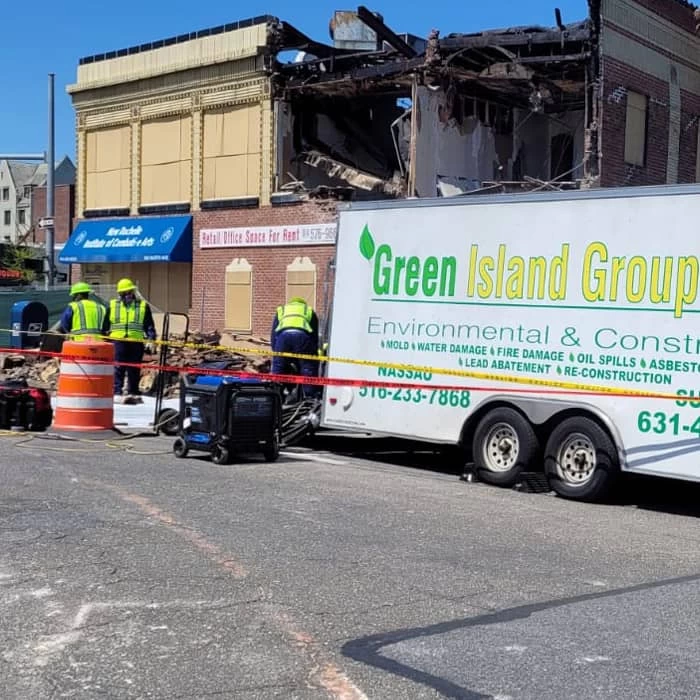
Once on-site, our team assesses the full scope of damage — visible and hidden. That includes moisture readings inside wall cavities, air quality testing, and a check for any disturbed hazardous materials like asbestos or lead paint that are common in homes of this age. From there, we handle emergency board-up and tarping if needed, then move into the structured drying, soot removal, odor treatment, and debris clearing phases.
When it comes time to rebuild, we manage the permit process with the Town of North Hempstead Building Department — now handled through the Town’s OpenGov platform — so you’re not learning a new system while you’re displaced from your home. And throughout every phase, we document everything to insurance-standard specifications and bill your carrier directly.
Fire damage restoration in Carle Place covers a lot more ground than most homeowners expect going in. Our scope includes emergency stabilization, full structural drying, soot and smoke removal, odor elimination using thermal fogging and ozone treatment, HVAC decontamination, and licensed asbestos and mold remediation where needed. For homes built before 1978 — which describes most of Carle Place’s housing stock — lead paint disturbance is assessed and handled under our USEPA Lead/RRP certification.
One category that often catches Carle Place homeowners off guard is oil burner puff-backs. Long Island has one of the highest concentrations of oil-heated homes in the country, and many of the mid-century homes here still run on original or aging oil systems. A puff-back isn’t a fire, but it releases a cloud of soot and oil mist that coats every interior surface — and it requires the same professional restoration process. If you’ve had a puff-back and your home smells like burnt oil or every surface has a greasy film, that’s a restoration job, not a heating repair.
Once remediation is complete, we handle the licensed reconstruction under our Nassau County General Contractor license — structural repairs, drywall, flooring, whatever your home needs to be fully livable again. You don’t manage two separate companies. You make one call and we carry it through.
Does homeowners insurance cover fire damage restoration in Carle Place, NY?
In most cases, yes — standard homeowners insurance policies cover fire damage restoration, including smoke damage, soot cleanup, water damage from firefighting, and structural repairs. What varies is how thoroughly the damage gets documented and how aggressively the claim is managed. Insurance adjusters work for the insurance company, not for you, and their initial assessment doesn’t always capture the full scope — especially in older homes where damage inside wall cavities or disturbed hazardous materials add to the total.
We bill insurance companies directly and document every phase of the restoration process to the standard that adjusters and carriers expect. For a Carle Place home with a median value around $744,400 — and a construction history that can involve multiple renovation layers over seven or eight decades — that documentation quality directly affects how much of the work gets covered. We’ve guided hundreds of Long Island families through this process, and we know where claims tend to get disputed and how to prevent it.
How quickly does fire damage need to be addressed before it gets worse?
The short answer is immediately. Soot is acidic and starts permanently bonding to walls, ceilings, and metal surfaces within hours of a fire — the longer it sits, the more it etches into materials that could otherwise be cleaned rather than replaced. The water used to extinguish the fire creates a parallel problem: mold can begin colonizing wet structural materials within 24 to 48 hours, and in a home without a basement — which describes many of the original Levitt-era slab-on-grade homes in Carle Place — that water has nowhere to go and stays in contact with structural elements longer than it would in a house with drainage below grade.
Odor is another time-sensitive issue. Smoke particles are microscopic and embed in insulation, HVAC ductwork, upholstered furniture, and clothing throughout the home, not just in the affected room. The longer those particles sit, the harder they are to neutralize. Getting a certified restoration team on-site fast isn’t just about optics — it’s the difference between a home that’s restorable and one that requires a full gut renovation.
My Carle Place home was built in the 1950s — does that change the restoration process?
It changes it significantly, and any restoration company worth hiring should tell you that upfront. Homes built in Carle Place during the 1940s, 1950s, and 1960s — including the original Levitt homes and the wave of construction that followed — were built with materials that are now classified as hazardous. Asbestos was used in floor tiles, pipe insulation, ceiling tiles, boiler wrap, and joint compound. Lead-based paint was standard on virtually every painted surface until 1978. A fire disturbs these materials, and once disturbed, they can’t be legally or safely handled by an unlicensed contractor.
We hold NYS DOL Asbestos licensure, NYS DOL Mold licensure, and USEPA Lead/RRP certification. That combination means we’re legally equipped to handle what a fire in a mid-century Carle Place home is likely to uncover — without stopping the project mid-stream to bring in a separate licensed firm. If you’re not sure whether your home contains these materials, the honest answer is: if it was built before 1980 in this area, assume it does until a proper assessment says otherwise.
What is a puff-back, and do I need a fire restoration company for it?
A puff-back happens when an oil-fired furnace misfires and backfires, releasing a pressurized cloud of soot and oil mist through the heating system and into the living space. It’s not a fire, but the result looks and smells like one — every surface in the home, sometimes every room, gets coated in a fine, greasy, black film. The odor is persistent and the soot, if not treated properly, will keep releasing particles into the air long after the initial event.
Long Island has one of the highest concentrations of oil-heated homes in the country, and Carle Place is no exception. Many of the mid-century homes here still run on oil systems that haven’t been fully updated. Puff-backs are more common than most homeowners realize, and they require the same professional remediation process as smoke damage from a fire — air scrubbing, surface cleaning, HVAC decontamination, and odor neutralization. A standard cleaning service won’t resolve it. If your home has experienced a puff-back, we handle the full restoration, and in most cases it’s covered under your homeowners insurance policy.
Can I stay in my home during fire damage restoration?
It depends on the extent of the damage and what’s been disturbed in the process. If the fire was contained to one area and the structural integrity of your home is intact, there are situations where you can remain in an unaffected part of the house during restoration. But in most cases — particularly after a significant fire in an older Carle Place home — temporary displacement is the safer and more practical choice.
The reasons go beyond comfort. Soot particles and smoke residue in the air are a genuine health hazard, especially for children, elderly residents, or anyone with respiratory conditions. If asbestos-containing materials have been disturbed, your home is legally off-limits for occupants until remediation is complete and clearance testing confirms the air is safe. Your homeowners insurance policy typically includes Additional Living Expenses (ALE) coverage, which pays for temporary housing while your home is being restored. We can help you understand what your policy covers so you’re not paying out of pocket for a hotel while the work is underway.
How long does fire damage restoration take for a home in Carle Place?
There’s no single honest answer, because the timeline depends on the size of the fire, the extent of smoke and water damage, whether hazardous materials were disturbed, and how quickly the permitting process moves. For a contained kitchen fire with limited smoke spread, restoration might take two to three weeks. For a fire that affected multiple rooms, involved structural damage, and required asbestos or lead remediation, the timeline can extend to several months.
In Carle Place specifically, the permitting piece adds a real variable. Any structural reconstruction requires permits from the Town of North Hempstead Building Department, and the inspection schedule is set by the Town — not by the contractor. We manage that process on your behalf, including filing through the Town’s OpenGov platform and coordinating inspections, but the municipal timeline is what it is. What we can control is starting the process immediately, keeping the documentation clean so there are no permit delays caused by incomplete paperwork, and keeping you informed at every stage so you’re not left wondering where things stand.