Your Postwar Home Deserves More Than a Generic Cleanup
Most East Massapequa homes were built in the postwar boom — and fire damage in a 60-year-old house isn’t just about what burned. We handle fire damage restoration from the first call to the final walkthrough, including everything hiding inside the walls.
I needed a professional consultation explanation of procedure for safe removal of Asbestos in my apartment complex. Without having an account yet, I was very impressed with the caring, knowledgeable and generous advice offered by Jessica, and will look forward to doing business in the future. Thank you so much! I feel much more informed about a sometimes scary endeavor. Peace. Nancy Silva Mineola, NY.
Mia Munoz
Used this company to clean up some water flood in my house. They were fast and easy to work with.very professional, Would recommend to anyone!
Nini Valle
Great company, had a flood and they responded quickly and efficiently. Billed my insurance company directly. I highly recommend this company!
joe colapietro, jr
I had pipe freeze in my basement right before a snow storm and they made to within an hour to help start the clean up process. They we by our side throughout the entire process and even helped with the insurance company. They did such a great job with the cleanup, repair, remidiation, I contracted them to perform the repairs and finishes in the basement. They came with enough manpower and material to get the job done. Leo and Jessica were nothing but a pleasure to deal with!!
Cristian Arredondo c
I had some water damage in my home and Green Island was able to take care of my issue quickly and effectively. I am very pleased with the work they did. They responded quickly and were very professional.
Michael M
Outstanding service! From the office to the field crew everyone was friendly, helpful and responsive. I highly recommend Green Island Group.
What Full Restoration Actually Looks Like in East Massapequa
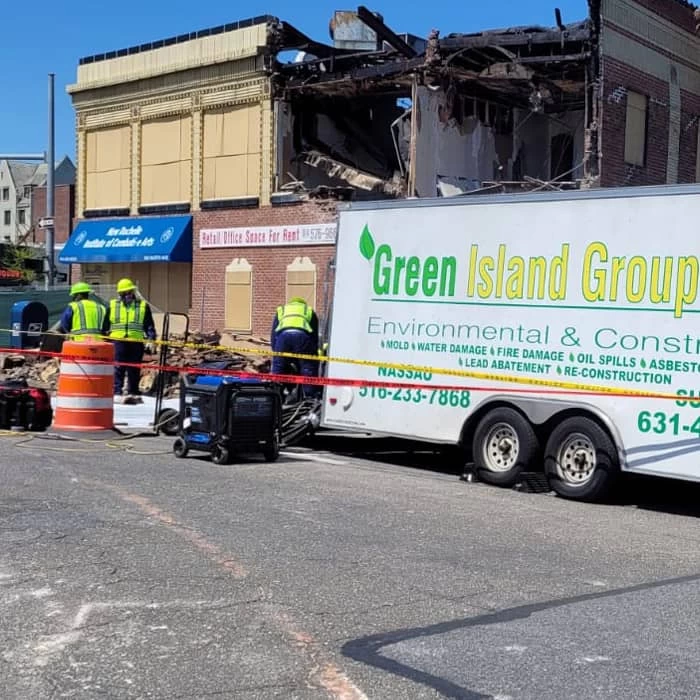
When a fire happens in an East Massapequa home, the visible damage is rarely the whole story. Smoke travels through HVAC ducts, wall cavities, and insulation — well beyond the room where the fire started. And in homes built between the 1940s and 1960s, the way those walls are constructed means smoke embeds deeper and spreads further than it would in newer builds. By the time restoration is done correctly, the smell is gone, the air tests clean, and every surface that absorbed combustion byproducts has been treated — not just wiped down.
The other outcome that matters here is safety compliance. East Massapequa’s housing stock almost certainly contains asbestos-containing materials — floor tiles, pipe insulation, ceiling coatings — that were standard in postwar construction. A fire that disturbs those materials creates a hazardous situation that goes beyond standard cleanup. When that work is done right, you’re not just getting your home back. You’re getting it back without a hidden liability tucked inside the walls.
The firefighting water that saved your home also soaked into your subfloor, framing, and insulation. Without proper extraction and drying, mold follows within 24 to 48 hours. When the full process is handled under one roof — water extraction, structural drying, smoke remediation, hazardous materials abatement, and reconstruction — you move back into a home that’s genuinely restored, not just patched.
Licensed Fire Restoration Company, East Massapequa
Every License This Job Actually Requires
We are a Long Island-based restoration company with active General Contractor licenses in Nassau County and Suffolk County, IICRC certification for fire and smoke damage restoration, NYS DOL licenses for asbestos and mold remediation, and USEPA Lead/RRP certification. That combination matters in East Massapequa specifically — because restoring a 1950s or 1960s home after a fire isn’t just a cleanup job. It’s a hazardous materials project wrapped inside a reconstruction project, and most contractors are only licensed to do one or the other.
With over 5,000 completed restoration projects across New York State and a base in Bohemia, just off the Southern State Parkway, we have worked throughout Nassau County and know the Town of Oyster Bay permit process that governs all reconstruction work in East Massapequa. From the Biltmore Shores waterfront neighborhood to the neighborhoods east of Carmans Road near the Amityville school district line, this is familiar territory — not a market we’re figuring out as we go.
From Emergency Call to Move-Back-In Day — No Handoffs
When you call, someone picks up — around the clock, every day of the year. From our location in Bohemia, we can reach East Massapequa via the Southern State Parkway within an hour. That response time matters because acidic soot begins permanently bonding to surfaces within hours of a fire, and the water used to extinguish it starts creating mold risk almost immediately. The faster the response, the smaller the total scope of damage.
Once on-site, we assess the full extent of the loss — not just the burn zone, but smoke migration through your HVAC system, water saturation in your subfloor and framing, and the presence of any hazardous materials that the fire may have disturbed. In East Massapequa’s older homes, that last step isn’t optional. If asbestos-containing materials are present, we handle licensed abatement before any demolition or reconstruction begins, as required by New York State law. We also notify the NYS Department of Labor prior to abatement, which is a legal requirement that not every contractor follows.
From there, we move through water extraction, structural drying, smoke and soot remediation, odor elimination, and full reconstruction — all under our Nassau County General Contractor license, so you’re not coordinating between three separate companies while you’re displaced. Before we consider the job complete, your home has to pass our own inspection: no odor, no visible residue, no unresolved moisture readings. We also pull all required permits through the Town of Oyster Bay Building Department and handle the documentation your insurance company needs to process the claim.
Fire and Smoke Damage Restoration Services, East Massapequa
Built for Long Island's Older Homes, Not a Generic Checklist
Fire damage restoration in East Massapequa covers a wider scope than most homeowners expect going in. Beyond the burned materials, the job typically involves smoke and soot remediation throughout the entire home — including ductwork — water damage mitigation from firefighting efforts, structural drying, and in most cases, licensed hazardous materials abatement. Because virtually every home in this community predates 1978, lead paint disturbance is a near-certainty during demolition. Because most homes predate the mid-1970s, asbestos-containing materials are likely present in floor tiles, pipe insulation, or ceiling finishes. We hold the USEPA Lead/RRP certification and NYS DOL Asbestos License to handle both legally.
Oil heat is another factor that comes up frequently in this area. Long Island has one of the highest concentrations of oil-heated homes in the country, and East Massapequa is no exception. If your oil burner experienced a puff-back during or after the fire — or if the fire itself affected your heating system — soot contamination can extend through every room in the house through the ductwork. We include HVAC system inspection and cleaning as part of the full restoration scope when it’s warranted.
The reconstruction side of the work is handled under our active Nassau County General Contractor license, which means we can take the project from demolition through finished carpentry, drywall, flooring, and paint — everything required to bring your home back to its pre-loss condition. One company, one contract, one point of contact from start to finish.
Can I stay in my East Massapequa home after a fire?
In most cases, no — at least not immediately. After a fire, there are several factors that determine whether a home is safe to occupy: structural integrity, air quality, the presence of active smoke or soot contamination, and whether hazardous materials like asbestos or lead have been disturbed. In East Massapequa’s older housing stock, that last consideration is especially important. Asbestos fibers and lead dust are invisible and don’t have a smell, so you can’t assess that risk on your own.
Beyond the hazmat question, smoke-damaged air is genuinely harmful to breathe, even after the visible smoke has cleared. Fine particulate matter from combustion embeds in soft surfaces and continues to off-gas for days. Until a professional assessment confirms that air quality is within safe limits and any hazardous materials have been properly contained or abated, re-entry is a real health risk — not just a precaution. Your insurance policy likely includes additional living expense (ALE) coverage for exactly this situation, which covers temporary housing costs while your home is being restored.
How long does fire damage restoration take for a typical East Massapequa house?
The honest answer is that it depends on the scope, and scope in an East Massapequa home is often larger than it first appears. A contained kitchen fire with limited smoke spread might take two to four weeks. A fire that caused significant structural damage, spread smoke through the HVAC system, and disturbed asbestos-containing materials in a postwar home can take two to four months or longer.
The variables that extend timelines in East Massapequa specifically are the hazardous materials abatement process — which requires NYS DOL notification and a mandatory waiting period before work begins — and the Town of Oyster Bay permit process for reconstruction. Permits take time, and any licensed contractor working in East Massapequa has to factor that into the schedule. We give you a realistic timeline at the assessment stage, not an optimistic one designed to win the job. If the scope changes as we open walls and find additional damage, we communicate that immediately rather than surprising you at the end.
Does homeowner's insurance cover fire damage restoration in New York?
Yes, standard homeowner’s insurance policies in New York cover fire damage restoration, including smoke damage, water damage from firefighting efforts, and the cost of temporary housing if your home is uninhabitable. What varies is how much your insurer pays and how smoothly the claim process goes — and that’s where documentation and contractor experience matter significantly.
We bill insurance companies directly and document every phase of the restoration to insurance-standard specifications. That includes photo documentation, moisture readings, air quality testing results, and itemized scope of work. For a home in East Massapequa with a current market value in the $675,000 to $800,000 range, the difference between a well-documented claim and a poorly documented one can be tens of thousands of dollars. We’ve worked with every major carrier that operates in Nassau County and know what adjusters look for. Our job isn’t just to restore your home — it’s to make sure your claim reflects the full scope of what that restoration requires.
What does smoke damage do to an older East Massapequa home that newer homes don't face?
Postwar homes in East Massapequa were built with construction methods and materials that create specific challenges after a fire. Many have original plaster walls rather than drywall — plaster is more porous and absorbs smoke and odor compounds more deeply than modern drywall does. Original hardwood floors, older insulation materials, and decades of paint layers all retain smoke differently than newer materials would.
The bigger issue is what’s inside the walls. Homes built in the 1940s through 1960s commonly contain asbestos in floor tiles, pipe insulation, and textured ceiling coatings. When a fire or the subsequent demolition disturbs those materials, you have a hazardous materials situation layered on top of a fire restoration project. That combination requires a contractor who holds both restoration certifications and state-issued hazmat licenses — not two separate companies, but one that can legally and competently handle both. That’s a short list in Nassau County, and we’re on it.
What is an oil burner puff-back, and does it count as fire damage?
A puff-back happens when an oil burner misfires and discharges a cloud of fine soot and oily residue through the furnace and into the home’s ductwork. Within minutes, that soot can coat walls, ceilings, furniture, and clothing in every room connected to the heating system — without any actual fire occurring. It’s one of the most common service calls we receive from Long Island homeowners, and East Massapequa’s concentration of older oil-heated homes makes it a relevant scenario here.
Whether a puff-back is covered by homeowner’s insurance depends on your specific policy and how the incident is classified, but many standard policies do cover sudden and accidental discharge events. The restoration process for a puff-back is similar to smoke damage remediation: surface cleaning, HVAC system cleaning, air scrubbing, and odor treatment throughout the affected areas. If your home experienced a puff-back in connection with a fire, or if your oil heating system was affected by fire damage, we assess and address both as part of the same restoration scope.
Does Green Island Group handle permits for fire restoration work in East Massapequa?
Yes. All structural fire damage repairs in East Massapequa require building permits through the Town of Oyster Bay Building Department — this isn’t optional, and it applies to any work involving demolition, framing, electrical, plumbing, or mechanical systems. As a licensed General Contractor in Nassau County, we pull all required permits, coordinate inspections, and ensure every phase of reconstruction meets current Town of Oyster Bay building code requirements.
This matters more than it might seem. Unpermitted work after a fire can create serious problems when you go to sell the home, file a future insurance claim, or refinance. It can also void portions of your current claim if your insurer discovers that restoration work was done without required permits. We handle the permit process as a standard part of every project in East Massapequa — it’s built into the scope, not an add-on. If asbestos abatement is required, we also handle the mandatory NYS Department of Labor notification prior to beginning that work, which is a separate legal requirement from the building permit process.