Estate-Scale Fires Need More Than a Standard Response
When your Lattingtown home takes a hit from fire or smoke, the next call you make determines how much of it you actually get back — we respond within the hour, handle your insurance, and see the job through to full reconstruction.
I needed a professional consultation explanation of procedure for safe removal of Asbestos in my apartment complex. Without having an account yet, I was very impressed with the caring, knowledgeable and generous advice offered by Jessica, and will look forward to doing business in the future. Thank you so much! I feel much more informed about a sometimes scary endeavor. Peace. Nancy Silva Mineola, NY.
Mia Munoz
Used this company to clean up some water flood in my house. They were fast and easy to work with.very professional, Would recommend to anyone!
Nini Valle
Great company, had a flood and they responded quickly and efficiently. Billed my insurance company directly. I highly recommend this company!
joe colapietro, jr
I had pipe freeze in my basement right before a snow storm and they made to within an hour to help start the clean up process. They we by our side throughout the entire process and even helped with the insurance company. They did such a great job with the cleanup, repair, remidiation, I contracted them to perform the repairs and finishes in the basement. They came with enough manpower and material to get the job done. Leo and Jessica were nothing but a pleasure to deal with!!
Cristian Arredondo c
I had some water damage in my home and Green Island was able to take care of my issue quickly and effectively. I am very pleased with the work they did. They responded quickly and were very professional.
Michael M
Outstanding service! From the office to the field crew everyone was friendly, helpful and responsive. I highly recommend Green Island Group.
What Full Restoration Actually Looks Like in Lattingtown
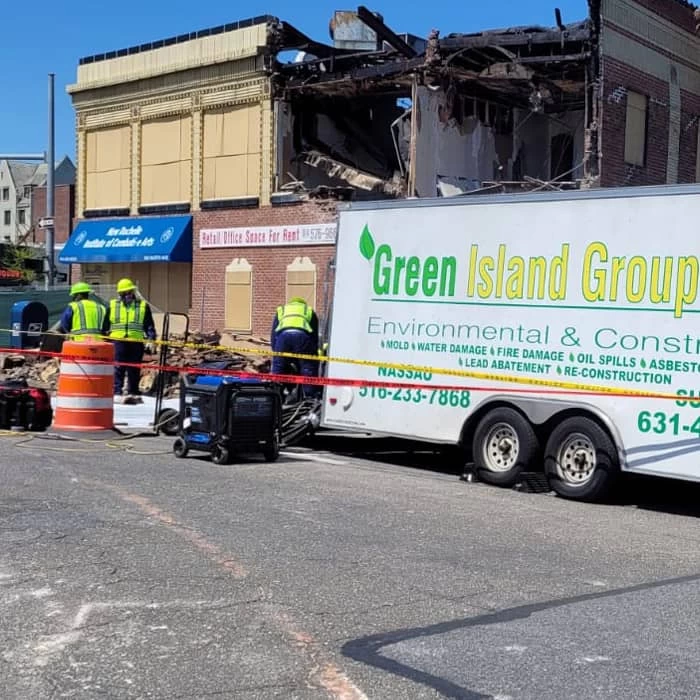
A fire in a Lattingtown home is a different problem than a fire in most places. When your property spans 6,000 or 7,000 square feet, smoke doesn’t stay in one room. It moves through multi-zone HVAC systems, settles into original plaster ceilings, gets into custom millwork, and works its way behind walls long before the flames are out. By the time the Locust Valley Fire Department clears the scene, the secondary damage is already in motion.
That’s the part most homeowners don’t expect. The fire gets put out, and then the clock starts on everything else — soot bonding permanently to surfaces, water from suppression soaking into subfloors, and in a coastal environment like Lattingtown, mold beginning to develop within 24 to 48 hours. The dampness coming off Long Island Sound doesn’t wait for a contractor’s schedule.
What you get with a full restoration isn’t just cleanup. It’s a coordinated response that stops the damage from compounding, documents everything for your insurance carrier, and brings your home back to exactly what it was — or better. Every room assessed, every system inspected, every material handled the way a property like yours deserves.
The Credentials Behind the Work Actually Matter in Lattingtown
We are a locally owned restoration company based on Long Island, serving Lattingtown and Nassau County’s North Shore with a team that holds IICRC certification for fire and smoke damage restoration, a Nassau County General Contractor license, NYS DOL licenses for both asbestos and mold, and USEPA Lead/RRP certification. That’s not a list of badges. In a village like Lattingtown where a meaningful portion of the housing stock predates 1980, those licenses are the legal requirement for doing the work correctly.
Homes near the Creek Club, throughout the Lattingtown Harbor development, and along the estate roads off Route 25A regularly contain asbestos-containing materials, lead paint, and oil heating systems that can complicate what looks like a straightforward fire restoration. We are equipped — and licensed — to handle all of it without handing your project off to a second or third contractor.
With over 5,000 completed restoration projects across New York State, we have worked in homes like yours before.
From Emergency Response to Final Walkthrough — No Gaps, No Delays
The first thing that happens is simple: someone shows up. We maintain a sub-one-hour on-site response commitment, 24 hours a day, every day of the year. In Lattingtown, where the fire department is staffed entirely by volunteers and response logistics on local roads off Route 25A can vary, getting a restoration team on-site quickly is what limits how far the damage spreads.
Once on-site, our team conducts a full structural and environmental assessment — not just what burned, but what the fire touched, what the suppression water reached, and what the smoke traveled through. In older homes throughout Lattingtown Harbor or the estate properties near the Bailey Arboretum, that assessment includes testing for asbestos and lead before any demolition or removal begins. New York State law requires it, and skipping that step creates serious liability for the homeowner.
From there, the process moves through water extraction and structural drying, debris removal, hazardous material abatement if needed, smoke and soot remediation across every affected surface and HVAC zone, odor elimination, and then reconstruction. Because we hold a Nassau County General Contractor license, we can pull permits directly from the Village of Lattingtown’s Building Inspector and manage the rebuild under the same contract — no handoffs, no gaps, no second contractor to coordinate.
Built for the Homes That Actually Exist in Lattingtown
Fire restoration in Lattingtown covers more ground than most companies advertise. We handle emergency board-up and securing, full structural assessment, water extraction and drying, smoke and soot cleaning across all surfaces — walls, ceilings, floors, contents, and ductwork — odor neutralization using thermal fogging and ozone treatment, asbestos and lead abatement where required, mold remediation under NYS DOL licensing, and complete reconstruction through our Nassau County GC license.
Puff-back from oil burners is one of the most common calls we receive on the North Shore. Oil heat is the dominant fuel source in Lattingtown and across this stretch of Nassau County, and when a burner misfires, it can coat every room in a home with oily, acidic soot in seconds. In a 7,000-square-foot estate, that’s not a small cleaning job. It requires the same professional-grade response as structural fire damage — air scrubbers, NADCA-certified HVAC cleaning, and full surface remediation throughout the home.
Insurance is handled directly. We bill your carrier, document every step of the process, and work through the claims process with you — which matters when you’re holding a high-value home policy and the loss runs into six figures. The goal is a complete, documented restoration that reflects the actual value of your home, not the cheapest available alternative.
Does fire restoration in Lattingtown require permits from the village directly?
Yes — and this is something a lot of homeowners don’t realize until it causes a delay. Lattingtown is an incorporated village with its own municipal government, its own Building Inspector, and its own zoning code under Chapter 315. Any reconstruction or structural alteration following a fire requires permits issued at the village level, not just Nassau County permits. A contractor who isn’t familiar with that process — or who doesn’t hold a Nassau County General Contractor license — can’t legally pull those permits on your behalf.
We hold a Nassau County GC license and have experience navigating the permitting requirements specific to Lattingtown and the other incorporated villages within the Town of Oyster Bay. That means the permit process doesn’t fall on you to manage, and the reconstruction doesn’t stall while you track down a separate contractor who’s qualified to handle it.
How quickly does smoke damage spread through a large home after a fire?
Faster than most people expect. Smoke is not contained to the room where the fire started — it moves through HVAC ductwork, wall cavities, and interconnected spaces throughout the entire structure within minutes. In a Lattingtown home with multiple HVAC zones, like most of the larger properties in this village, smoke can reach rooms on the opposite side of the house before the fire is even out. The longer soot sits on a surface — especially on porous materials like plaster, wood, or fabric — the more permanently it bonds.
That’s why the timeline from fire suppression to professional response matters so much. Every hour of delay increases the scope of cleaning required and raises the risk of soot damage becoming permanent. Our one-hour on-site response commitment exists specifically to close that window, because in a home this size, waiting until morning is not a neutral decision.
What is puff-back damage and is it common in Lattingtown homes?
Puff-back happens when an oil burner misfires or experiences a delayed ignition, causing a backfire that pushes a blast of oily, acidic soot through the heating system and into the living space. It’s not a fire in the traditional sense, but the contamination it produces can cover every surface in a home — walls, ceilings, furniture, clothing, and HVAC ductwork — in seconds. The residue is oily and acidic, which means it doesn’t wipe off easily and it actively damages surfaces the longer it sits.
Oil heat is the dominant fuel source in Lattingtown and across Nassau County’s North Shore, which makes puff-back one of the most common restoration calls in this area. It’s especially likely at the start of heating season in the fall, when a furnace that’s been idle all summer fires up for the first time. In a Lattingtown estate with thousands of square feet and complex multi-zone ductwork, a single puff-back event can mean a restoration project that rivals the scope of a structural fire. We handle puff-back with the same IICRC-certified process as fire and smoke damage — full surface remediation, NADCA-certified duct cleaning, and odor elimination throughout the home.
Does homeowners insurance typically cover fire damage restoration costs in Lattingtown, NY?
In most cases, yes — fire damage is a covered peril under standard homeowners insurance policies, including the high-value home policies common in Lattingtown. Carriers like Chubb, AIG Private Client, and PURE, which are frequently used for properties in this price range, generally cover the full scope of fire restoration including cleanup, remediation, and reconstruction up to the policy limits. What varies is how the claim is documented, scoped, and negotiated — and that’s where a lot of homeowners run into problems.
Insurance adjusters work for the insurance company, and their initial assessment of a loss doesn’t always reflect the true cost of restoring a home of this size and complexity to its pre-loss condition. We document every step of the restoration process, provide complete written scopes of work, and bill your carrier directly. The goal is to make sure your claim reflects what it actually costs to restore a Lattingtown estate — including the custom finishes, original architectural details, and period-appropriate materials that can’t be priced off a generic replacement schedule.
Can fire damage in an older Lattingtown home disturb asbestos or lead paint?
It can, and in many cases it does. A significant portion of Lattingtown’s housing stock was built before 1980 — including the entire Lattingtown Harbor development, which began in 1950, and the Gold Coast-era estates that predate it by decades. Homes built during those periods commonly contain asbestos in floor tiles, pipe insulation, ceiling tiles, and joint compound, as well as lead paint on interior and exterior surfaces. When a fire damages or disturbs those materials, they become an active hazard.
Under New York State Code Rule 56, only a NYS DOL-licensed asbestos contractor can legally handle the removal or disturbance of asbestos-containing materials during a restoration or demolition project. Similarly, NYS law requires a licensed mold remediation contractor for mold work, and USEPA Lead/RRP certification is required for work on pre-1978 homes. We hold all three credentials. That matters because many restoration companies operating in this area do not — which means they’re either skipping required steps or subcontracting work they aren’t licensed to perform themselves.
How long does fire damage restoration take for a large home in Lattingtown?
The honest answer is that it depends on the scope, and scope in a Lattingtown home can vary significantly. A contained kitchen fire with limited smoke spread might be fully remediated in one to two weeks. A fire that moves through a multi-zone HVAC system, affects multiple rooms, and requires asbestos abatement before reconstruction can begin — which is a realistic scenario in many of the older estate properties in this village — can take several months from emergency response to final walkthrough.
The variables that affect timeline most in Lattingtown specifically are the size of the home, the age of the construction and what hazardous materials testing reveals, the extent of smoke and water penetration through the structure, and the permitting process through the Village of Lattingtown’s Building Inspector. We manage all of those moving parts under one contract, which eliminates the delays that happen when a homeowner is trying to coordinate between a remediation company, a separate GC, and a hazmat subcontractor. A clear scope, a single point of contact, and a team that can pull village permits directly keeps the project moving on a realistic, predictable timeline.