Lynbrook's Older Homes Deserve More Than a Cleanup Crew
When fire hits a pre-war Colonial or Tudor on a Lynbrook side street, the damage runs deeper than what you can see — and you need a certified team that knows exactly what they’re walking into.
I needed a professional consultation explanation of procedure for safe removal of Asbestos in my apartment complex. Without having an account yet, I was very impressed with the caring, knowledgeable and generous advice offered by Jessica, and will look forward to doing business in the future. Thank you so much! I feel much more informed about a sometimes scary endeavor. Peace. Nancy Silva Mineola, NY.
Mia Munoz
Used this company to clean up some water flood in my house. They were fast and easy to work with.very professional, Would recommend to anyone!
Nini Valle
Great company, had a flood and they responded quickly and efficiently. Billed my insurance company directly. I highly recommend this company!
joe colapietro, jr
I had pipe freeze in my basement right before a snow storm and they made to within an hour to help start the clean up process. They we by our side throughout the entire process and even helped with the insurance company. They did such a great job with the cleanup, repair, remidiation, I contracted them to perform the repairs and finishes in the basement. They came with enough manpower and material to get the job done. Leo and Jessica were nothing but a pleasure to deal with!!
Cristian Arredondo c
I had some water damage in my home and Green Island was able to take care of my issue quickly and effectively. I am very pleased with the work they did. They responded quickly and were very professional.
Michael M
Outstanding service! From the office to the field crew everyone was friendly, helpful and responsive. I highly recommend Green Island Group.
What Full Recovery Actually Looks Like in Lynbrook
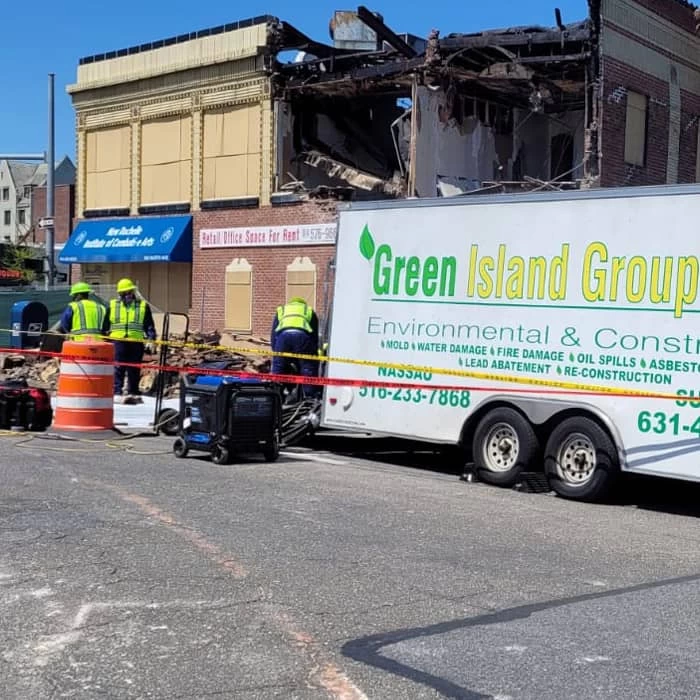
Fire damage in Lynbrook isn’t the same as fire damage somewhere else. More than half the homes in this village were built before 1950 — pre-war plaster walls, original hardwood floors, aging oil-fired heating systems, and a very high likelihood of asbestos-containing materials hidden inside the structure. When a fire happens in a Lynbrook home like that, the restoration process has to account for all of it. A crew that only handles the surface cleanup and hands you off to someone else for the hazardous materials isn’t giving you a complete job.
Smoke is the other half of the problem that most people don’t fully anticipate. In Lynbrook’s older homes, smoke doesn’t stay in the room where the fire started. It moves through original ductwork, plaster wall cavities, and attic spaces — embedding soot and combustion byproducts in areas that look completely fine. That invisible contamination affects your air quality and can cause long-term health issues if it’s not addressed properly. Real restoration means finding all of it, not just cleaning what’s visible.
Then there’s the water. Every fire in Lynbrook that gets suppressed leaves behind moisture — and in a home with wood framing, cellulose insulation, and decades of absorbed humidity, mold can take hold within 24 to 48 hours. A restoration that doesn’t address the water damage underneath the fire damage isn’t finished. What full recovery looks like here is one team, one process, and no gaps between the cleanup and the rebuild.
We’re a locally owned Long Island restoration company — not a national franchise with a call center somewhere else. Our team is IICRC certified for fire and water damage restoration, holds a Nassau County General Contractor License, and carries NYS DOL licenses for both asbestos and mold remediation. That combination matters specifically in Lynbrook, where the age of the housing stock means hazardous materials aren’t a rare exception — they’re a regular part of the job.
When a fire damages a home near Sunrise Highway or off Peninsula Boulevard, the work can’t stop at cleanup. Reconstruction has to happen under the same roof, with the same accountability. We handle the full scope — from emergency board-up and stabilization through complete rebuild — with 5,000-plus completed restoration projects across New York State behind us. We also bill insurance directly and have a documented track record of guiding Nassau County homeowners through the claims process from start to finish.
The first call triggers an emergency response. We operate 24 hours a day, every day, and aim to have a certified crew on-site within one hour. For a Lynbrook address, that’s a realistic window — we stage equipment across Long Island, and the village is well-connected via Sunrise Highway and the Southern State Parkway. When our crew arrives, the immediate priority is stabilizing the property: boarding up openings, tarping the roof if needed, and stopping the damage from getting worse before assessment begins.
From there, our team conducts a full scope of the loss — not just the burn zone, but the entire structure. In Lynbrook’s pre-war homes, that means checking wall cavities, ductwork, and attic spaces for smoke and soot migration. If asbestos-containing materials or lead paint have been disturbed, that gets documented and addressed under the appropriate state licenses before any demolition or reconstruction begins. Nassau County and the Village of Lynbrook both require permits for post-fire reconstruction work, and we coordinate that process directly so you’re not stuck managing paperwork while you’re displaced.
Once the structure is cleared, dried, and remediated, reconstruction begins under the same contract. You’re not finding a second contractor or re-explaining the scope to someone new. The rebuild matches what was there — including the architectural character of original pre-war construction that can’t just be swapped for modern materials and called equivalent.
Fire damage restoration in Lynbrook covers a wider scope than most homeowners expect when they first make the call. The core service includes emergency stabilization, full structural assessment, smoke and soot removal throughout the affected areas, water extraction and structural drying from firefighting suppression, content cleaning and pack-out when needed, and complete reconstruction through to move-in. But the local conditions here add layers that not every restoration company is equipped — or licensed — to handle.
Because the majority of Lynbrook’s housing stock predates 1980, asbestos abatement is a real and frequent part of the restoration process. Floor tiles, pipe insulation, ceiling finishes, and joint compound in these older homes can all contain asbestos. When fire or demolition disturbs those materials, New York State law requires a licensed asbestos contractor to handle the remediation. We hold that license. The same applies to lead paint, which is present in most Lynbrook homes built before 1978 — we carry USEPA Lead/RRP Certification for legally compliant work.
For homeowners with oil-fired heating systems — which are common throughout Nassau County’s South Shore — puff-back soot remediation is also part of what we handle. An oil burner malfunction can coat an entire home’s interior in oily black soot without a structural fire ever occurring. That’s a separate service category that most restoration companies don’t explicitly offer, but it’s a real and recurring problem for Lynbrook homeowners with older heating systems.
What should I do immediately after a house fire in Lynbrook, NY?
The first thing to do is make sure the property has been cleared by the Lynbrook Volunteer Fire Department before anyone re-enters. Once the scene is released, call a certified restoration company as quickly as possible — not because of a sales pitch, but because the clock is already running on two separate problems. Soot begins permanently bonding to surfaces within hours of a fire, and the water used to suppress the fire creates mold risk within 24 to 48 hours in the wood framing and plaster construction common to Lynbrook’s older homes.
While you’re waiting for our crew to arrive, document everything you can with photos or video if it’s safe to do so. That documentation matters for your insurance claim. Don’t attempt to clean anything yourself — improper cleaning of soot on pre-war plaster walls or original hardwood floors can cause permanent damage and may actually reduce your claim recovery. Let the certified team assess the full scope before anything is touched.
Does homeowners insurance cover fire damage restoration costs in Nassau County?
In most cases, yes — standard homeowners insurance policies cover fire damage, including smoke and soot remediation, water damage from firefighting suppression, and structural reconstruction. But the amount you recover depends heavily on how the claim is documented and presented. Insurance adjusters work for the carrier, not for you, and they’re not always looking for reasons to pay the full scope of a loss.
We bill insurance directly and document every stage of the restoration to the standards that Nassau County carriers recognize. That includes IICRC-certified methodology, which major insurance companies use as a benchmark when evaluating claims. For Lynbrook homeowners with homes valued at $600,000 or more, the difference between a well-documented claim and a poorly documented one can be tens of thousands of dollars. We have a track record of attending material selection appointments and advocating for full coverage — not just completing the work and leaving you to sort out the paperwork.
My Lynbrook home was built in the 1940s — does that affect the restoration process?
It does, and significantly. Homes built in the 1940s — which describes a large portion of Lynbrook’s housing stock — have a high probability of containing asbestos-containing materials and lead paint. Under New York State law, asbestos remediation requires a licensed asbestos contractor, and work that disturbs lead paint requires USEPA Lead/RRP certified personnel. These aren’t optional steps — they’re legal requirements, and a restoration company that skips them is exposing you to liability and health risk.
Beyond the hazardous materials, the construction methods in pre-war Lynbrook homes require a different approach than modern drywall construction. Original plaster-and-lath walls absorb smoke differently, original hardwood floors respond differently to water extraction, and the architectural details — the trim profiles, the door and window casings, the built-in character of a 1940s Colonial or Tudor — can’t just be replaced with off-the-shelf modern materials and considered equivalent. We have the credentials and the experience with this type of construction to handle it correctly.
How long does fire damage restoration typically take for a home in Lynbrook?
The honest answer is that it depends on the scope of the damage, but there are some realistic ranges. A contained kitchen fire with smoke spread to adjacent rooms typically takes two to four weeks for full remediation and repair. A more significant structural fire affecting multiple rooms or floors can run eight to sixteen weeks, particularly in Lynbrook’s older homes where hazardous material testing, abatement, and permit coordination add time to the front end of the process.
The permit process through the Village of Lynbrook Building Department is a real timeline factor. Post-fire reconstruction requires permits, and the village operates under Nassau County’s fire prevention code — which in some cases is more stringent than the state baseline. We coordinate the permit process directly, which removes a significant source of delay for homeowners who are already dealing with temporary displacement. Having one company handle everything from emergency response through final inspection is one of the most practical ways to keep the timeline from stretching unnecessarily.
Can smoke damage spread through the HVAC system in an older Lynbrook home?
Yes, and it’s one of the most underestimated aspects of fire damage in Lynbrook’s older housing stock. Original ductwork in pre-war and early post-war homes often lacks the sealing and insulation of modern systems, which means smoke and soot can travel quickly through the entire HVAC network — depositing combustion byproducts in rooms that appear completely unaffected. You might have a fire that starts and stays in one room, but end up with soot contamination and odor in bedrooms on the opposite side of the house.
Addressing this properly requires more than running an air purifier. We use air scrubbers, thermal fogging, ozone treatment, and HVAC cleaning to restore indoor air quality throughout the entire structure — not just the visible damage area. This is especially important in Lynbrook’s two-family homes and multi-unit buildings, where smoke from one unit can contaminate a neighboring unit through shared ductwork or wall cavities. If the HVAC system isn’t cleaned as part of the restoration, the odor and air quality problems will persist long after the visible damage is repaired.
What is a puff-back, and is it covered the same way as fire damage in Lynbrook?
A puff-back happens when an oil-fired furnace or boiler malfunctions and backfires — expelling a burst of soot, oil residue, and combustion byproducts through the ductwork and into the living spaces of the home. It’s not a fire in the traditional sense, but the cleanup is just as involved. Oily black soot coats walls, ceilings, furniture, and HVAC components, and the odor penetrates soft materials quickly. Nassau County’s South Shore — including Lynbrook — has a high concentration of homes with oil heating systems, and puff-back events are a recurring issue, particularly during the heating season.
Most standard homeowners insurance policies do cover puff-back damage, but coverage can vary depending on the cause of the malfunction and how the claim is documented. The cleanup process for puff-back soot is different from dry fire soot — the oily residue requires specific cleaning agents and methods to avoid smearing it further into surfaces. We handle puff-back remediation with the same certified methodology we apply to structural fire damage, and we document the scope to insurance standards so the claim process moves without unnecessary friction.