When a Manhasset Home Burns, the Real Work Starts Now
Fire damage in a pre-war Manhasset home isn’t just cleanup — it’s asbestos, lead paint, aging systems, and a seven-figure asset on the line. We handle all of it, start to finish.
I needed a professional consultation explanation of procedure for safe removal of Asbestos in my apartment complex. Without having an account yet, I was very impressed with the caring, knowledgeable and generous advice offered by Jessica, and will look forward to doing business in the future. Thank you so much! I feel much more informed about a sometimes scary endeavor. Peace. Nancy Silva Mineola, NY.
Mia Munoz
Used this company to clean up some water flood in my house. They were fast and easy to work with.very professional, Would recommend to anyone!
Nini Valle
Great company, had a flood and they responded quickly and efficiently. Billed my insurance company directly. I highly recommend this company!
joe colapietro, jr
I had pipe freeze in my basement right before a snow storm and they made to within an hour to help start the clean up process. They we by our side throughout the entire process and even helped with the insurance company. They did such a great job with the cleanup, repair, remidiation, I contracted them to perform the repairs and finishes in the basement. They came with enough manpower and material to get the job done. Leo and Jessica were nothing but a pleasure to deal with!!
Cristian Arredondo c
I had some water damage in my home and Green Island was able to take care of my issue quickly and effectively. I am very pleased with the work they did. They responded quickly and were very professional.
Michael M
Outstanding service! From the office to the field crew everyone was friendly, helpful and responsive. I highly recommend Green Island Group.
Your Manhasset Home Restored — Not Just Cleaned Up
There’s a big difference between a company that wipes down surfaces and calls it done, and one that actually restores your home to what it was. Smoke particles are microscopic. They get into your walls, your ductwork, your wood framing — and if they’re not fully extracted, you’ll still smell it six months later. Real restoration means the air is clean, the structure is sound, and nothing is hidden behind fresh paint.
In Manhasset, nearly half of all homes were built before 1939. That’s not a minor detail — it changes everything about how fire damage gets handled. Pre-war construction commonly contains asbestos floor tiles, pipe insulation, and plaster materials that a fire will disturb. It means lead paint. It means old electrical systems that may have contributed to the fire in the first place and need to be fully assessed before reconstruction begins. A restoration company that isn’t licensed to handle those materials legally can’t finish the job — and in some cases, they can make it worse.
When the work is done right, you get your home back. Not a version of it with covered-up damage and lingering odor — the actual home, rebuilt and cleared. That’s what this process looks like when it’s handled by a company that holds every credential required to do it in Nassau County.
We’re a locally owned restoration and environmental services company serving Long Island, Queens, and New York City. Not a franchise. Not a call center dispatching crews from a corporate playbook. A real Long Island company with real accountability on every job.
For work in Manhasset and the broader Town of North Hempstead, that means holding a Nassau County General Contractor license — the specific credential required to pull permits through the North Hempstead Building Department on Plandome Road and legally complete structural reconstruction. It also means holding NYS DOL Asbestos Contractor certification, USEPA Lead/RRP certification, NYS DOL Mold Remediation licensing, and IICRC certification for fire and water damage restoration. In a community where the homes are old, the values are high, and the hazards are real, that combination matters.
With over 5,000 completed restoration projects across New York State, we’ve worked through every scenario Long Island produces — including the pre-war and mid-century homes that define neighborhoods like Strathmore, Plandome, and Munsey Park in and around Manhasset.
From the First Call to Move-Back-In Day — One Company, No Handoffs
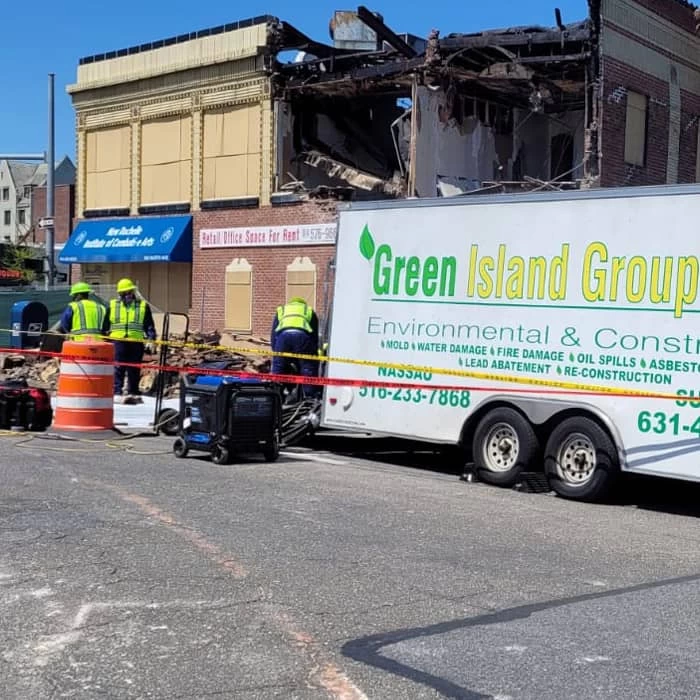
The first call triggers an immediate response. We arrive on-site within one hour, 24 hours a day, seven days a week. The first priority is stabilizing the property — board-up, emergency tarping, and securing the structure against weather and unauthorized access. This isn’t just common sense. Under Town of North Hempstead code, a fire-damaged building must be sealed within 72 hours of the occurrence. That’s a legal obligation, and it’s one of the first things we handle.
From there, we conduct a full assessment — structural damage, smoke and soot penetration, water intrusion from firefighting, and hazardous material identification. In Manhasset’s older housing stock, that assessment almost always includes testing for asbestos and lead. If those materials are present and disturbed, abatement comes before any demolition or reconstruction begins. There’s no legal shortcut around that, and any company that skips it is putting you at risk.
Once the hazmat work is cleared, the restoration moves into demolition of unsalvageable materials, structural drying, odor elimination using air scrubbers and thermal fogging, HVAC cleaning, and full reconstruction. Every phase is documented to insurance-standard specifications, and we handle the permit process with the North Hempstead Building Department directly — so you’re not managing that on top of everything else.
What's Actually Included When the Damage Is This Serious
Fire damage restoration in Manhasset covers a lot of ground, and the scope depends entirely on what the fire touched and what the home contains. At minimum, every job includes emergency stabilization, a full damage assessment, smoke and soot removal from all affected surfaces, odor elimination, water extraction and structural drying from firefighting, content evaluation, and a complete documentation package for your insurance carrier. We bill insurance directly and manage the claim communication so the process doesn’t fall on you.
For the older homes that make up the majority of Manhasset’s housing stock, the scope typically expands. Asbestos abatement, lead-safe work practices, and HVAC system cleaning — using NADCA-certified methods — are standard inclusions when pre-war or mid-century construction is involved. Oil burner puff-backs, which are common in Long Island’s older oil-heated homes, require a specific approach: full HVAC decontamination, oily soot removal from every affected surface, and odor treatment throughout the home.
When structural reconstruction is required, we carry the work through to completion — framing, drywall, flooring, electrical, plumbing, and finish work — all under a Nassau County General Contractor license and fully permitted through the Town of North Hempstead. You deal with one company, one timeline, and one point of contact from the first emergency call to the final walkthrough.
Does the Town of North Hempstead require permits for fire damage repairs in Manhasset?
Yes, and the requirements are specific. Under Town of North Hempstead code, any structural repair, demolition, or reconstruction following fire damage requires building permits issued by the North Hempstead Building Department, which is located on Plandome Road in Manhasset. Beyond the permit requirement, the code also mandates that a fire-damaged building be sealed against unauthorized access within 72 hours of the occurrence — and that the property owner notify the Building Official in writing within two weeks of the fire regarding their intent to repair, demolish, or rebuild.
As of March 2026, the Town of North Hempstead transitioned all permit and licensing applications to the OpenGov platform, so the submission process has changed from what some older contractors may be used to. We hold a Nassau County General Contractor license and manage the full permit process on your behalf — filing applications, coordinating inspections, and ensuring all work meets the 2020 Residential Code of New York State. You don’t have to navigate that while also dealing with displacement and an insurance claim.
My Manhasset home was built in the 1930s — does that affect fire damage restoration?
Significantly. Homes built before 1939 — which accounts for nearly half of all housing in Manhasset — commonly contain asbestos in floor tiles, pipe insulation, ceiling materials, and roofing. They also frequently contain lead paint, which is present in virtually all homes built before 1978. When a fire occurs in a home like this, the damage itself disturbs these materials, creating a hazmat situation that has to be addressed before any demolition or reconstruction can legally begin.
This isn’t a minor procedural step. Under New York State law, asbestos abatement must be performed by a NYS DOL-licensed asbestos contractor. Lead-safe work practices require USEPA Lead/RRP certification. A restoration company without these credentials cannot legally complete the job in your home — and if they attempt to, they’re exposing you to liability and health risk. We hold both credentials, along with NYS DOL Mold Remediation licensing for the mold that frequently develops in older structures after firefighting water has been absorbed into plaster walls and dense wood framing.
How long does fire damage restoration typically take for a home in Manhasset?
There’s no honest single answer to this — the timeline depends on the extent of the damage, the age and construction of the home, and whether hazardous materials are involved. A contained kitchen fire in a newer home might be fully restored in two to four weeks. A more significant fire in a pre-war Manhasset home that requires asbestos abatement, structural demolition, and full reconstruction can take three to six months or longer.
What affects the timeline most in Manhasset specifically is the combination of older construction and the permit process through the Town of North Hempstead. Asbestos testing, abatement, and clearance air sampling add time before demolition can begin. Permit approval through the Building Department adds time before reconstruction can start. We manage both of these processes proactively — filing permits early, scheduling abatement contractors in sequence, and keeping the insurance carrier updated throughout — which minimizes delays that are within anyone’s control. A realistic timeline is discussed with you at the assessment stage so you’re not guessing.
Will my homeowner's insurance cover the full cost of fire damage restoration?
Most standard homeowner’s insurance policies cover fire damage restoration, including smoke and soot cleanup, water damage from firefighting, and structural reconstruction. What they cover in full versus partially depends on your specific policy — your coverage limits, your deductible, and whether you have replacement cost value coverage or actual cash value coverage. The difference between those two matters a lot when you’re restoring a Manhasset home worth $1.5 million or more.
The bigger practical issue is documentation. Insurance adjusters work from scope of work reports, and the completeness of that documentation directly affects the settlement. We document every phase of the restoration process to insurance-standard specifications — from the initial damage assessment through final reconstruction — and bill the insurance carrier directly. We’ve guided hundreds of Long Island homeowners through the claims process and have specific experience with the scope items that adjusters commonly challenge, including hazardous material abatement costs and full HVAC decontamination. If there’s a gap between what the adjuster offers and what the actual restoration requires, that’s a conversation we’re equipped to have on your behalf.
What is an oil burner puff-back, and how is it cleaned up in an older Manhasset home?
A puff-back happens when an oil burner misfires or backfires — instead of igniting cleanly, it blasts a cloud of oily, black soot back through the heat exchanger and into the HVAC distribution system. From there, that soot travels through every duct in the house and deposits on walls, ceilings, furniture, clothing, and every surface the air touches. It’s not a fire in the traditional sense, but the contamination can be just as extensive — and in some cases, it covers an entire home.
Puff-backs are particularly common in Long Island’s older oil-heated housing stock, and Manhasset’s pre-war and mid-century homes run heavily on oil heat. Cleaning up a puff-back correctly requires NADCA-certified HVAC system decontamination, oily soot removal from all affected surfaces using specific chemical agents, content cleaning or pack-out, and odor treatment. Standard household cleaning doesn’t touch oily soot — it smears it. In a Manhasset home with original hardwood floors, plaster walls, and high-end finishes, an improperly cleaned puff-back leaves permanent staining and a persistent odor that doesn’t go away on its own. We hold NADCA certification and handle puff-back remediation as a full-scope service.
How do I know if smoke odor has been fully eliminated after a fire in my home?
The honest answer is that if you can still smell it, it hasn’t been. Smoke particles range from 0.4 to 0.7 microns in size — small enough to penetrate drywall, insulation, wood framing, HVAC ductwork, and upholstered materials. In a Manhasset home with plaster walls and dense old-growth framing, smoke contamination goes deeper into the structure than it does in modern construction. Surface cleaning alone won’t reach it, and painting over smoke-stained walls without proper treatment just seals the odor in temporarily — it comes back.
Full odor elimination requires a layered approach: HEPA air scrubbing to capture airborne particles, thermal fogging to penetrate porous materials, ozone treatment for deep structural decontamination, and NADCA-certified HVAC cleaning to clear the duct system. We use all of these methods in sequence, not as standalone options. The standard for completion isn’t “we treated it” — it’s that the air quality has been tested and confirmed, and the odor is gone. For a home in a community like Manhasset, where the property value and the quality of your living environment both matter, that’s the only acceptable outcome.