North Bay Shore Homes Deserve a Full Recovery Not Just a Cleanup
When fire hits a home in North Bay Shore, the damage rarely stops where the flames did. We handle everything from emergency response to full reconstruction so you’re not managing four contractors while your family is displaced.
I needed a professional consultation explanation of procedure for safe removal of Asbestos in my apartment complex. Without having an account yet, I was very impressed with the caring, knowledgeable and generous advice offered by Jessica, and will look forward to doing business in the future. Thank you so much! I feel much more informed about a sometimes scary endeavor. Peace. Nancy Silva Mineola, NY.
Mia Munoz
Used this company to clean up some water flood in my house. They were fast and easy to work with.very professional, Would recommend to anyone!
Nini Valle
Great company, had a flood and they responded quickly and efficiently. Billed my insurance company directly. I highly recommend this company!
joe colapietro, jr
I had pipe freeze in my basement right before a snow storm and they made to within an hour to help start the clean up process. They we by our side throughout the entire process and even helped with the insurance company. They did such a great job with the cleanup, repair, remidiation, I contracted them to perform the repairs and finishes in the basement. They came with enough manpower and material to get the job done. Leo and Jessica were nothing but a pleasure to deal with!!
Cristian Arredondo c
I had some water damage in my home and Green Island was able to take care of my issue quickly and effectively. I am very pleased with the work they did. They responded quickly and were very professional.
Michael M
Outstanding service! From the office to the field crew everyone was friendly, helpful and responsive. I highly recommend Green Island Group.
A fire leaves more behind than char and ash. Smoke moves fast through your HVAC system, into wall cavities, into rooms that never saw a flame. Soot starts permanently staining surfaces within 24 to 72 hours. By the time most homeowners get a contractor on the phone, the damage has already spread well beyond what they can see. That window matters, and losing it costs real money.
For North Bay Shore homeowners, there’s another layer most restoration companies aren’t upfront about. A large portion of the housing stock here was built between the 1970s and 1990s which puts it squarely in the window for asbestos-containing materials. Floor tiles, ceiling tiles, pipe insulation, joint compound a fire that disturbs any of those materials creates an environmental problem on top of the structural one. Not every restoration company is certified to handle that. We are.
Then there’s the water. Fire trucks push roughly 250 gallons per minute. Even a contained kitchen fire can leave thousands of gallons soaking into your floors, walls, and framing. Mold can start in as little as 24 to 48 hours after that water intrusion. When you get a company that handles fire, smoke, water extraction, and mold remediation under one roof, you’re not just getting convenience you’re closing the gaps where secondary damage typically takes hold.
Local Fire Damage Restoration Company, North Bay Shore
Long Island-Based, Not a Franchise Answering to Someone Else
We’re a locally owned restoration company serving Nassau and Suffolk County not a franchise operation with a corporate office in another state making decisions about your home. When you call, you’re reaching people who know North Bay Shore’s housing stock, understand the Town of Islip’s permitting process, and have worked in communities like Bay Shore, Brentwood, and Central Islip long enough to know what these homes are made of and what they need.
That local knowledge matters in ways that don’t show up in a franchise brochure. It means knowing that a 1978 split-level off County Route 13 likely has different remediation requirements than a newer build. It means understanding how to document damage for a Suffolk County insurance adjuster, not a generic national claims process. Multiple customers have specifically called out the insurance assistance we provided as the thing that made the difference not just the cleanup work, but the advocacy.
We stay with you from the first call to the final coat of paint. That’s not a tagline it’s the actual scope of what we do.
From the First Call to a Finished Home Here's the Sequence
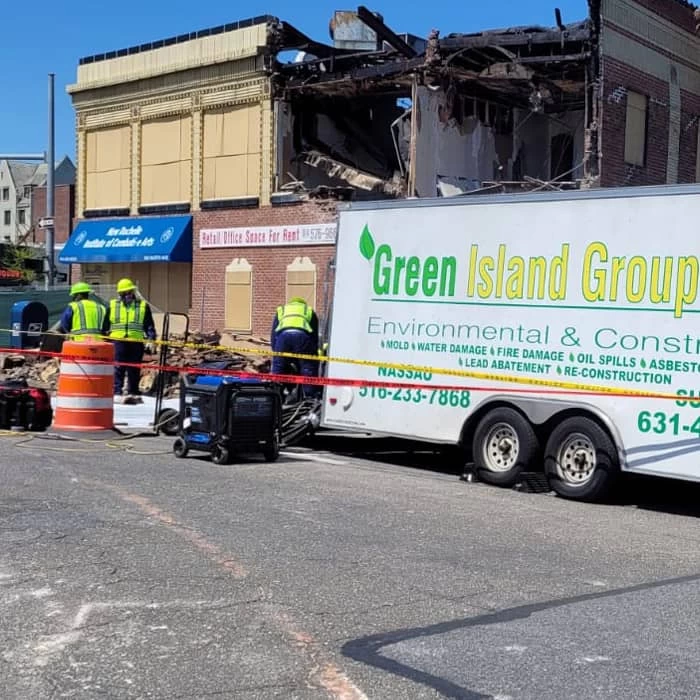
The first step is emergency response securing the property, boarding up openings, and stopping any active exposure to weather or further damage. North Bay Shore’s suburban density means an unsecured fire-damaged home can become a safety issue for neighboring properties quickly, so this step isn’t optional and it isn’t slow. Our documented response times run under an hour.
Once the property is stabilized, the assessment phase begins. This is where the full scope of damage gets documented not just what’s visible, but what smoke has penetrated, where water has traveled, and whether any materials require environmental remediation before restoration work can proceed. For homes built before 1980 in the North Bay Shore area, that assessment includes checking for asbestos-containing materials that may have been disturbed. Any abatement work that’s required is handled in-house, under New York State Department of Labor certification you don’t need to find a separate specialist and wait on their schedule.
From there, the process moves through water extraction and drying, smoke and soot remediation, structural repairs, and full reconstruction. All work requiring permits is pulled through the Town of Islip building department nothing gets done unpermitted, which matters both for your insurance claim and for any future sale of the property. The job isn’t handed off. We see it through to finished walls, floors, and livable space.
Fire and Smoke Damage Restoration, North Bay Shore NY
Every Phase of Recovery, Handled Under One Roof
Fire damage restoration isn’t one service it’s a sequence of them. What we bring to a North Bay Shore home is the ability to run that entire sequence without handoffs. Emergency board-up and securing, smoke and soot remediation, water extraction from firefighting efforts, odor elimination, asbestos abatement when the housing stock requires it, mold remediation, structural demolition where needed, and full reconstruction including finishes. One company, one point of contact, start to finish.
The odor piece is worth addressing directly, because it’s one of the most common things homeowners underestimate. Surface cleaning doesn’t remove smoke molecules that have soaked into drywall, wood framing, insulation, and soft goods. We use thermal fogging, ozone treatment, and hydroxyl generator technology to neutralize odor at the molecular level not cover it up. The goal is a home that doesn’t smell like a fire happened, period.
For North Bay Shore residents navigating an insurance claim likely for the first time the documentation and adjuster communication support we provide is often what determines whether the payout covers the actual scope of work. With median home values approaching $490,000 in this area and most homeowners carrying mortgages, the difference between a well-documented claim and an underpaid one isn’t minor. It can be the difference between a full recovery and a financial gap that follows a family for years.
What should I do immediately after a house fire in North Bay Shore?
The most important thing you can do in the first hour is get a restoration company on-site not tomorrow, not after you’ve made a few calls. Soot begins bonding permanently to surfaces within 24 to 72 hours, and smoke infiltrates wall cavities and HVAC systems faster than most people expect. Every hour you wait narrows the window for cleaning versus replacing, which directly affects your total restoration cost and what your insurance claim needs to cover.
Before anyone re-enters the home, make sure the fire department has cleared it as structurally safe. Don’t run the HVAC system that circulates smoke and soot into every room in the house, including ones that weren’t affected by the fire. Document everything you can with photos before anything is moved or cleaned. When you call us, we’ll respond quickly, assess the full scope of damage including any environmental concerns relevant to your North Bay Shore home’s age and construction, and walk you through exactly what comes next including how to start the insurance claim process the right way.
Does homeowners insurance cover fire damage restoration costs in New York?
In most cases, yes a standard homeowners insurance policy covers fire damage restoration, including structural repairs, smoke and soot remediation, water damage from firefighting efforts, and temporary housing if your home is uninhabitable. But what the policy covers and what the insurance company initially offers to pay aren’t always the same number. That gap is where homeowners get hurt, especially on larger claims.
The documentation phase of restoration is where claims are won or lost. If the full scope of damage including smoke penetration into wall cavities, water saturation in structural materials, and any environmental remediation required for older North Bay Shore homes isn’t thoroughly documented before work begins, it becomes very difficult to recover those costs after the fact. Our process includes detailed damage documentation specifically designed to support a complete insurance claim. Multiple customers have pointed to this as the part of the process that made the biggest difference in their recovery. You’re not just hiring a contractor you’re getting someone in your corner during the claim.
How long does fire damage restoration typically take for a Long Island home?
It depends on the scope of damage, but here’s a realistic framework. A contained fire a kitchen fire, for example, with limited structural damage might take two to four weeks from emergency response through final reconstruction. A more significant fire that affects multiple rooms, requires structural demolition, or involves environmental remediation (which is a real possibility in North Bay Shore’s older housing stock) can run eight to twelve weeks or longer.
The variables that extend timelines most often are permitting, environmental testing and abatement, and the availability of materials. All restoration reconstruction work in North Bay Shore requires permits through the Town of Islip building department, and inspection schedules affect how quickly phases can progress. Asbestos abatement, if required, must be completed and cleared before reconstruction can begin there’s no shortcut there. What keeps timelines from dragging unnecessarily is having one company managing all of it rather than coordinating between separate contractors who don’t share a schedule or a communication chain.
My North Bay Shore home was built in the 1980s should I be worried about asbestos after a fire?
If your home was built before approximately 1980, there’s a real possibility that some building materials contain asbestos and a fire that disturbs those materials creates an environmental hazard that has to be addressed before any restoration or reconstruction work can proceed. The materials most commonly involved are vinyl floor tiles, ceiling tiles, pipe insulation, and joint compound used around drywall seams. None of these are visible hazards under normal conditions, but fire damage that breaks them apart or disturbs them changes that.
New York State requires that asbestos abatement work be performed by contractors certified through the New York State Department of Labor. This isn’t something a general restoration company can handle without that certification. We hold the environmental remediation credentials to assess, contain, and abate asbestos-containing materials as part of the restoration process which means you don’t have to find a separate certified abatement contractor, wait on their availability, and then restart the restoration timeline. It’s handled in sequence, by the same team, without gaps.
Rooms far from the fire smell like smoke is that normal, and can it be fixed?
Yes, and yes. Smoke doesn’t stay where the fire was. It moves through HVAC ductwork, travels through wall cavities, and settles into porous materials drywall, wood framing, insulation, carpeting, upholstered furniture throughout the entire home. A fire in your kitchen can leave detectable smoke odor in bedrooms, closets, and finished basement spaces that never saw any flame or visible soot. This is one of the most common surprises homeowners face after a fire, and it’s also one of the most underestimated items in a restoration scope.
Surface cleaning doesn’t solve this. Painting over smoke-affected drywall without proper treatment will allow odor to bleed back through within weeks. The correct process involves neutralizing smoke molecules at the source using professional equipment thermal fogging, ozone generators, or hydroxyl technology combined with proper sealing of affected surfaces before any finishes are applied. In homes with forced-air HVAC systems, which are common throughout North Bay Shore’s residential neighborhoods, the duct system itself often needs to be cleaned and treated as part of the odor remediation process or the smell will continue to circulate long after the visible damage is gone.
How does Green Island Group handle fire restoration differently from a franchise operation?
The most practical difference is accountability. A franchise operation is part of a national corporate system. The people who show up may be skilled, but the company’s decisions, pricing structures, and processes are shaped by a franchise model that serves a corporate brand, not your specific situation. When something goes sideways, the escalation path leads to a franchise agreement, not a local owner who has their name and reputation on the line in your community.
We’re independently owned and operated on Long Island. The people managing your project are the same people whose business lives or dies by the outcome. That difference shows up in the details in how thoroughly damage gets documented for your insurance claim, in whether the team stays engaged through the full reconstruction phase or hands off once the remediation is done, and in whether you have a consistent point of contact who knows your home’s history from day one. For North Bay Shore homeowners navigating what is likely the largest insurance claim of their lives, that consistency and local accountability isn’t a minor distinction. It’s the whole difference.