When a Fire Hits a Home This Valuable, the Response Has to Match
We respond to fire damage in Plandome Manor 24/7 — licensed for Nassau County, equipped for older North Shore homes, and ready to handle everything from emergency board-up to full reconstruction.
I needed a professional consultation explanation of procedure for safe removal of Asbestos in my apartment complex. Without having an account yet, I was very impressed with the caring, knowledgeable and generous advice offered by Jessica, and will look forward to doing business in the future. Thank you so much! I feel much more informed about a sometimes scary endeavor. Peace. Nancy Silva Mineola, NY.
Mia Munoz
Used this company to clean up some water flood in my house. They were fast and easy to work with.very professional, Would recommend to anyone!
Nini Valle
Great company, had a flood and they responded quickly and efficiently. Billed my insurance company directly. I highly recommend this company!
joe colapietro, jr
I had pipe freeze in my basement right before a snow storm and they made to within an hour to help start the clean up process. They we by our side throughout the entire process and even helped with the insurance company. They did such a great job with the cleanup, repair, remidiation, I contracted them to perform the repairs and finishes in the basement. They came with enough manpower and material to get the job done. Leo and Jessica were nothing but a pleasure to deal with!!
Cristian Arredondo c
I had some water damage in my home and Green Island was able to take care of my issue quickly and effectively. I am very pleased with the work they did. They responded quickly and were very professional.
Michael M
Outstanding service! From the office to the field crew everyone was friendly, helpful and responsive. I highly recommend Green Island Group.
When a fire happens in a home like yours — a custom-built residence in one of Nassau County’s most established villages — the damage goes deeper than what burned. Smoke travels through wall cavities and HVAC ducts. Soot begins bonding to original plaster, hardwood, and architectural millwork within hours.
The firefighting water that saved your home creates a second problem: mold risk that starts within 24 to 48 hours. What you need isn’t just a cleanup crew. You need a company that understands the full picture and can handle all of it.
For Plandome Manor specifically, that scope matters more than almost anywhere else on Long Island. A significant portion of the village’s 275 homes were built before 1980 — which means there’s a real chance your fire event disturbed asbestos-containing materials. Floor tiles, pipe insulation, joint compound, ceiling tiles. Under New York State law, those materials require licensed abatement before any restoration work can legally continue. A company without an NYS DOL Asbestos License cannot legally finish the job in most homes here. That’s a regulatory requirement, and it’s worth knowing before you hire anyone.
What you get when this is done right: your home is restored to pre-fire condition, your insurance claim is fully documented and supported, and you’re not managing three separate contractors across a six-month process. One company, one point of contact, from the night of the fire to the day you’re back home.
Every License This Job Requires — We Hold Them All
We are a locally owned and operated restoration company based on Long Island, serving Nassau County, Suffolk County, Queens, and New York City. We hold IICRC certification for fire and water damage restoration, a Nassau County General Contractor License, NYS DOL Asbestos and Mold Licenses, and USEPA Lead/RRP certification.
That combination isn’t common. It means we can legally and completely handle a fire restoration project in a pre-1980 home in Plandome Manor — from hazardous material assessment through full structural reconstruction — without handing the project off to anyone else.
We’ve completed over 5,000 restoration projects across New York State, including homes throughout Nassau County’s North Shore — Manhasset, Port Washington, Great Neck, and the surrounding communities that share the same older housing stock and the same elevated risk profile. We know the Manhasset-Lakeville Fire Department and the Port Washington Fire Department. We know the permitting process through Plandome Manor’s own Department of Public Works. We know what these homes are made of and what it takes to restore them correctly.
From the Night of the Fire to the Day You Move Back In
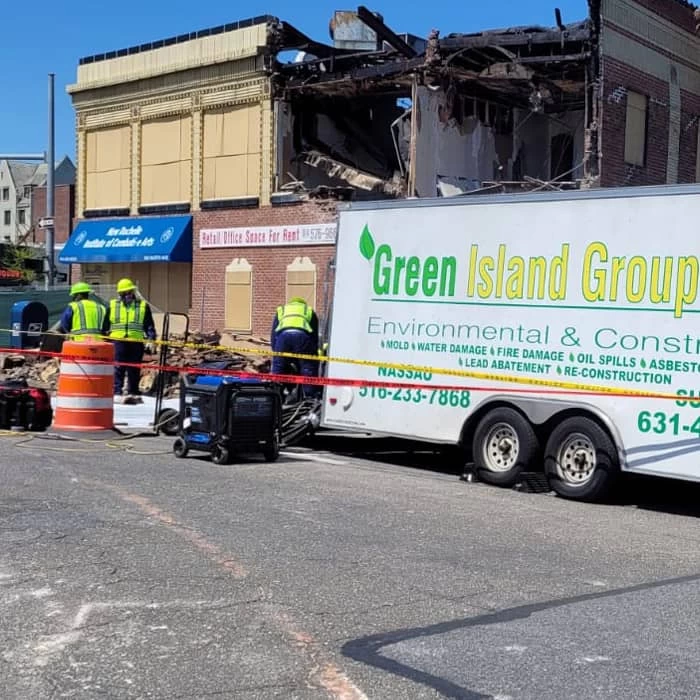
The first call happens fast. When you reach us — any hour, any day — a real person answers and a crew is dispatched. Our goal is to be on-site in Plandome Manor within one hour. The first priority is securing the property: board-up, tarping, and making sure the structure is safe and protected from further exposure.
We coordinate directly with the Manhasset-Lakeville Fire Department or Port Washington Fire Department, whoever responded, to gain access as quickly as possible. From there, we assess the full scope. That means smoke and soot penetration through the HVAC system, water saturation from suppression, and — in homes built before 1980 — a mandatory check for asbestos-containing materials before any demolition or restoration work begins.
If asbestos is present, we handle abatement in-house under our NYS DOL license. No waiting on a separate contractor. No project delays while you coordinate between companies. Once the hazardous material phase is clear, restoration moves forward in sequence: water extraction and drying, smoke and odor removal using industrial air scrubbers and thermal fogging, structural repairs, and finally reconstruction.
We document every phase to insurance-standard specifications and bill your carrier directly. By the time we’re done, your home is back — not patched together, but actually restored.
Fire damage restoration in Plandome Manor isn’t a generic service. The village’s housing stock — from the waterfront estates of Plandome Park to the mid-century ranches of Plandome Mills — spans nearly a century of construction. Many of these homes have original plaster walls, hardwood floors, period millwork, and oil-fired heating systems.
Each of those details changes how restoration is approached. Puff-back damage from an oil burner malfunction, for example, coats every surface in the home with fine, oily soot through the ductwork — it’s not a fire, but it requires fire-grade restoration across every room.
Because Plandome Manor has no public sewer system, all homes run on cesspools or septic tanks. That matters after a fire: the thousands of gallons of water used to suppress a structural fire have nowhere to drain except into the ground and your foundation. Moisture intrusion, soil saturation, and mold risk are all elevated here compared to communities with municipal sewer infrastructure.
Our water extraction and structural drying process accounts for that — we don’t just dry what’s visible. Every project we take on in Plandome Manor is handled under our Nassau County General Contractor License and in full compliance with the Nassau County Fire Prevention Ordinance, which requires restoration contractors to be licensed with the Nassau County Fire Marshal and hold valid lead and asbestos abatement credentials. We meet every one of those requirements.
Building permits for reconstruction work in Plandome Manor are issued through the village’s own Department of Public Works, and we navigate that process as part of the job — not as an afterthought.
Does my home in Plandome Manor need asbestos testing before fire restoration begins?
If your home was built before 1980 — which includes a large portion of Plandome Manor’s housing stock, from the Plandome Park waterfront homes to the Plandome Mills ranches — the answer is almost certainly yes. Under NYS DEC Code Rule 56, any demolition or restoration work in pre-1980 construction requires an asbestos survey before work can legally proceed.
Materials like floor tiles, pipe insulation, ceiling tiles, and joint compound are commonly asbestos-containing in homes of that era. This isn’t a formality. If asbestos is disturbed during restoration without proper handling, it creates a serious health hazard and a legal liability.
We hold the NYS DOL Asbestos License required by New York State, so we conduct the assessment and handle any required abatement in-house. You don’t need a separate contractor, and the project doesn’t stall while you find one. It’s built into our process from the start.
How quickly does fire smoke damage need to be treated before it becomes permanent?
Faster than most people expect. Acidic soot begins bonding to surfaces within hours of a fire being extinguished. On porous materials — original plaster walls, hardwood floors, fabric, upholstery — that bonding process accelerates quickly. Within 24 to 48 hours, smoke odor and residue can penetrate deep enough that surface cleaning alone won’t remove it.
Within a week, some finishes and materials may be permanently stained or degraded. For a home in Plandome Manor averaging over 4,000 square feet with original architectural materials, the window for preventing permanent damage is narrow.
That’s why our response commitment is within one hour for Nassau County locations — because the timeline is real. The sooner extraction, air scrubbing, and soot removal begin, the more of your home’s original materials can be saved rather than replaced.
Will my homeowner's insurance cover the full cost of fire damage restoration?
Most comprehensive homeowner’s policies cover fire damage restoration, including smoke damage, water damage from firefighting suppression, and structural reconstruction. But what your policy pays out depends heavily on how well the damage is documented.
Adjusters work from the documentation they receive — and an incomplete assessment means an incomplete claim. We document every phase of the restoration process to insurance-standard specifications and bill carriers directly. We’ve guided hundreds of Long Island families through the claims process, and our customers have specifically noted that we attended material selection appointments with them to make sure they received fair pricing from their carrier.
For a home in Plandome Manor valued at over $1 million, the difference between a well-documented claim and a poorly documented one can be substantial. Getting that right from the first call matters.
What is puff-back damage, and is it common in Plandome Manor homes?
A puff-back happens when an oil-fired furnace malfunctions and backfires, releasing a cloud of fine, oily black soot through the heating system and into the living space. It’s not a structural fire, but the damage it causes is serious — and it’s disproportionately common in Plandome Manor and other Nassau County North Shore communities.
This is due to the concentration of oil-heated homes built in the mid-20th century. What makes puff-back particularly damaging is how it spreads. The soot travels through HVAC ductwork and deposits on every surface in the home — walls, ceilings, furniture, clothing, kitchen cabinets.
It’s adhesive and oily, which means standard cleaning doesn’t remove it. It requires the same professional-grade treatment as smoke damage from a structural fire: surface cleaning, HVAC duct cleaning, air scrubbing, and odor treatment throughout the entire home.
If you’ve had a puff-back event in your Plandome Manor home, it warrants a full professional assessment, not a DIY cleanup.
How long does fire damage restoration typically take for a large home in Plandome Manor?
The honest answer is that it depends on the scope, and scope in Plandome Manor tends to be significant. Homes here average over 4,000 square feet, were often built with original materials that require careful handling, and many predate 1980 — which adds the asbestos assessment and potential abatement phase before restoration work can begin.
A minor smoke and soot event in a contained area might be resolved in one to two weeks. A structural fire with water damage, asbestos abatement, and full reconstruction can take two to four months or longer.
What we can tell you is that every delay in starting the process adds to the total timeline — and potentially to the total cost. Mold growth from firefighting water, permanent soot bonding, and secondary structural damage from moisture all get worse with time.
The fastest path to getting back into your home is a fast, thorough response on day one, followed by a clearly sequenced process with no handoffs between contractors. That’s how we run every project.
Does Green Island Group handle fire restoration permits through Plandome Manor's village government?
Yes — and it’s worth understanding how this works in Plandome Manor specifically, because it’s different from most Nassau County communities. Plandome Manor is an incorporated village with its own Department of Public Works and its own Superintendent of Buildings. Building permits for reconstruction work are issued at the village level, not just through Nassau County.
That’s a separate permitting track that not every contractor is familiar with. As a licensed Nassau County General Contractor, we handle the permitting process as part of the restoration project. You don’t need to manage permit applications, coordinate with the village building department, or track inspection schedules on top of everything else you’re already dealing with.
We know the process, we know the requirements, and we manage it from start to finish so the reconstruction phase moves forward without administrative delays holding up your timeline.