When a Home Worth Protecting Gets Hit by Fire, the Response Has to Match
In Roslyn Harbor, where homes sit on wooded acres above Hempstead Harbor and properties routinely sell above $1.9 million, fire damage restoration isn’t a commodity service. We respond within one hour, handle everything from emergency board-up through full reconstruction, and bill your insurance directly.
I needed a professional consultation explanation of procedure for safe removal of Asbestos in my apartment complex. Without having an account yet, I was very impressed with the caring, knowledgeable and generous advice offered by Jessica, and will look forward to doing business in the future. Thank you so much! I feel much more informed about a sometimes scary endeavor. Peace. Nancy Silva Mineola, NY.
Mia Munoz
Used this company to clean up some water flood in my house. They were fast and easy to work with.very professional, Would recommend to anyone!
Nini Valle
Great company, had a flood and they responded quickly and efficiently. Billed my insurance company directly. I highly recommend this company!
joe colapietro, jr
I had pipe freeze in my basement right before a snow storm and they made to within an hour to help start the clean up process. They we by our side throughout the entire process and even helped with the insurance company. They did such a great job with the cleanup, repair, remidiation, I contracted them to perform the repairs and finishes in the basement. They came with enough manpower and material to get the job done. Leo and Jessica were nothing but a pleasure to deal with!!
Cristian Arredondo c
I had some water damage in my home and Green Island was able to take care of my issue quickly and effectively. I am very pleased with the work they did. They responded quickly and were very professional.
Michael M
Outstanding service! From the office to the field crew everyone was friendly, helpful and responsive. I highly recommend Green Island Group.
Your Home Restored — Not Just Cleaned Up and Handed Back
A fire doesn’t end when the flames do. Acidic soot starts bonding permanently to surfaces within hours. Smoke travels through HVAC systems and wall cavities well beyond the burn zone — and in the large, multi-zone homes common throughout Roslyn Harbor, that means contamination can reach rooms that never saw a single flame. By the time a slow-responding contractor shows up, the damage has already spread further than it needed to.
The water used to put the fire out creates its own problem. Roslyn Harbor has no central sewer system — every home runs on a private septic — which means firefighting water saturates the ground around your foundation and soaks into structural materials fast. Without proper extraction and drying, mold follows within 24 to 48 hours. That turns a contained fire event into a multi-phase remediation job if it isn’t addressed immediately and correctly.
What you get on the other side of this process — when it’s done right — is a home that smells clean, breathes clean, and is structurally sound from the ground up. Not a home that looks okay on the surface but still carries smoke odor three months later. Not a property with hidden moisture damage behind the drywall. A genuine restoration, documented to insurance standards, with every hazardous material handled legally and every system — HVAC included — brought back to pre-loss condition.
Every License the Job Requires — Already in Hand Before We Arrive
We’re a locally owned and operated Long Island restoration company serving all of Nassau County, including Roslyn Harbor, 24 hours a day, 365 days a year. With over 5,000 completed restoration projects across New York State, we’ve worked on properties throughout the North Shore — homes with the same older construction, the same oil heating systems, and the same complex site conditions as the properties here in Roslyn Harbor.
What sets us apart from the franchise operations isn’t a tagline. It’s credentials. We hold IICRC certification for fire and smoke restoration, a Nassau County General Contractor license, NYS DOL Asbestos and Mold licenses, and USEPA Lead/RRP certification. For a village where a meaningful portion of the housing stock predates 1980 — and where some properties trace back to the Gold Coast era — that combination of licenses isn’t optional. It’s the difference between a contractor who can legally complete the job and one who discovers a problem mid-project and walks away.
We handle the insurance company directly, document everything to adjuster-standard specifications, and stay with the job from the first emergency call through the final walkthrough.
From the Night of the Fire to the Day You Walk Back In
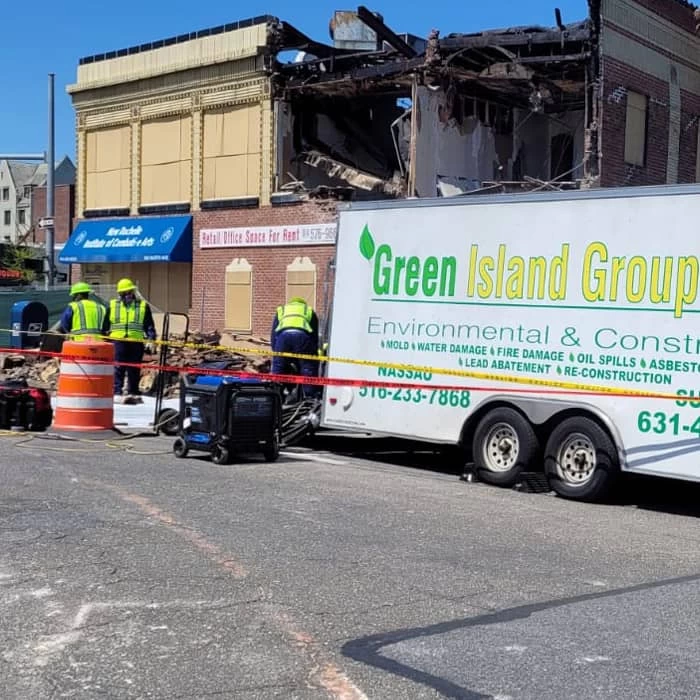
The first call triggers an immediate response. We stage crews and equipment on Long Island specifically to honor a one-hour on-site commitment — not a one-hour callback, an actual arrival. When you’re dealing with a fire in Roslyn Harbor, that hour matters. Our crew arrives, assesses the full scope of damage including smoke migration through your HVAC system, and secures the property with emergency board-up and tarping so the structure is protected before anything else happens.
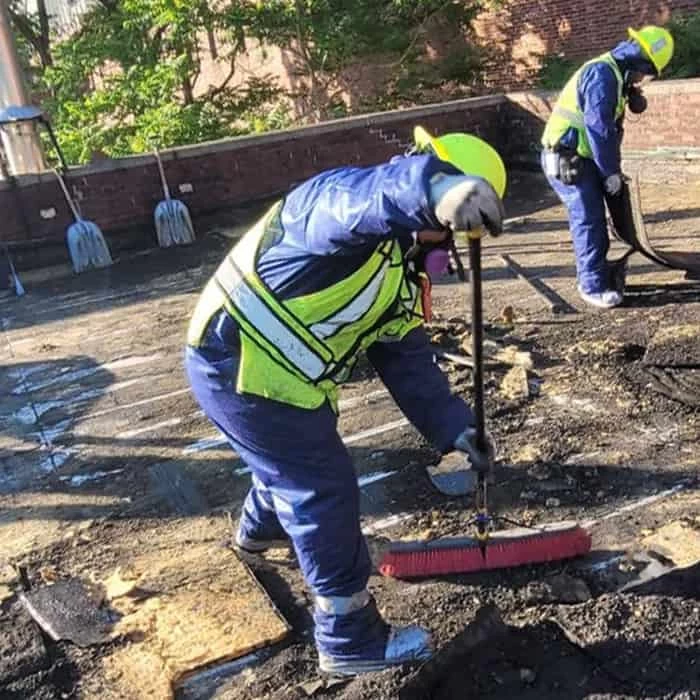
From there, the remediation phase begins. Soot and smoke residue are removed using IICRC-standard methods — dry chemical sponges for certain surfaces, wet cleaning for others, and air scrubbers running continuously to pull particulates out of the air. If your home has an oil-fired heating system, as many Roslyn Harbor properties do, the ductwork gets inspected and cleaned as part of this phase, not as an afterthought. Any asbestos-containing materials disturbed by the fire are handled under our NYS DOL Asbestos License — no subcontracting, no gaps in the chain of custody.
Once the structure is clean, dry, and cleared, reconstruction begins under our Nassau County General Contractor license. We pull the permits through the Village of Roslyn Harbor’s building department, manage the rebuild, and coordinate directly with your insurance adjuster throughout. You don’t manage two separate contractors. You don’t chase down a general contractor after the remediation company disappears. One company, one process, one point of contact until the job is done.
What's Actually Included When Your Home Has This Much at Stake
Fire restoration in Roslyn Harbor isn’t a standard package job. The homes here are large, often historically significant, and built across multiple eras — which means the scope of what needs to be addressed varies significantly property to property. Our fire damage restoration service covers emergency response and securing, full structural assessment, soot and smoke removal from all affected surfaces, HVAC and ductwork cleaning, odor elimination using thermal fogging and ozone treatment, water extraction and structural drying from firefighting efforts, and complete reconstruction through our licensed general contracting operation.
For properties built before 1980 — which includes a substantial portion of Roslyn Harbor’s housing stock — a pre-demolition asbestos survey is standard practice before any structural work begins. This isn’t a formality. It’s a legal requirement under New York State law, and it’s one that many restoration companies quietly skip because they’re not licensed to handle what they might find. We hold the NYS DOL Asbestos License and USEPA Lead/RRP certification, so if the fire disturbed pipe insulation, floor tiles, or joint compound in an older home near the Nassau County Museum of Art grounds or along Motts Cove Road, we can address it legally and completely without stopping the job.
Content restoration — cleaning and deodorizing personal property rather than simply replacing it — is also part of the conversation. In a village where homes contain artwork, antiques, and custom materials of real value, that matters. Everything is documented to insurance standards from day one, so your claim reflects the full scope of what was lost or damaged.
What should I do immediately after a house fire in Roslyn Harbor?
The most important thing you can do in the first hour is call a certified restoration company and avoid re-entering the structure until it’s been assessed. Fire-damaged homes can have compromised structural elements that aren’t visible, and the air inside carries soot particulates and combustion byproducts that are genuinely harmful to breathe. Don’t try to clean anything yourself — soot from a house fire is oily and acidic, and wiping it without the right materials typically drives it deeper into surfaces rather than removing it.
Once you’re safe, call your insurance company to open a claim and document what you can from outside the structure with photos or video. We can be on-site within one hour and will handle the communication with your adjuster from that point forward. In Roslyn Harbor specifically, where homes sit on private septic systems and wooded lots, early assessment also matters for managing firefighting water runoff before it saturates the ground around your foundation and creates a secondary mold problem.
How long does fire damage restoration typically take for a larger home?
The honest answer is that it depends heavily on the scope of the fire and the size of the property. For a contained kitchen fire in a large home, remediation alone might take five to ten days. For a fire that affected multiple rooms or spread through the HVAC system — which is a real risk in the multi-zone homes common throughout Roslyn Harbor — the remediation phase can run two to three weeks before reconstruction even begins. Full reconstruction after significant structural damage can take several months.
What affects the timeline most, beyond the fire itself, is how quickly the response happens and whether the contractor is equipped to handle everything in-house. Every day of delay allows soot to bond more permanently and moisture to move deeper into structural materials. A contractor who has to subcontract the asbestos work, wait on a separate general contractor for the rebuild, or pause for permit delays adds weeks to a timeline that’s already stressful. We hold every license required to move through each phase without stopping, which is the most direct way to keep the timeline as short as the damage allows.
Does my homeowner's insurance cover fire damage restoration in New York?
Standard homeowner’s insurance policies in New York cover fire damage restoration, including smoke and soot cleanup, water damage from firefighting efforts, and structural repairs. What varies is how thoroughly the claim gets documented and whether the adjuster’s initial assessment captures the full scope — particularly for smoke migration through HVAC systems and hidden moisture damage, both of which are easy to undercount on a first walkthrough.
The part that catches many homeowners off guard is the contents and additional living expenses coverage. If you’re displaced from your Roslyn Harbor home during restoration, your policy likely covers temporary housing up to a specified limit. We bill insurance companies directly and document every phase of the work to adjuster-standard specifications, which means the claim reflects the actual scope of the damage rather than whatever was visible on day one. We’ve navigated hundreds of Long Island insurance claims and can walk you through what to expect from your specific policy before any work begins.
Does fire damage in an older Roslyn Harbor home mean dealing with asbestos?
Potentially, yes — and it’s something that needs to be addressed before demolition or structural work begins, not discovered mid-project. Homes built before 1980 commonly contain asbestos in pipe insulation, floor tiles, ceiling tiles, joint compound, and boiler insulation. Roslyn Harbor has a meaningful share of older housing stock, including Gold Coast-era structures and mid-century construction, where asbestos-containing materials are genuinely likely to be present. When a fire damages these structures, it can disturb those materials and create a legal and health situation that an unlicensed contractor cannot legally handle.
New York State law requires a licensed contractor for asbestos abatement under Industrial Code Rule 56. We hold the NYS DOL Asbestos License, which means we conduct the required pre-demolition survey, handle any abatement work legally, and document everything in the chain of custody required by the state. You don’t need to find a separate asbestos specialist or pause the job while one is located. The same company that responds to the fire handles the hazardous materials work and continues straight through to reconstruction.
What is a puff-back and do I need professional restoration for it in Roslyn Harbor?
A puff-back happens when an oil-fired burner misfires and forces soot, smoke, and combustion byproducts back through the heating system and into the living space. Oil heat is extremely common throughout Nassau County’s North Shore, including Roslyn Harbor, which makes puff-backs a fairly frequent service call in this area — especially heading into and out of the heating season. The result is a fine coating of oily, acidic soot on walls, ceilings, furniture, and contents throughout the affected rooms.
It looks like a cleaning problem. It isn’t. Oily soot from a puff-back smears when you wipe it, embeds into porous surfaces, and if it gets into your HVAC ductwork — which it almost always does — it recirculates every time the system runs. Professional remediation using the same IICRC-standard process used for fire smoke damage restoration is the right approach. We handle puff-back cleanup regularly for North Shore homeowners, document it to insurance standards, and include ductwork cleaning as part of the scope so the system doesn’t keep redistributing contamination after the visible surfaces are clean.
How does Green Island Group handle fire damage insurance claims in Roslyn Harbor, NY?
We handle it directly, which is the short version. We bill your insurance company directly, so you’re not fronting restoration costs on a property of this value and waiting for reimbursement. From the moment we arrive on-site, every phase of the work is documented to the specifications that insurance adjusters require — scope of damage, materials affected, remediation methods used, and reconstruction costs. That documentation is what protects you from a claim that gets underpaid because the initial assessment missed smoke migration into the HVAC system or moisture damage behind the walls.
For Roslyn Harbor homeowners specifically, where a fire claim on a $1.9 million property can involve hundreds of thousands of dollars in coverage, having a contractor who understands the claims process and advocates for a complete and accurate settlement is a real financial protection. We’ve worked through hundreds of Long Island insurance claims, know what adjusters look for, and stay in direct communication with your adjuster throughout the job. If there are gaps between what the policy covers and what the full restoration requires, we’ll identify those early so you’re not surprised at the end.